
Data Centers and Air Pollution: What's Documented and What Isn't
September 24, 2026
Do Data Centers Cause Air Pollution?
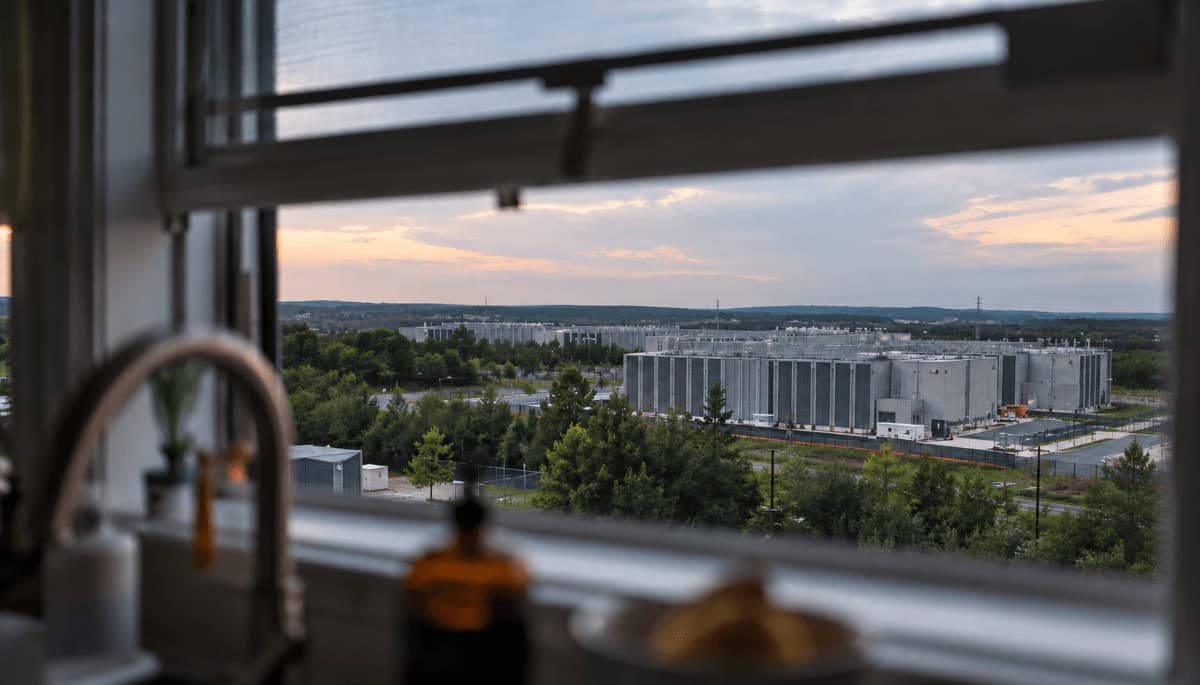
Yes, but mostly indirectly. Most of their pollution comes from the power plants that supply their electricity. Some comes directly from on-site diesel generators or gas turbines, which release nitrogen oxides and fine particles (PM2.5) near homes.
Size up your own address with three questions:
- What burns? Diesel generators or gas turbines on site.
- How close is it? Within sight or earshot of your home.
- How often does it run? Tests, outages, and grid emergencies.
Indoors, the EPA recommends an HVAC filter rated at least MERV 13, which captures microscopic particles. Take the quiz below to find your match.
Made in the U.S. by Filterbuy since 2013.
Answer a few quick questions and we'll match you to the right filter for your home.
Already know your size? Shop air filters at Filterbuy.com
TL;DR
Data centers affect air quality in two ways. Most of their pollution comes indirectly from the power plants that supply their electricity, and some comes directly from on-site diesel generators or gas turbines. The risk is best documented in Northern Virginia and around Memphis, and Filterbuy's read is that it concentrates where fuel burns near homes.
Key Takeaways
U.S. data centers used about 4.4% of the nation's electricity in 2023, according to Lawrence Berkeley National Laboratory.
Berkeley Lab's latest update projects that data centers could use 9.5%–15.3% of U.S. electricity by 2030.
In Northern Virginia, Virginia Commonwealth University (VCU) researchers found that backup generator emissions of nitrogen oxides rose 111% between 2015 and 2023.
A data center with no on-site combustion adds little local air pollution, so the risk depends on how its power is generated.
The EPA recommends home HVAC filters rated at least MERV 13 for fine particles, though most filters handle particles or gases, not both.
Data Centers And Air Pollution: Our Short Answer
Filterbuy makes air filters in the U.S., so we judge pollution sources by three questions: what burns, how close is it, and how often does it run? On grid electricity alone, a data center or server farm adds little local pollution. The trouble starts when fuel burns, whether at distant power plants or at generators and turbines on site. Where generators cluster near homes, as in Northern Virginia, neighbors carry more of the burden.
How Do Data Centers Affect Air Quality?
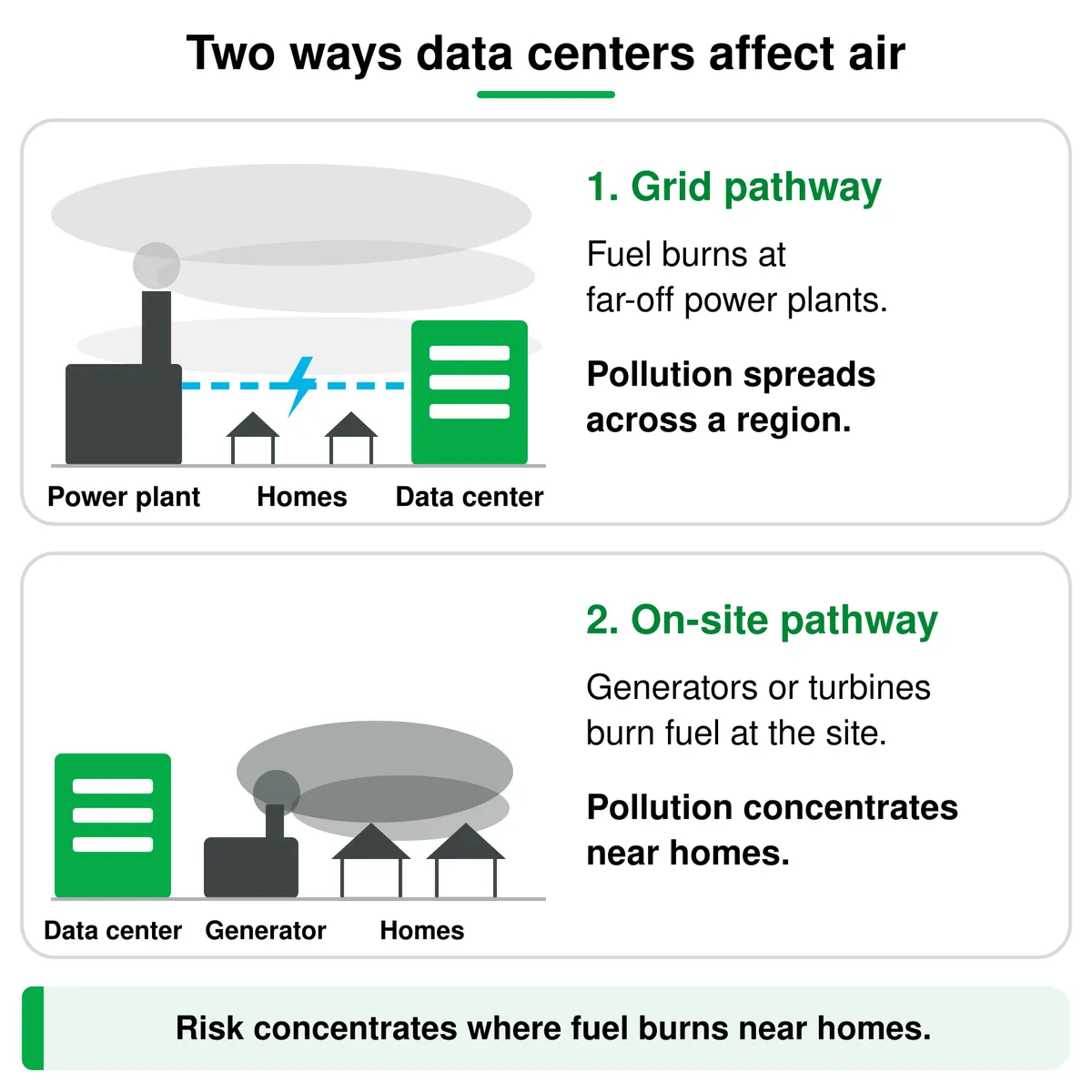
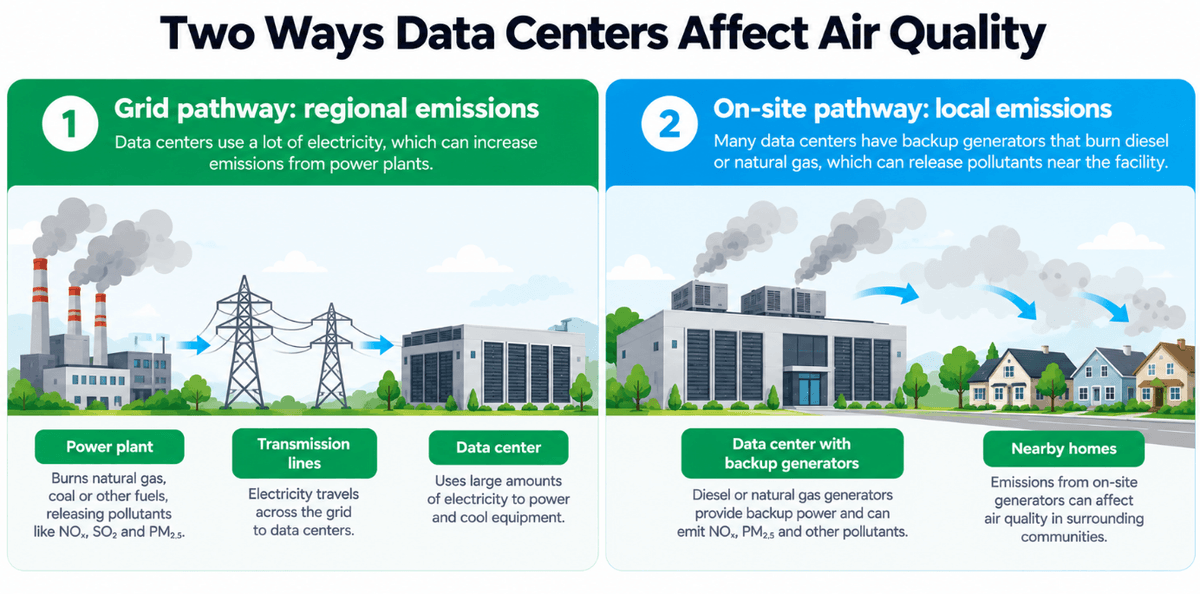
A data center's air quality impact depends on where its fuel burns. Rising data center electricity demand, driven largely by AI servers according to Berkeley Lab, plays out through two pathways:
The grid pathway is pollution from the fossil-fuel plants that generate a data center's electricity, spread across a region.
The on-site pathway comes from generators and turbines at the facility, concentrating pollution near homes.
Trade publication Data Center Knowledge agrees, and either way the main pollutants are nitrogen oxides and fine particles (PM2.5, which travels deeper into the lungs than coarser PM10).
What's Documented About Data Center Pollution, And What Isn't?
As an air filter maker, Filterbuy has a stake in this topic, so we built this ledger to separate proof about data center emissions from speculation. Permit records and university research give the firmest footing.
Status as of September 23, 2026.
Researchers at UC Riverside and Caltech estimate that Northern Virginia's backup generators cause $190 million to $260 million a year in regional health costs, with roughly tenfold more possible at permit limits.
What The Regional Air Quality Report Cards Show
Both hot spots already fight smog, which nitrogen oxides help create. In the American Lung Association's 2026 report, the Washington metro, including Northern Virginia, received an F for ozone. Shelby County, Tennessee also earned an F for ozone, and DeSoto County, Mississippi, where Southaven sits, failed for year-round particle pollution. Those grades reflect every pollution source, not data centers alone.
Filterbuy sees this in its own returns: our team has reported that filters from Memphis customers carry more black carbon than almost any other Southeast metro we serve. For today's Air Quality Index (AQI) readings, check the live Virginia AQI map or the live Memphis AQI map.
How Large Are Data Center Backup Generator Emissions?
Backup generators are large diesel engines that keep a data center online when the grid fails; Environment America reports sites typically house dozens rated at 1–3 megawatts each.
Northern Virginia shows how quickly that adds up. A Sierra Club investigation counted about 10,500 data center diesel generators there, with nearly 27 gigawatts of capacity.
Emissions have climbed with that growth. Mapping permit data for 138 Northern Virginia data centers, VCU researchers found generator emissions of nitrogen oxides rose 111% from 2015 to 2023, while particulate matter rose 139%.
What worries researchers most is the headroom. Data centers produce about 11% of the region's nitrogen oxides from stationary sources (under 4% counting vehicles), yet at permit limits they could release 10–20 times more. Grid strain is what could bring that closer: during Winter Storm Fern in January 2026, federal regulators let the regional grid operator ask data centers to run their generators.
What Happens When Data Centers Build Their Own Power Plants?
When the grid can't deliver power fast enough, some AI companies build their own, and that is where AI data center pollution becomes most visible. The best-known example is xAI, Elon Musk's AI company, whose Colossus 2 data center in South Memphis runs on gas turbines in nearby Southaven, Mississippi.
In March 2026, Mississippi regulators approved a construction permit for 41 permanent turbines. Meanwhile, trailer-mounted turbines have run without air permits under a state exemption for short-term equipment, and court filings cited 57 of them. The NAACP sued in April 2026, arguing that federal law requires permits for those units; xAI and the U.S. Department of Justice want the case dismissed. As of September 23, 2026, Filterbuy found no published ruling.
How Are The Rules Changing In 2026?
Some states are tightening. Illinois now expects new diesel backup generators at data centers to meet Tier 4 standards, which cut nitrogen oxides by 88% and particulate matter by 85% compared with Tier 2, according to Environment America. Virginia still limits Tier 2 units to emergencies, although new guidance may widen what counts as one.
Federal rules are loosening. On July 1, 2026, the EPA proposed letting states decide whether to offer public comment on "minor source" permits, which cover most data center generators. The EPA says emission standards stay the same, while the Sierra Club argues communities will lose visibility. The rule is not final.
What Does A Nearby Data Center Mean For Your Home's Air?
Try our three questions on your address. Filterbuy has made filters in the U.S. since 2013, and this is the checklist we would hand a neighbor. Generator runs are hard to miss: during a multi-day Loudoun County outage, shoppers smelled diesel, and one advocate compared the noise to planes landing.
Filterbuy framework based on EPA and state agency guidance.
Find the permits. Virginia DEQ lists issued air permits for data centers, and Shelby County posts air pollution control notices. Elsewhere, search your state environmental agency's air permit database.
Watch the numbers. Check the Filterbuy live AQI map during heat waves and grid emergencies.
Filter the particles. The EPA recommends a filter rated at least MERV 13, or the highest your system can handle. See Filterbuy's MERV 13 air filters and our best air filters for high-pollution areas.
Treat gases separately. Filters mainly capture particles. Filterbuy's Odor Eliminator activated carbon filters help with odors and volatile organic compounds (VOCs), but no residential filter readily captures carbon monoxide.
“I hear the same assumption from homeowners near highways and industrial parks: they think changing their filter more often will fix a high pollution problem. The rating matters far more than the schedule.”
— Michelle Wan, Brand Manager and Air Quality Writer, Filterbuy
Pro Tip from Filterbuy: The EPA notes that HVAC systems usually run less than 25% of the time, so a filter on auto may clean your air for only about six hours a day. When AQI climbs, switch the fan to on so the filter keeps working.
A good filter lowers indoor particles but can't cancel a nearby source. Review how often to change your HVAC filter.
Supporting Statistics
1. One in three Virginia data centers sits near homes
Virginia's Joint Legislative Audit and Review Commission (JLARC) found one-third of the state's data centers sit near residential areas.
JLARC puts generators at under 4% of Northern Virginia's nitrogen oxide emissions.
Why it matters: your exposure depends on how close you live, not on regional totals.
Source: JLARC, Data Centers in Virginia (2024)
2. 152.3 million Americans live with failing air
The American Lung Association's State of the Air 2026 found that 44% of Americans live where ozone or particle pollution earns a failing grade.
Unhealthy ozone reached more people than in any of the five previous reports.
Why it matters: new nitrogen oxide sources add to smog where air already fails.
Source: American Lung Association, State of the Air 2026: Key Findings
3. Americans spend about 90% of their time indoors
The EPA estimates that most people spend about 90% of their time indoors, mostly at home.
Filters rated MERV 13 must remove at least 50% of the smallest particles tested.
Why it matters: your home filter is where you control most of your exposure.
Source: U.S. EPA, Guide to Air Cleaners in the Home
Frequently Asked Questions
Do data centers cause air pollution?
Yes, though mostly indirectly, through the power plants that supply their electricity and through on-site generators or turbines.
Are data center backup generators dangerous to live near?
They can be. Running generators release nitrogen oxides and fine particles, plus carbon monoxide. Your risk depends on how many run nearby and how often.
How often do data center backup generators actually run?
Less often than many assume. Virginia's JLARC found most operators had zero to two minor outages per site over two years, so most runs are maintenance tests.
Are gas turbines cleaner than diesel generators?
Gas generally burns cleaner than diesel, but turbines used as primary power run around the clock, so a large plant can still be a major nitrogen oxide source.
Glossary
Sources
Lawrence Berkeley National Laboratory / U.S. DOE, 2024 Report on U.S. Data Center Energy Use
VCU News, Northern Virginia data center air pollution rivals power plant emissions (Feb. 2026)
Sierra Club, EPA Proposes Air Pollution Exemption "Deal" for Data Centers (July 2026)
Data Center Knowledge, Do Data Centers Cause Air Pollution? It Depends on Power (July 2026)
UC Riverside News, AI's deadly air pollution toll (UC Riverside/Caltech study)
Environment America, False emergencies, real pollution (May 2026)
Earthjustice, NAACP Sues xAI for Illegal Pollution from Data Center Power Plant (Apr. 2026)
Mississippi Today, Department of Justice sides with Elon Musk's xAI in Southaven lawsuit (June 2026)
Shelby County Health Department, Air Pollution Control Public Notices
Joint Legislative Audit and Review Commission (JLARC), Data Centers in Virginia (2024)
American Lung Association, State of the Air 2026: Key Findings