
The Self-Reinforcing Loop Between Climate Change and Air Quality
August 19, 2026

By Michelle Wan | Reviewed by David Clark, Licensed HVAC Technician | Published August 19, 2026 | Updated August 19, 2026
How Air Quality and Climate Change Feed Each Other
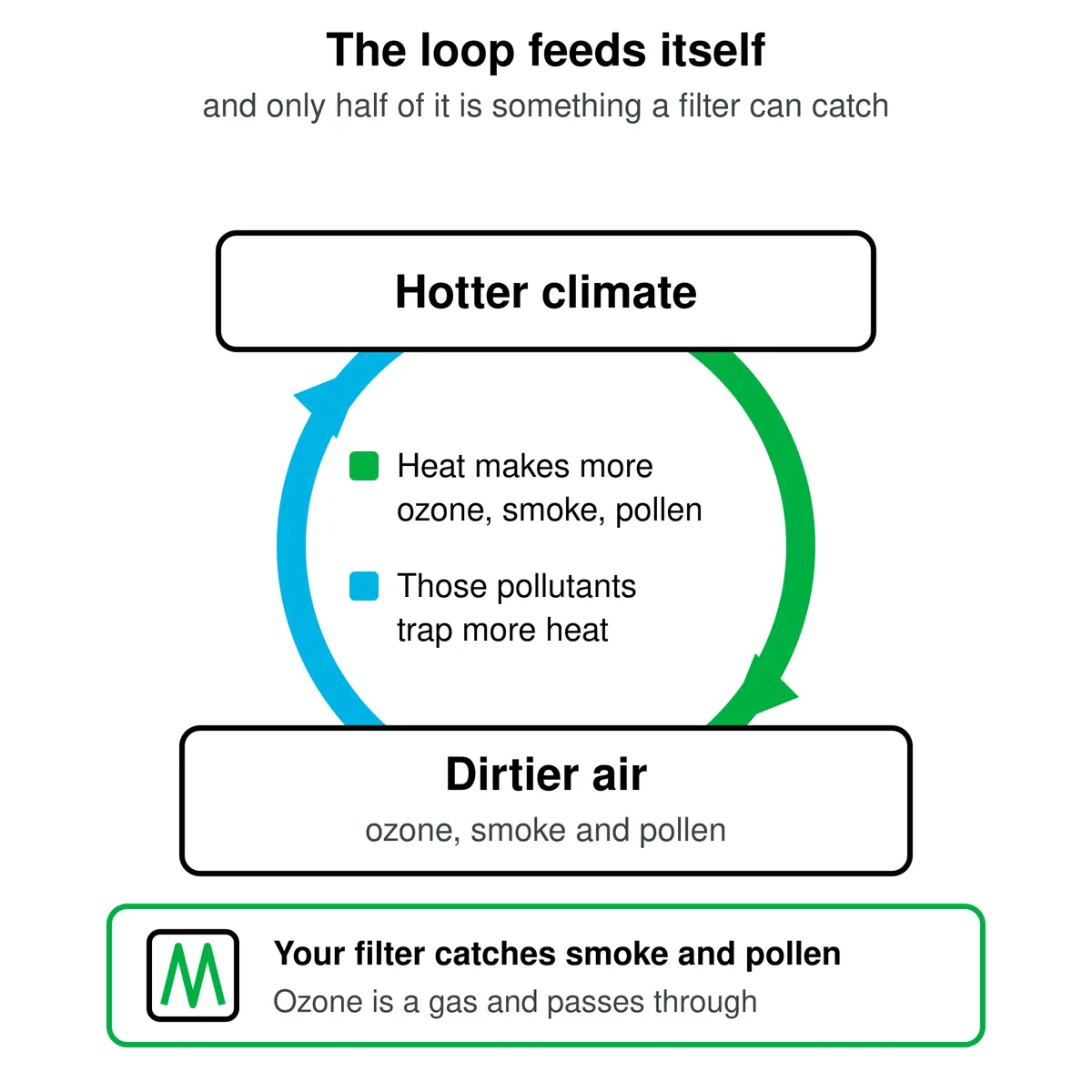
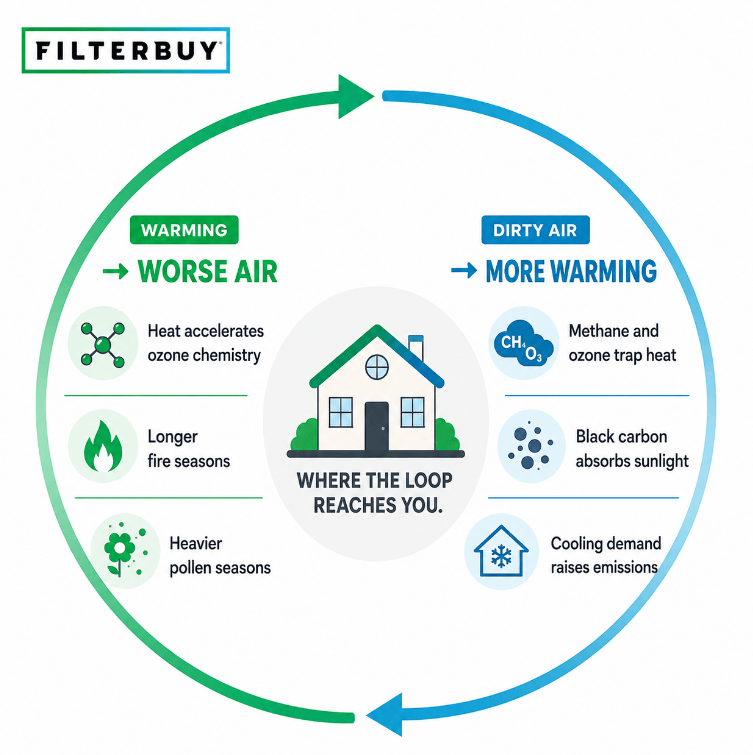
A warming climate makes air pollution worse, and that pollution traps more heat. Heat speeds ozone formation, lengthens fire seasons and stretches pollen seasons, and the methane, ozone and black carbon in the resulting pollution push temperatures higher still. Both halves of that loop reach you indoors, through window gaps, door seals and every hour your HVAC system runs.
The particle half: smoke and pollen, which load a filter visibly.
The gas half: ground-level ozone, which passes straight through pleated media.
You cannot slow the loop from your hallway, but you can decide what reaches your family through it. Take the quick match below to find the filter your system can handle.
Answer 3 quick questions and we will match you to your filter.
Already know your size? Filterbuy manufactures MERV 8, 11 and 13 filters in the United States in 600+ sizes.
TL;DR
Climate change and air pollution feed each other. Warmer temperatures speed ozone formation and lengthen fire seasons, while the methane, ozone, and black carbon in the resulting pollution trap heat and push temperatures higher still. The loop tightens each year, and it reaches you through every window gap, door seal, and HVAC return in your house. Filterbuy is a U.S. air filter manufacturer, and after a decade of shipping to more than two million households, we see the last few feet of that loop up close.
Key Takeaways
Ozone gets worse as the planet warms. Ground-level ozone forms faster in heat, an effect EPA researchers call the climate penalty. In California it rises 2–8 parts per billion per 1°C of warming.
Wildfire smoke has erased roughly a quarter of America's air quality progress. A 2023 study in Nature found smoke eroded about 25% of the PM2.5 gains made since 2000 across three-quarters of states.
The pollutants that dirty your air also heat the planet. Methane, tropospheric ozone, black carbon, and HFCs are short-lived climate pollutants, accounting for as much as 45% of current human-caused warming.
Cooling demand closes the loop inside your home. The International Energy Agency calls rising air conditioning use a destructive feedback loop: heat drives cooling, cooling drives emissions, emissions drive heat.
A used filter tells you which half of the loop you are in. Smoke and pollen load it visibly; ozone passes through as a gas.
Filtration is the part you control. The CDC advises high-efficiency filters, MERV 13 or higher for systems that can handle them. Filterbuy manufactures MERV 8, 11, and 13 in more than 600 sizes.
What Is The Air Quality And Climate Change Feedback Loop?
The air quality and climate change feedback loop is a self-reinforcing cycle in which a warming climate worsens air pollution, and that pollution accelerates warming. Heat speeds ozone formation and lengthens fire seasons; the resulting smoke, methane, and ozone trap additional heat. Progress on one is repeatedly undercut by the other.
Both halves end up indoors. Outdoor fine particulate matter (PM2.5) infiltrates through the ordinary leaks every house has, and your HVAC system is already positioned to catch it. Most coverage stops at the atmosphere. The part worth your attention is where the loop crosses your threshold.
How Does Climate Change Make Air Quality Worse?
Warming degrades air quality three ways: it speeds the photochemistry behind ground-level ozone, creates the hot dry conditions behind larger wildfires, and lengthens pollen seasons. All three are measurable in U.S. data today.
Ozone is the clearest case. Ground-level ozone is never emitted directly. It forms when sunlight reacts with nitrogen oxides and VOCs from vehicles and industry, and heat makes that reaction run faster. EPA modeling frames this as a direct threat to gains won under the Clean Air Act.
Wildfire smoke is the most visible case. Marshall Burke and colleagues at Stanford found that since 2016, smoke has slowed or reversed PM2.5 progress in three-quarters of contiguous states. In June 2026, Weizhi Deng and colleagues at the University of Iowa reported in Science that fires are now reversing progress on ozone too: national smog fell 11% from 2003 to 2015, then rose about 4% as fires grew. During the 2023 Canadian fire season, ozone exceeded federal standards for 148 million Americans.
Pollen is the case people feel first. William Anderegg and colleagues documented North American pollen seasons starting roughly 20 days earlier and carrying 21% more pollen than in 1990.
The Loop, Leg By Leg
Sources: Nature (2023) for PM2.5 trends; PNAS (2021) for pollen; IPCC AR6 and the Climate & Clean Air Coalition for short-lived climate pollutants; IEA for cooling demand.
How Does Air Pollution Warm The Climate?
Methane, tropospheric ozone, black carbon, and hydrofluorocarbons are what the IPCC classifies as climate forcers with atmospheric lifetimes under about two decades. Methane does double duty: a potent greenhouse gas itself, and a precursor to ground-level ozone, which is also one. Black carbon absorbs sunlight and darkens snow.
Because these pollutants clear the atmosphere quickly, cutting them delivers climate benefits fast and cleaner air now. You will see their contribution quoted two ways, as up to 45% of warming or as slightly ahead of CO₂. Both are credible; they count different gases over different baselines. Either way, air pollutants are a first-order driver of warming.
Where The Loop Reaches Your House
The climate and air quality feedback loop closes inside your home through your HVAC system. Hotter summers mean longer runtimes, pushing more household air through your filter in exactly the season when ozone peaks and smoke is most likely.
We see the consequence in the filters that come back to us. During heavy smoke stretches, the Filterbuy filters customers return are the most visibly loaded of the year, arriving gray in a couple of weeks rather than the usual 60 to 90 days. Nothing about the house changed. Only the air outside did. It tracks the pattern we follow across spring pollen, summer ozone, and fall smoke.
"The feedback loop sounds abstract until you handle the evidence. We ship filters into every climate in this country, and the ones that come back tell the story in order. Pollen in spring. Then a stretch in midsummer when filters arrive gray in two weeks instead of three months. Nobody in that house changed anything. The air did."
Michelle Wan, Brand Manager and Air Quality Writer, Filterbuy
The exposure is not marginal. The American Lung Association's 2026 State of the Air findings put 152.3 million Americans, 44% of the country, in counties failing for ozone or particle pollution. See the metro breakdown in our roundup of the worst air quality cities in the U.S.
What A Used Filter Tells You About Which Half Of The Loop You Are In
A used HVAC filter reads the particle half of the loop, not the gas half. Smoke and pollen load it visibly, while ozone passes straight through, since no pleated media catches a gas. A filter still looking clean during a bad-air week has not failed you. It is telling you which pollutant you face, and each calls for a different response.
The filter darkens in weeks, not months. A particle event, almost always smoke or heavy pollen. Replace it early and run the system on recirculate.
The filter looks normal but your AQI is orange. Ozone is driving the number and filtration will do little. Shift outdoor activity to morning and evening.
Both at once, on a hot windless afternoon. The two halves overlapping, which in much of the country is now the ordinary shape of a summer day.
Which Filter For Which Conditions
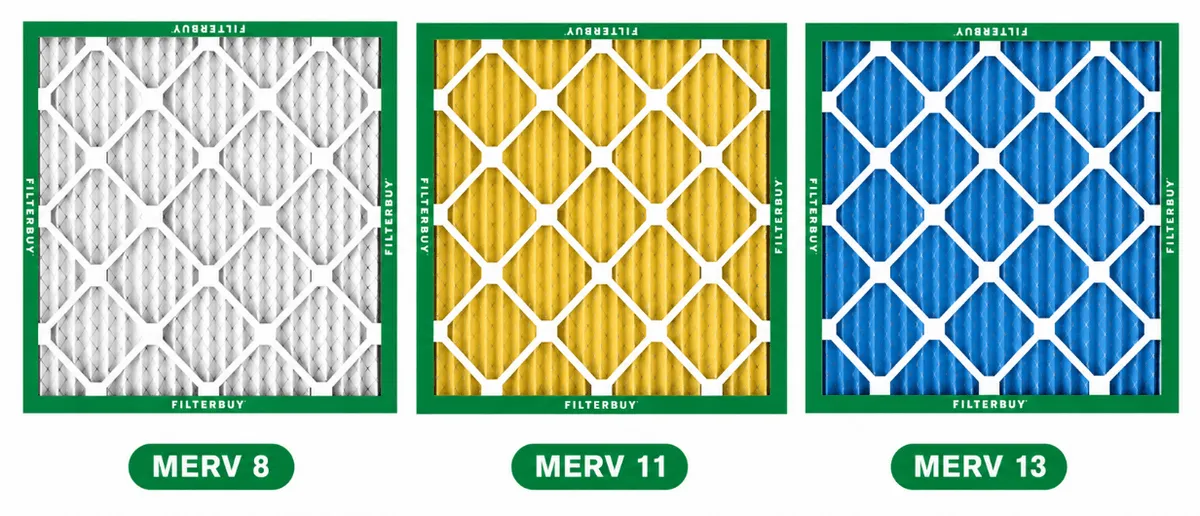
Filterbuy manufactures all three ratings. The EPA recommends MERV 13 or higher during smoky periods, replaced more often than usual. Confirm your system's capacity with a licensed HVAC technician.
Which Leg Hits Hardest Where You Live
The loop is national, but it does not arrive the same way everywhere. One regional detail rarely comes up and changes the advice completely: about half of Northeast households cool with window or portable units rather than central systems, per EIA survey data. No ductwork means no filter slot to upgrade, so the standard advice to fit a MERV 13 does not apply. Timing and a portable air cleaner do that work instead.
Regional patterns drawn from the Fifth National Climate Assessment, the 2023 Nature wildfire analysis, the 2026 Science ozone analysis, and EIA household cooling data. Local conditions vary; check your own AQI.
What Homeowners Can Actually Do
You cannot fix the loop from your thermostat, but you can control the last few feet.
Match your filter to the season. Our guide to choosing a MERV rating for wildfire smoke covers what each captures. Check with a licensed technician first, since a filter too restrictive will starve the blower.
Check the AQI before opening windows. Ozone peaks on hot sunny afternoons, so check the AQI near you first.
Inspect more often during smoke events. Smoke loads a filter far faster than dust, so look every few days rather than waiting the month out.
Set it and forget it. Auto-delivery exists because the right filter only helps when it is in the slot. If you know your size, shop MERV 13 filters.
What Filtration Cannot Do
It cannot touch ozone. Ozone is a gas, pleated media catches particles, so the two never meet.
It only works while the blower runs. A system set to AUTO on a mild day is cleaning nothing.
It does not seal a leaky house. Filtration works alongside closed windows, not instead.
It does not fix the loop. This is adaptation, not mitigation. Filterbuy sells filters, and we still will not pretend otherwise.
Supporting Statistics
1. Air pollution warms the planet, not just the lungs. Methane, VOCs, carbon monoxide, and black carbon contributed about 1.5°F of warming as of 2019, against roughly 1.4°F from carbon dioxide.
Source: the Fifth National Climate Assessment chapter on air quality.
2. Wildfire has outrun its own record. Through August 17, 2026, wildfires burned 7,270,038 acres across 48,960 fires, against 5,131,474 acres for all of 2025.
Source: the National Interagency Fire Center statistics dashboard.
3. The loop runs through your HVAC system. 88% of U.S. households use air conditioning, two-thirds centrally, rising to 93% in the South.
Source: the EIA Residential Energy Consumption Survey.
Frequently Asked Questions
Does air pollution cause climate change, or does climate change cause air pollution?
Both, which is what makes it a feedback loop. Warming worsens ozone, wildfire smoke, and pollen; the methane, ozone, and black carbon in polluted air trap additional heat. Neither direction is the whole story.
Is ground-level ozone getting worse in the U.S.?
Recent data suggests progress has stalled. More than 129 million Americans live in counties with failing ozone grades, about 4 million more than in the prior year’s report, and the 2026 Science analysis found national ozone rising roughly 4% since 2015 after a decade of decline.
Can an air filter protect me from ozone?
No. Standard pleated filters capture particles, not gases. A MERV 13 filter is highly effective against the PM2.5 in wildfire smoke, but ozone is a gas and passes through. Activated carbon media helps with some gases and odors; for ozone specifically, the reliable protection is limiting exposure on high-ozone afternoons.
Why does wildfire smoke reach states with no wildfires?
Smoke plumes travel thousands of miles. The Stanford analysis found smoke influencing PM2.5 trends in states with essentially no fires of their own, including across the Midwest, South, and Northeast.
Does using less air conditioning help?
Marginally, and not at the cost of your safety. Extreme heat is itself a serious health risk. The more useful levers are equipment efficiency, sealing the house so the cooling you pay for stays in, and keeping a clean filter so your system is not fighting restricted airflow.
Breathe Easier While The Loop Tightens
You cannot slow the loop from your hallway, but you can decide what reaches your family through it. Check your AQI before opening the windows. Put a filter your system can handle in the slot. Change it on the schedule the season demands, not the one on the box.
Filterbuy builds every filter it sells in the United States, in 600+ standard sizes, with custom sizes cut to your exact dimensions when your system takes something the hardware store never stocks.
Glossary
About The Author And Reviewer
Michelle Wan is Filterbuy's Brand Manager and Air Quality Writer, covering AQI trends, wildfire smoke, and indoor air quality.
David Clark is a Licensed HVAC Technician who reviewed this article for technical accuracy, particularly the claims about filter ratings, airflow, and residential system limits.