
What Is an Air Handler, and How Is It Different From a Furnace?
November 25, 2026
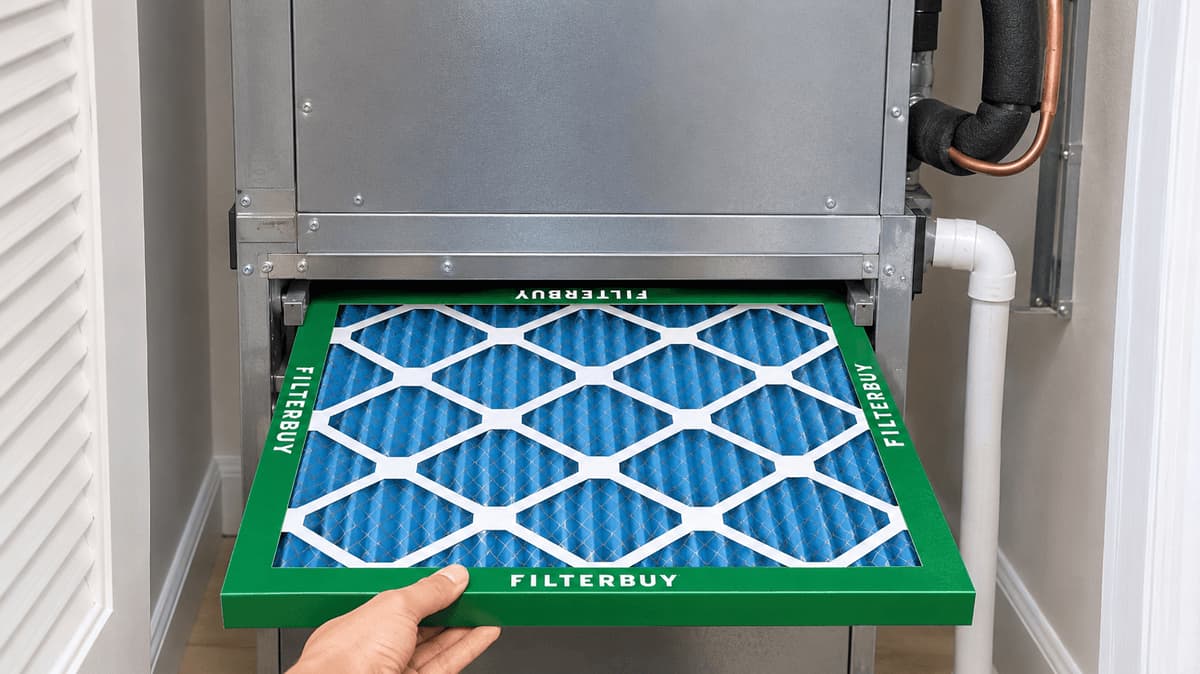
An air handler is the indoor cabinet in a central heating and cooling system that pulls room air through your filter and across a coil, then sends it back through the ducts. A furnace also moves air, but it also generates its own heat.
TL;DR
An air handler, sometimes called a fan coil, circulates air that a heat pump or air conditioner has heated or cooled, without burning fuel. A furnace generates heat, so most homes have one or the other. The air handler filter sits behind a return grille or in a cabinet slot.
Key Takeaways
An air handler is the indoor half of a split HVAC system and makes no heat without optional heat strips.
With a heat pump outside and no gas service, the cabinet people call the furnace is almost always an air handler.
A furnace has its own heat source and blower, so a furnace home rarely needs an air handler.
The condenser is the outdoor unit, and it never filters indoor air.
The air handler filter sits upstream of the blower, behind a grille or in a cabinet slot.
What Is an Air Handler?
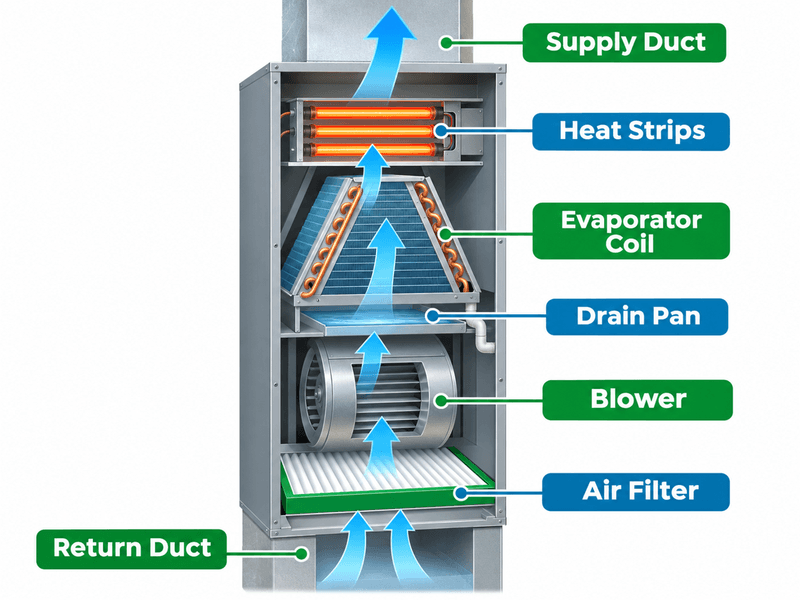
An air handler, also called a fan coil or AHU, is the sheet-metal cabinet that moves air through a central HVAC system. It usually sits in a closet, attic, garage, or basement, tied to your ducts and to an outdoor unit's refrigerant lines.
Pacific Northwest National Laboratory's Traditional Split Heat Pumps guide places the evaporator coil and refrigerant metering device inside the air handler, alongside the blower. Here is what the main parts do:
Blower: pulls return air in and pushes it out to the supply ducts.
Evaporator coil: absorbs heat and moisture while the system is cooling.
Electric heat strips: optional resistance coils that add backup or primary heat.
Filter rack or slot: holds the filter on the return side, if the installer built one in.
What Does an Air Handler Do in Summer and Winter?
An air handler moves air across a cold coil in summer and a warm coil in winter, with heat strips as backup in deep cold. During cooling, the coil pulls heat and moisture out of the room air. During heating, a heat pump reverses refrigerant flow so the same coil runs warm, and many thermostats show AUX HEAT when the strips help out.
EMERGENCY HEAT, often labeled EM HEAT, is a manual setting that turns the heat pump off and runs the strips alone. Save it for a failed outdoor unit, since strip heat costs more to run.
Because a heat pump air handler runs in every season, its filter never gets the spring and fall break a furnace filter does. That year-round workload shapes Filterbuy's filter advice for all-electric homes.
"In an all-electric home, the air handler filter never gets an off season. Put it on a monthly calendar instead of waiting for the first hot week."
Michelle Wan, Brand Manager and Air Quality Writer, Filterbuy
Air Handler vs. Furnace: What Is the Difference?
The difference between an air handler and a furnace is where the heat comes from. A furnace creates heat by burning natural gas, propane, or oil, or with electric elements, and has its own blower. An air handler only moves air that a heat pump or air conditioner has already heated or cooled.
Because the cabinets look nearly identical, many homeowners call an air handler a furnace. In a home with a gas furnace and central air, the furnace blower does the air-moving job. In a dual-fuel system, a heat pump pairs with a gas furnace, and the furnace still moves the air.
Air Handler vs. Furnace at a Glance
| Feature | Air Handler | Furnace |
|---|---|---|
| Makes heat | Only with heat strips | Yes |
| Power | Electricity | Gas, propane, oil, or electric |
| Pairs with | Heat pump or central AC | AC coil, or heat pump in dual fuel |
| Vent pipe | None | Flue or PVC vent |
| Filter spot | Return grille or cabinet rack | Return grille or blower slot |
How to Tell Which One You Have in 60 Seconds
A furnace has a vent pipe or gas line, and an air handler has neither. At Filterbuy, we look at HVAC equipment from the filter's side of the cabinet, and one rule of thumb saves the most time: if your home has a heat pump outside and no gas service, the box everyone calls the furnace is almost always an air handler. To confirm, look for these clues without opening a panel:
Vent pipe. A metal flue or white PVC pipes leaving the cabinet point to a fuel-burning furnace.
Gas line. A pipe with a shutoff valve running into the cabinet means a gas or propane furnace.
Nameplate. A label that says fan coil or air handler, especially one listing a heat kit in kilowatts, means an air handler. AFUE or input BTUs mean a furnace.
Keep all panels closed, and ask a licensed technician if labels are missing.
Air Handler vs. Condenser: What Is the Difference?
The air handler is the indoor unit of a split system, and the condenser is the outdoor unit. The condenser houses the compressor and releases heat outside during cooling. Copper refrigerant lines connect the two, but only the air handler touches the air you breathe.
On a heat pump system, the outdoor unit also pulls heat from outside air in winter, so it is called the heat pump rather than the condenser. Neither version holds a filter.
A ductless mini split uses the same design, and each wall-mounted indoor head is a compact air handler with a washable mesh screen. A 7-year compressor warranty and a 3-year parts warranty back Filterbuy's single-zone ductless mini split systems.
Where Is the Filter on an Air Handler?
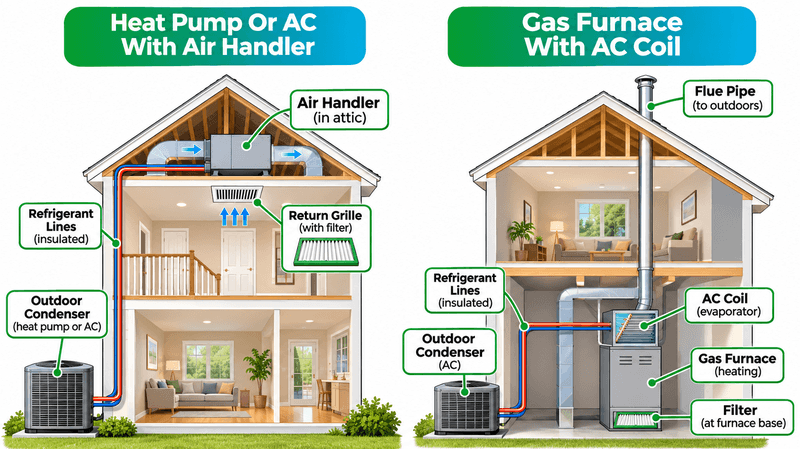
The air handler filter always sits on the return side, upstream of the blower. That usually means a return grille in a wall, ceiling, or closet door, or a slot where the return duct meets the cabinet. Turn the system off before opening any filter door.
Air Handler Filter Location by Setup
Slide the new filter in with its airflow arrow pointing toward the blower. For a room-by-room search, see Filterbuy's full HVAC air filter location guide and furnace filter locations by system type, then follow our step-by-step filter replacement instructions for the swap.
Once you find the filter, write its size and change date on the frame or cabinet with a marker so the next swap takes a minute.
Which Filter Does an Air Handler Use, and How Often Should You Change It?
An air handler uses the same pleated HVAC filters a furnace does. Check it monthly and change it when it looks dirty, usually every one to three months for a 1-inch filter. As a filter manufacturer, Filterbuy builds its catalog around the sizing details that matter most at an air handler:
Order the printed size. Go by the size printed on the old filter's frame, not a tape-measure reading. That nominal size runs slightly larger than the actual filter.
Match the thickness. One-inch filters fit most return grilles, while media cabinets often take 4-inch air filters. Deeper media holds more pleats, so it usually lasts longer between changes.
Expect odd sizes at the cabinet. A rack built into an air handler is sized to that cabinet. If no standard size seats snugly, Filterbuy's custom air filters are cut to your exact dimensions.
For most homes, Filterbuy's MERV 8 air filters are the standard choice. MERV 11 air filters suit households with allergies and asthma, pets, or pollen, and MERV 13 air filters are the pick for wildfire smoke. Before moving up a tier, confirm the MERV range your air handler supports in its owner's manual.
See how often to change your HVAC filter for intervals by thickness, or let a Filterbuy air filter subscription deliver the right size on your schedule.
"The filter is the one part of an air handler a homeowner should handle. Leave everything behind the access panels to a licensed technician."
David Clark, Licensed HVAC Technician, Filterbuy HVAC Solutions
Supporting Statistics
42% of U.S. households used electricity as their main heating fuel in 2024, while natural gas fell to 47%. Electric heat often means a heat pump paired with an air handler.
Source: Electricity Use Is Becoming More Common for Residential Heating
Annual U.S. heat pump sales rose 70% over the past 20 years while gas furnace sales fell 7%, according to RMI’s analysis of AHRI shipment data. Most split heat pumps pair with an indoor air handler, so more homes now have one.
Source: Tracking the Heat Pump & Water Heater Market in the United States
ENERGY STAR advises inspecting, cleaning, or changing air filters once a month in central air conditioners, furnaces, and heat pumps.
Source: Maintenance Checklist
Frequently Asked Questions
Why Is There Water Around My Air Handler?
A puddle under the cabinet usually means a clogged condensate line or a cracked drain pan. The coil pulls moisture from the air during cooling, and those parts carry it away. Turn the system off and call a licensed technician.
Do I Need an Air Handler if I Have a Furnace?
Usually not, because the furnace blower already moves air across the central air coil. Homes with a split heat pump and no furnace need an air handler.
Can an Air Handler Heat a Home Without a Heat Pump?
Yes, if it has electric heat strips. Strip heat is dependable but uses more electricity than a heat pump.
Does Every Air Handler Have a Filter Slot?
No. Many installers put the filter behind a return grille instead, so check every grille before assuming there is none.
Should My Air Handler Match My Outdoor Unit?
Yes. Efficiency ratings apply to specific indoor and outdoor pairings certified by AHRI, so a replacement should be a listed match for your outdoor unit.
Find the Right Filter for Your Air Handler
Filterbuy manufactures pleated air filters in the USA in more than 600 sizes, with fast and free 2-day delivery to most US states. Shop air filters by size and MERV rating.
Glossary
Air handler (AHU or fan coil): The indoor cabinet that circulates conditioned air through the ducts.
Furnace: An indoor heater that makes its own heat from fuel or electric elements.
Condenser: The outdoor unit that releases heat outside.
Heat pump: An electric system that moves heat out in summer and in during winter.
Evaporator coil: The indoor coil that absorbs heat and moisture.
Heat strips: Electric resistance coils for auxiliary and emergency heat.
Return grille: The vent where room air enters the ducts.
Split system: Indoor and outdoor units joined by refrigerant lines.
MERV: Minimum Efficiency Reporting Value, a 1–16 scale rating of how well a filter captures particles.
AHRI: The Air-Conditioning, Heating, and Refrigeration Institute, which certifies matched equipment ratings.