Installation, Costs & Filter Guide (NC Climate)
By Michelle Wan, Brand Manager and Air Quality Writer · Technically reviewed by David Clark, Licensed HVAC Technician · Published August 12, 2026 · Updated August 12, 2026
A single-zone mini split runs $2,000 to $5,500 installed in Charlotte, and a three-to-five-zone system runs $8,000 to $14,500. Labor is 30 to 50 percent of that, so your quote depends mostly on how many rooms you are cooling.
Mecklenburg County requires two permits, mechanical and electrical, at a $60 base fee each. The federal 25C tax credit ended December 31, 2025, though Duke Energy and Energy Saver NC rebates still apply.
Not sure which size fits your space? Take the quick match below, or compare 12,000 to 24,000 BTU systems.

Answer 3 quick questions and we will match you to the right mini split for your space.
A ductless mini split in Charlotte, NC costs roughly $2,000–$5,500 installed for a single zone and $8,000–$14,500 for a three-to-five-zone system, plus Mecklenburg County mechanical and electrical permits. The federal 25C tax credit expired December 31, 2025, so 2026 savings now come from Energy Saver NC and Duke Energy rebates instead. And the filter inside your mini split protects the equipment. It is not an allergy filter.
Charlotte single-zone mini split installs run about $2,000–$5,500; multi-zone systems reach $14,500. Labor is 30–50% of the total.
There is no federal heat pump tax credit in 2026. Section 25C was terminated for equipment placed in service after December 31, 2025.
Duke Energy pays $500 to replace an existing heat pump and up to $1,000 to replace electric strip heat, and Energy Saver NC offers up to $8,000 for income-qualified households.
Oversizing is the number one mistake in Charlotte humid summers. An oversized unit short-cycles, never runs long enough to pull moisture, and leaves rooms cold and clammy.
The Department of Energy rates a mini split washable mesh filter as very low particulate capture efficiency. It catches lint and hair, not pollen. Allergen control happens elsewhere in the house.
Most mini split advice online comes from one of two places: an HVAC contractor who installs the equipment, or a retailer who sells filters. Filterbuy, a U.S. air filter manufacturer that also builds its own ductless systems, sits on both sides of that line. Filterbuy has manufactured pleated filter media in the United States since 2013, including at its plant in Talladega, Alabama, builds replacement filters for every major mini split brand, and manufactures its own ductless line. That means Filterbuy has no commercial reason to overstate what a mini split filter captures, and none to understate it either.
Worth saying outright: Filterbuy sells both the filters and the mini splits discussed on this page. Weigh the guidance with that in mind. Where this page is unflattering to ductless equipment, and it is in several places, the dual position is the reason we can afford to say so.
For most Charlotte homeowners, a mini split is a supplemental purchase, not a replacement. Unlike the Northeast, the Piedmont built ducted central systems as standard for decades, so the typical local buyer is not going ductless whole-home. They are solving one stubborn room. That distinction changes the math, and it is why we lead with single-zone pricing rather than the multi-zone package a whole-home quote will steer you toward.
A mini split is usually the right answer when:
You have a bonus room over the garage. DOE flags exactly this case: an addition with five exposed surfaces, three exterior walls, an insulated ceiling, and a floor over unconditioned space. Charlotte subdivisions are full of them, and the central system almost never reaches them well.
You finished a basement, sunroom, or attic and never extended the ductwork.
You are replacing electric baseboard or wall heaters, which is also the scenario Duke Energy pays the most to convert.
You need to cool a garage, workshop, or detached office where running ducts is not realistic.
Think twice when:
Your ducts are already inside conditioned space and in good shape. The 30% duct-loss argument for going ductless mostly evaporates, and a central system is usually cheaper per ton.
The real problem is insulation or air sealing. A head sized to overcome a leaky bonus room is a permanent monthly bill instead of a one-time fix. Get the envelope assessed first.
You want whole-home coverage on a tight budget. Five zones in Charlotte lands in the same range as a full central replacement, without the whole-house filtration.
Humidity is your main complaint rather than temperature. See the sizing section below, because ductless is not automatically the stronger tool for that job.
Expect $2,000 to $5,500 for a professionally installed single-zone mini split in Charlotte, and $8,000 to $14,500 for a whole-home multi-zone system. A basic single-zone install lands near $3,000 nationally, per our national mini split installation cost breakdown. Labor accounts for 30–50% of the bill, at $75–$150 per hour for 4 to 8 hours of work.
TABLE 1: CHARLOTTE MINI SPLIT COST BY CONFIGURATION
National installed ranges, 2026. Charlotte-metro labor tracks close to the national average. Excludes Mecklenburg County mechanical and electrical permit fees.
Three local line items the national calculators leave out:
Two permits, not one. Mecklenburg County Code Enforcement issues permits county-wide, including inside Charlotte, and a mini split needs both a mechanical permit and an electrical permit for the dedicated circuit. The county base fee is $60 per trade, so budget roughly $120 before any valuation-based charges.
Panel capacity. Most 18,000 BTU and larger heads need a 208–240V dedicated circuit, as our mini split electrical requirements guide explains. Older Charlotte homes on 100-amp service sometimes need a panel upgrade first. Before you assume that cost, ask about 115V equipment: DOE notes that single-zone units from 6,000 to 12,000 BTU are available at 115/120V and can often go on a lightly loaded existing 15A or 20A circuit. Filterbuy 12,000 BTU ductless systems ship in both a 115V and a 230V version for exactly this reason. For a bonus room or home office, the right voltage can take a panel upgrade off the quote entirely.
Historic district review. Dilworth, Fourth Ward, and Wesley Heights have design rules governing where an outdoor condenser can sit and whether line-set covers must be painted.
One more 2026 factor: new units ship with low-GWP A2L refrigerant, either R-32 or R-454B, which adds roughly 10–15% to equipment cost versus the R-410A units these systems replaced. Filterbuy ductless systems use R-32. If you are comparing quotes, confirm which refrigerant each one is priced around, because an R-410A unit sitting in a warehouse is not the bargain it looks like once you need service parts.
There is no federal tax credit for a heat pump or mini split installed in 2026. The IRS states in its One Big Beautiful Bill fact sheet (FS-2025-05) that the Section 25C credit is not allowed for any property placed in service after December 31, 2025. If a Charlotte contractor is still advertising "30% back, up to $2,000," that page is out of date. Duke Energy and Energy Saver NC are what remain.
TABLE 2: WHAT CHARLOTTE HOMEOWNERS CAN ACTUALLY CLAIM IN 2026
Duke Energy rebates require a licensed, insured contractor and minimum 15.2 SEER2 / 7.5 HSPF2 on a heat pump replacement. Duke's published requirements do not separately address ductless equipment, so confirm eligibility before you sign. Verified August 2026.
Size a Charlotte mini split with an ACCA Manual J load calculation, and resist the urge to round up. Charlotte sits in the humid-subtropical Piedmont, where summer comfort is decided by moisture as much as temperature. An oversized head cools the room to setpoint fast, shuts off, and never runs long enough to wring water out of the air. The result is the classic cold-and-clammy room and, over a Charlotte July, a real mold risk.
This is where inverter-driven ductless equipment genuinely outperforms older single-stage systems. A variable-speed compressor modulates like a dimmer switch, running long and low instead of blasting and stopping, which removes far more moisture per cycle. That is why ENERGY STAR treats ductless heat pumps as a full-season system rather than a summer add-on. Ask your installer for the Manual J worksheet; a contractor who sizes by square footage alone is guessing.
Here is the part that rarely makes it into a sales conversation. DOE reports that ductless systems generally dehumidify worse than ducted systems in cooling mode, and that the gap widens in the highest-efficiency models. The efficiency number on the sticker and the moisture performance you actually feel in August are not the same measurement. Ask your installer for the unit sensible heat ratio, where lower is better, and in a genuinely damp house ask whether a supplemental dehumidifier belongs in the plan. We would rather you hear that now than in your second July.
Related: how to choose a mini split system walks through BTU sizing room by room, and the most reliable mini split brands compares warranty depth and cold-weather performance.
A Charlotte mini split installer needs a North Carolina heating contractor license, EPA Section 608 refrigerant certification, and a pulled permit. North Carolina licenses heating contractors through the State Board of Examiners of Plumbing, Heating and Fire Sprinkler Contractors; residential-scale forced air heating and cooling falls under the Heating Group 3 classification. Verify the license before money changes hands.
Five questions worth asking on the first call:
What is your NC license number, and who on the crew holds EPA 608 certification?
Will you pull both the mechanical and electrical permits?
Can I see the Manual J calculation for my rooms?
What refrigerant does this unit use, and what is the compressor warranty?
Will you handle the Duke Energy rebate paperwork?
Unpermitted HVAC work in Mecklenburg County can mean correction orders, and insurers have grounds to deny claims tied to it. At $60 per trade, the permit is cheap insurance. Homeowners doing their own install can pull trade permits directly through the county homeowner permitting process, but the county requires that you personally perform the work.
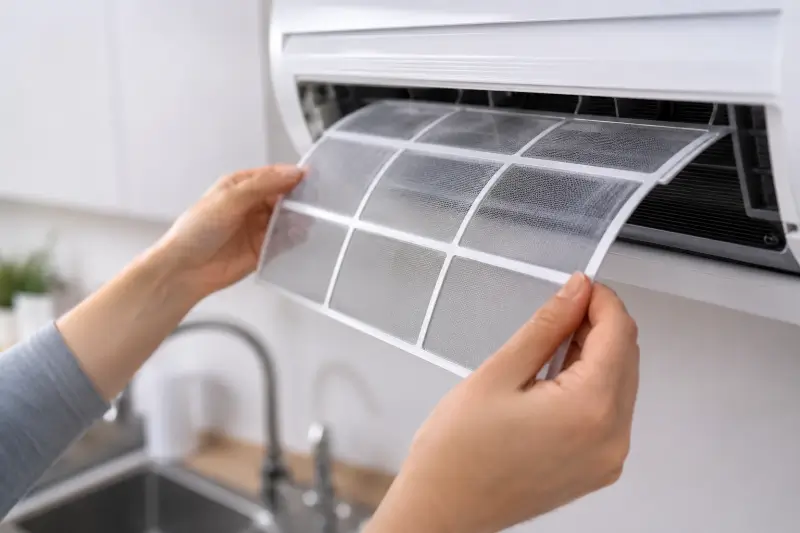
A mini split uses a washable mesh pre-filter built into the indoor head, not a disposable pleated filter. The Department of Energy rates that mesh as having very low particulate capture efficiency. It catches lint, hair, and large dust so the evaporator coil stays clean, which is a real job, just not the job most buyers assume.
Filterbuy builds replacement filters for every major mini split brand and manufactures its own ductless systems, so we have watched this play out from both ends. The pattern repeats: a homeowner installs a mini split, decides the new system is handling the air, and stops changing the filter on the central system. Eighteen months later there is a fouled coil, weak airflow, and a household breathing worse air than before the upgrade. So we will say it plainly. Your mini split filter is equipment protection, not allergen control. Our guide to how mini splits affect indoor air quality breaks down what those mesh screens do and do not capture.
That matters here because of how Charlotte allergy season actually behaves. In the 2026 Allergy Capitals report from the Asthma and Allergy Foundation of America, Charlotte ranks #55 of 100 metro areas, with a total score of 79.79 against a national average of 80.63, a sharp drop from #18 in the 2025 report. But the subscores tell a more useful story: Charlotte pollen score is average, while over-the-counter allergy medicine use is worse than average. Charlotte households medicate more than the raw pollen count alone would predict.
So where does allergen control actually happen?
If your home also has central ductwork, that is your filtration workhorse. A MERV 11 to MERV 13 pleated filter in the central return captures pollen and fine particulate the mini split never will. Check your system tolerance first using our MERV pressure drop chart.
If the mini split is your only system, add a portable HEPA air cleaner in the bedroom, where you spend a third of your day. We compare the two approaches in mini split vs. air purifier and in MERV 13 vs HEPA.
Either way, clean the mesh filter on schedule. A clogged pre-filter starves airflow, which raises running amps and strains the compressor, the most expensive part to replace. Our step-by-step mini split filter cleaning guide covers every major brand.
"Nobody should need an HVAC license to figure out whether their air is actually being filtered. A mini split will keep a Charlotte bonus room comfortable through August. It will not keep oak pollen out of your bedroom in April. Those are two different problems, and the second one is the one people call us about."
— Michelle Wan, Brand Manager and Air Quality Writer, Filterbuy
TABLE 3: CHARLOTTE MINI SPLIT FILTER AND MAINTENANCE RHYTHM
A damp filter reinstalled during a humid Piedmont summer is a common starting point for mold growth inside the indoor head.
These come out of the DOE Building America Solution Center technical guide rather than any brochure. Each one is a setting or a design choice that costs nothing to get right at install and is expensive to fix later.
Set the indoor fan time-delay to 30 seconds or less.
DOE recommends this specifically for humid climates. When the fan keeps running after the compressor stops, moisture sitting on the evaporator coil evaporates back into the room you just dehumidified.
Charlotte is a humid climate. Ask for it at commissioning.
Your wall unit is reading the wrong air.
High wall heads and ceiling cassettes sense temperature at the intake, near the ceiling, where air is warmest.
DOE notes the result is that the room at head and chest level can run colder than your setpoint, in both seasons. The fix is to set the unit slightly higher, or to use a wired wall thermostat if the model supports one.
Three heads per outdoor unit is the practical ceiling.
Some systems accept up to eight. DOE generally does not recommend going past three.
If a Charlotte quote hangs five heads off one condenser to hit a price, that is a design decision worth questioning.
On a multi-zone, every head must run in the same mode.
Set one head to heat and another to cool and some systems will flip the outdoor unit back and forth, causing extreme efficiency losses.
This surprises people in Charlotte shoulder season, when one room wants heat in the morning and another wants cooling by afternoon.
Turning heads off does not always save money.
If shutting zones down drops the load below the outdoor unit minimum capacity, it short-cycles and savings can go negative.
If you plan to run most zones off most of the time, DOE suggests more than one outdoor unit instead. Better to design for it than discover it on a bill.
Three federal findings back the guidance on this page.
Duct losses top 30%.
DOE: duct systems can lose more than 30% of heating and cooling energy when ducts sit in an unconditioned attic, crawlspace, or garage.
Charlotte's older housing stock is full of exactly those duct runs.
Ductless removes the loss category entirely, because the indoor heads sit inside the conditioned space.
Mesh pre-filters capture very little.
DOE rates ductless washable mesh filters as "very low particulate capture efficiency."
Recommended cleaning interval: about every two weeks.
Clip-in supplemental filters often cover only part of the mesh, so most air bypasses them.
What it means: the filter protects the equipment, not your lungs. MERV 11 to MERV 13 in a central return or a portable HEPA does the allergen work.
Mold can start in 24 to 48 hours.
EPA: keep indoor relative humidity below 60%, ideally between 30% and 50%.
Damp materials dried within 24 to 48 hours will, in most cases, not grow mold.
An oversized mini split short-cycles and never runs long enough to hold humidity in that band.
A mesh filter reinstalled while damp puts a wet surface directly in the air path.
TABLE 4: SUPPORTING RESEARCH AT A GLANCE
Figures retrieved August 2026 from U.S. federal government sources. Links to each primary source appear in the Sources list below.
Yes. Charlotte winter design temperature is roughly 22°F, and modern inverter-driven ductless heat pumps produce usable heat well below freezing. Cold-climate performance is a bigger concern in the NC mountains than in Mecklenburg County.
DIY-friendly pre-charged systems exist, and homeowners do install them. You still need the permits and inspection, and any work involving refrigerant handling requires EPA Section 608 certification. See our DIY mini split installation guide and the full step-by-step install walkthrough.
For one or two rooms, yes, because you skip the ductwork entirely. For whole-home cooling in a house that already has good ducts, a central system is usually cheaper per ton.
Keep your system breathing. Whether you run a mini split, a central system, or both, the filter is the cheapest protection your HVAC equipment will ever get. Filterbuy ships filters factory-direct in 600+ standard sizes plus made-to-order custom sizes, so an odd return grille in a 1950s Charlotte ranch is not a dead end. Find your filter size at Filterbuy and set auto-delivery to land before pollen season rather than after it.
Related reading: mini split installation cost · best mini split air conditioners · how to install a mini split · mini split air quality
Michelle Wan is Filterbuy's Brand Manager and Air Quality Writer. She works directly with Filterbuy's U.S. manufacturing teams across plants in Alabama, Florida, Pennsylvania, and Utah, so her guidance is based on how filters are actually built, loaded, and replaced in real homes rather than on spec sheets. This guide was technically reviewed by David Clark, a licensed HVAC technician, for accuracy on sizing, refrigerant, and electrical requirements.
IRS, FAQs on OBBB energy provision terminations (FS-2025-05). Section 25C termination date.
Duke Energy, Rebate for HVAC Replacement. rebate amounts and efficiency minimums.
NC DEQ, Energy Saver North Carolina and the Energy Saver NC program portal. HEAR and HOMES rebate amounts.
Asthma and Allergy Foundation of America, 2026 Allergy Capitals report. Charlotte ranking and subscores.
Mecklenburg County Code Enforcement, Permitting and Homeowner Permitting Process. permit requirements and the $60-per-trade base fee.
NC State Board of Examiners of Plumbing, Heating and Fire Sprinkler Contractors, license verification.
ENERGY STAR, Ductless Heating and Cooling. ductless heat pump efficiency and certification.
U.S. Department of Energy, Building America Solution Center: Ductless (Mini-Split) Heat Pumps. duct losses above 30%, mesh filter capture efficiency, two-week cleaning interval, and dehumidification performance.
U.S. EPA, A Brief Guide to Mold, Moisture and Your Home. indoor relative humidity targets and the 24-to-48-hour mold window.
Ductless mini split: A split-system heat pump that heats and cools individual rooms through wall-mounted indoor heads connected to an outdoor compressor, with no ductwork.
SEER2: Seasonal Energy Efficiency Ratio 2, the current federal cooling efficiency rating. Higher is more efficient.
HSPF2: Heating Seasonal Performance Factor 2, the heating-side efficiency rating for a heat pump.
MERV: Minimum Efficiency Reporting Value, 1 to 16, measuring how well an air filter captures particles. Higher captures smaller particles.
Manual J: The ACCA industry-standard room-by-room heating and cooling load calculation used to size equipment correctly.
Line set: The insulated copper refrigerant tubing connecting the indoor head to the outdoor unit.
A2L refrigerant: The low-global-warming-potential refrigerant class (R-32, R-454B) required in new 2026 equipment, replacing R-410A.
Energy Saver NC: North Carolina IRA-funded home energy rebate program administered by NC DEQ, covering the HEAR and HOMES tracks.