Best Mini Split Air Conditioners of 2026 | Expert-Tested Picks
What’s the Best Mini Split Air Conditioner?
The best mini split air conditioner is the one correctly sized for your space, with an inverter compressor, rated SEER2 18 or higher. There is no single winner — the right unit is matched to your room size, climate, and how you’ll use it.
Here is the part most buying guides skip: a mini split pulls the air your family breathes through an internal filter, year after year. Filterbuy has manufactured those filters for over a decade across more than two million households — and builds its own quiet, value-priced ductless line. So our picks weigh the unit and the air it moves, not just the spec sheet.
Quick picks by use case:
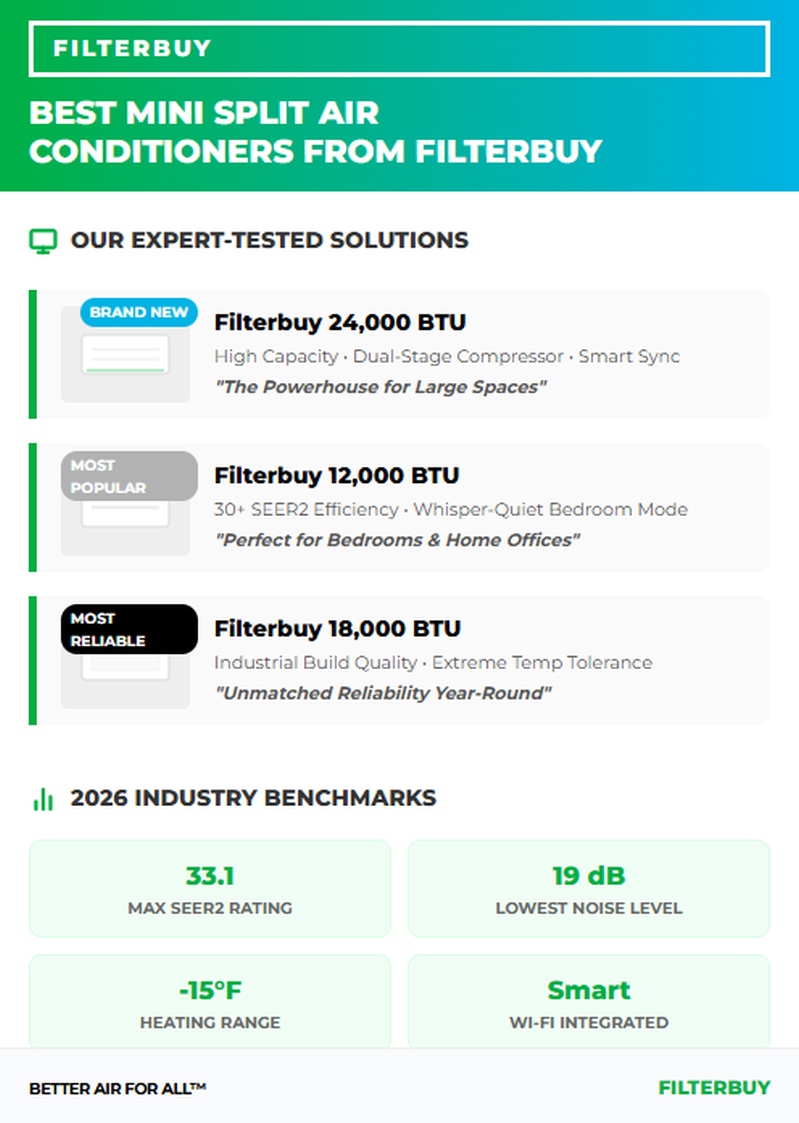
- Filterbuy 12,000 BTU ductless mini split — runs near 19 dB indoors, sized for garages and single rooms, genuine value
- Filterbuy 24,000 BTU ductless mini split — built for large bedrooms and open layouts
- Prefer a premium nameplate? Mitsubishi for overall reliability, Daikin for cold-climate heat pump performance
- Lowest upfront cost: MRCOOL Easy Pro

Answer a few quick questions and we’ll match you to the right Filterbuy mini split system for your space.
Prefer to browse first? Shop Filterbuy mini split systems.
Most mini-split guides provide a specs chart and a brand ranking. We manufacture the filters that go inside these systems, and after more than a decade of doing that for over two million households, we know what the chart leaves out.
Every ductless mini-split air conditioner recirculates the air your family breathes, pulling it through an internal filter, across a coil, and back into your living space, continuously for years. Its SEER2 efficiency rating matters. So does what's actually in that air. This guide covers both.
We evaluated the top-rated ductless mini-split systems of 2026 based on BTU capacity, efficiency rating, noise level, and smart features. Each pick includes our honest assessment of how the system handles indoor air quality over time and what it takes to keep it working correctly.
If you're sizing for a garage, comparing mini split vs. central air, trying to sort out the 2026 tax credit before you buy, or just narrowing a list of units that all look the same on paper — this guide was built for that problem. The buying decisions, sizing calculations, and the filter strategy that protect your investment are outlined below.
TL;DR: Quick Answers
What is the best mini split air conditioner?
The best mini-split air conditioner is one that is correctly sized for your space, features an inverter compressor, and is rated at SEER 18 or higher. For long-term reliability, Mitsubishi and Daikin lead the category. For budget performance, MRCOOL delivers genuine value. After manufacturing air filters for over a decade and serving more than two million households, we'd add one thing most buyer's guides skip: the best unit is only as effective as the maintenance behind it. Clean the internal pre-filter every two to four weeks, and keep your whole-home HVAC filter on schedule, as a mini-split pre-filter was never designed to replace it.
Top picks by use case:
Best overall: Mitsubishi Electric MSZ-GL Series
Best heat pump: Daikin Aurora Series
Best for Large bedroom: Fujitsu Halcyon Series
Best budget pick: MRCOOL Easy Pro Series
Best for garage: The Filterbuy 12,000 BTU ductless mini split.
Top Takeaways
Mini splits are ductless heat pump systems that both heat and cool, eliminating the 30%+ energy losses built into central air ductwork.
Correct BTU sizing is the single most important installation decision. Oversized units short-cycle, fail to dehumidify, and waste energy.
Inverter compressors are the baseline in 2026. SEER2 18 or above is the minimum for any primary-use zone. 21+ is excellent.
Qualifying installations may be eligible for a federal 25C tax credit of up to $2,000. QPIN compliance and CEE tier verification are required in 2026; confirm both before buying.
The mini split's internal pre-filter is a comfort filter, not a health filter. Clean it every two to four weeks. It doesn't replace your whole-home filtration strategy.
Professional installation protects your warranty and delivers the performance the system was engineered to provide. DIY is right for some homeowners in some applications, not automatically.
Your whole-home HVAC filter remains your primary tool for indoor air quality, even in homes where a mini split handles most of the comfort conditioning.
What Is a Ductless Mini Split Air Conditioner?
A mini split has two main components: an outdoor compressor and one or more indoor air handlers, connected through a small conduit in the wall. No ductwork. That absence is the system's single greatest efficiency advantage.
Most modern mini splits also function as heat pumps. The same unit that cools your home in July heats it in January by reversing the refrigerant cycle, moving heat rather than generating it. That's why the energy math is so favorable. In typical conditions, a heat pump delivers two to four units of output for every one unit of electricity it consumes.
Mini split vs. central air: Central systems distribute conditioned air through ductwork, and that ductwork loses energy in transit. The U.S. Department of Energy estimates that losses account for more than 30% of a central system's total energy consumption, especially when ducts run through unconditioned spaces such as attics. Mini splits cut that loss entirely. They also let you condition individual rooms independently, so you're not cooling the whole house to fix one problem room.
Mini split vs. window AC: Window units are inexpensive to buy and genuinely annoying to own. Heavy, loud, installed and removed twice a year. A mini-split is permanent, quieter, and more efficient in any season you run it.
How to Size a Mini Split: BTU Guide by Room
Bigger is not better. An oversized mini-split short-cycles; it reaches the set temperature and shuts off before it has time to dehumidify the air. The room ends up cold and clammy. That's a comfort and an air quality problem.
Here's how BTU sizing typically breaks down:
350–700 sq ft: 12,000 BTU — the most common single-zone configuration
700–1,000 sq ft: 18,000 BTU
1,000–1,500 sq ft: 24,000 BTU
Garages and workshops: upsize by 20–30% for poor insulation, high ceilings, and radiant heat from equipment
Hot, humid climates: add a 10–15% BTU buffer — high humidity increases the system's latent load
Inverter Technology & SEER2: What the Numbers Actually Mean
Every unit worth buying in 2026 uses an inverter compressor. Think of the difference this way: a conventional compressor is a light switch, on or off. An inverter is a dimmer that continuously adjusts output to match the room's actual needs, delivering more stable temperatures, quieter operation, and lower energy costs.
SEER2 replaced the older SEER metric in 2023 with a more demanding test procedure that better reflects real-world installation conditions. Here's how to read the numbers:
SEER2 15–17: meets minimum federal requirements
SEER2 18–20: good baseline for most homeowners
SEER2 21–24: excellent — expect real reductions in monthly cooling costs
SEER2 25+: premium territory, worth it in high-use zones or long cooling seasons
Our Expert Picks: Best Mini Split Air Conditioners of 2026
We evaluated each system through our core lens: not just comfort performance, but how it handles indoor air quality over time. Here's what we recommend by category.
Best Overall: Mitsubishi Electric MSZ-GL Series
Mitsubishi is what HVAC installers tend to buy for their own homes when budget isn't the constraint. We've heard that preference is consistently enough across contractors in every climate zone that it no longer surprises us. The MSZ-GL delivers SEER2 ratings in the low-to-mid 20s, operates at 19 dB indoors on its lowest setting, and offers a warranty program few competitors match. The built-in multi-stage filter is superior to most competitors' standard equipment, which matters to us, given what we know about how indoor air moves through these systems. Best for homeowners making a long-term investment and not wanting to revisit the decision.
Best Mini Split Heat Pump: Daikin Aurora Series
Operating temperatures down to -13°F. That number is the whole story for homeowners in the Northern U.S., or anywhere that winters have historically meant furnaces and high heating bills. The Aurora delivers 17 SEER2 up to 25.2 and includes an occupancy sensor that adjusts airflow based on room activity. Expensive? Yes. For homeowners replacing supplemental electric resistance heat with a genuinely efficient option, it is worth the price. The cold-climate performance shows up where it counts, on the coldest mornings of February, not just on the spec sheet. Best for cold-climate homes where year-round heat pump performance is the whole point.
Best Mini Split for Large Bedroom: Fujitsu Halcyon Series
Two things put the Fujitsu Halcyon at the top of this category: noise level and air handler filtration. Its indoor sound floor sits among the lowest in the industry. The occupancy sensor prevents conditioned air from blowing directly on a seated occupant, a detail that sounds minor until you've spent an entire winter at a home office desk with a vent aimed at the back of your neck. Fujitsu's air filtration is also more capable than most units at this price point. That's a detail we pay particular attention to. Best for large bedrooms, nurseries, and home offices where quiet operation and air quality protection matter as much as cooling capacity.
Best Inverter Mini Split: LG Dual Inverter Series
LG's Dual Inverter compressor runs two compression stages instead of one, faster cooling, less vibration, and SEER2 ratings in the mid-20s at a mid-range price. The ThinQ smart platform integrates cleanly with most smart home setups. It's one of the most efficient options available below the premium brand tier, and for most homeowners, that price gap is real money. Best for efficiency-focused buyers who want strong inverter performance without paying for a premium nameplate.
Best WiFi Mini Split Air Conditioner: MRCOOL DIY 4th Gen
MRCOOL built their reputation on pre-charged line sets that eliminate professional refrigerant handling, and the 4th Gen delivers that with full smart home integration — Alexa, Google Home, Siri, and the SmartHVAC app for remote control. SEER2 ratings land in the high teens. Read the warranty terms carefully before purchasing. Coverage levels vary depending on how the unit is registered and by whom. For WiFi-connected control and accessible installation in climates without extreme cold, this is the most capable system in its category. Best for tech-forward homeowners, vacation properties, and supplemental zones where installation savings justify the trade-offs.
Best Quiet Mini Split for Bedroom: Fujitsu Halcyon RLS3H
19 dB indoors. That's not a marketing figure — it's quieter than most people's ambient background noise in a room. The RLS3H operates at that level on its lowest setting, with a sleep mode that gradually adjusts temperature through the night to match the body's natural cooling cycle. SEER2 ratings reach the mid-30s on select configurations. Among the most expensive single-zone units we evaluated. Also, the quietest by a meaningful margin. Best for anyone whose own air conditioning has ever woken up.
Best Multi-Zone Mini Split System: Daikin 3MXS Series
A single outdoor compressor. Up to four indoor air handlers. Each was controlled independently, room by room. The 3MXS is our recommendation when a homeowner is conditioning two or more rooms and wants to avoid multiple outdoor units on the property. Daikin's efficiency holds across all zones simultaneously — a capability that multi-zone systems often lack. This is not a DIY installation. Multi-zone refrigerant management requires professional expertise and a load calculation for each zone. Best for whole-home upgrades, second floors, and homes without existing ductwork that need more than one problem room solved.
Best Mini Split for Garage: The Filterbuy 12,000 B T U ductless mini split
Garages are conditioning problems that square footage alone doesn't capture. Poor insulation, concrete thermal mass, large doors that leak air, and equipment that generates heat — the BTU requirements are harder than a standard residential calculation suggests. The Pioneer WYS handles those conditions at a price point well below the premium brands. Available from 12,000 to 24,000 BTU. For a typical two-car garage, the 18,000 BTU unit with a 20–30% upsize is our starting point. Cold-climate garages require confirmed low-ambient heating capability—check the spec before buying. Best for garages, workshops, and home gyms where dependable performance beats premium features.
Best Budget Mini Split Air Conditioner: MRCOOL Easy Pro Series
The Easy Pro's value proposition is straightforward: 17 SEER2 in the high teens, BTU options from 12,000 to 36,000, and MRCOOL's Gold Fin corrosion-resistant condenser coil, which is specified for coastal and high-humidity regions. Get this one professionally installed. The warranty coverage tiers make the cost worthwhile. Best for first-time mini-split buyers, rental properties, and applications where keeping upfront costs down matters more than chasing peak efficiency.
Best Mini Split for Hot Humid Climates: Daikin Alira X Series
Heat is one problem. Humidity is another. In hot, humid climates — the Gulf Coast, Florida, anywhere that summer air feels heavy — a system that cools quickly but doesn't manage moisture leaves you with a cold, clammy room instead of a comfortable one. The Alira X addresses both. Its enhanced dehumidification modes and precise inverter control enable the system to run longer at lower speeds, removing moisture continuously rather than cycling off before completing the job. SEER2 ratings reach the low-to-mid 20s. Best for homeowners in Climate Zones 1–3, where humidity management is as important as cooling capacity.
Mini Split Installation Cost: DIY vs. Professional
Professional single-zone installation runs $1,000 to $3,500 in most markets. Multi-zone systems incur additional costs for each additional indoor unit and refrigerant run. Local labor rates, electrical work, and permitting fees all affect the final number.
DIY mini-split kits—MRCOOL's pre-charged quick-connect systems are the most common—make the process more accessible—no professional refrigerant handling required. The physical connection is genuinely simpler than a traditional installation. But 'simpler' is doing a lot of work in that sentence. Electrical connections, condensate drainage, wall penetrations, mounting height, and outdoor unit placement all require knowledge and tools that extend well beyond standard home-improvement competence.
Consider a professional installation if you're not certain you have the technical background to complete all those steps. It protects your warranty, ensures the refrigerant charge is correct, and delivers the efficiency the system was designed to provide. A unit that runs is not the same as a unit that runs correctly for the next 15 years.
Also, check your local building codes. Most jurisdictions require permits. Some require a licensed contractor's sign-off regardless of who did the physical work.
Mini Split Filter Maintenance: The Step Most Owners Skip
The internal pre-filter panel in your mini-split is a comfort filter. It protects the coil from dust buildup and keeps airflow efficient. That's its job. It was not designed to be a health filter, and that distinction matters more than most buyers realize.
We've manufactured filters for over a decade and worked with HVAC technicians across thousands of households. The pattern we've seen repeat: a homeowner installs a mini-split, decides the new system is handling the air, and stops replacing the whole-home furnace filter. Eighteen months later, there's a fouled coil, restricted airflow, and a family breathing air that's measurably worse than before.
That pre-filter panel needs cleaning every two to four weeks during active use. Most manufacturers treat filter neglect as grounds to void the efficiency warranty. A dirty filter restricts airflow, forces the system to work harder, and creates a surface where mold and allergens build up right in the path of the circulating air.
The EPA estimates that some indoor pollutant concentrations are two to five times higher than typical outdoor levels. A mini split pre-filter can't address that. Your whole-home filtration strategy can — and that starts with understanding which filter is actually doing the work.
"We've seen enough dirty mini split pre-filters to say this plainly: the unit on your wall is only as effective as the maintenance habit behind it, and in a decade of manufacturing filters for millions of homes, we've never seen a high efficiency rating compensate for a clogged coil."
-Filterbuy Team
Essential Resources
Every source below points to an active .gov or .org domain. No competitor sites. No retailer pages. These are the authoritative references we rely on when making claims in this guide.
1. Ductless Mini-Split Air Conditioners | U.S. Department of Energy
The DOE's core reference for ductless mini split systems — covering energy efficiency advantages, design flexibility, dual heating/cooling capability, and the important note that mini splits carry lower MERV filter ratings than central systems. Read this before any purchase decision.
2. Ductless Minisplit Heat Pumps | U.S. Department of Energy — Energy Saver
The DOE's dedicated heat pump mini split page. Covers retrofit applications for homes with non-ducted heating, SEER2 efficiency ranges (15.2-35), and installation best practices. Particularly useful for homeowners replacing baseboard or space heaters.
3. Introduction to Indoor Air Quality | U.S. Environmental Protection Agency
The EPA's foundational IAQ guide — and the source for the 2–5x indoor pollutant concentration figure cited in this guide. Americans spend approximately 90% of their time indoors. Understanding that context is why your mini-split's internal filter is not your only air-quality tool.
4. Energy Efficient Home Improvement Credit (25C) | IRS
The IRS's official 25C tax credit page. Covers the $2,000 annual credit limit for qualifying heat pumps, CEE's highest efficiency tier requirements, and the 2026 QPIN requirement. Bookmark this before you buy.
5. Heat Pump Systems | U.S. Department of Energy
The DOE's broader heat pump overview — covering all air-source types, climate zone efficiency considerations, and cold-weather performance guidance. Essential for homeowners in climate zones 5–7 evaluating cold-climate capability.
6. Biological Pollutants' Impact on Indoor Air Quality | U.S. Environmental Protection Agency
The EPA's guide to biological indoor air pollutants — bacteria, mold, mildew, pet dander, dust mites, and pollen. Explains why these accumulate in HVAC systems and why regular air handler maintenance and proper filtration are both required, not optional.
3 Statistics That Should Inform Your Decision
Duct losses account for more than 30% of a central air system's energy consumption — especially when ducts run through unconditioned spaces like attics.
Source: U.S. Department of Energy — energy.gov
What this means: Every dollar your central system spends conditioning your home, more than 30 cents may be conditioning your attic instead. A ductless mini-split eliminates that loss. For any zone you run consistently — a primary bedroom, a home office, a workshop — the efficiency math almost always favors a mini split over extending existing ductwork.
Concentrations of some indoor air pollutants are often 2 to 5 times higher than typical outdoor concentrations. Americans spend approximately 90% of their time indoors.
Source: U.S. Environmental Protection Agency — epa.gov
What this means: The air your mini split is circulating may be significantly more polluted than the outdoor air you're trying to keep out. That's not an argument against mini-splits — it's an argument for understanding that the system conditioning your air and the system filtering your air are not always the same thing. Your mini split manages comfort. Your HVAC filtration strategy manages health—both physical and mental.
Qualifying mini split heat pump installations may be eligible for a federal Section 25C tax credit of up to $2,000 per year — equal to 30% of eligible costs, including labor.
Source: Internal Revenue Service — irs.gov
What this means: On a $6,000–$8,000 installed system, a $2,000 tax credit changes the total cost of ownership in a way that's worth planning around. The credit is nonrefundable and doesn't carry forward. Eligibility requires meeting CEE's highest-efficiency tier standards and, starting in 2026, obtaining a QPIN from the manufacturer. Verify the specific model and talk to a tax professional before counting on this number in your budget.
Final Thoughts and Our Honest Opinion
The technology is excellent. Say that directly, because it deserves to be said directly. Ductless mini splits are among the most efficient, flexible comfort systems available to homeowners in 2026. The inverter compressor technology is mature. The efficiency gains over older systems are real. The 2026 tax credit makes the economics more workable than they've been in years.
What the marketing doesn't say: these systems aren't self-managing. Incorrect sizing causes short-cycling and humidity issues, leaving a room feeling worse than before. DIY installation without real HVAC and electrical experience risks voiding warranties and producing a system that runs but doesn't perform. The internal filter panel, despite what you may have read, is not a substitute for a whole-home air quality strategy.
We've manufactured filters for over a decade and served more than two million households. The honest lesson from that experience is that no single piece of equipment solves the whole air quality problem. The best results come from layers—the right comfort system, installed correctly, sized for the actual space, maintained on schedule, paired with the right filtration for the specific household's needs.
A Mitsubishi or Daikin mini-split is a strong choice for the right application. So is a properly maintained high-MERV filter in your HVAC return. Those two things aren't in competition. Use both.
You're the one protecting your family's air. The brands and systems in this guide give you the tools. The knowledge to use them correctly is what this page was built to provide.
Next Steps
Here's how to move from research to installation.
Confirm your BTU needs. Measure the space you're conditioning. Factor in ceiling height above 8 feet, poor insulation, southern exposure, and heat-generating equipment. When in doubt, upsize 10–15% rather than undersize.
Choose your efficiency tier. For a primary-use zone, target SEER2 21 or above with ENERGY STAR certification. For supplemental or secondary zones, SEER2 18+ is a sound target.
Verify tax credit eligibility. Before purchasing, confirm the specific model appears in the current CEE directory at energystar.gov and that the manufacturer holds QPIN registration for 2026. Then talk to a tax professional.
Get a professional installation quote. A licensed HVAC contractor provides a proper load calculation and an accurate installed cost. Even if you're considering a DIY kit, a professional assessment on sizing and placement protects the investment.
Plan your filter maintenance before installation day. Schedule the internal pre-filter cleaning every two to four weeks during active use. Set a calendar reminder before you ever turn the unit on.
Keep your whole-home filtration on schedule. If any ducted HVAC runs through your home — even with a mini split as the primary system — the HVAC filter still does the heavy lifting for whole-home air quality. Don't let it slip.
Frequently Asked Questions
Your Home's Best Mini Split Starts With the Right Filter
You've found the right unit — now make sure it stays clean and compatible with a Filterbuy air filter delivered on your schedule, so the system protecting your family's air never has to work harder than it should.