Mini Split Installation Cost
What to Expect in 2026 (By Zone and Size)
How Much Does Mini Split Installation Cost?
A fully installed Filterbuy single-zone mini split runs about $1,399 to $2,849 — the system at a set price plus professional labor. The equipment is a fixed price by size ($799, $899, or $1,349), so the only variable in your total is local install labor.
You buy the system outright at a set price with free 2-day delivery, then pay a licensed pro for the install. No equipment guesswork, and the number is easy to plan around.
- 12,000 BTU (up to 550 sq ft): $799 unit + $600–$1,100 labor = $1,399–$1,899 installed
- 18,000 BTU (up to 850 sq ft): $899 unit + $700–$1,300 labor = $1,599–$2,199 installed
- 24,000 BTU (up to 1,200 sq ft): $1,349 unit + $800–$1,500 labor = $2,149–$2,849 installed
Take the quick match quiz below to find your size, or shop mini split systems to see the full line.

Answer 3 quick questions and we’ll match you to the right mini split for your home.
Most homeowners walk into their first mini split conversation with one number in mind: the unit price they found online. That number covers maybe half the story. Zone count, BTU sizing, and installation complexity drive the rest — and together, those three variables move the total cost more than any brand name or efficiency rating ever will.
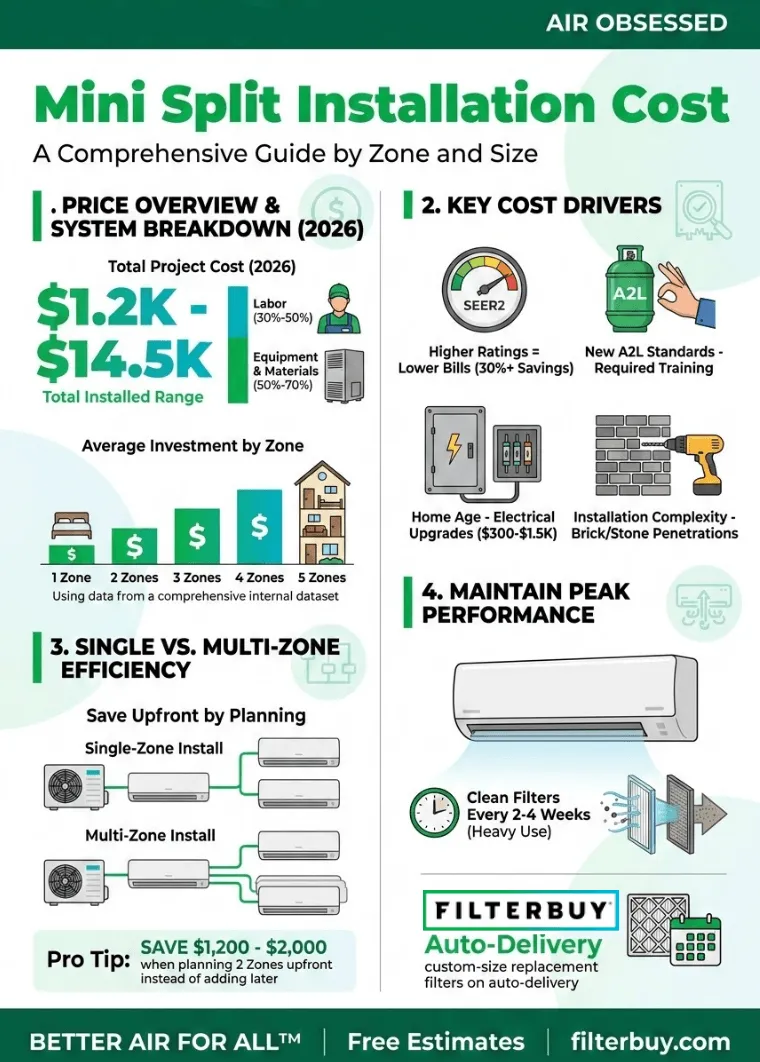
Here's what the full picture looks like in 2026. Total mini split installation cost runs from about $1,200 to $14,500, fully installed. A single-zone system for one bedroom lands between $1,500 and $3,100. A three-zone setup conditioning a living room, master bedroom, and home office runs $6,500 to $11,000. Those ranges tighten fast once you know your home — and that's exactly what this guide does.
We'll break down every line item: unit cost, labor, electrical upgrades, and permits. By the time you reach the bottom, you'll know what you should be paying and why.
TL;DR Quick Answers
What is the average cost to install a mini split? The average cost to install a mini split runs $2,000 to $5,500 for a single-zone system, fully installed. Multi-zone systems range from $4,000 to $14,500, depending on the number of zones.
How much is the mini split labor cost per zone? Mini split labor cost runs $500 to $2,000 per zone nationally, depending on installation complexity and local labor rates.
What is the ductless AC installation cost for a 12,000 BTU unit? A 12,000 BTU ductless AC installation costs $1,500 to $3,100 fully installed, including the unit ($900 to $2,000) and labor ($600 to $1,100).
How much does a single-zone mini split installation cost? Single-zone mini split installation cost ranges from $1,200 to $5,500, depending on BTU size, brand, and local labor rates.
What is the mini split installation cost per room? Mini split installation cost per room ranges from $1,200 for a 9,000 BTU single-zone setup to $4,300 or more for an 18,000 BTU system in a larger open living area.
How much does a multi-zone ductless mini split system cost? A two-zone system costs $4,000 to $9,000 installed. Three zones run $6,500 to $11,000. A five-zone system can reach $10,500 to $14,500 or more, depending on BTU requirements and installation complexity.
Top Takeaways
Total mini split installation cost runs $1,200 to $14,500+ fully installed, driven primarily by zone count and BTU size.
Labor represents 30 to 50 percent of the total project cost. Get a line-item quote that separates unit cost, labor, electrical, and permit fees.
Single-zone systems are the most affordable entry point ($1,200 to $5,500 installed). Multi-zone systems deliver better per-zone value when two or more rooms need conditioning.
Match BTU to actual room square footage. An oversized unit short-cycles, wastes energy, and loses the humidity control that makes a mini split worth having.
Higher SEER2 efficiency costs more upfront and lowers monthly bills measurably in climates with long cooling seasons.
According to the U.S. Department of Energy, duct losses account for more than 30 percent of energy consumption in ducted homes. Ductless systems cut that loss entirely.
Federal tax credits for qualifying ENERGY STAR-certified mini split systems may be available. Verify current eligibility at energystar.gov and consult a tax professional before purchasing.
Protect your system after installation. Clean filters keep your mini split running at the efficiency you paid for. Filterbuy offers auto-delivery in every size.
What Does Mini Split Installation Cost in 2026?
Every ductless mini split installation carries two cost components: the unit and the labor to install it. Both vary, and neither tells the full story without the other.
Unit cost moves with BTU capacity, brand, and SEER2 efficiency rating. Labor moves with how difficult the installation actually is at your specific home — line set length, mount height, electrical condition, and local market rates all factor in. Here's what real installed pricing looks like in 2026, by system type and size:
Single Zone — 9,000 BTU | Unit: $700–$1,500 | Labor: $500–$900 | Total Installed: $1,200–$2,400
Single Zone — 12,000 BTU | Unit: $900–$2,000 | Labor: $600–$1,100 | Total Installed: $1,500–$3,100
Single Zone — 18,000 BTU | Unit: $1,200–$3,000 | Labor: $700–$1,300 | Total Installed: $1,900–$4,300 Single Zone — 24,000 BTU | Unit: $1,500–$4,000 | Labor: $800–$1,500 | Total Installed: $2,300–$5,500
Multi-Zone (2–3 zones) | Unit: $2,500–$6,000 | Labor: $1,500–$3,000 | Total Installed: $4,000–$9,000
Multi-Zone (4–5 zones) | Unit: $5,000–$10,000 | Labor: $2,500–$4,500 | Total Installed: $7,500–$14,500
Note: These figures represent 2026 national averages. Your local mini split installation cost may run 15 to 30 percent higher or lower, depending on labor rates, permit requirements, and site conditions.
How Much Does Mini Split Labor Cost?
Labor is the line item homeowners most often underestimate. It typically represents 30 to 50 percent of the total project cost — sometimes more when your home throws complications at the installer.
Nationally, licensed HVAC technicians charge $75 to $150 per hour for ductless mini split work. A standard single-zone installation takes 4 to 8 hours. Five things push that number up:
Long refrigerant line sets: Standard installations include up to 25 feet of copper line. Each additional 10 feet adds $50 to $150.
Second-floor or high-ceiling mounts: Ceiling cassettes and second-story indoor heads add 1 to 3 hours of labor per zone.
Electrical panel upgrades: Many older homes need a new 240V dedicated circuit. Budget $300 to $800 per outdoor condenser.
Permit fees: Most jurisdictions require a permit for HVAC work. Expect $100 to $500, depending on your municipality.
Difficult wall penetrations: Brick, concrete, or stone exteriors require core drilling. Add $150 to $400 per penetration.
Filterbuy HVAC Solutions handles the permit process on every installation we perform in Florida and Texas. The paperwork is on us, not you.
Mini Split Unit Cost by Size: What You're Actually Paying For
BTU capacity is the primary driver of unit cost. BTU — British Thermal Units — measures how much heat the system removes per hour. Larger spaces need more BTUs, and more BTUs mean a more expensive unit.
Here's the unit cost by size, with room coverage based on standard insulation and typical ceiling height:
9,000 BTU | ~350 sq ft | Unit: $700–$1,500 | Best for: Bedroom, home office
12,000 BTU | ~550 sq ft | Unit: $900–$2,000 | Best for: Master bedroom, studio
18,000 BTU | ~1,000 sq ft | Unit: $1,200–$3,000 | Best for: Open living area
24,000 BTU | ~1,500 sq ft | Unit: $1,500–$4,000 | Best for: Large open floor plan
SEER2 efficiency rating also moves the unit cost. A 16 SEER2 entry-level unit costs considerably less upfront than a premium 26 SEER2 model at the same BTU size. The premium unit can cut monthly energy costs by 30 percent or more across the system's 15 to 20-year life. Having served over two million households, we've watched homeowners at both ends of the efficiency spectrum make this call — and the right answer comes down to one practical question: how many months per year does your system actually run?
Single Zone vs. Multi-Zone Mini Split Installation Cost
The question we hear most often is this: install one zone now and add more later, or commit to a multi-zone system from the start?
The answer is almost always multi-zone from the start. With a multi-zone system, you share the outdoor condenser cost across all indoor air handlers. Adding a second zone to an existing outdoor unit typically runs $1,500 to $3,000 additional. Add a second zone to a single-zone system later, and you may need to replace the outdoor condenser entirely, paying that cost twice.
Single-zone vs. multi-zone mini split installation cost, fully installed in 2026:
1 zone: $1,200–$5,500
2 zones: $4,000–$9,000
3 zones: $6,500–$11,000
4 zones: $9,000–$13,500
5 zones: $10,500–$14,500+
In our experience installing ductless systems across Florida, Texas, and beyond, homeowners who plan for two zones upfront — even if they only activate one at first — save an average of $1,200 to $2,000 compared to adding a second zone later.
What Factors Drive Your Ductless AC Installation Cost?
Beyond zone count and BTU size, five things move your total cost the most:
Brand and efficiency tier: Mitsubishi, Daikin, and Fujitsu premium systems run 20 to 40 percent more than mid-tier brands. Premium is not always the right call — it depends on your climate and how hard the system works.
SEER2 rating: Higher efficiency costs more upfront and lowers monthly bills. In climates where the system runs 8 to 10 months a year, a higher SEER2 model often pays for itself in 4 to 6 years.
Refrigerant type: Most 2026 systems use A2L refrigerants — R-32 or R-454B — which are mildly flammable and require updated installer handling. Expect a small labor premium in markets where technician training on A2L is newer.
Regional labor rates: Labor in the Northeast and Pacific Coast runs 25 to 40 percent above the national average. Sun Belt markets tend to stay closer to the mean.
Home age and electrical condition: Pre-1990 homes frequently need panel work. Budget $300 to $1,500 for electrical upgrades if your home is older.
Mini Split Installation Cost Per Room: Budgeting Room by Room
If you're thinking about mini split installation cost per room, here's the most practical framework: find the square footage of each room, match it to a BTU size using the table above, then add $500 to $2,000 per zone for labor.
One 350 sq ft bedroom needs a 9,000 BTU unit. Total installed: $1,200 to $2,400. One 1,000 sq ft living area needs an 18,000 BTU unit. Total installed: $1,900 to $4,300.
The most cost-effective approach for multi-room projects is always a single multi-head outdoor condenser running multiple indoor air handlers — not separate single-zone systems per room. The savings in equipment, labor, and electrical work are real and worth planning for.
"Here's what we tell every homeowner before they talk to any contractor: get three line-item quotes, not three total-cost quotes. The difference matters. A quote that breaks out unit cost, labor hours, line set length, electrical work, and permit fees separately is a quote you can actually evaluate. A total with no breakdown is a number you cannot verify. We've installed mini splits in enough homes to know where the surprises hide — and an honest contractor won't hesitate to show you exactly where your money is going."
Essential Resources
The seven resources below are the most authoritative references available for homeowners researching mini split installation cost. Each was verified prior to publication.
1. U.S. Department of Energy — Ductless Minisplit Heat Pumps
The DOE's primary consumer resource on ductless mini split systems. Covers energy efficiency advantages, installation considerations, and the benefits of ductless over ducted systems. Start here. https://www.energy.gov/energysaver/ductless-minisplit-heat-pumps
2. ENERGY STAR — Federal Tax Credits for Energy Efficiency
ENERGY STAR's official guide to federal tax credits for qualifying heat pump mini split systems under the Inflation Reduction Act. Includes eligibility requirements, credit caps, and certified product lists. Verify current-year status before purchasing. https://www.energystar.gov/about/federal-tax-credits
3. U.S. Department of Energy — Ductless Mini-Split Air Conditioners
Covers dual heating and cooling functionality, installation flexibility, and the trade-off between higher upfront cost and lower long-term operating cost. Useful for homeowners deciding between mini split and central AC. https://www.energy.gov/energysaver/ductless-mini-split-air-conditioners
4. U.S. Department of Energy — Heat Pump Systems
An overview of all heat pump types, including ductless mini splits, with data on the percentage of U.S. homes without ductwork and guidance on system selection by climate zone. https://www.energy.gov/energysaver/heat-pump-systems
5. Filterbuy HVAC Solutions — Ductless Mini-Split Installation Services
Filterbuy HVAC Solutions specializes in installing and servicing all major ductless brands, with a focus on Mitsubishi and Gree. Single and multi-zone residential installations from mounting to electrical, drain lines, and copper line sets. Free estimate available. https://hvac.filterbuy.com/cooling/
6. Filterbuy — Air Source vs. Ground Source vs. Mini Split Heat Pumps
A side-by-side comparison of the three main heat pump types with cost data, efficiency ratings, and climate guidance. Includes filter maintenance recommendations by system type. https://filterbuy.com/resources/heat-pumps/heat-pumps-basics/air-source-vs-ground-source-vs-mini-split-heat-pumps-which-is-best-for-your-home/
7. ENERGY STAR — Air Source Heat Pumps Certified Products List
The official certified product list for air source heat pumps including ductless mini split systems. Use this to confirm that any system you're considering meets the efficiency thresholds required for federal tax credit eligibility. https://www.energystar.gov/about/federal-tax-credits/air-source-heat-pumps
Supporting Statistics
According to the U.S. Department of Energy, duct losses account for more than 30 percent of energy consumption for space conditioning — particularly when ducts run through unconditioned spaces like attics. Ductless mini split systems eliminate that loss because there's no ductwork to leak.
Source: energy.gov/energysaver/heat-pump-systems/ductless-mini-split-heat-pumps
Between 12 and 25 percent of U.S. homes rely on heating and cooling systems without ductwork, according to the U.S. Department of Energy. That's the core market for ductless mini splits, and for many of those homeowners, it's also the most practical and energy-efficient option on the table.
Source: energy.gov/energysaver/heat-pump-systems
Qualifying ENERGY STAR-certified ductless mini split heat pump systems may be eligible for a federal tax credit covering 30 percent of installation cost, up to $2,000 per year, under the Inflation Reduction Act's Energy Efficient Home Improvement program. Eligibility requirements and program status are subject to annual updates. Verify current status at energystar.gov and consult a tax professional before purchasing.
Source: energystar.gov/about/federal-tax-credits
Final Thoughts and Opinion
Here's the honest take from people who have done this for years: mini split installation cost is one of the most predictable HVAC investments you'll make, once you understand the three variables that actually drive it.
Zone count is the biggest lever. Get that right and your budget has a shape. BTU sizing is the second lever, and this is where an experienced technician genuinely matters more than any cost guide — an oversized unit short-cycles, wastes energy, and can't manage humidity the way a properly sized system can. Installation complexity is the third. It's where line-item quotes separate the contractors worth hiring from everyone else.
Our honest opinion: if you're conditioning a space without ductwork, adding comfort to a room addition, or upgrading an older home, a ductless mini split is almost always the most cost-effective, highest-quality solution available in 2026. The upfront cost is real. So is the 15 to 20 year return — through lower energy bills, room-by-room comfort control, and a system that outperforms ducted alternatives in spaces where ductwork would require major construction work.
One more thing worth saying. After the installation is done, the system needs clean filters to hold its efficiency. The indoor air handler filters are the single most overlooked maintenance item on any mini split, and the one with the most direct impact on both air quality and system performance. Filterbuy makes that part easy.
Next Steps
You now know what mini split installation costs and what drives the number. Here's how to move forward:
Identify your zones. Walk through your home and list every space you want to condition. Measure the square footage of each. This is the foundation of any accurate quote.
Map BTU size to each zone. Use the sizing table in this guide as a starting point. A licensed HVAC technician should run a Manual J load calculation before final equipment selection.
Decide multi-zone upfront. If there's any chance you'll want a second or third zone in the next few years, plan for a multi-head outdoor unit now. The math almost always works in your favor.
Get three line-item quotes. Ask each contractor to separate unit cost, labor, line set, electrical, and permit fees. Any bid that only gives you a total is one you cannot properly evaluate.
Check your tax credit eligibility. Visit energystar.gov to confirm current federal tax credit requirements and verify that your selected system qualifies before you purchase. Talk to a tax professional about your personal eligibility.
Book your free estimate with Filterbuy HVAC Solutions. Our licensed, insured, direct-employee technicians serve Florida and Texas markets with free, no-obligation, line-item estimates. We handle permitting, electrical coordination, and installation from start to finish.
Set up filter auto-delivery. After installation, your mini split's indoor air handlers need clean filters to perform the way they should. Filterbuy supplies replacement filters in custom sizes on auto-delivery so you never miss a change cycle.
Frequently Asked Questions
Get a Free Mini Split Installation Estimate
You know what mini split installation costs in 2026. You know what moves the number and how to read a quote. The next step is getting a real number for your home.
Filterbuy HVAC Solutions provides free, no-obligation, line-item installation estimates for ductless mini split systems across our Florida and Texas service areas. Our licensed, insured, direct-employee technicians specialize in installing leading ductless brands, including Mitsubishi and Gree, with options ranging from single-zone bedroom setups to multi-zone systems. We handle permits, electrical coordination, and installation from start to finish.