
MRCOOL Mini Split Review (2026): Is the DIY King Worth the Hype?
Is A MRCOOL Mini Split Worth Buying?
Yes, if you are the one installing it. MRCOOL ships pre-charged QuickConnect line sets, so a homeowner makes the refrigerant connections without a vacuum pump or an EPA 608 license, and self-installing keeps the standard 7-year compressor and 5-year parts coverage. Hire a technician anyway and you paid for a feature you will not use. Here is how the two systems on this page line up.
- You install it yourself. MRCOOL DIY 5th Gen runs 22.5 to 23.9 SEER2, and the warranty holds when you do the work.
- You hire an installer. The Filterbuy mini split runs 17 SEER2 at 52 to 55 dBA outdoors, starting at $719.10 for the 12,000 BTU.
- Either way. Most units need a dedicated 208/230V circuit, and the wall unit uses a washable mesh screen rather than a MERV-rated filter.
Shop Filterbuy Mini Split Systems

Answer a few quick questions and we will point you to the mini split size and voltage that fit your space.
TL;DR
MRCOOL DIY is a ductless mini split heat pump a homeowner can install without a vacuum pump, refrigerant license, or HVAC tools. 5th Generation systems run 22.5 to 24 SEER2 with a 7-year compressor warranty. The tradeoffs are real: 230V models still need an electrician, line set length limits placement, and the built-in filter is a washable mesh screen, not a MERV-rated filter. Filterbuy sells a competing mini split, so we compare both below. If DIY install is what you came for, MRCOOL is still the one to buy.
Key Takeaways
Pre-charged QuickConnect line sets mean no EPA 608 certification and no vacuum pump. That separates MRCOOL from Mitsubishi, Daikin, and LG.
The 5th Gen warranty is 7 years compressor, 5 years parts, and self-installing does not void it. The Lifetime tier needs 60-day registration plus paid MRCOOL Care.
"DIY" does not mean "no electrician." A 230V condenser needs a dedicated circuit at 18A minimum ampacity.
The ductless mesh filter is not MERV-rated. It protects the coil, not your air.
A ductless head needs a professional deep clean every one to three years. DOE lab guidance says it is not a DIY job, and MRCOOL excludes maintenance.
MRCOOL ducted systems take standard 1-inch pleated filters, 16x20x1 through 23x20x1.
MRCOOL and Filterbuy: Two Answers to the Same Problem
Get a quote to cool a garage or addition and the number usually makes you close the laptop. Two companies answer that sticker shock in opposite ways. MRCOOL, of Hickory, Kentucky, built the DIY mini split category outright: pre-charged QuickConnect line sets let a homeowner skip the vacuum pump and the refrigerant license. Filterbuy, meaning us, came from the indoor air quality side and sells a ductless mini split system built on the opposite bet, trading self-installation for lower cost and quieter operation.
So MRCOOL is a competitor, and you should read this knowing it. We have made pleated filters in the USA for over a decade, run the lab behind our MERV and pressure drop chart, and service systems through Filterbuy HVAC Solutions in Florida. That is why this review covers what other MRCOOL reviews skip: what the indoor filter does.
What Is a MRCOOL DIY Mini Split?
A MRCOOL DIY mini split is a ductless inverter heat pump made by MRCOOL, LLC of Hickory, Kentucky, pairing an outdoor condenser with one or more wall-mounted air handlers. It heats and cools without ductwork. The defining feature is the pre-charged QuickConnect line set: lines arrive sealed and charged, so a homeowner connects them by hand instead of brazing and pulling a vacuum. Mitsubishi, Daikin, Fujitsu, and LG all expect a licensed technician. Universal and Central Ducted are the ducted lines, and those take standard filters.
MRCOOL Pros and Cons
MRCOOL trades refinement for accessibility.
Is MRCOOL Installation Actually DIY?
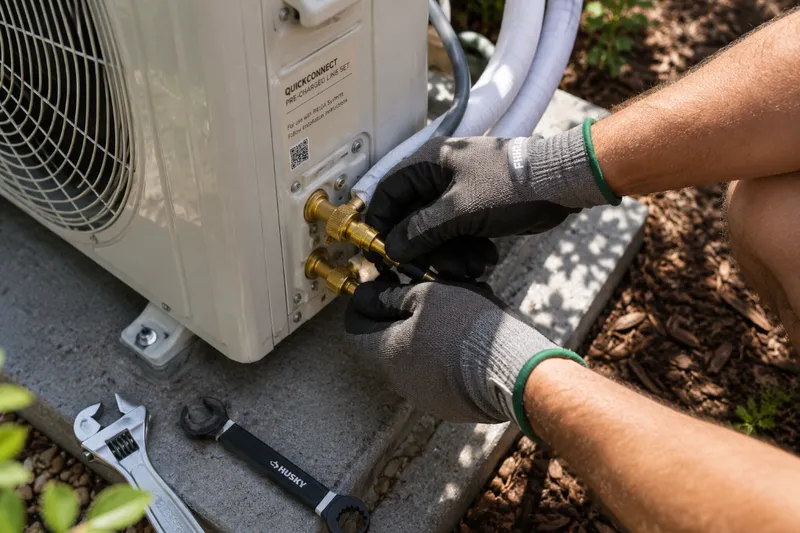
Mostly yes, with one asterisk. The refrigerant side is genuinely DIY: QuickConnect fittings mean no vacuum pump, no brazing, no EPA certification. The electrical side is not. Most DIY condensers run 208/230V on a dedicated circuit, and the 18,000 BTU spec sheet lists 18 amps minimum ampacity on a 20-amp breaker. No circuit means an electrician and probably a permit. The other trap is line set length: 25 feet ships, 75 feet is the 18K maximum, and swapping later means a whole new pre-charged set.
How Well Does MRCOOL Actually Perform?
MRCOOL 5th Gen single-zone systems run roughly 22.5 to 23.9 SEER2, well above the federal minimum. The 18,000 BTU condenser is rated 22.5 SEER2, EER2 13.7, covering about 800 square feet. Two cautions. Efficiency is not uniform, so pull the AHRI certificate for your model. And cold-weather range varies sharply: MRCOOL operating temperature ranges put 5th Gen heating at -13F or -22F by unit, but the 36K stops at 5F. Outdoors it runs 58.5 dBA on the 18K, roughly conversation volume up close.
The Warranty Fine Print Most Reviews Skip
The standard 5th Gen warranty is 7 years compressor, 5 years parts, and MRCOOL published warranty terms state no registration is required. Self-installing does not void it, which is unusual in HVAC. The confusion is the upgraded tier. The Limited Lifetime Compressor Warranty is a separate program, and reseller blogs quote windows of 60 days, 180 days, and no deadline. Read the warranty document, then register your system. One exclusion matters: MRCOOL excludes normal maintenance, including filter cleaning.
Terms vary by generation. Confirm the warranty document for your model.
Which Filters Fit a MRCOOL System?
This is where most MRCOOL reviews get vague. It depends on whether your system is ductless or ducted, and the two are not interchangeable.
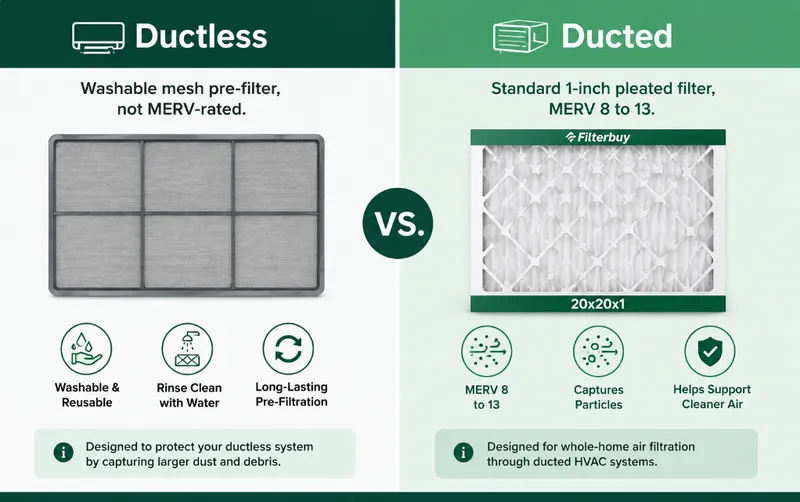
A mesh pre-filter protects the coil. It is not whole-home filtration.
Ductless: clean the mesh, do not shop for a replacement
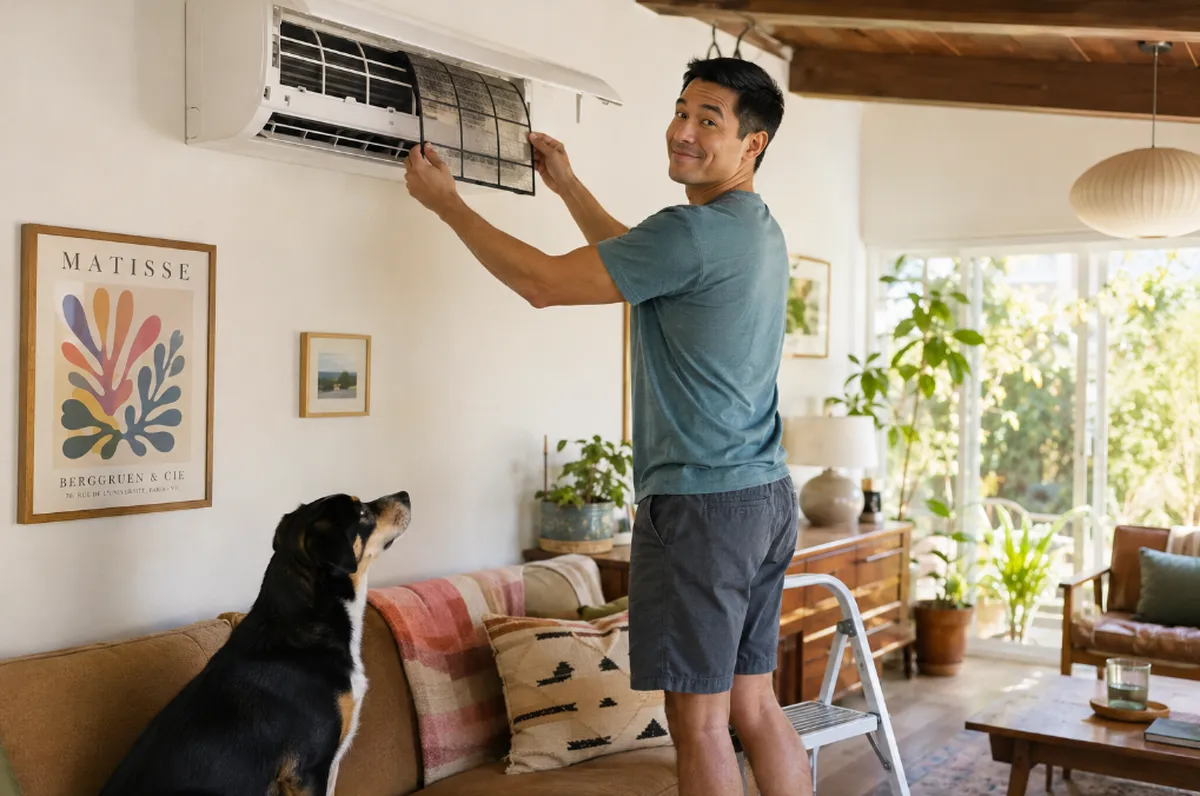
Ductless heads use washable mesh pre-filters that slide out of the front panel. MRCOOL cleaning steps: power down, vacuum, rinse in lukewarm water, dry fully. Check monthly with pets or dust. That screen protects the coil and blower. It carries no MERV rating and does not capture PM2.5 from wildfire smoke or spring pollen. It is coil protection, not air cleaning.
Ducted: standard 1-inch filters, and here are the sizes
The Universal, Central Ducted, and VersaPro lines take standard 1-inch disposable filters. We built this table from MRCOOL filter size documentation. Their guidance is MERV 8 to MERV 11, capped at 300 ft/min face velocity.
MRCOOL-published sizes. Confirm your model number before ordering.
We do not make a replacement for the ductless mesh screen. Clean the one that came with it. But four ducted dimensions above are not off-the-shelf, which is where a custom-cut filter stops being a luxury.
MERV 8 handles dust and pollen, MERV 11 suits pets and allergies, MERV 13 captures smoke.
Add a mini split to a garage and the rest of the house still runs on ducted HVAC, which does the real filtration where your family spends time. A mini split conditions a room. The 20x20x1 or 16x20x1 in your return cleans the air.
The Maintenance Nobody Quotes You
Plan on a professional deep clean of each indoor head every one to three years, plus cleaning the mesh filter yourself every two to four weeks. MRCOOL covers none of it, and no other MRCOOL review we found raises this.
Pacific Northwest National Laboratory, which runs the Building America Solution Center for the U.S. Department of Energy, documents why. Ductless heads filter poorly, so dust reaches the blower wheel. The wheel gets wet in cooling, wet dust sticks and grows mold, and that sits in the airstream of the room you sleep in. PNNL says the deep clean is not a DIY job.
Every 2 to 4 weeks: clean the mesh filter yourself. Free, five minutes.
Every 1 to 3 years: professional deep clean of each head, a cost few buyers budget for.
Never: warranty coverage for any of it. MRCOOL excludes normal maintenance.
Filterbuy HVAC Solutions does this cleaning in our Florida service area, which is how we know it is a real line item. It does not make MRCOOL a bad buy. It makes the sticker price incomplete.
What the DIY price does not include
Dedicated 208/230V circuit and electrician.
A permit in most jurisdictions.
A longer line set past 25 feet.
Condenser pad or bracket, and a disconnect box.
The periodic head cleaning.
MRCOOL vs the Filterbuy Mini Split
MRCOOL wins on DIY install, efficiency, parts warranty, and cold-weather range. Ours wins on price and sound. Install a MRCOOL yourself and the warranty holds; self-installing ours voids it.
Manufacturer specs, August 2026. Confirm the AHRI certificate for your unit.
So Is MRCOOL Good? Who It Is Right for
Yes, for a specific homeowner: conditioning a space with no ductwork, comfortable with a day of careful work, able to pay for the electrical. It is the wrong buy if you want a hands-off install with a contractor labor warranty, if quiet above a bed is non-negotiable, or if you expect it to fix whole-home air quality. Hiring an installer anyway? Read our complete mini split buying guide, what is a ductless mini split, or the pros and cons of mini split systems.
Supporting Statistics
1. Ductless mesh filters capture very little, per a DOE national laboratory
Very low particulate capture.
Cleaning interval: roughly every two weeks.
Ducted filters, replaced quarterly, can filter an entire home.
Source: Building America Solution Center, U.S. Department of Energy
2. Americans spend about 90 percent of their time indoors
Americans spend about 90 percent of their time indoors.
Some pollutants run two to five times higher indoors.
Source: U.S. Environmental Protection Agency
3. Mini splits use up to 60 percent less energy than electric resistance heat
Up to 60 percent less energy than electric radiators.
Over 4,500 pounds of greenhouse gas emissions avoided per lifespan.
Source: ENERGY STAR, U.S. EPA
Essential Resources on MRCOOL Mini Splits: 7 Checks Before You Buy
Confirm the efficiency is certified. The AHRI Directory lists verified SEER2 per matched pair.
Check the tax credit. ENERGY STAR states 25C covered installs through December 31, 2025.
Claim surviving rebates. The Rebate Finder searches state and utility programs by ZIP; some need pre-approval.
See what ships in the box. MRCOOL lists included components.
Read the manual first. Free from MRCOOL documentation. If a step stops you, that is your answer.
Size it correctly. Our guide to choosing a mini split system covers BTU sizing.
Run the payback math. See whether mini splits are worth it against window units and new ductwork.
Frequently Asked Questions
Glossary
MRCOOL: HVAC manufacturer in Hickory, Kentucky, maker of the DIY homeowner-installable ductless mini splits.
Filterbuy: U.S. air filter manufacturer in Talladega, Alabama, publisher of this review, and operator of Filterbuy HVAC Solutions.
QuickConnect line set: MRCOOL pre-charged refrigerant line set with push-together fittings, no vacuum pump needed.
SEER2: Seasonal Energy Efficiency Ratio 2, the U.S. cooling efficiency standard. Higher is more efficient.
MERV: Minimum Efficiency Reporting Value, the 1 to 16 filter scale. MERV 8 catches dust and pollen; MERV 13 catches smoke.
Pre-filter: A coarse washable screen protecting a coil and blower. Not a MERV-rated air filter.
PM2.5: Fine particulate matter 2.5 microns or smaller, the pollutant of concern in wildfire smoke.
AHRI: Air-Conditioning, Heating, and Refrigeration Institute, certifier of matched-pair efficiency ratings.