Mini Split vs. Portable AC: Which Is Better for Your Space? (2026)
For a room you cool regularly, a mini split is the better choice. A portable AC earns its place when the need is short-term or when a lease forbids drilling an exterior wall.
Both pull heat out of your house using the same refrigeration cycle. What separates them is where the hot half of that cycle sits.
- Ductless mini split. The compressor sits outdoors, and an inverter throttles output to roughly 10 percent of rated capacity instead of cycling on and off.
- Single-hose portable AC. The compressor sits on your floor, and it vents using air drawn from the room it is cooling, so hot outdoor air seeps back in.
- Efficiency. Mini splits reach SEER2 ratings from 15.2 up to 35. Portable units are rated on CEER, a figure that includes standby draw.
- The number on the box. Size a portable to the SACC on its EnergyGuide label, not the ASHRAE figure in marketing. A unit sold as 14,000 BTU commonly carries a SACC between 8,000 and 10,000.
- Filtration. Both ship with washable mesh screens that capture very few fine particles.
Not sure which side your room falls on? The quick match below sorts it out in under a minute.

Answer a few quick questions and we will point you to the right system for your room.
Already know you want ductless? Filterbuy builds SEER 17 variable-speed systems in 12,000, 18,000, and 24,000 BTU, with free 2-day delivery.
A portable air conditioner costs a few hundred dollars and cools a room by dinnertime, straight out of the box. A mini split costs several times more and usually needs a licensed technician. Both pull heat out of your house using the same refrigeration cycle. What separates them is where the hot half of that cycle sits, and that difference drives the gap in efficiency, noise, moisture, and what your family breathes.
The Short Answer
For any room you cool regularly, a mini split wins on nearly every measure that matters after the first week. It runs quieter and holds a steadier temperature on far less electricity. A portable AC earns its place when the need is short-term, when a lease forbids drilling an exterior wall, or when a room needs cooling a few days a year.
The efficiency gap is wider than the two price tags suggest. The Department of Energy estimates portable units draw roughly twice the energy of a typical new window air conditioner, and window units already fall short of what a modern ductless system delivers.
I write about air quality for Filterbuy. We manufacture the filters that sit inside ductless heads, and we build our own mini split line. We make no portable air conditioner. Read the filtration section with that in mind, and check the sources yourself.
Michelle Wan, Brand Manager and Air Quality Writer, Filterbuy
Top Takeaways
A single-hose portable AC rejects heat using air drawn from the room it is cooling, which pulls hot outdoor air back in through gaps in the building envelope.
Ductless mini splits reach SEER2 ratings from 15.2 up to 35, and inverter compressors throttle to roughly 10 percent of rated capacity instead of cycling at full power.
A mini split puts its compressor outdoors. A portable AC puts it on your floor, so no design path leads to a quiet unit.
Both ship with washable mesh screens that capture very few fine particles.
How Each System Moves Heat
A compressor pressurizes refrigerant, a cold coil absorbs heat from indoor air, and a second coil dumps that heat elsewhere. Where the second coil lives decides almost everything.
A mini split puts it outside. The evaporator coil and blower mount on an interior wall or ceiling, and the compressor and condenser coil sit outdoors on a pad or wall bracket. A conduit roughly three inches across carries refrigerant lines, power, and a condensate drain through the wall. Nothing that rejects heat stays indoors, which is the point of how a ductless system is put together.
A portable AC packs everything into one rolling cabinet on your floor. Its condenser still has to dump heat, so a flexible hose vents through a window kit. Single-hose models pull the air for that job out of the very room they are cooling. As that air exits, the room falls below outdoor pressure and hot outdoor air seeps back in through window frames, door gaps, and outlet boxes. The cabinet also radiates compressor and hose heat into the space.
Dual-hose models solve part of this. The second hose feeds the condenser outdoor air instead of air you already paid to cool.
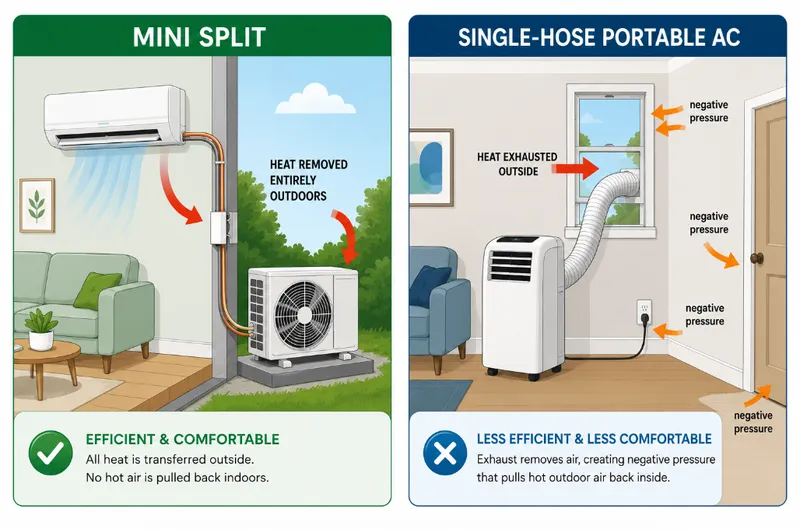
Mini Split vs. Portable AC at a Glance
SEER2 and CEER are separate federal metrics and are not directly comparable.
The Number On The Box Is Not The Cooling You Get
Portable air conditioners carry two capacity ratings, and stores lead with the wrong one. Federal rules require seasonally adjusted cooling capacity, or SACC, which accounts for duct and infiltration losses. The ASHRAE figure in marketing skips those penalties.
A unit sold as 14,000 BTU commonly carries a SACC between 8,000 and 10,000, and single-hose models lose the most. Find the SACC on the EnergyGuide label and size the room to that number. A mini split has no equivalent gap between rated and delivered capacity, which is why a 12,000 BTU head can outperform a portable with a bigger number on the carton.
Efficiency and What It Costs to Run
Efficiency is where the two separate hardest. A ductless system running long and slow at partial load draws less power than one slamming between full output and off, and inverter compressors are built for exactly that.
Portable units have no equivalent advantage, and the single-hose design defeats any compressor gain. Federal standards took effect in January 2025 and rate them on CEER, a figure that includes standby draw.
On a room you run most of the summer, that efficiency gap compounds fast enough to close much of the upfront price difference within a few seasons.
Noise
A mini split's loudest component is its compressor, and it sits outdoors. Inside you get a wall blower that on its lowest setting can fall below the ambient noise of a quiet bedroom. A portable AC puts that compressor on your floor a few feet from your head. For a bedroom, nursery, or office, that alone often ends the comparison.
Humidity Control
A cooling coil removes moisture as a side effect of lowering air temperature, and equipment varies widely in how well it does that. Engineers measure it with sensible heat ratio, where lower is better. Traditional systems land near 0.75. Newer high-efficiency equipment runs higher, which means worse dehumidification, and ductless systems are especially prone to it.
That matters in humid regions, where a head optimized for a high SEER2 number can leave a room cool and clammy. Check the sensible heat ratio in the manufacturer's performance data and use the unit's dry mode. In a genuinely humid climate, plan on separate dehumidification.
"Sensible heat ratio is the number nobody asks for, and it decides whether a humid room feels right or just feels cold. Ask the installer for it before you sign anything."
David Clark, Licensed HVAC Technician, technical reviewer
Portable ACs remove moisture as they run, but they cycle, and most collect condensate in a bucket you empty or a drain line you route. The EPA recommends indoor relative humidity below 60 percent, ideally 30 to 50 percent, and neither machine guarantees that alone.
What Neither Unit Does for Your Air
Most comparisons stop at cost and cooling. Filterbuy keeps going, because the filters inside these systems are what we manufacture.
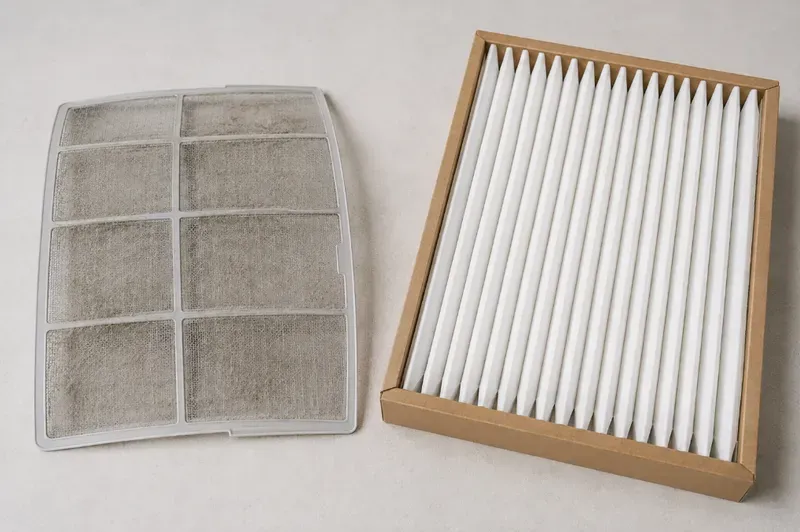
Both use washable mesh screens with very low particle capture. Those screens keep dust off the coil and avoid choking a small, low-pressure blower. They were never designed to protect lungs. Pacific Northwest National Laboratory documented that add-on filters for ductless heads often cover only part of the screen area, so most air bypasses them.
Wall-mounted ductless heads carry a second problem. The blower wheel gets wet during cooling and dust sticks to it, which supports fungal growth directly in the airstream. PNNL recommends a deep clean every one to three years, and it is not a homeowner job. Portable units have the same screen and coil, plus a condensate tray sitting in a warm room.
Neither machine is your air quality strategy. A ducted system accepts a disposable pleated filter across the full MERV range and replaces it every three months, which is what actually pulls fine particles out of a house. If your home has ductwork, the filter in that return stays your primary tool regardless of what you hang on the wall or roll into the corner. If not, plan on a correctly sized portable air cleaner alongside whatever cooling you choose.
Total Cost of Ownership
Upfront, portable wins by a wide margin. Across five years in a room you occupy, that ordering flips.
A portable unit costs a few hundred dollars with no installation. A single-zone mini split adds professional labor on top of equipment cost, and DOE notes that mini splits can run about twice the price of a window unit of similar capacity.
Set against that, count the lower operating cost and the long service life. Most models are heat pumps that replace electric resistance heat all winter. Portable units last a fraction as long and heat poorly.
One correction worth making before you budget. The federal Section 25C credit that covered qualifying heat pump installations expired for equipment placed in service after December 31, 2025. Any page still presenting it as available for a 2026 install is out of date. State and utility rebates remain worth checking, and many now require ENERGY STAR certification, a low global warming potential refrigerant such as R-32 or R-454B, and a variable-speed inverter compressor.
Which Is Right for Your Space?
Choose a mini split when the room is one you occupy daily, when you own the property, when quiet matters, or when the space runs on electric baseboard or a wall heater. Single-zone units from 6,000 to 12,000 BTU often run on 115 volts rather than 240, so they still need their own dedicated circuit but rarely force a service panel upgrade.
Choose a portable AC when you rent and cannot modify an exterior wall, when the need spans one summer, when you move often, or when the room sees use a few days a year. Buy dual-hose and size on SACC. Plan where the condensate goes.
If a window is available, price a window unit too. It beats a portable on efficiency at similar cost. To narrow models, the Filterbuy mini split buying guide works through sizing and brand trade-offs.
The Pattern We Keep Seeing
"After manufacturing filters for over a decade and serving more than two million households, the pattern is always the same. Homeowners buy the machine, then assume it handles the air. The filter that was doing the real work stops getting changed."
David Heacock, Founder and CEO, Filterbuy
Seven Sources Worth Reading Before You Buy
1. Find Out Why the EPA Flags Ductless Filtration
The EPA’s consumer page explains why limited fine-particle filtration is a ductless disadvantage that retailers rarely mention.
2. Get The Engineering Detail Retailers Leave Out
This Building America guide from Pacific Northwest National Laboratory covers mesh filter capture, blower wheel contamination, and sensible heat ratio.
3. Why Single Hose Portables Waste Energy
The Appliance Standards Awareness Project explains the negative pressure problem in plain language, with DOE's twice-a-window-unit estimate.
4. Read The Federal Rule Behind Portable AC Ratings
DOE's final rule defines the single duct and dual duct classes and sets the efficiency floor a portable unit must clear.
5. See Why Reliable Cooling Is A Health Issue
CDC's heat tracking program reports that air conditioning is the strongest protective factor against heat-related illness, even at a few hours a day.
6. Protect Your Air Quality In A Heat Wave
EPA guidance treats cooling and indoor air as one problem, including why a fan moves air without cooling it.
7. Verify The Efficiency Rating Is Actually Certified
The AHRI directory shows whether an indoor and outdoor pairing is certified at the rating on the brochure.
Supporting Statistics
Nearly half of a $1,900 household energy bill goes to heating and cooling.
Why it matters: efficiency in a room you run daily moves real money.
Air conditioning alone uses about 19 percent of home electricity, roughly 254 billion kilowatt-hours.
Why it matters: a single-hose portable inflates that slice. An inverter mini split shrinks it.
Damp or moldy homes show 40 to 80 percent higher rates of respiratory problems.
Why it matters: about 21 percent of current U.S. asthma, close to 4.6 million cases, traces to that exposure.
Frequently Asked Questions
Can a portable ac cool a room as well as a mini split?
For a small, well-sealed room over a short period, a correctly sized dual-hose portable comes close. Over a full season a mini split holds a steadier temperature, because the compressor throttles rather than cycles, and it runs more quietly.
Do mini splits filter air better than portable air conditioners?
Not meaningfully. Both use washable mesh screens with very low fine particle capture, and add-on filters for ductless heads often cover only part of the screen area. Whole-home filtration through a ducted system, or a standalone air cleaner in a ductless home, is what addresses particles.
Are mini splits eligible for a federal tax credit in 2026?
No. The Section 25C Energy Efficient Home Improvement Credit expired for equipment placed in service after December 31, 2025. State and utility rebates are still active in many areas, and most require ENERGY STAR certification, a low global warming potential refrigerant, and a variable-speed inverter compressor.
Glossary Of Key Terms
SACC. Seasonally adjusted cooling capacity. The federally required capacity rating for portable ACs, measured with duct and infiltration losses included.
ASHRAE rating. The older lab-condition capacity number, measured without those penalties, still used on portable AC packaging.
SEER2. Seasonal cooling efficiency for ductless and central systems. It replaced SEER in January 2023 under a tougher test procedure.
CEER. Combined energy efficiency ratio. The portable and window unit metric, reported in Btu per watt-hour and including standby power.
Sensible heat ratio. The share of cooling capacity spent lowering temperature rather than removing moisture. Lower is better in a humid room.
Inverter compressor. A variable-speed compressor that throttles output continuously instead of cycling between full power and off.
MERV. Minimum efficiency reporting value. The scale that rates how well a filter captures particles, with higher numbers catching finer ones.
Cool the Room, Then Clean the Air
Whichever unit you choose, the filter doing the real work is the one you replace. Filterbuy builds them in Alabama across 600 sizes, and our ductless mini split systems come from the same team.