
Toyota Camry Cabin Air Filter
Find Your Size, Change It In 10 Minutes
Published July 29, 2026. Last updated July 29, 2026.
TL;DR:
The Toyota Camry cabin air filter sits behind the glove box on the passenger side. Most owners swap it in about 10 minutes with no tools, and the right part depends on model year.
Key Takeaways
Toyota dealers recommend a change about every 15,000 miles. Filterbuy rates its cabin filters for 12 months or 12,000 miles.
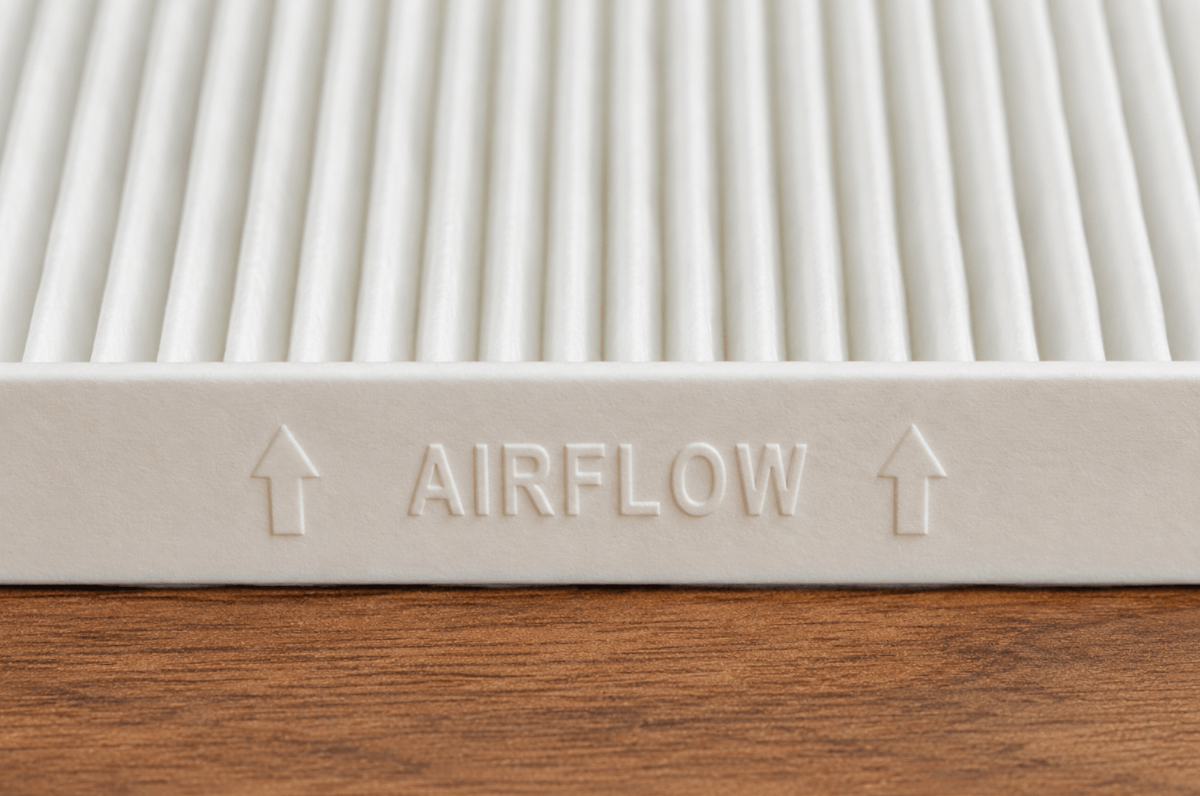
An UP marking and an AIRFLOW marking point opposite ways yet install the same way, which trips up more owners than any other step.
Which Cabin Air Filter Fits Your Toyota Camry?
Your Camry's cabin air filter is set by generation, not trim, and the Camry Hybrid shares the gas model's part.
Camry Hybrid uses the same cabin air filter as the gas model of the same year. Cross-reference numbers are published by filter manufacturers for general guidance; confirm fitment by VIN before ordering.
If a shop fitted a non-OEM part, match your old filter or look up fitment by trim and engine.
What Size Is A Toyota Camry Cabin Air Filter?
The cabin air filter for a 2007-2017 Toyota Camry measures 9.7 by 9.3 by 1.8 inches. That figure comes off the Filterbuy production line, because it is what we cut ours to. Most owners skip measuring and match the old panel, since the housing accepts one shape.
Toyota lists two numbers across those years, 87139-YZZ08 and 87139-07020, but the filter never changed. Filterbuy cuts one part for that eleven-year span, and the same body fits more than thirty other Toyota, Lexus, Scion, Subaru, and Pontiac models on our Camry cabin filter compatibility table. When a catalog splits a 2011 from a 2015, the paperwork changed and the part did not.
Our Camry filter covers 2007 through 2017 only. Owners of 2018 and newer cars should buy Toyota's 87139-0E040 or a reputable equivalent, and we would rather say so here than at checkout.
Where Is The Cabin Air Filter On A Toyota Camry?
The Toyota Camry cabin air filter sits directly behind the glove box on the passenger side of the dashboard. Nothing under the hood comes off and no bolts come out. Its housing feeds outside air into the heating and cooling system, so all your vent air has passed through it. See also what a cabin air filter does.
How Do You Change A Toyota Camry Cabin Air Filter?
Changing a Camry cabin air filter takes about 10 minutes and usually requires no tools. These steps cover 2007 through current model years.
Empty the glove box, since anything left inside falls out when it drops.
Squeeze both sides inward so the stops clear the dashboard and the box swings down. Some years have a damper arm on the right that unclips first.
Release the tabs on each side of the rectangular housing and set the cover aside.
Pull the old filter straight toward you. Expect dust, so hold it level over a bag.
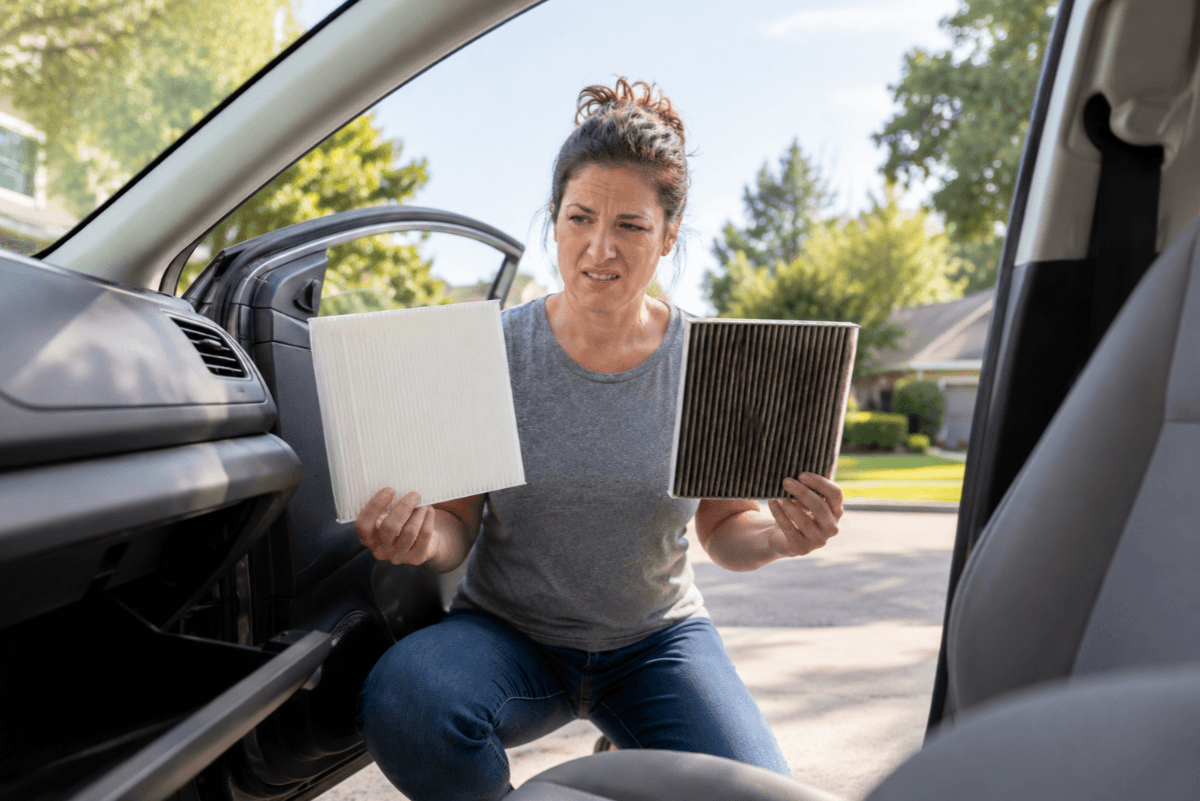
Check which marking your new filter carries, the step people most often get wrong.
Insert the new filter, replace the cover, and reseat the glove box. Run the fan on high to confirm stronger airflow.
UP Arrow Or AIRFLOW Arrow? They Mean Opposite Things
Read the wording next to the arrow, not just the arrow. A genuine Toyota filter carries an UP marking, an orientation label, so that arrow points toward the roof. Many aftermarket filters carry an AIRFLOW marking, which shows where air travels, and a Camry pulls air downward into the blower, so that arrow points at the floor. Both labels end in the same installed position.
If you are unsure, check the filter you removed. Its dirty side faces up, because incoming air hits it first. Our walkthrough for replacing a cabin air filter at home covers other vehicles.
"I don’t want anyone to feel like they need an HVAC license just to pick the right filter. My job is to give you the straight answer, explain why it matters, and let you get back to your day."
— Michelle Wan, Brand Manager and Air Quality Writer, Filterbuy
How Often Should You Replace A Toyota Camry Cabin Air Filter?
Two numbers apply here and they do not conflict. Toyota dealer service departments recommend replacement about every 15,000 miles, matching the inspection interval in Toyota's maintenance schedule. Filterbuy rates its auto cabin filters for 12 months or 12,000 miles, printed on our packaging, because that is what the media is warranted to.
Filters clog on exposure rather than odometer readings, so the same Camry can need service at 8,000 miles in one city and 20,000 in another. See our guidance on how often to change a cabin air filter
Cabin air filters clog on exposure, not on odometer readings. Toyota's maintenance schedule calls for inspection at 15,000 miles; these intervals adjust that baseline for real driving conditions.
A Los Angeles study found driving filled about 6% of participants' days but delivered 33% to 45% of their ultrafine particle exposure.
What Does A Camry Cabin Air Filter Do For The Air You Breathe?
A cabin air filter is a pleated media panel that captures dust, pollen, mold spores, road grit, and exhaust before that air reaches your vents. Much of what it catches is fine particulate matter, or PM2.5, small enough per the EPA to reach deep into the lungs.
A randomized cross-over study of 48 commuters published in Environmental Science & Technology found cabin filtration cut in-vehicle PM2.5 by roughly 30%, ultrafine particles by 28%, and black carbon by 32% versus the same commutes unfiltered. Those researchers measured whether a filter was present, not which brand, which is why a clogged filter matters on an ordinary drive.
Home filters carry a standardized MERV rating and cabin filters usually do not, which makes the two hard to compare. Filterbuy publishes a tested capture rate instead. See our buyer's guide to cabin air filters and how to choose a cabin air filter.
What A Cabin Air Filter Will Not Fix
A cabin air filter traps particles and does not remove gases. The same commuter study found no reduction at all in nitrogen dioxide, benzene, or carbon monoxide. If your complaint is exhaust smell rather than dust, only activated carbon media touches it.
There is also a free fix most drivers never use. The California Air Resources Board found car travelers can cut exposure to PM2.5, ultrafine particles, and black carbon by up to 75% by switching climate control to recirculate. Use it in stop-and-go traffic, in a tunnel, or behind a diesel.
The same researchers warn against running recirculate for hours, because with no fresh air entering, carbon dioxide from occupants climbs, and elevated CO2 has been linked to reduced cognitive performance.
Which Cabin Air Filter Is Best For Your Camry?
The right filter depends on what is bothering you.
Dust and pollen only. Any reputable particulate filter matching your OEM number handles this, so do not pay more.
Exhaust smell or traffic fumes. You need activated carbon, because a particle filter does not touch gases however efficient.
Allergies, asthma, or wildfire smoke. Choose the highest-efficiency media that fits the housing, since the airflow penalty is small and the capture difference is not.
Toyota's filter for 2018-and-newer Camrys is already charcoal, so those owners start with carbon from the factory. Owners of 2007 to 2017 cars start with plain particulate media, so an upgrade buys them more.
How Much Does A Toyota Camry Cabin Air Filter Cost?
A shop charges roughly $89 to $116 for a Camry cabin air filter replacement, mostly labor, according to RepairPal's Camry estimator. The Filterbuy HEPA cabin filter for the 2007-2017 Camry lists at $13.99, and genuine Toyota filters run roughly $20 to $45.
Signs Your Camry's Cabin Air Filter Needs Replacing
The clearest signs are weaker airflow and a musty smell when the fan runs. Because the filter hides behind the glove box, drivers notice symptoms long before they see the panel. Watch also for slow-clearing window fog, dust returning to the dash quickly, and more than a year since the last change. See more signs a cabin air filter needs replacing.
Supporting Statistics: What Government Research Shows
High-efficiency cabin filters cut in-cabin particle levels by 55% to 90%, roughly twice what a standard factory filter achieves. Media choice matters as much as change interval.
Source: California Air Resources Board, Research Synthesis #17-03 (2017)
The EPA’s annual health limit for PM2.5 is 9.0 micrograms per cubic meter, while unfiltered cabin air in the commuter study above averaged 20. Read that for scale, since the EPA figure is an annual average and the other a 94-minute drive.
Source: U.S. Environmental Protection Agency, PM National Ambient Air Quality Standards (2024)
One in four U.S. adults (25.2%) had a diagnosed seasonal allergy in 2024, along with 20.6% of children. If that describes you or a passenger, this filter earns its keep.
Source: CDC National Center for Health Statistics, Data Brief No. 545 (January 2026)
Frequently Asked Questions
Ready To Breathe Easier In Your Camry?
Match your year and model, then set a reminder for next year. Browse cabin filters for every Toyota model or use the selector on the auto cabin air filter page.
About The Author
Michelle Wan is Brand Manager and Air Quality Writer at Filterbuy, where she turns MERV ratings, filtration, and HVAC efficiency into plain-English advice and fronts much of the brand's educational video content (B.A., University of California, Santa Cruz). Working directly with Filterbuy's U.S. manufacturing teams, she writes from how filters are built and used, not from spec sheets.
Reviewed for technical accuracy by David Clark, Licensed HVAC Technician, Filterbuy HVAC Solutions. Filterbuy is a second-generation, family-owned American manufacturer that sold its first filter in 2013 and makes 100% of its products in the USA. Camry figures come from Filterbuy production and catalog data.