
Tacoma Real-Time AQI Tracker


Get Alerts For Unhealthy AQI In Your Area
When air quality in your area reaches unhealthy levels, we'll send you a quick alert, along with expert tips on how to reduce your exposure.
What's Actually In Tacoma Air Today?
What High AQI Means for Your Lungs in Tacoma
How to Read AQI
The Air Quality Index (AQI) measures how polluted the air is and how it may affect your health.
0–50 (Good): Air quality is satisfactory.
51–100 (Moderate): Acceptable, but some pollutants may pose minor concerns.
101–150 (Unhealthy for Sensitive Groups)
151–200 (Unhealthy)
201–300 (Very Unhealthy)
301+ (Hazardous)
Moderate
Still okay for most, but if you have asthma or allergies, take it easy and avoid long outdoor workouts.
Shop MERV 11 filters→What's the Right Filter for Your AQI Level?


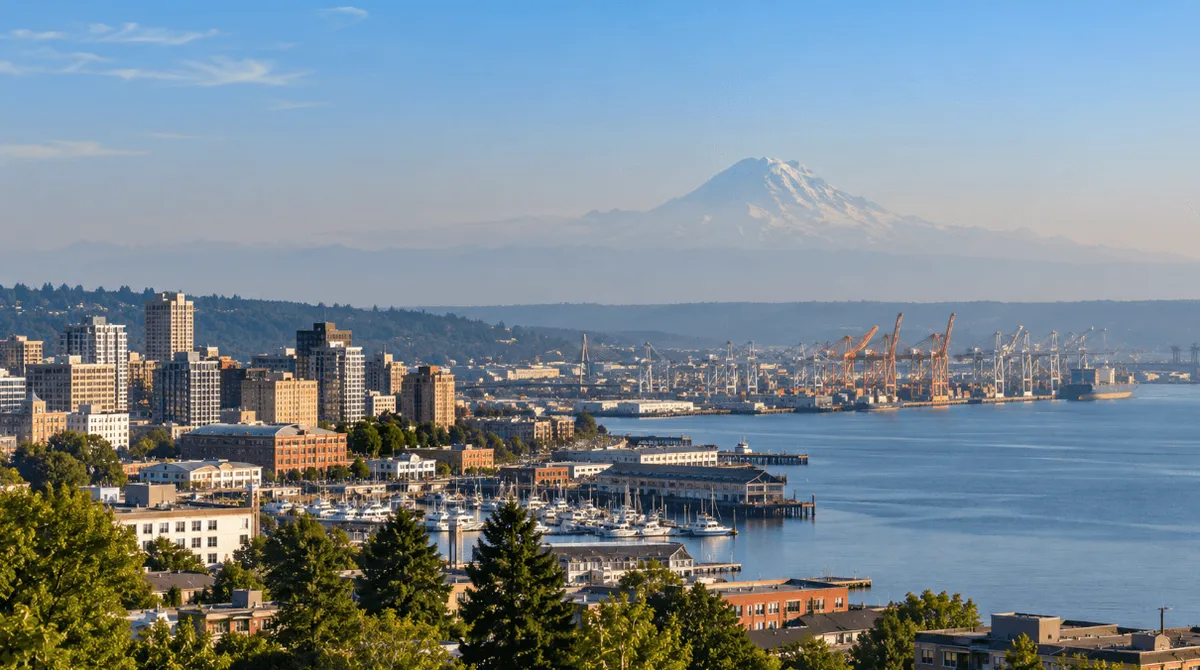
Check Today's Live Real Time Air Quality Index AQI Map in Tacoma, WA Now
TL;DR
The live map above shows Tacoma's current air quality. Most unhealthy days here come from fine particles, mainly winter wood smoke and late-summer wildfire smoke. At AQI 100, Filterbuy's action line, switch to MERV 13, set the fan to On, run a portable HEPA cleaner in each occupied room and close up.
Key Takeaways
Fine particles (PM2.5) drive most unhealthy days; the Seattle-Tacoma metro ranks 8th worst nationally for short-term particle spikes (2026 State of the Air).
In 2025, winter wood smoke topped the regional health goal on more days than wildfire smoke did.
Pierce County burn bans trigger sooner than King County's.
At AQI 100, Filterbuy recommends four steps: MERV 13, fan On, room HEPA cleaners and close up.
How to Read the Live Tacoma AQI Map in a Minute
The map shows a 0 to 500 Air Quality Index score for whichever pollutant measures highest. In Tacoma, that's usually PM2.5, the fine particles in smoke and vehicle exhaust. The question Filterbuy hears most from Pacific Northwest households is why the sky looks smoky while the map reads Good. Often the smoke rides high above the city, so trust the nearest station over the view from your window.
Two regulatory fine-particle monitors cover south and east Tacoma: the Puget Sound Clean Air Agency's South L Street site and the state Department of Ecology's South 36th Street site. The agency's calibrated sensor map fills in the gaps, while Filterbuy's Seattle and Federal Way air quality pages cover neighbors to the north.
What Each AQI Level Means for Your Day in Tacoma
On the EPA scale, air becomes unhealthy for sensitive groups at 101. Filterbuy acts one step earlier, at 100: MERV 13 in the HVAC with the fan On, plus a portable HEPA cleaner in each occupied room.
Tacoma AQI Levels and What to Do
Categories follow the EPA AirNow scale. AQI 100 is Filterbuy's action line.
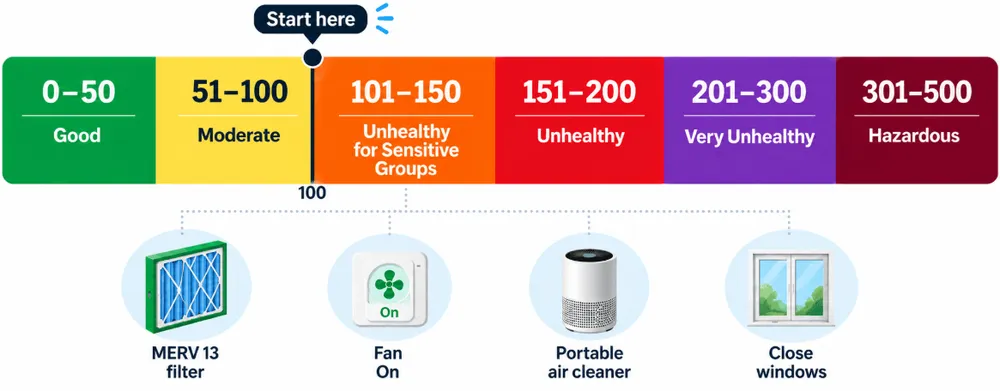
Filterbuy's Four Steps at AQI 100
Start with official guidance from AirNow and the Tacoma-Pierce County Health Department, including any stay-indoors or evacuation instructions. Then follow Filterbuy's recommended order:
Switch the HVAC to a MERV 13 filter. EPA says most furnaces and HVAC systems can handle MERV 13 without equipment problems as long as the filter is replaced often, so check the fit like any filter.
Set the thermostat fan to On so air passes through the filter continuously.
Run a portable HEPA cleaner in each occupied room, starting with bedrooms. EPA recommends a CARB-certified unit with a smoke CADR of at least two-thirds of the room's square footage, so a 150-square-foot bedroom needs 100 or more.
Close windows and doors, and set any fresh-air intake to recirculate. While smoke is in, skip candles, the fireplace, frying and smoking, and vacuum only with a sealed unit.
"Most homeowners have no idea whether they even have a fresh-air intake until they go looking for one. If you cannot identify it, that is the moment to call a technician rather than start covering things up."
David Clark, Licensed HVAC Technician, Filterbuy HVAC Solutions
Why Tacoma's AQI Can Look Off
AirNow's hourly NowCast weights recent hours, while federal standards use 24-hour averages, so the two disagree when smoke shifts fast.
Tacoma also logs more Moderate days than it used to. EPA tightened the fine-particle AQI breakpoints in 2024, and as the Puget Sound Clean Air Agency notes, that moved more days into Moderate without the air getting worse.
Burn bans can start while the map still reads Good, because the agency calls them when it expects pollution to build, and wood smoke peaks at night and early morning. Uncalibrated PurpleAir sensors can also read high in smoke.
Your station matters. After Filterbuy pulled three years of Ecology data and removed wildfire days, South L Street still read higher than South 36th Street every year, a gap smoke alone doesn't explain.
Tacoma's Two Stations, Three Years
Worst-day (98th percentile) 24-hour PM2.5, µg/m³, wildfire days removed. Federal threshold: 35. Source: Ecology.
Is Tacoma's Air Safe to Breathe Right Now?
Tacoma's air safety depends on the live reading. AirNow advises sensitive groups to reduce prolonged or heavy outdoor exertion once the AQI passes 100, and everyone above 150. Children, older adults, pregnant people and people with heart or lung disease face greater risk, and anyone with a health condition should follow their doctor first.
Risk also varies by neighborhood. Ecology's 2025 South and East Tacoma report found adult asthma at 12.9% there versus 11.4% statewide, though not necessarily because of air pollution. The health department also warns that cloth face coverings don't stop smoke.
Tacoma Air Quality Forecasts, Alerts and Burn Bans
The Puget Sound Clean Air Agency forecasts air quality year-round. The agency posts burn ban status and issues smoke alerts with the health department. For fire locations, check the AirNow Fire and Smoke Map or Filterbuy's Tacoma wildfire and smoke map; the Washington air quality map gives the statewide view.
An air quality burn ban targets fall and winter wood smoke and is separate from a summer fire safety ban. Under Stage 1, fireplaces and uncertified wood stoves and inserts are off-limits unless you have an approved no-other-heat exemption, and all outdoor burning stops. Stage 2 adds certified and pellet stoves. Pierce County's Stage 1 trigger is stricter than King County's: forecast PM2.5 above 30 micrograms per cubic meter within 72 hours, versus 35 within 48.
Inside the Tacoma-Pierce County Smoke Reduction Zone, uncertified wood stoves have been illegal to buy or operate since October 1, 2015.
What's Actually in Tacoma's Air
The Puget Sound Clean Air Agency names home wood smoke, vehicles, wildfires and industry as the region's main PM2.5 sources. Diesel exhaust, mostly from ships, off-road equipment, trucks and rail, accounts for over 80% of the potential cancer risk from Puget Sound air pollution. That puts the Port of Tacoma, the Tideflats and I-5 at the center of the local picture.
Tacoma has solved a particle problem before. EPA named Tacoma-Pierce County a PM2.5 nonattainment area on November 13, 2009, over winter wood smoke and redesignated it to attainment on February 10, 2015, after burn bans and stove change-outs.
Wildfire Smoke: Tacoma's Fastest-Moving Air Event
Wildfire smoke can push Tacoma from Good to Unhealthy within a day, usually drifting in from Eastern Washington or Canada. In September 2020, the Puget Sound Clean Air Agency recorded its highest fine-particle levels since it began monitoring them in 1999.
Filterbuy's guide on how to recover from wildfire smoke exposure covers cleanup after a smoke event.
What If Your Tacoma Home Has No Central HVAC?
Without ducts, there's no filter slot, so portable cleaners become the main defense. Filterbuy doesn't sell them, so this advice earns us nothing. In homes heated by baseboards or ductless heat pumps, run a CARB-certified HEPA cleaner in each occupied room during smoke. If a cleaner is unavailable or unaffordable, the health department and EPA both point to a do-it-yourself box-fan cleaner with a MERV 13 filter as a stopgap. Use a certified 2012-or-newer fan, and don't leave it running unattended.
Tacoma Needs a Winter Filter Plan Too
Most smoke advice is written for August, but Filterbuy's customer-support queue says otherwise: fireplace-season air complaints reach us in December and peak in January. Puget Sound's 2025 data agrees, with wood smoke topping the health goal on more days than wildfire smoke. Filters catch particles, not ozone or nitrogen dioxide, so filtering pays off year-round.
In winter, the furnace already moves air through your filter for hours a day. Late-summer smoke is different: a home without air conditioning may barely run its system, so setting the fan to On matters most then. It's why we pair every MERV 13 recommendation with fan On.
Tacoma's Air-Year at a Glance
Typical patterns, not forecasts. Fireworks dates per Ecology.
"The filter is the one part of this system you actually control, and it is the part people forget. I would rather someone run a MERV 13 filter that they change on time than a higher rating they leave in until winter."
Michelle Wan, Brand Manager and Air Quality Writer, Filterbuy
Which Filter the Tacoma AQI Calls For
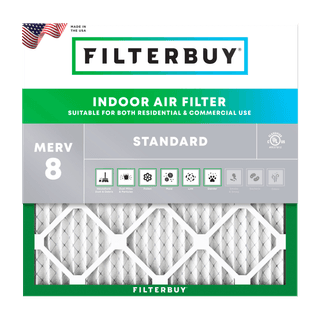
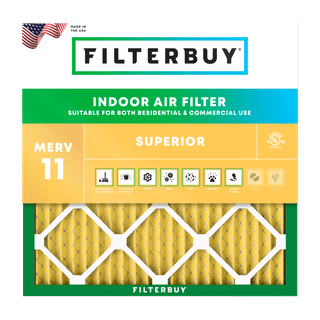
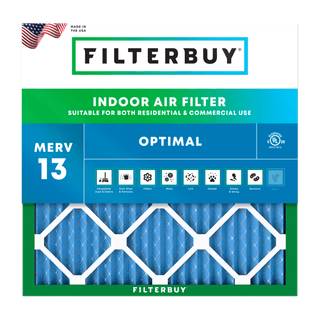
For smoke, burn-ban days and any reading of 100 or above, use MERV 13 air filters. EPA recommends MERV 13 or higher during smoke events. For everyday readings from 0 to 99, a MERV 8 or MERV 11 filter handles dust, pollen and pet dander. Make sure the filter fits snugly, since a gap at the frame lets air skip the media. That's why Filterbuy makes more than 600 sizes. See Filterbuy's guide to the best MERV filter for wildfire smoke.
Filterbuy's 90-day rating assumes a cycling blower, and smoke loads a filter much faster. During a smoke event, check the filter and replace it once it looks dirty, dark brown or black, which EPA notes can be well before the normal interval. Keep a spare on the shelf, or use Filterbuy auto-delivery, so a fresh one is ready.
Supporting Statistics
11 days at Unhealthy for Sensitive Groups or worse (Pierce County, 2020)
Peak: wildfire smoke, September 8 to 18.
Source: Puget Sound Clean Air Agency, 2020 Data Summary
5.7 unhealthy air days a year (South and East Tacoma, 2022 to 2024)
Down from 7.0 a year in 2020 to 2022.
Source: Washington State Department of Ecology, South and East Tacoma Community Report
88 Moderate days, 1 Unhealthy day (Pierce County, 2025)
In Filterbuy customer reports, wet wood is the top cause of excess smoke.
Source: Puget Sound Clean Air Agency, 2025 Data Summary
Frequently Asked Questions
What is the air quality in Tacoma today?
The live map above shows the current Tacoma AQI and the pollutant driving it.
Is the air quality bad in Tacoma today?
Check the map above. 101 or higher is unhealthy for sensitive groups, and 151 or higher for everyone. Filterbuy starts the four steps at 100.
Is there a burn ban in Tacoma today?
Check the Puget Sound Clean Air Agency's burn ban status page, since bans can start while the AQI reads Good.
Why is Tacoma air often worse on winter nights?
Calm, cold air traps wood smoke near the ground after dark, so on burn-ban days, air out the house in the afternoon, not at night.
How do I check Tacoma PM2.5 right now?
Tap a station on the live map, or check the Puget Sound Clean Air Agency's calibrated sensor map.
Glossary
AQI: The EPA's 0 to 500 Air Quality Index, divided into six health categories.
PM2.5: Fine particles 2.5 micrometers or smaller, the main component of wood and wildfire smoke.
NO2: Nitrogen dioxide, a traffic and combustion gas monitored near I-5 in Tacoma.
Air quality burn ban: A temporary Stage 1 or Stage 2 wood-burning limit from the Puget Sound Clean Air Agency.
MERV: Minimum Efficiency Reporting Value, a 1 to 16 filter rating.
CADR: Clean air delivery rate, a portable cleaner's filtered airflow.