
Air Quality in Mississippi
Air quality index (AQI⁺) and PM2.5 air pollution in Mississippi •


Get Alerts For Unhealthy AQI In Your Area
When air quality in your area reaches unhealthy levels, we'll send you a quick alert, along with expert tips on how to reduce your exposure.
Live Air Quality Ratings in Mississippi
Live Most Polluted City Ranking
Real-time most polluted cities in Mississippi
Live Cleanest City Ranking
Real-time cleanest cities in Mississippi
The Right Air Filter For High AQI Days
When outdoor air quality drops, the EPA recommends upgrading to a MERV 13 filter — or the highest-rated filter your HVAC system can handle — to help capture more of the fine particulate (PM2.5) that comes with poor air quality. MERV 13 is the highest rating most residential systems can run without restricting airflow.
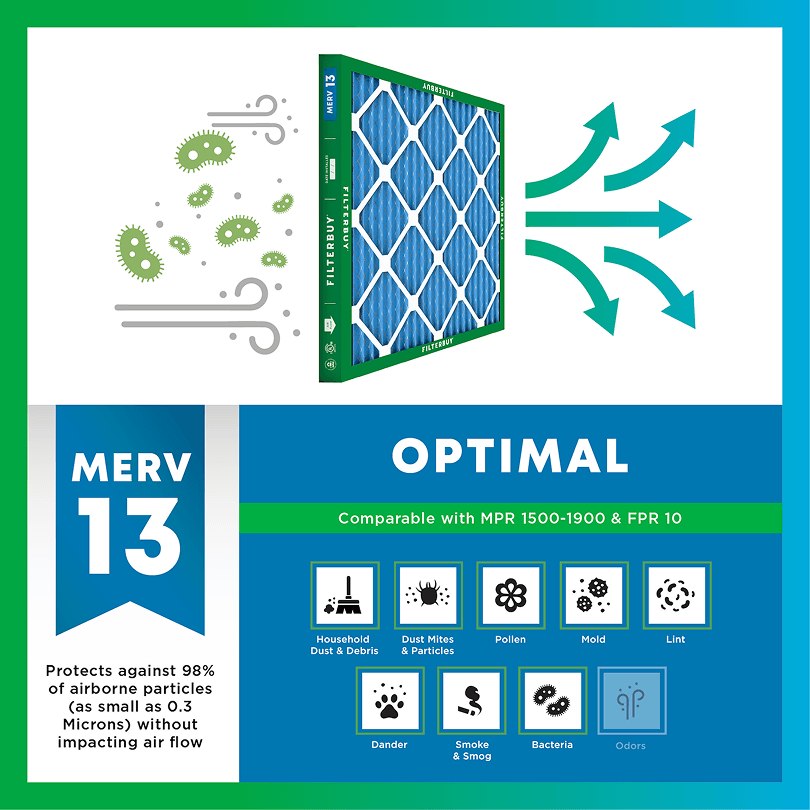

- Captures PM2.5 and other fine particulates
- Filters ash, soot, and smoke particles
- Rated to capture particles as small as 0.3 microns
- Matches the filter rating the EPA suggests during high-AQI and smoke events

AQI FAQs
What is AQI?
AQI stands for Air Quality Index, the EPA's scale for reporting daily air quality. It runs from 0 to 500. The higher the number, the greater the level of air pollution. Values at or below 100 are generally considered satisfactory; values above 100 mean air quality is unhealthy, first for sensitive groups, then for everyone as numbers climb.
What does AQI measure?
The AQI tracks five major pollutants regulated by the Clean Air Act: ground-level ozone, particle pollution (PM2.5 and PM10), carbon monoxide, sulfur dioxide, and nitrogen dioxide. The reported AQI value reflects whichever pollutant is highest at that time — most often ozone or fine particles (PM2.5).
How is AQI calculated?
Monitoring stations measure pollutant concentrations, and the EPA converts each into a standardized 0–500 score using set breakpoints. Each pollutant gets its own sub-index, and the highest sub-index becomes the reported AQI. That's why a single number can represent different pollutants on different days.
What is a good AQI?
An AQI of 0–50 is rated "Good" — air quality poses little or no risk. 51–100 is "Moderate," acceptable for most people though unusually sensitive individuals may want to limit prolonged outdoor exertion. Anything at or below 100 is generally considered satisfactory air quality.
What does an AQI of 100 (or 150) mean?
100 is the dividing line: at or below it, air quality is satisfactory for the general public. From 101–150, air is "Unhealthy for Sensitive Groups" — people with respiratory conditions, older adults, and children. From 151–200, it's "Unhealthy" and everyone may begin to feel effects.
Why is the AQI bad today?
Short-term AQI spikes usually come from wildfire smoke, temperature inversions that trap pollutants near the ground, high-ozone weather (hot, sunny, stagnant days), or heavy traffic and industrial activity. Check a real-time source like the map on this page to see which pollutant is driving today's reading in your area.
What AQI is bad for running or exercise?
Many runners follow the EPA category lines: below 50, no adjustment needed; 51–100, unusually sensitive people may shorten intense workouts; above 100, sensitive groups are advised to reduce prolonged or heavy outdoor exertion; above 150, that advice extends to everyone. Exercise increases how much air you breathe in, which is why thresholds matter more during workouts.
What AQI is safe to open windows?
A common rule of thumb is to keep windows open when the AQI is under 100 and close them when it climbs above, especially during wildfire smoke events when fine particles are elevated. When windows are closed, running your HVAC system with a fresh filter helps capture particles circulating indoors.
Should I wear a mask based on AQI?
Public health agencies generally suggest considering a well-fitted N95-style respirator outdoors when the AQI exceeds 150, particularly during smoke events. Cloth and surgical masks don't filter fine particles effectively. Follow guidance from your local health department, which may adjust recommendations during severe episodes.

Check Today's Live Real Time Air Quality Index AQI Map in Mississippi Now
By Michelle Wan, Brand Manager and Air Quality Writer, Filterbuy · Reviewed by David Clark, Licensed HVAC Technician · Published July 31, 2026 · Updated July 31, 2026
TL;DR
Mississippi's live air quality index (AQI) map below shows real-time conditions statewide, drawn from EPA AirNow and Mississippi Department of Environmental Quality (MDEQ) monitors. Ground-level ozone leads here, and fine-particle pollution (PM2.5) ranks second. MDEQ forecasts three separate areas, not one statewide number: DeSoto County, the Jackson metro, and the Gulf Coast. Read the monitor closest to you. Above 100, cut outdoor exertion and run a MERV 13 filter indoors.
Right now in Mississippi, find your city's current AQI on the live map above. The number tells you how clean the air is at that monitor, and whether kids, older adults, and anyone with asthma or heart disease should take it easy outside. The half most maps skip is what that number does to the air inside your house, and Filterbuy, a U.S. air filter manufacturer, knows that half best.
Key Takeaways
Ozone drives Mississippi's worst grades and every one of its official Action Days. Fine particles rank second statewide but fail the standard at two sites.
Mississippi currently meets every federal air quality standard, so most days are Good or Moderate rather than hazardous.
MDEQ forecasts three areas and declares Ozone Action Days for DeSoto, Hancock, Harrison, and Jackson counties. Mississippi's failing grades sit in DeSoto County, filed nationally under the Memphis metro.
A MERV 13 filter captures fine particles, though no pleated filter removes ozone.
How Do I Read Mississippi's Live AQI Map Right Now
Read the number and the color on the live map above. The number is the air quality index, a 0 to 500 scale where lower means cleaner air. Readings come from EPA AirNow and MDEQ stations, so they are official measurements.
Each reading names the dominant pollutant, usually ozone or PM2.5. Ozone peaks on hot, stagnant afternoons because ground-level ozone forms when sunlight reacts with traffic and industrial emissions. Fine particles arrive at any hour and linger.
Now the part worth knowing before you trust any dot on any map. Mississippi's network is thin. MDEQ's 2024 air quality data summary reports monitors in nine of the state's 82 counties: Bolivar, DeSoto, Forrest, Hancock, Harrison, Hinds, Jackson, Lauderdale, and Lee. Live outside those nine and your nearest reading may be an hour away, so treat it as a regional signal and note the wind direction. You can also read an AQI map by ZIP code to see which station you are actually relying on.
No aggregator mentions the timing. MDEQ runs its daily ozone forecast from March 1 through October 31. Only the Jackson N-CORE site measures ozone year round, so a winter reading is telling you about particles, not smog.
What Counts As A Good AQI In Mississippi Today
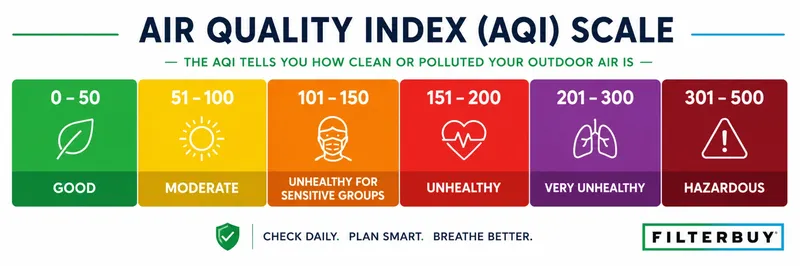
An AQI at or below 50 is Good and safe for everyone. Readings of 51 to 100 are Moderate, and what a Moderate reading means depends on where you land in that band. Above 100 the air is unhealthy, first for sensitive groups and then for everyone. EPA revised the fine-particle breakpoints in 2024, so a reading that once landed in Good may now show as Moderate, which Filterbuy's reference on how the AQI is calculated explains.
Source: U.S. EPA and AirNow, U.S. Air Quality Index.
Our guide to what the Air Quality Index measures decodes each category, and you can check your local AQI anytime.
Why Mississippi's Air Quality Is Three Separate Stories
A statewide average describes almost nobody here, and MDEQ's practice proves it. The agency publishes MDEQ's daily air quality forecast for three areas and reserves Ozone Action Day declarations for four counties: DeSoto, Hancock, Harrison, and Jackson. On a declared Action Day, open burning of agricultural and yard waste is prohibited there, and notice posts the night before.
Regional synthesis by Filterbuy, from MDEQ forecast areas and American Lung Association State of the Air 2026 grades.
Here is what almost every national air quality page gets wrong. Mississippi's worst air sits in DeSoto County, which the American Lung Association reports inside the Memphis-Clarksdale-Forrest City metro, ranked 27th worst in the nation for ozone with an F grade. A Southaven or Olive Branch resident searching for Mississippi air quality never sees it, because it is filed under Tennessee. The number behind that grade is narrow. DeSoto measured 71 parts per billion of ozone against a 70 ppb federal standard in 2024, and MDEQ joined EPA's Ozone Advance Program with the Memphis metro in response. If your reading climbs, our guide to why air quality turns bad covers the causes, and what PM2.5 is explains the haze.
Author Perspective
I have written these live AQI pages for states across the country, and Mississippi is where a statewide number misleads people most. Its worst readings publish under a Tennessee metro name, so the residents breathing them cannot find their own data. That is why this page follows MDEQ’s three forecast areas.
Michelle Wan, Brand Manager and Air Quality Writer, Filterbuy
Seasonal smoke here is usually planned. The Mississippi Forestry Commission prescribed burning program maps active permits, so you can confirm whether a haze is scheduled. The paperwork shows how much of Mississippi's particle load is smoke rather than traffic. MDEQ is pursuing exceptional-events demonstrations at its Hattiesburg and DeSoto sites to exclude PM2.5 driven by prescribed fire and wildfire.
Why Outdoor Air Quality Changes The Air Inside Your Mississippi Home
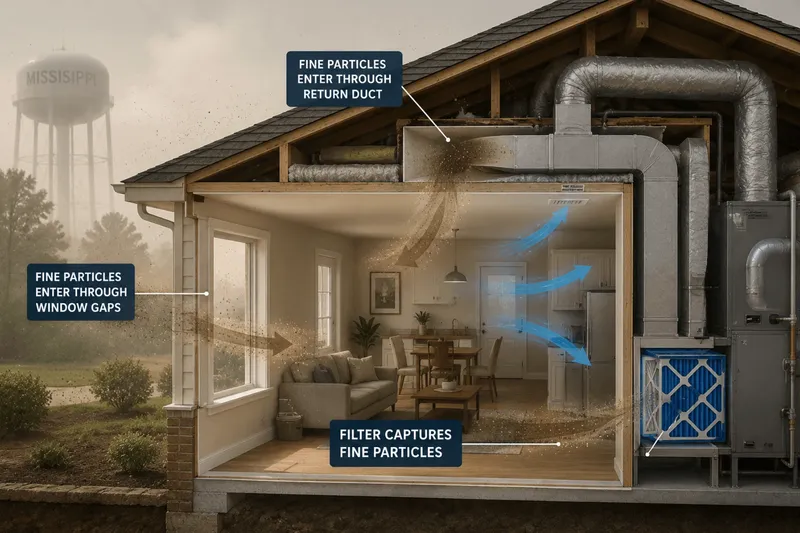
Outdoor pollution does not stay outdoors. Fine particles slip through gaps around windows and doors and ride in through your HVAC system, so when Mississippi's AQI climbs, indoor levels follow within an hour or two. Americans spend roughly 90 percent of their time indoors, where some pollutants run two to five times higher, according to EPA's indoor air quality assessment.
Mississippi adds a layer Filterbuy knows from where we build. Our plant sits in Talladega, Alabama, inside the same hot, humid belt, where cooling runs most of the year and pushes household air through one filter again and again. During smoke events EPA recommends a high-efficiency filter rated MERV 13 or higher and running the system fan as often as possible.
One caveat, because ozone leads here. Pleated filters capture particles, so a MERV 13 does not remove ozone, a gas that passes through the media. Shift activity to morning or evening and keep windows shut. Filterbuy's guide to how ground-level ozone affects your health covers what helps.
Expert Quote
After manufacturing filters for over a decade and serving more than two million households, the pattern I see in Mississippi is a cooling season that barely stops. That filter runs nine or ten months a year, and on smoke days it is the only thing between outdoor air and your family’s lungs. Get a MERV 13 in before the first Action Day, then check it monthly instead of quarterly.
David Clark, Licensed HVAC Technician, Filterbuy
How Can Mississippians Protect Indoor Air On High AQI Days
Above 100, work these four steps in order.
Seal the house. Keep windows and doors closed until the number drops. Fresh air on an ozone afternoon carries the pollutant you are avoiding.
Filter with MERV 13. Run the fan continuously, set to On rather than Auto, so air is cleaned on a loop.
Recirculate rather than intake. Add a portable HEPA cleaner in your main room.
Change it sooner. Smoke and pollen load a filter fast. Inspect monthly in spring and summer.
If MERV 13 airflow concerns you in an older system, MERV 11 filters are the step down worth considering, and our guide to the best MERV rating for smoke covers the tradeoff.
Stay Ready Before The Next Action Day
Set up a Filterbuy air filter subscription so a fresh MERV 13 filter arrives when you need it, free and factory-direct. Better Air For All.™
Tracking another state? Compare live AQI maps for every U.S. state.
Mississippi Air Quality By The Numbers
65,296 Mississippi children breathe failing-grade air. They live in an area that failed at least one pollution measure.
Source: American Lung Association, State of the Air 2026
93 percent of Southern households ran air conditioning in 2020. No census region runs more. A Mississippi filter logs far more hours than a northern one.
Source: U.S. Energy Information Administration, Residential Energy Consumption Survey
High-efficiency filtration cut indoor PM2.5 by roughly 50 percent. A randomized, sham-controlled trial across 172 homes tested central high-efficiency filters and portable cleaners. Filtration does measurable work.
Source: National Institutes of Health, randomized air filtration trial
7 Mississippi Air Quality Resources We Keep One Tap Away
All seven are free and agency-maintained.
1. See The Official Number Before You Trust Any App
AirNow is the EPA's national reporting system, and most commercial apps pull from it. When a reading elsewhere disagrees, this is the number that settles it.
Best For: Doubtful readings.
Source: AirNow, AQI Basics
2. Get Tomorrow's Mississippi Forecast Before You Plan The Weekend
Current and next-day forecasts for all three areas, plus EnviroFlash signup.
Best For: Planning ahead.
Source: Mississippi Department of Environmental Quality
3. Find Out Who In Your Home Carries The Most Risk
State-level asthma prevalence and hospitalization tables.
Best For: Household risk.
Source: Centers for Disease Control and Prevention
4. Turn An Asthma Diagnosis Into A Written Plan
The state asthma surveillance program, plus an action plan template for you and your doctor.
Best For: Asthma households.
Source: Mississippi State Department of Health
5. Tell Pollen Apart From Pollution
AAFA ranks cities by pollen burden yearly and tracks how tree, grass, and weed seasons shift. Mississippi's humid climate stretches that calendar past spring.
Best For: Spring and fall symptoms.
Source: Asthma and Allergy Foundation of America
6. Know Whether That Haze Is A Planned Burn
The National Weather Service office in Jackson issues twice-daily fire weather forecasts and spot forecasts for controlled burns across 58 counties and parishes.
Best For: Burn season.
Source: National Weather Service Jackson, Mississippi
7. Keep The System That Cleans Your Air Running Right
ENERGY STAR lists what a professional service visit should cover, including monthly filter inspection. Use it to judge a service plan.
Best For: Annual maintenance.
Source: ENERGY STAR
Frequently Asked Questions About Mississippi Air Quality
Glossary
Air Quality Index (AQI): EPA's 0 to 500 scale for outdoor air quality, divided into six color-coded health categories.
Ozone (ground-level): A gas formed when sunlight and heat react with traffic and industrial emissions.
PM2.5 (fine particulate matter): Airborne particles 2.5 micrometers or smaller, small enough to reach deep into the lungs.
MDEQ (Mississippi Department of Environmental Quality): The state agency that monitors Mississippi air and declares Action Days.
Ozone Action Day: An MDEQ declaration for DeSoto, Hancock, Harrison, or Jackson County when ozone is forecast to turn unhealthy.
MERV (Minimum Efficiency Reporting Value): A 1 to 16 scale for particle capture. EPA cites MERV 13 for fine particles.
About The Author And Reviewer
Michelle Wan writes Filterbuy's live AQI pages and air quality resource library.
David Clark, Licensed HVAC Technician, verified the filtration and HVAC guidance for accuracy.
About Filterbuy: Filterbuy has made air filters in the United States for over a decade. Better Air For All.