
Air Quality in Alabama
Air quality index (AQI⁺) and PM2.5 air pollution in Alabama •


Get Alerts For Unhealthy AQI In Your Area
When air quality in your area reaches unhealthy levels, we'll send you a quick alert, along with expert tips on how to reduce your exposure.
Live Air Quality Ratings in Alabama
Live Most Polluted City Ranking
Real-time most polluted cities in Alabama
Live Cleanest City Ranking
Real-time cleanest cities in Alabama
The Right Air Filter For High AQI Days
When outdoor air quality drops, the EPA recommends upgrading to a MERV 13 filter — or the highest-rated filter your HVAC system can handle — to help capture more of the fine particulate (PM2.5) that comes with poor air quality. MERV 13 is the highest rating most residential systems can run without restricting airflow.
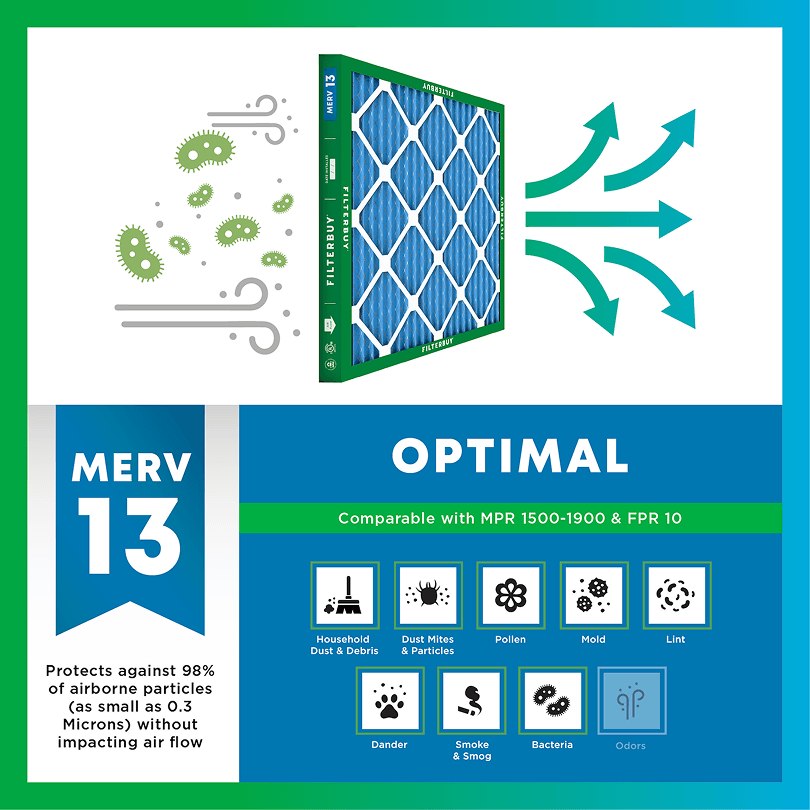
- Captures PM2.5 and other fine particulates
- Filters ash, soot, and smoke particles
- Rated to capture particles as small as 0.3 microns
- Matches the filter rating the EPA suggests during high-AQI and smoke events

AQI FAQs
What is AQI?
AQI stands for Air Quality Index, the EPA's scale for reporting daily air quality. It runs from 0 to 500. The higher the number, the greater the level of air pollution. Values at or below 100 are generally considered satisfactory; values above 100 mean air quality is unhealthy, first for sensitive groups, then for everyone as numbers climb.
What does AQI measure?
The AQI tracks five major pollutants regulated by the Clean Air Act: ground-level ozone, particle pollution (PM2.5 and PM10), carbon monoxide, sulfur dioxide, and nitrogen dioxide. The reported AQI value reflects whichever pollutant is highest at that time — most often ozone or fine particles (PM2.5).
How is AQI calculated?
Monitoring stations measure pollutant concentrations, and the EPA converts each into a standardized 0–500 score using set breakpoints. Each pollutant gets its own sub-index, and the highest sub-index becomes the reported AQI. That's why a single number can represent different pollutants on different days.
What is a good AQI?
An AQI of 0–50 is rated "Good" — air quality poses little or no risk. 51–100 is "Moderate," acceptable for most people though unusually sensitive individuals may want to limit prolonged outdoor exertion. Anything at or below 100 is generally considered satisfactory air quality.
What does an AQI of 100 (or 150) mean?
100 is the dividing line: at or below it, air quality is satisfactory for the general public. From 101–150, air is "Unhealthy for Sensitive Groups" — people with respiratory conditions, older adults, and children. From 151–200, it's "Unhealthy" and everyone may begin to feel effects.
Why is the AQI bad today?
Short-term AQI spikes usually come from wildfire smoke, temperature inversions that trap pollutants near the ground, high-ozone weather (hot, sunny, stagnant days), or heavy traffic and industrial activity. Check a real-time source like the map on this page to see which pollutant is driving today's reading in your area.
What AQI is bad for running or exercise?
Many runners follow the EPA category lines: below 50, no adjustment needed; 51–100, unusually sensitive people may shorten intense workouts; above 100, sensitive groups are advised to reduce prolonged or heavy outdoor exertion; above 150, that advice extends to everyone. Exercise increases how much air you breathe in, which is why thresholds matter more during workouts.
What AQI is safe to open windows?
A common rule of thumb is to keep windows open when the AQI is under 100 and close them when it climbs above, especially during wildfire smoke events when fine particles are elevated. When windows are closed, running your HVAC system with a fresh filter helps capture particles circulating indoors.
Should I wear a mask based on AQI?
Public health agencies generally suggest considering a well-fitted N95-style respirator outdoors when the AQI exceeds 150, particularly during smoke events. Cloth and surgical masks don't filter fine particles effectively. Follow guidance from your local health department, which may adjust recommendations during severe episodes.

Check Today's Live Real Time Air Quality Index AQI Map in Alabama Now
Author: Michelle Wan · Reviewer: David Clark, Licensed HVAC Technician · Publish Date: July 21, 2026 · Updated Date: July 21, 2026
TL;DR
Alabama's air quality is usually Good to Moderate, but summer ozone and year-round fine particle pollution (PM2.5) can push the Air Quality Index into unhealthy territory, especially around Birmingham. Use the live map above to check Alabama's real-time AQI right now, then match today's number to the right indoor response and Filterbuy filter below.
Key Takeaways
Alabama's Air Quality Index runs on a 0–500 scale, and anything above 100 is unhealthy for sensitive groups. Check the live map above for your exact reading right now.
Ozone (smog) is Alabama's warm-season problem, forming on hot, sunny summer days, while fine particle pollution (PM2.5) can spike any time of year.
In the American Lung Association's 2026 “State of the Air” report, Jefferson County (Birmingham) earned a failing grade, while the Tuscaloosa and Gadsden areas ranked among the nation's cleanest.
Alabama's official monitoring network is limited: many of its 67 counties have no monitor, so a live map helps fill the gaps between stations.
When the AQI climbs above 100, close your windows, run your HVAC fan, and upgrade to a Filterbuy MERV 13 filter to capture more of the fine particles that slip indoors.
How Do You Read Alabama's Live AQI Map?
The Air Quality Index (AQI) is a 0–500 scale from the U.S. Environmental Protection Agency (EPA) that turns pollutant levels into a single color-coded number. On the map above, green and yellow mean the air is fine for most people; orange and higher mean sensitive groups, and eventually everyone, should limit time outdoors. Each color maps to a specific health category:
The live map pulls readings from the EPA's AirNow network, which gathers data from official monitors run by the Alabama Department of Environmental Management (ADEM) and the Jefferson County Department of Health. Because those monitors are spread thin, the color you see reflects the nearest station, not necessarily the air on your exact street.
What Is Alabama's Air Quality Like Today, and What Drives It?
We pull Alabama's AQI every morning, and the number is rarely the whole story. What's driving it matters more. Ozone and smoke can read the same on the dial but call for very different moves.
Alabama's air is Good or Moderate most days, but two pollutants do the real damage: ground-level ozone in summer and fine particle pollution (PM2.5) year-round. Ozone forms when heat and sunlight cook vehicle exhaust and industrial emissions together, so Alabama's hot, humid summers are peak ozone season. PM2.5 comes from traffic, coal-fired power plants, wood smoke, and wildfire haze that can drift in from hundreds of miles away, the same three culprits behind why the air turns bad on any given day.
The split tells the story: ADEM forecasts ozone in the warm season, the Jefferson County Department of Health forecasts PM2.5 year-round, and an Air Quality Alert fires when the AQI is expected to hit 101 or higher. It varies sharply by region, too. In the American Lung Association's 2026 “State of the Air” (EPA data, 2022–2024), Jefferson County got a failing grade for particle pollution, while Tuscaloosa and Gadsden ranked among the nation's cleanest.
One layer the AQI doesn't capture: pollen. Alabama's pine, oak, and grass seasons are among the heaviest in the Southeast. Pollen isn't scored on the Index, but it worsens the same allergy and asthma symptoms as fine particles, and loads your filter faster in spring and fall.
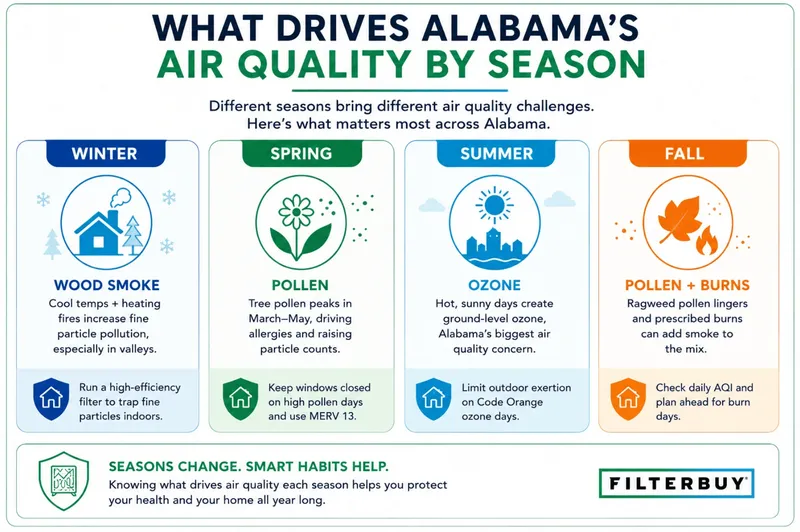
How to Tell What's Driving Today's Number
A high reading always has a cause, and the cause decides your move. Here's the quick diagnosis we use, no monitor required:
What Does Today's AQI Mean for the Air Inside Your Alabama Home?
Here's where we come at this differently from a weather app: Filterbuy is an Alabama company. Our founder rebuilt his family's Talladega machine shop into a filter business in 2012, set on making something in his own hometown, and we've built our filters here in Alabama ever since. After more than a decade and millions of households served, we've learned the one thing a weather app won't tell you: the AQI shows what's outside, but the filter in your HVAC decides what your family actually breathes.
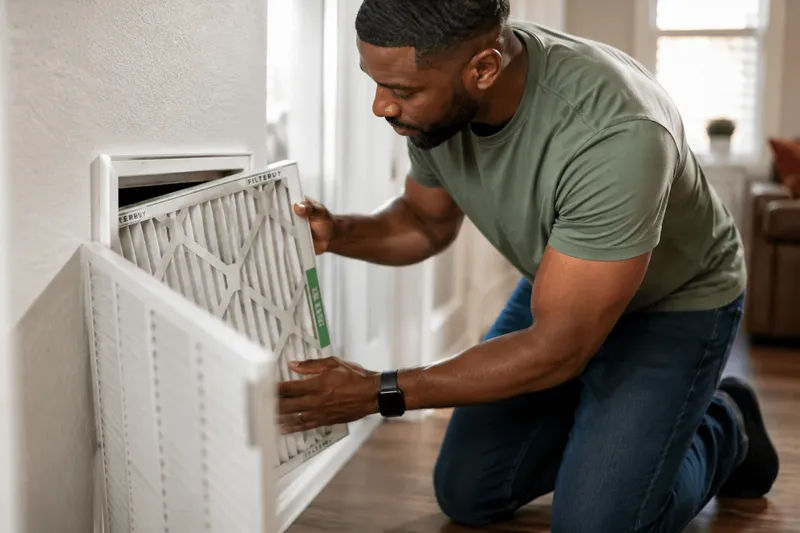
I don't want anyone to feel like they need an HVAC license just to pick the right filter. My job is to give you the straight answer, explain why it matters, and let you get back to your day.
Michelle Wan, Brand Manager & Air Quality Writer, Filterbuy
So a high outdoor number is really an indoor-air problem, and your filter is the first line of defense. Here's how we translate it into a simple indoor game plan:
Fine particles and smoke are small enough to ride your HVAC's airflow deep into the house. On normal days, a MERV 8 or MERV 11 filter handles dust and pollen; the EPA recommends a MERV 13 filter during wildfire smoke and high-particle days. Match the filter to the season, not just to when you remember.
Who Is Most at Risk When Alabama's AQI Is High?
Some people feel high AQI long before others. Children, older adults, pregnant people, and anyone with asthma, COPD, or heart disease are most sensitive to ozone and fine particles, and the first to notice how polluted air affects your health. For them, an Orange day (AQI 101–150) is already a reason to ease up outdoors; whether it's safe to exercise outside depends on the number and your own health. For everyone else, Red and above (151+) is the line to watch. Indoors, the move is the same: keep windows closed, keep air moving through a quality filter, and give sensitive family members the cleanest room in the house.
How Can You Protect Your Indoor Air in Alabama?
Protecting your indoor air in Alabama comes down to a short, repeatable routine. You don't need to overthink it, and you don't need to be home to make it happen:
Check the live map above before outdoor plans, or zoom out to the national live AQI map and your city's page (for example, Huntsville's live AQI) to compare nearby readings.
On any day above 100, close windows and set your HVAC fan to “on” so air keeps cycling through the filter.
Run a MERV 13 filter during ozone and smoke season to capture more fine PM2.5.
Change your filter on schedule. Filterbuy auto-delivery ships the right size to your door so you never run a clogged filter during a bad-air stretch.
On heavy-smoke days, add a portable HEPA unit in bedrooms to create one clean room.
The Numbers Behind the Advice
We're not guessing. The research backs this up:
90% of your day is spent breathing indoor air, often 2–5× dirtier than outside. Your HVAC filter is the fix. (EPA)
152.3 million Americans (44%) breathe failing-grade air. Jefferson County is one of them. (American Lung Association, 2026)
Cleaner PM2.5 could prevent ~4,500 early deaths and 800,000 asthma cases a year. That’s why filtering fine particles matters. (EPA, 2024 estimate)
Alabama Air Quality FAQs
Our 7 Go-To Sources for Alabama's Air
You don't need a dozen apps to stay ahead of Alabama's air. These are the seven the Filterbuy team actually checks. Grab the ones that fit your day, then let a good MERV 13 filter handle what sneaks inside.
Check the live number first. AirNow is the EPA’s official real-time AQI for your area, straight from government monitors.
Watch for smoke on the move. The AirNow Fire and Smoke Map layers live PM2.5 over satellite smoke plumes and fire spots, so you catch drifting haze early.
Get ahead of summer ozone. ADEM runs Alabama’s monitors and forecasts warm-season ozone. Check it before hot, still afternoons.
Know when Birmingham sounds the alarm. The Jefferson County Department of Health forecasts PM2.5 all year and flags any day the AQI is headed for 101 or higher.
See your county’s report card. The American Lung Association’s “State of the Air” grades Alabama counties on ozone and soot every year. Plain-English, no jargon.
Learn why summer turns hazy. Alabama Partners for Clean Air breaks down how heat and sun cook up ozone, and what helps on action days.
Protect your people when smoke rolls in. The CDC’s wildfire guide covers who’s most at risk and the exact steps to take before, during, and after.
About the Author & Reviewer
Michelle Wan is Brand Manager and Air Quality Writer at Filterbuy, where she turns the technical side of indoor air quality (MERV ratings, filtration, HVAC efficiency, and pressure drop) into plain-English advice for busy homeowners. She is the face of much of Filterbuy's educational content, appearing in the brand's social posts and YouTube videos, and earned her B.A. in Sociology from the University of California, Santa Cruz, in 2021.
David Clark, a licensed HVAC technician, reviewed this page for technical accuracy, checking the claims on HVAC systems, MERV ratings, airflow, and filter compatibility during high-AQI conditions.
Glossary
Air Quality Index (AQI): The U.S. EPA’s 0–500 scale that converts pollutant concentrations into one color-coded number; higher means more health risk.
PM2.5: Fine particle pollution 2.5 micrometers or smaller (from smoke, exhaust, and industry), small enough to reach deep into the lungs.
Ground-level ozone: A summer “smog” pollutant that forms when sunlight and heat react with vehicle and industrial emissions; Alabama’s main warm-season problem.
MERV: Minimum Efficiency Reporting Value, the 1–16 scale that rates how well an air filter captures particles; MERV 13 captures a large share of PM2.5.
NAAQS: National Ambient Air Quality Standards, the health-based EPA limits for six criteria pollutants, including ozone and PM2.5.
AirNow: The EPA-run system that aggregates official monitor data nationwide and powers real-time AQI maps like the one on this page.
ADEM: The Alabama Department of Environmental Management, the state agency that operates Alabama’s ozone and PM2.5 monitoring network.
Sensitive groups: People at higher risk from air pollution: children, older adults, pregnant people, and anyone with asthma, COPD, or heart disease.