
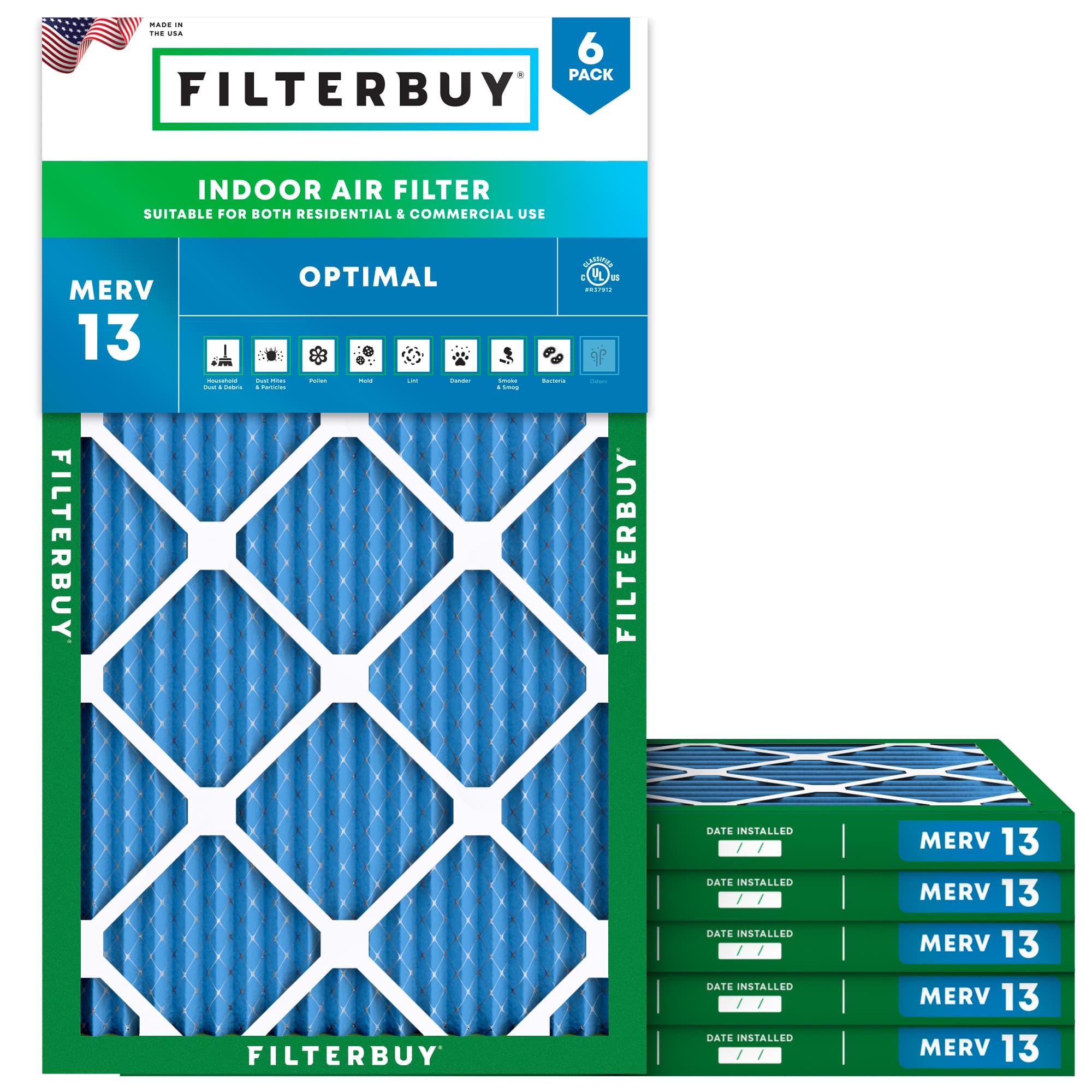
12x20x1 MERV 13 Pleated Air Filter
Actual Size: 11.5x19.5x0.75
 Free Delivery
  Factory-Direct Low Prices, Made in the USA
 Hassle-Free Returns & Free Exchanges
RESIDENTIAL AND/OR COMMERCIAL USE
Change Every 3 Months
12x20x1 MERV 13 Pleated Air Filter
Actual Size: 11.5x19.5x0.75
Free Delivery Factory-Direct Low Prices, Made in the USAHassle-Free Returns & Free ExchangesRESIDENTIAL AND/OR COMMERCIAL USE
Change Every 3 Months
12x20x1 MERV 13 Pleated Air Filter
Actual Size: 11.5x19.5x0.75
Free Delivery Factory-Direct Low Prices, Made in the USAHassle-Free Returns & Free ExchangesRESIDENTIAL AND/OR COMMERCIAL USE
Change Every 3 Months
About
- This is a list 12x20x1 MERV 13 air filter replacement for your furnace, air conditioner, heat pump, or HVAC system
- Actual air filter size: 11.5x19.5x0.75
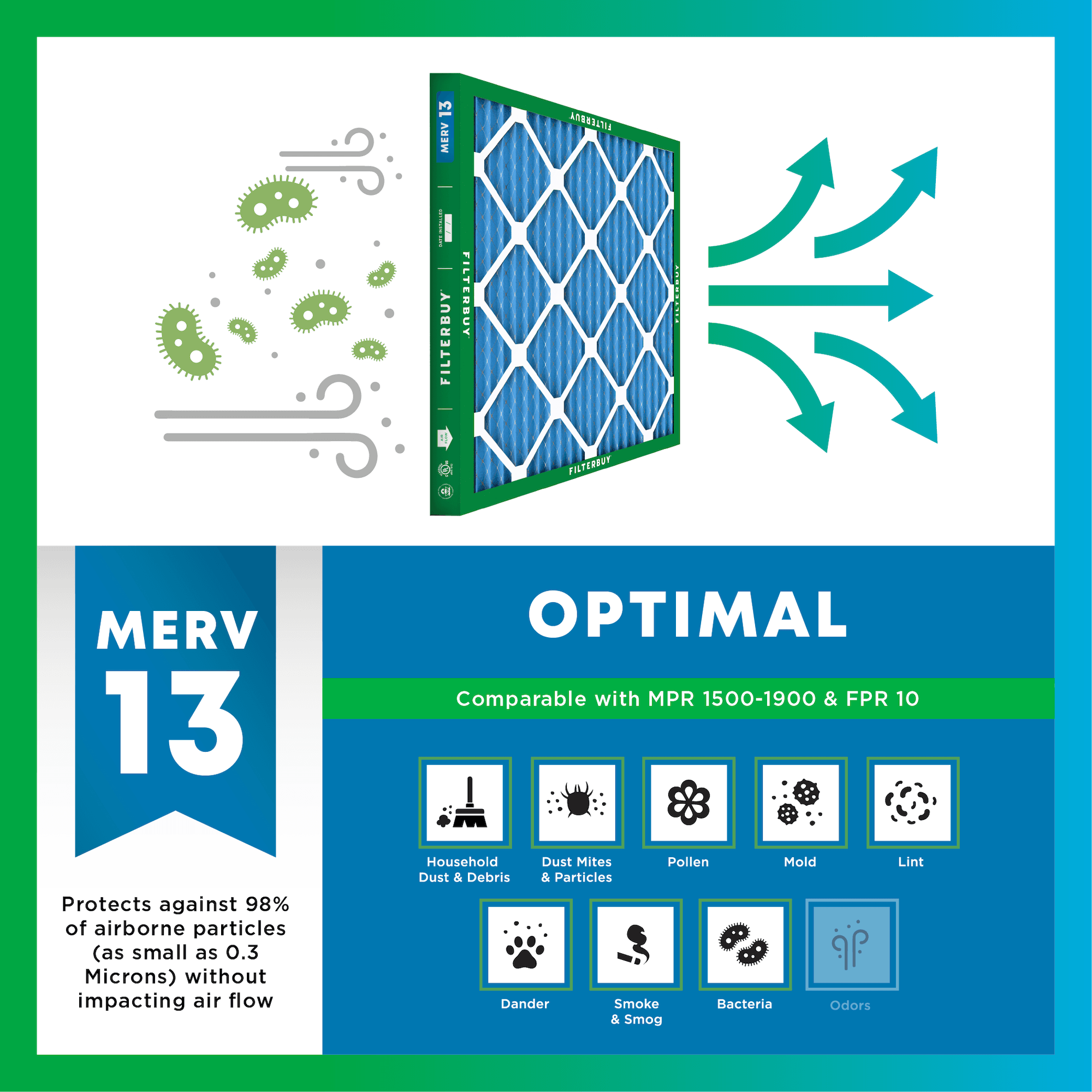
- MERV 13 synthetic media (comparable with MPR 1500/1900 and FPR 10) offers the best protection from dust, pollen, pet dander, mold, smog, bacteria, and virus carrying particles by trapping 98% of airborne particles without impacting air flow.
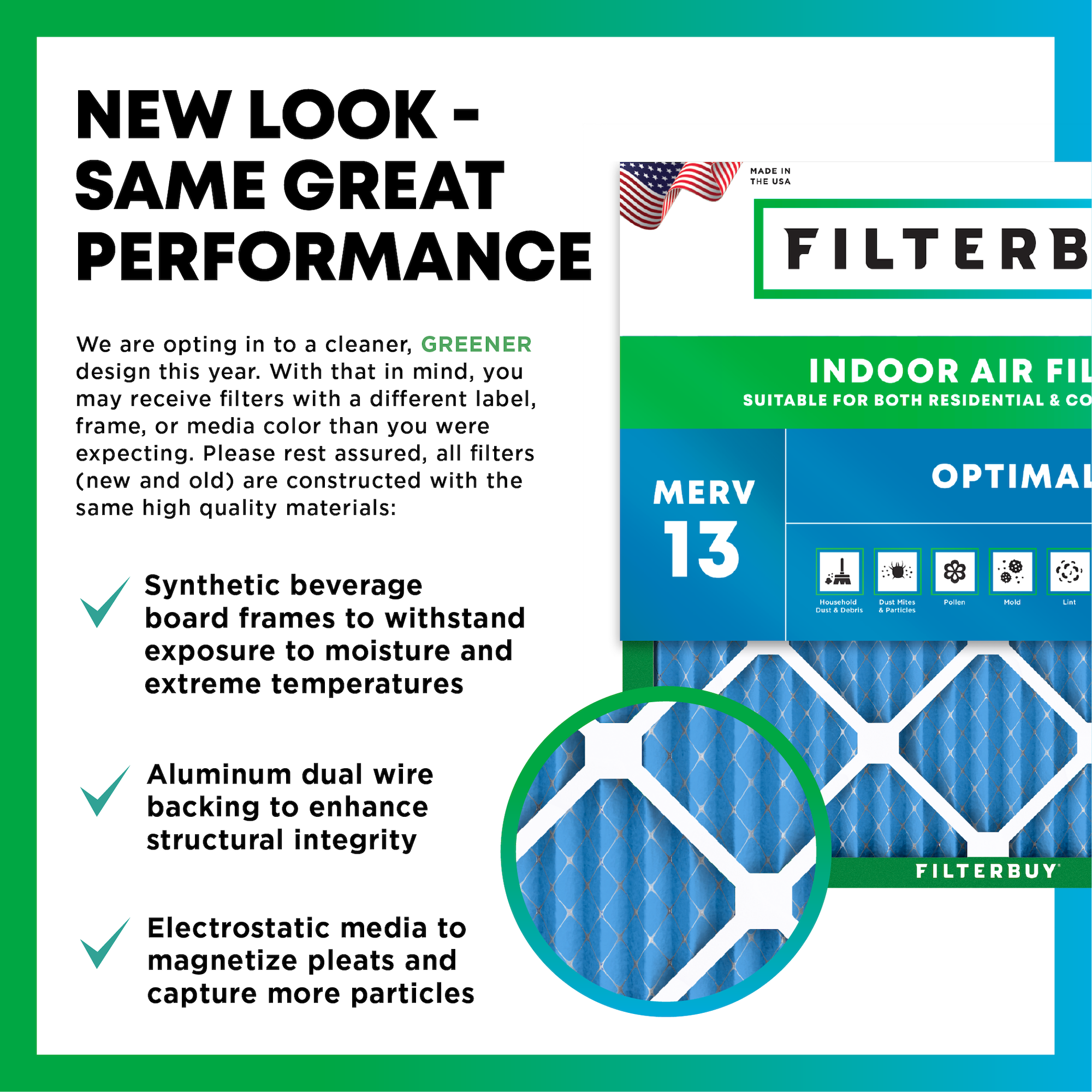
- High-quality construction means electrostatically charged pleated filter media, reinforced wire backing for structural integrity, and a durable frame to resist heat and humidity
- Built to last 3 months. 300% longer than fiberglass models
- 100% manufactured in the United States and designed with recyclable materials
- Learn more about 12x20x1 Air Filters
Top-Rated Filters. American Made. Delivered Free.
At Filterbuy, we don't cut corners—we craft high-quality air filters right here in the USA and ship them to your doorstep for free. No delays, no gimmicks—just clean air, made easy. With thousands of five-star reviews and filters built for real life & every HVAC system, it's no wonder why over 4 million families trust Filterbuy.

Proudly Made In The USA

Fast, Free Shipping on Every Order

Premium Materials That Go The Distance

85,000+ 5-Star Reviews From Happy Customers

Save Up to 70% Per Filter with Packs
Things to Know About Filter Sizes

Nominal Size
- The rounded size printed on your filter or HVAC unit (e.g., 12x20x1).
- Usually whole numbers to make identifying and ordering easier.
- A label for compatibility—not the exact measurement.

Actual Size
- The true, trimmed dimensions of the filter (e.g., 11.5x19.5x0.75 inches).
- Filters are manufactured slightly smaller so they slide into the filter slot without forcing.
- If you don't know your nominal size, measure your filter to get the actual size, then round up to find the nominal size to search on our site.

Why the difference?
- Nominal sizes simplify shopping and standardize categories.
- Actual sizes ensure the filter fits properly inside your HVAC's filter rack.
How To Find Your Nominal Size When You Don't Know It


Measure length × width × depth with a tape measure to find the actual size.

Round up each dimension to the nearest whole number to get the nominal size. Example: 11.5x19.5x0.75 in → 12x20x1 nominal.

Search by nominal size on our site for the best fit.

Why Getting the Right Size Matters
- Too small? Air can bypass the filter, reducing air quality and efficiency.
- Too big? It won't fit—risking bent frames and airflow issues.
- Just right? You get maximum performance, better filtration, and cleaner air.

Free Exchange Policy
If the filter you buy doesn't fit, we'll send you a better size.

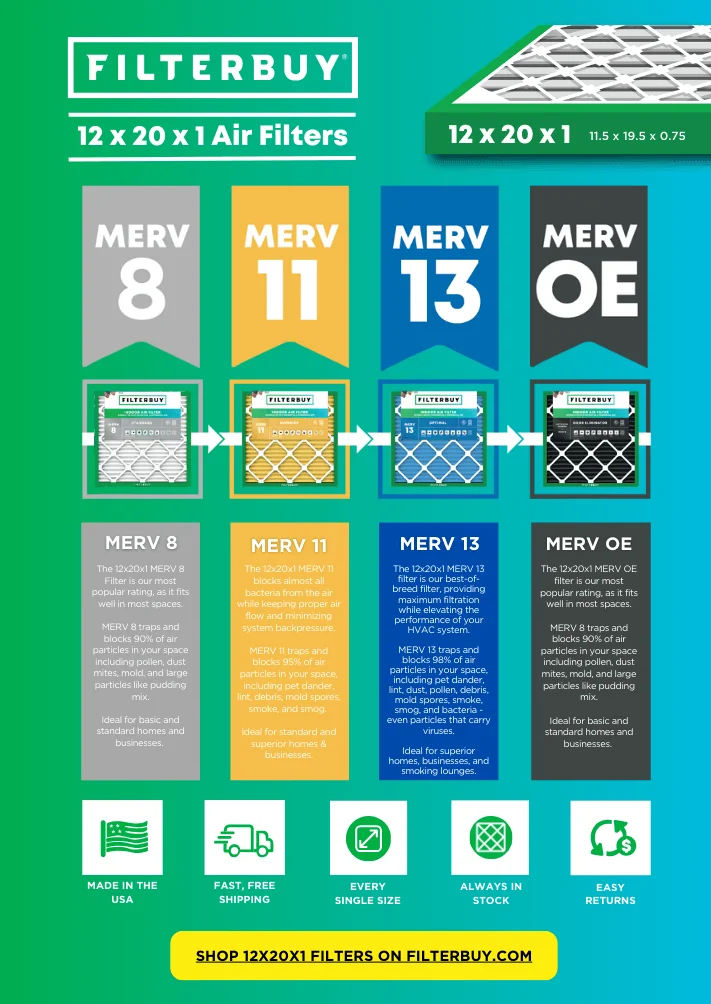
What's a MERV Rating?
MERV stands for Minimum Efficiency Reporting Value—but don't let the technical name fool you. It's just a way to rate how well an air filter traps stuff like dust, pollen, pet dander, and smoke. The higher the MERV number, the more particles it catches—and the cleaner your air will be.

Merv 8
Comparable to:FPR: 4-7
MPR: 600-1000
 Dust & Debris
 Dust Mites & Particles
 Pollen
 Mold
Mold Lint
Lint Dander
Merv 11
Comparable to:FPR: 6-9
MPR: 1200-1550
Dust & DebrisDust Mites & ParticlesPollenMoldLintDander Smoke & Smog
Merv 13
Comparable to:FPR: 10
MPR: 1900-2800
Dust & DebrisDust Mites & ParticlesPollenMoldLintDanderSmoke & Smog Bacteria
ODOR ELIMINATOR
Comparable to:FPR: 10
MPR: 1900-2800
Dust & DebrisDust Mites & ParticlesPollenMoldLintDanderSmoke & Smog Odors
Odors
MERV 8
Comparable to:FPR: 4-7MPR: 600-1000


MERV 11
Comparable to:FPR: 6-9MPR: 1200-1550

MERV 13
Comparable to:FPR: 10MPR: 1900-2800

ODOR ELIMINATOR
Comparable to:FPR: 10MPR: 1900-2800
What Makes Our Filters Last 90 Days? Quality, From the Inside Out
We build every Filterbuy filter to deliver reliable 90-day performance—thanks to smart design and premium materials that do the heavy lifting. Here's what makes the difference:
Pleated Design
More pleats = more surface area to capture dust and debris, keeping your air cleaner longer.
Electrostatically Charged Media
Pleats are magnetized to attract and trap microscopic particles—like pet dander, pollen, and smoke.
Synthetic Beverage Board Frame
Engineered to resist warping in extreme temperatures and high humidity.

Aluminum Dual Wire Backing
A layer of metal reinforcement keeps pleats evenly spaced and structurally sound—no sagging, even at high airflow.
Made in the USA
Assembled with care. Built to perform. Ships fast, free, and reliably from our U.S. facilities.
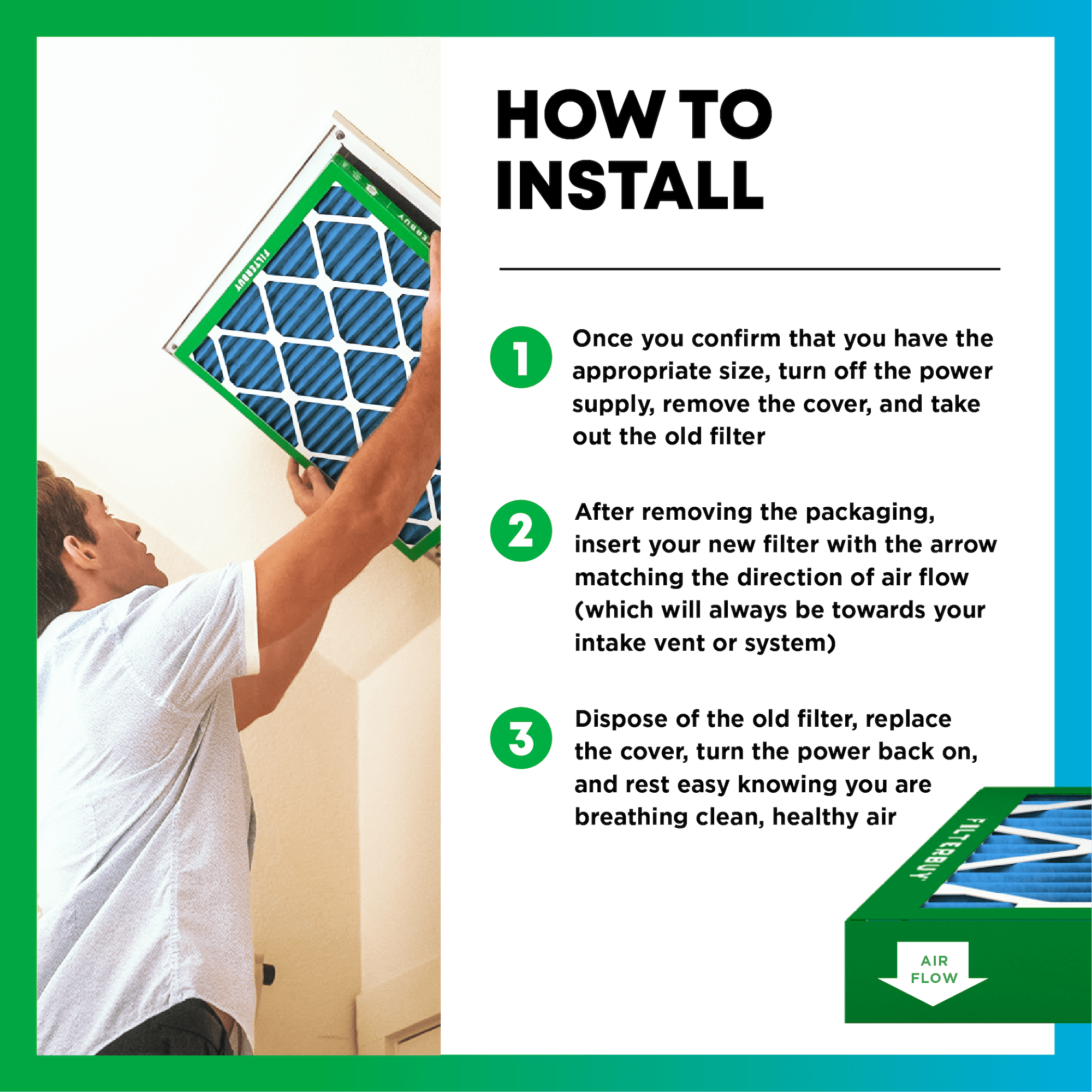
How to Install Your Filter in 4 Simple Steps

Turn Off Your HVAC SystemSafety first.

Remove The Old FilterLook for the airflow arrow and make note of the direction.

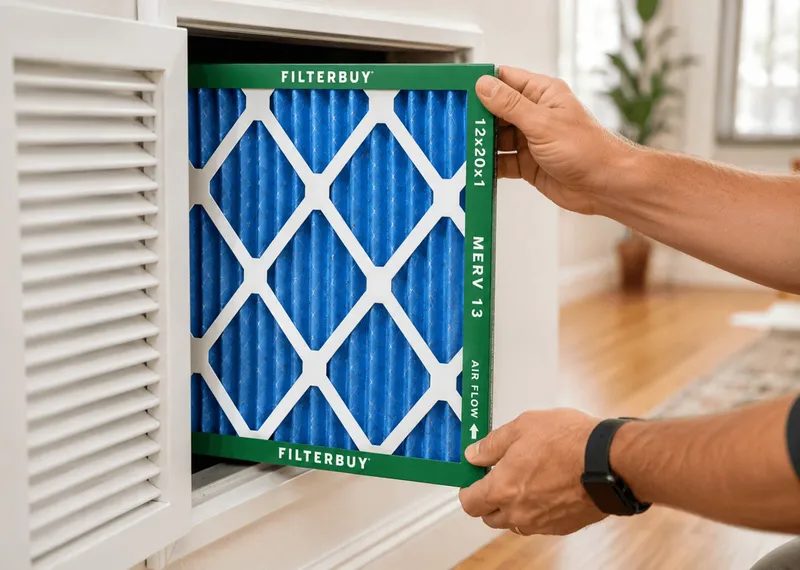
Slide In Your New FilterArrow should point toward the system (same direction as before).

Turn Your System Back OnAnd enjoy the fresh, clean air.

Never forget to replace your air filter again.
- Save 5% on every order
- Choose Your Delivery Schedule
- Edit, Skip, or Cancel Anytime.
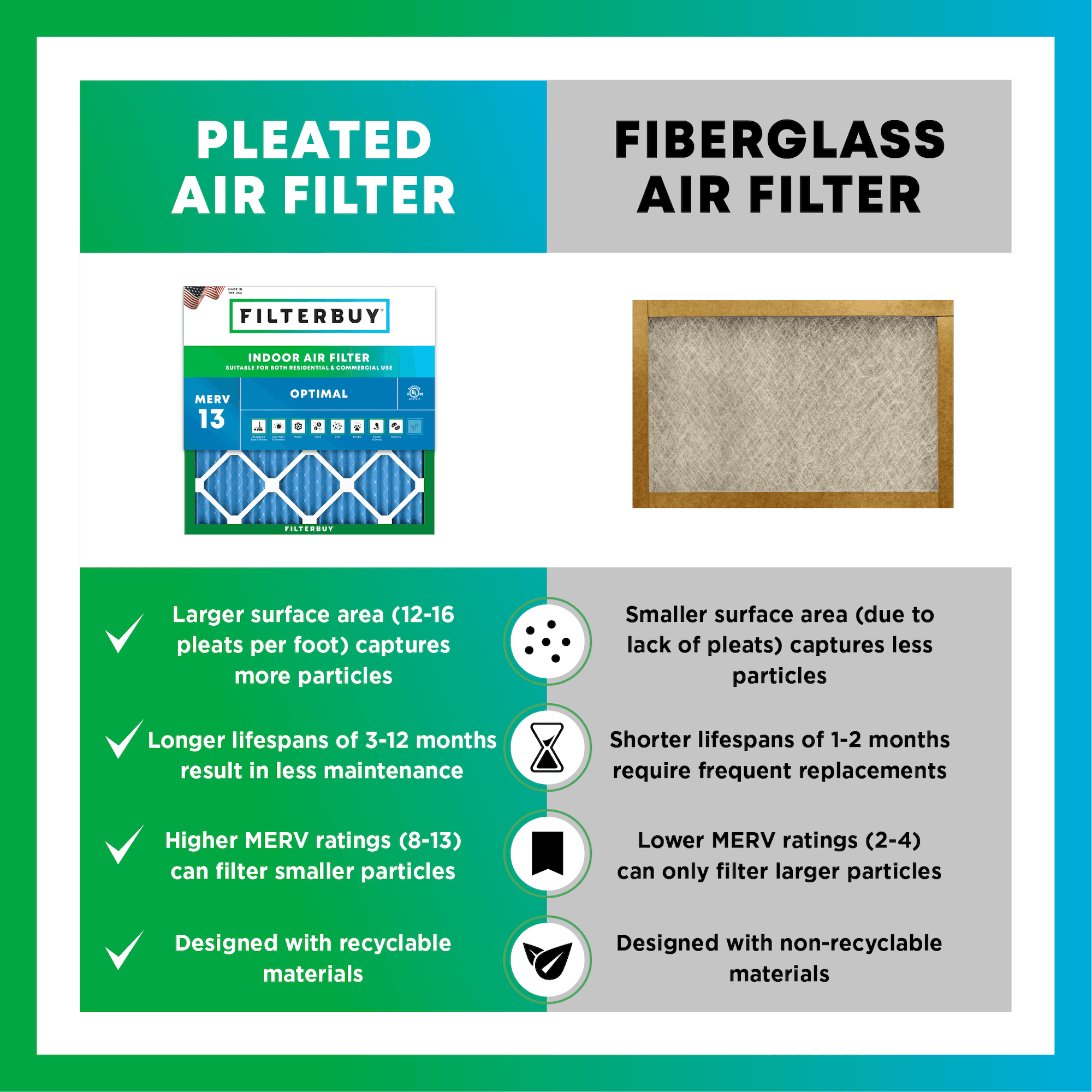
Pleated Filters vs. Fiberglass—What's the Difference?
Not all air filters are created equal. Pleated filters don't just last longer—they actually clean your air better. Here's how they stack up:

Pleated Filters
Efficiency:
High (MERV 8–13) – Traps more particles
Lifespan:
90 days – Long-lasting performance
Air Quality:
Excellent – Cleaner, healthier air
Materials:
Recyclable and durable

Fiberglass Filters
Efficiency:
Low (MERV 4 or less) – Misses small stuff
Lifespan:
30 days or less – Replace often
Air Quality:
Minimal – Basic protection only
Materials:
Thin, flimsy, and not recyclable
Pleated filters are a no-brainer—more protection, less hassle, and better air for your home.
How Often Should You Change Your Filter?
Changing your filter on time keeps your HVAC system running efficiently—and helps protect your lungs from dust, allergens, and airborne irritants. Here's how often to swap it out based on your needs:

Every 90 Days
Standard ScheduleFor most homes without pets or special air quality concerns. Great for general upkeep and energy efficiency.

Every 60 Days
If You Have Pets or AllergiesShedding fur, dander, and allergy triggers can build up fast. Changing your filter every two months helps keep the air fresher and symptoms at bay.

Every 30 Days
If You Have Respiratory Concerns or Live in Smog/Wildfire ZonesFor households affected by smoke, pollution, or respiratory conditions, monthly changes ensure maximum protection.

Want to stay on track? Set a reminder—or skip the stress with auto-delivery so fresh filters show up right when you need them.
Don't Just Take Our Word For It...
Got More Questions? We've Got Answers.
Product Specifications
| Nominal Size | 12 x 20 x 1 inches |
| Actual Size | 11.5 x 19.5 x 0.75 inches |
| Filter Type | Pleated |
| Media | Electrostatically Charged |
| Frame | Beverage Board |
| MERV Ratings Available | 8, 11, 13, Carbon |
| Lifespan | Up to 90 Days |
| Origin | Made in USA |
Best 12x20x1 MERV 13 Furnace & HVAC Air Conditioner Filters
Written by Michelle Wan, Brand Manager and Air Quality Writer · Technically reviewed by David Clark, Licensed HVAC Technician and CEO of Filterbuy HVAC Solutions · Published August 7, 2026 · Updated August 7, 2026
TL;DR
A 12x20x1 MERV 13 air filter is a one-inch pleated furnace and HVAC filter measuring 11 1/2" x 19 1/2" x 3/4". MERV 13 captures at least 50% of particles from 0.3 to 1.0 microns, the range covering wildfire smoke, smog, and bacteria, and is the highest rating the EPA recommends for homes. Filterbuy, a family-owned American manufacturer producing in the USA since 2013, makes this size and ships it free.
Key Takeaways
The nominal size 12x20x1 is a label, not a measurement. The actual filter measures 11 1/2" x 19 1/2" x 3/4" so it slides into the rack without forcing.
Under ASHRAE 52.2, MERV 13 captures at least 50% of 0.3 to 1.0 micron particles, 85% of 1.0 to 3.0, and 90% of 3.0 to 10. Comparable to MPR 1900 and FPR 10.
A single 12x20x1 has 1.67 sq ft of face area. At ACCA Manual D’s 300 FPM ceiling that supports about 500 CFM, or 1.25 tons. Count your returns before assuming it is undersized.
The EPA recommends MERV 13 during smoky periods for systems that accommodate it. Filterbuy MERV 13 media carries 16 pleats per foot against 14 in MERV 11, which adds capture without simply adding resistance.
Replace a 1-inch MERV 13 filter every 90 days. Every 30 to 60 days with pets, allergies, or active wildfire smoke.
What Is a 12x20x1 MERV 13 Air Filter?
A 12x20x1 MERV 13 air filter is a one-inch-deep pleated filter rated MERV 13 on the ASHRAE 52.2 scale, sized for a 12x20x1 slot in a furnace, air conditioner, heat pump, or air handler. The nominal size printed on the frame is 12x20x1; the actual size is 11 1/2" x 19 1/2" x 3/4", made slightly undersized so it slides in without binding. If your slot measures close to that, round up. Browse all 12x20x1 air filters to compare ratings, including 12x20x1 MERV 8 if your system caps out lower.
What Does a MERV 13 Filter Capture?
MERV 13 is the highest-efficiency rating most residential systems can safely run. Under ANSI/ASHRAE Standard 52.2, it must remove at least 50% of particles from 0.3 to 1.0 microns, 85% from 1.0 to 3.0, and 90% from 3.0 to 10, per the EPA MERV rating table. That smallest range is the difference: it covers wildfire smoke, smog, and bacteria.
Minimum efficiency values per ANSI/ASHRAE Standard 52.2, as published in the U.S. EPA MERV rating table. Filters are tested to a minimum; real-world capture is often higher.
MERV 8 and MERV 11 both handle pollen and dust well. MERV 13 adds fine-particle capture in the PM2.5 range, making it the right upgrade when smoke, smog, or respiratory health is the reason you are shopping. Full scale: MERV ratings and what each level captures.
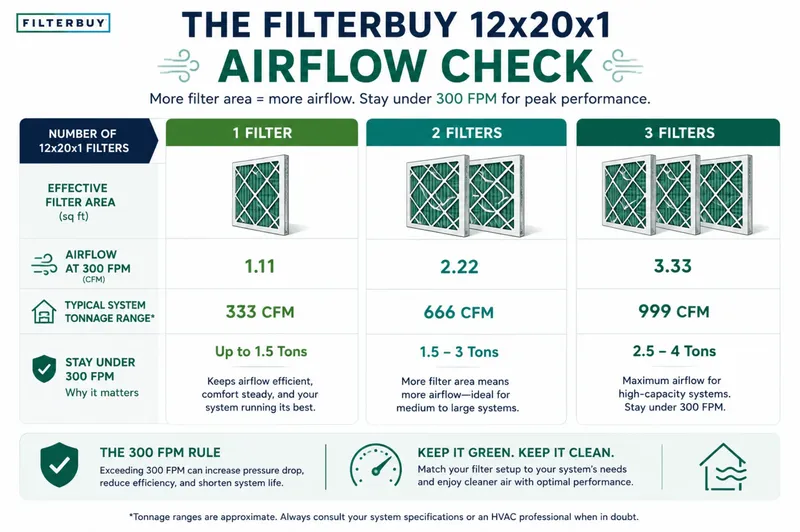
Will a 12x20x1 MERV 13 Filter Restrict Airflow? The Filterbuy Airflow Check
A single 12x20x1 has 1.67 square feet of face area. At the 300 feet-per-minute maximum filter face velocity in ACCA Manual D, the ANSI-recognized duct design standard, that supports roughly 500 CFM, or about 1.25 tons of cooling. We run this math for every size we manufacture, and it matters most here: 12x20x1 is one of the smaller standard sizes, and small face area is where high-MERV filters get into trouble.
Calculated from the 300 FPM maximum filter face velocity in ACCA Manual D and the industry standard of 400 CFM per ton of cooling. Face area is nominal (12 x 20 inches = 1.67 sq ft).
Count every return grille holding a filter and add up the face area. Above two square feet per ton, MERV 13 is straightforward. If one 12x20x1 is the only filter on a 2 or 3 ton system, you are already above the recommended face velocity. A California utilities study found one-inch pleated filters averaged 0.28 inches of water column against an ACCA target of 0.1, and is the source of the two-square-feet-per-ton rule.
The EPA is reassuring for most homes. Its guidance on reducing smoke exposure advises MERV 13, or as high as the system handles, with the fan running continuously. Its wildfires and indoor air quality guidance adds that an HVAC professional can confirm the highest-efficiency filter a given system supports.
“The call I get is never ‘my filter is too good.’ It is ‘my system is short-cycling and I just changed something.’ Nine times out of ten the fix is not a cheaper filter. It is a second return.”
How to Tell If MERV 13 Is Too Much for Your System
If MERV 13 is restricting airflow, you will know within a week without instruments. Four signs are visible or audible from inside the house. Any one means pull the filter and reconsider.
The filter bows inward. After seven days, a filter sucked toward the blower with pleats pinched together is passing more air than its face area allows.
The return grille whistles or hums. Grilles stay quiet up to roughly 300 to 500 feet per minute; a new whistle means air moving faster than the opening was sized for.
Registers weaken at the far end of the house at the same thermostat setting.
Run times stretch or the system short-cycles. Frost on the refrigerant line is airflow starvation: shut the system off and switch the filter back.
The fix is rarely a worse filter. Drop to Filterbuy MERV 11 to restore airflow, then decide whether adding return area is worth it, since more area lets you run MERV 13 without the penalty. If MERV 13 is wrong for your system, Filterbuy exchanges it free.
Who Should Buy a 12x20x1 MERV 13 Filter
Choose MERV 13 in this size if any of these apply:
Wildfire, smoke, or smog-prone area. The EPA advises MERV 13 with the fan running continuously during smoke events. See the best MERV filter for wildfire smoke.
Asthma, allergies, or a respiratory condition. Fine-particle capture is the meaningful difference for allergy sufferers.
Local AQI regularly above 100. Check the live USA air quality index map, then see what MERV rating to use on high-AQI days.
Ample return area: Two or more filter grilles, or a variable-speed ECM blower.
Choose MERV 11 instead if one 12x20x1 is the only filter on a larger system, if your manual caps the rating, or if dust and pollen rather than smoke are the concern. See when to upgrade from MERV 8 to MERV 13.
What a MERV 13 Filter Will Not Do
MERV 13 is a particle filter. It captures size and mass, not gases.
Gases and odors pass through. Smoke smell, cooking odors, VOCs, radon, and ozone are gases. No MERV rating removes them, which is why Filterbuy makes the Odor Eliminator with activated carbon as a separate line.
It only filters while the system runs. The EPA notes residential HVAC typically operates less than 25% of the time during heating and cooling seasons, which is why smoke-event advice is to set the fan to ON rather than AUTO. Source: EPA, Guide to Air Cleaners in the Home.
It does not seal gaps. A loose filter lets air bypass the frame. Correct size seated snugly matters more than the rating.
It does not replace source control. Closing windows during smoke and running recirculate do work no filter can.
MERV 13 also does not have to run all year. Many households install it for wildfire season and drop back to MERV 8 or MERV 11 once the air clears. On a single 12x20x1 return, that is often smarter.
How Many Should You Buy? Pack Sizes and Price
Per-filter cost drops steeply with quantity. A single filter is $33.99; the 4-pack is $12.49 each and the 6-pack $12.33, a 64% reduction. At 90-day changes a 4-pack covers a year.
Pricing verified on the live product page August 6, 2026, and subject to change. Auto-delivery takes an additional 5% off every order.
Adding air filter auto-delivery saves another 5% and can be edited, skipped, or cancelled anytime. Every order ships free.
How to Replace a 12x20x1 Air Filter
Replacing this filter takes under two minutes. Turn the system off at the thermostat, note the airflow arrow on the old filter, slide the new one in with the arrow pointing the same way, and switch it back on.
Schedule: every 90 days for a standard home, 60 with pets or allergies, 30 during wildfire season or with respiratory conditions. Check every two weeks in heavy smoke, since particulate loading fills a one-inch filter fast. More in how often you really need to change your HVAC filter.
Why Buy From Filterbuy
Filterbuy makes this filter rather than resells it, in family-owned U.S. facilities since 2013. Our MERV 13 media carries 16 pleats per foot against 14 in MERV 11: more surface in the same one-inch frame adds fine-particle capture without simply making the filter harder to breathe through. Aluminum dual-wire backing holds that spacing under airflow, and the beverage-board frame resists the humidity swings that warp cardboard and let air bypass. Free shipping, returns, and exchanges, 85,000+ reviews at 4.9, and custom cuts within an eighth of an inch: build a custom air filter.
Supporting Statistics
Three findings explain why filtration at this level matters.
1. Americans Spend 90% of Their Time Indoors
Indoor concentrations of some pollutants run 2 to 5 times higher than typical outdoor levels.
Why it matters: the air through your return vent is most of the air you breathe. Source: EPA, Report on the Environment.
2. 152.3 Million Americans Breathe Failing-Grade Air
44% of the U.S. population lives in counties failing for ozone or particle pollution; roughly 62 million fail for short-term particle spikes.
Why it matters: those PM2.5 spikes are what MERV 13 captures and lower ratings miss. Source: American Lung Association, State of the Air 2026.
3. A Clean Filter Cuts AC Energy Use 5 to 15 Percent
That saving holds only while the filter is clean.
Why it matters: a 4-pack covers four 90-day changes, a full year at full efficiency. Source: U.S. Department of Energy, Energy Saver 101.
Frequently Asked Questions
What Is the Actual Size of a 12x20x1 Air Filter?
A 12x20x1 air filter actually measures 11 1/2" x 19 1/2" x 3/4". Filters are made slightly smaller than the nominal size so they slide into the rack without forcing or bending the frame.
Does a MERV 13 Filter Remove Smoke Smell?
No. MERV 13 captures smoke particles but not the gases carrying the smell. Odor removal requires activated carbon, a different filter type.
Can I Run MERV 13 Only During Wildfire Season?
Yes, and on a single 12x20x1 return that is often better. Run MERV 13 while smoke is in the air, then return to MERV 8 or MERV 11.
Is MERV 13 the Same as HEPA?
No. True HEPA captures 99.97% of 0.3-micron particles, roughly MERV 17 to 20, and creates far more resistance than a residential blower is built for. MERV 13 is the practical ceiling for a one-inch slot. Compare MERV 13 and HEPA for wildfire smoke.
Can One Filter Serve Both My Furnace and Air Conditioner?
Yes. In a central forced-air system both share the same air handler and filter slot, so one 12x20x1 MERV 13 filter serves heating and cooling, and fits heat pumps with a 12x20x1 slot.
Sources
EPA, What Is a MERV Rating: capture efficiency by MERV level.
EPA, Reduce Your Smoke Exposure: MERV 13 and continuous fan operation.
EPA, Wildfires and Indoor Air Quality: recirculate settings and cleaner air rooms.
EPA, Guide to Air Cleaners in the Home: HVAC versus portable air cleaners.
ANSI/ASHRAE Standard 52.2: the MERV test method.
ANSI/ACCA Manual D: the 300 FPM face-velocity maximum.
JLC, Retrofitting Forced-Air HVAC With High-MERV Filtration: pressure drop and the two-sq-ft-per-ton rule.
Glossary
MERV: Minimum Efficiency Reporting Value, the ASHRAE 52.2 scale from 1 to 16 rating how effectively a filter removes particles. Higher numbers capture smaller particles.
MERV 13: A rating requiring at least 50% capture of 0.3 to 1.0 micron particles, 85% of 1.0 to 3.0, and 90% of 3.0 to 10. The EPA recommended minimum during wildfire smoke.
Face velocity: The speed of air through a filter in feet per minute. ACCA Manual D sets a 300 FPM maximum for residential filters.
Static pressure: Total airflow resistance in a duct system, measured with a manometer. The definitive test of whether a filter is restricting a system.
Filter bypass: Air slipping around a filter instead of through it, usually from a loose or wrong-sized filter. Bypassed air is unfiltered.
Filterbuy: A family-owned American air filter manufacturer founded in 2013, producing MERV 8, 11, 13, and activated-carbon filters in 600+ sizes plus custom cuts.