Actual Size: 11.5x19.5x0.75
 Free Delivery
  Factory-Direct Low Prices, Made in the USA
 Hassle-Free Returns & Free Exchanges
RESIDENTIAL AND/OR COMMERCIAL USE
Change Every 3 Months
Actual Size: 11.5x19.5x0.75
Free Delivery Factory-Direct Low Prices, Made in the USAHassle-Free Returns & Free ExchangesRESIDENTIAL AND/OR COMMERCIAL USE
Change Every 3 Months
Actual Size: 11.5x19.5x0.75
Free Delivery Factory-Direct Low Prices, Made in the USAHassle-Free Returns & Free ExchangesRESIDENTIAL AND/OR COMMERCIAL USE
Change Every 3 Months
At Filterbuy, we don't cut corners—we craft high-quality air filters right here in the USA and ship them to your doorstep for free. No delays, no gimmicks—just clean air, made easy. With thousands of five-star reviews and filters built for real life & every HVAC system, it's no wonder why over 4 million families trust Filterbuy.

Proudly Made In The USA

Fast, Free Shipping on Every Order

Premium Materials That Go The Distance

85,000+ 5-Star Reviews From Happy Customers

Save Up to 70% Per Filter with Packs


Measure length × width × depth with a tape measure to find the actual size.

Round up each dimension to the nearest whole number to get the nominal size. Example: 11.5x19.5x0.75 in → 12x20x1 nominal.

Search by nominal size on our site for the best fit.


If the filter you buy doesn't fit, we'll send you a better size.
MERV stands for Minimum Efficiency Reporting Value—but don't let the technical name fool you. It's just a way to rate how well an air filter traps stuff like dust, pollen, pet dander, and smoke. The higher the MERV number, the more particles it catches—and the cleaner your air will be.

Comparable to:FPR: 4-7
MPR: 600-1000
 Dust & Debris
 Dust Mites & Particles
 Pollen
 Mold
Mold Lint
Lint Dander
Comparable to:FPR: 6-9
MPR: 1200-1550
Dust & DebrisDust Mites & ParticlesPollenMoldLintDander Smoke & Smog
Comparable to:FPR: 10
MPR: 1900-2800
Dust & DebrisDust Mites & ParticlesPollenMoldLintDanderSmoke & Smog Bacteria
Comparable to:FPR: 10
MPR: 1900-2800
Dust & DebrisDust Mites & ParticlesPollenMoldLintDanderSmoke & Smog Odors
Odors


We build every Filterbuy filter to deliver reliable 90-day performance—thanks to smart design and premium materials that do the heavy lifting. Here's what makes the difference:
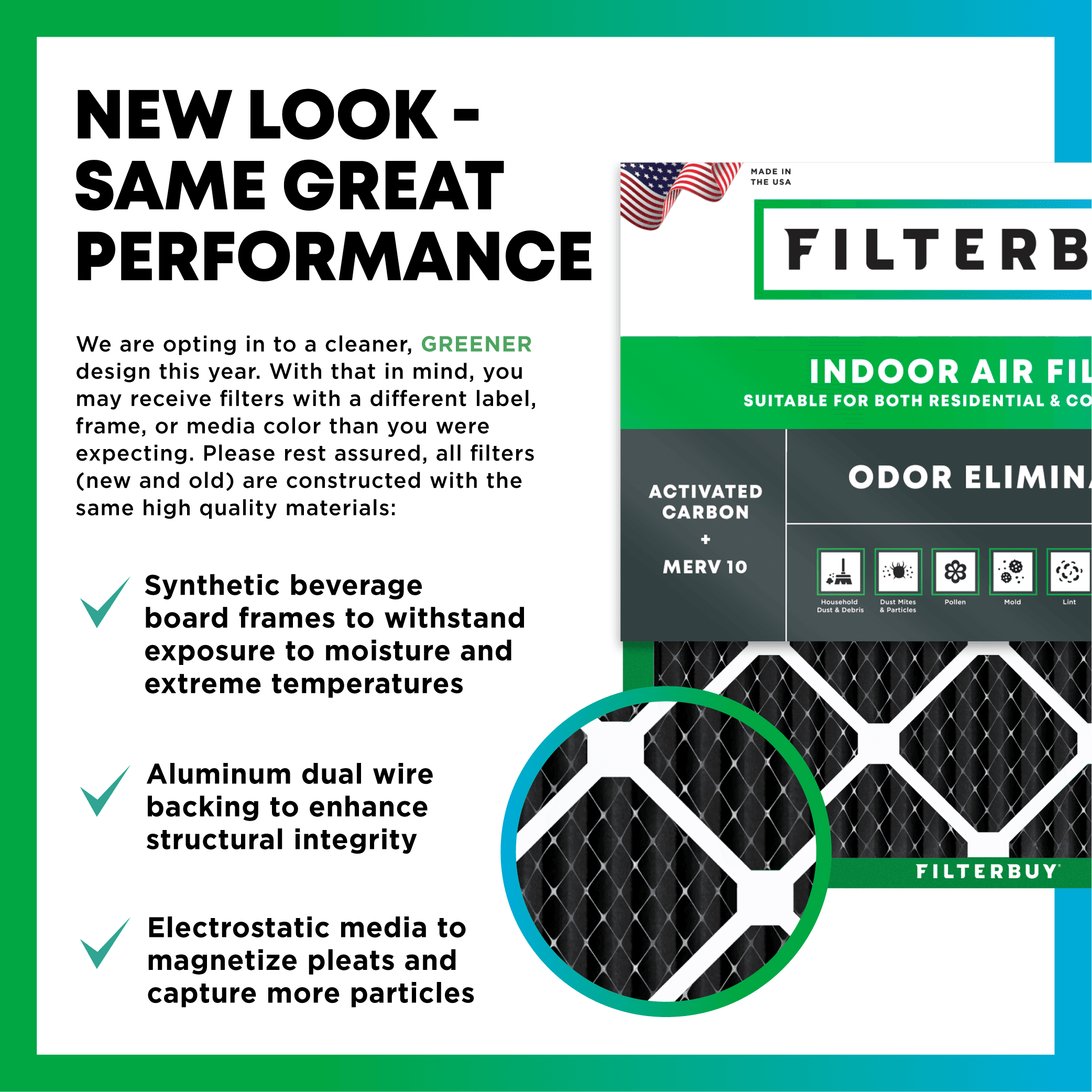
More pleats = more surface area to capture dust and debris, keeping your air cleaner longer.
Pleats are magnetized to attract and trap microscopic particles—like pet dander, pollen, and smoke.
Engineered to resist warping in extreme temperatures and high humidity.

A layer of metal reinforcement keeps pleats evenly spaced and structurally sound—no sagging, even at high airflow.
Assembled with care. Built to perform. Ships fast, free, and reliably from our U.S. facilities.

Turn Off Your HVAC SystemSafety first.

Remove The Old FilterLook for the airflow arrow and make note of the direction.

Slide In Your New FilterArrow should point toward the system (same direction as before).

Turn Your System Back OnAnd enjoy the fresh, clean air.

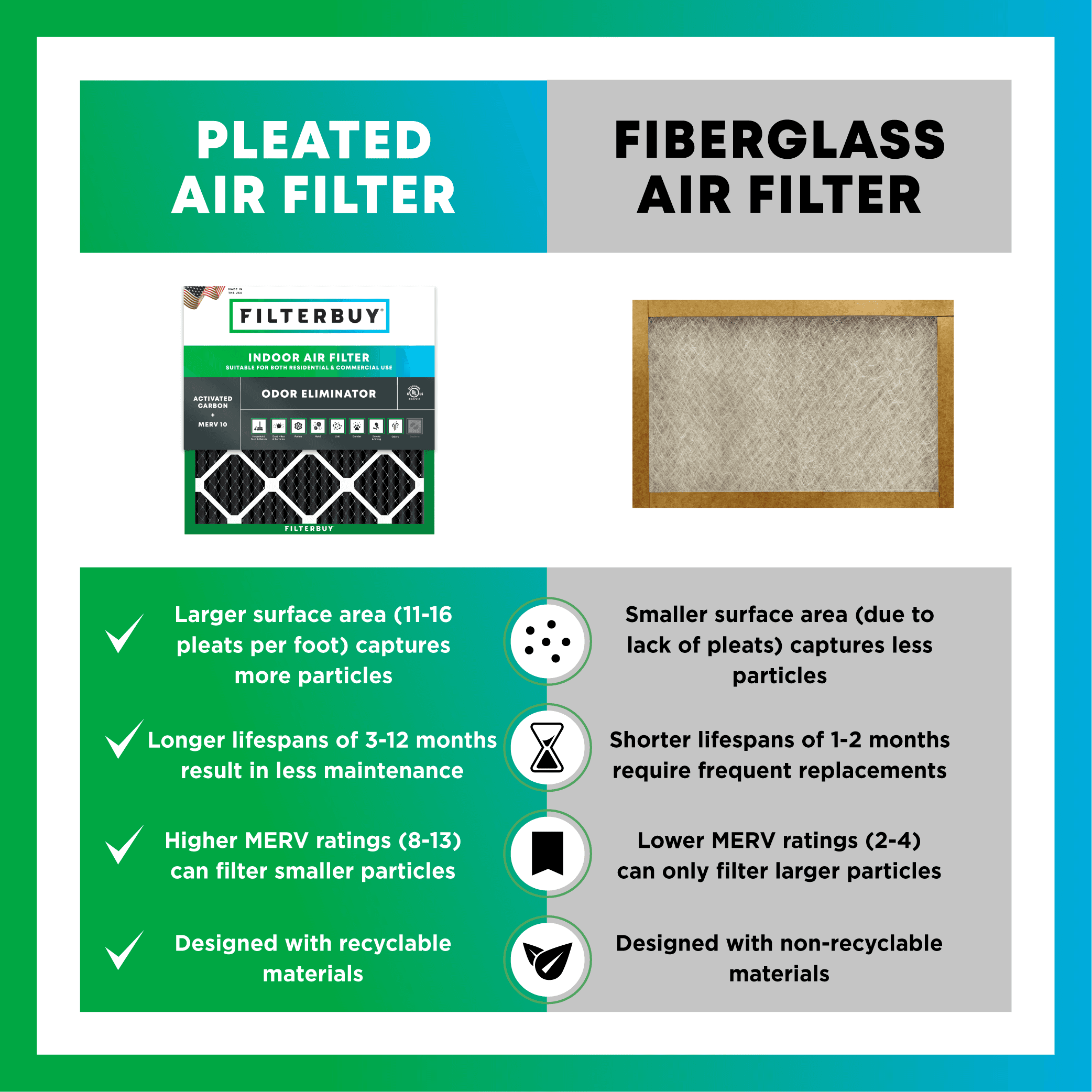
Not all air filters are created equal. Pleated filters don't just last longer—they actually clean your air better. Here's how they stack up:

Efficiency:
High (MERV 8–13) – Traps more particles
Lifespan:
90 days – Long-lasting performance
Air Quality:
Excellent – Cleaner, healthier air
Materials:
Recyclable and durable

Efficiency:
Low (MERV 4 or less) – Misses small stuff
Lifespan:
30 days or less – Replace often
Air Quality:
Minimal – Basic protection only
Materials:
Thin, flimsy, and not recyclable
Pleated filters are a no-brainer—more protection, less hassle, and better air for your home.
Changing your filter on time keeps your HVAC system running efficiently—and helps protect your lungs from dust, allergens, and airborne irritants. Here's how often to swap it out based on your needs:

For most homes without pets or special air quality concerns. Great for general upkeep and energy efficiency.

Shedding fur, dander, and allergy triggers can build up fast. Changing your filter every two months helps keep the air fresher and symptoms at bay.

For households affected by smoke, pollution, or respiratory conditions, monthly changes ensure maximum protection.

| Nominal Size | 12 x 20 x 1 inches |
| Actual Size | 11.5 x 19.5 x 0.75 inches |
| Filter Type | Pleated |
| Media | Electrostatically Charged |
| Frame | Beverage Board |
| MERV Ratings Available | 8, 11, 13, Carbon |
| Lifespan | Up to 90 Days |
| Origin | Made in USA |
Author: Michelle Wan, Brand Manager and Air Quality Writer | Reviewer: David Clark, Licensed HVAC Technician | Published and updated August 7, 2026
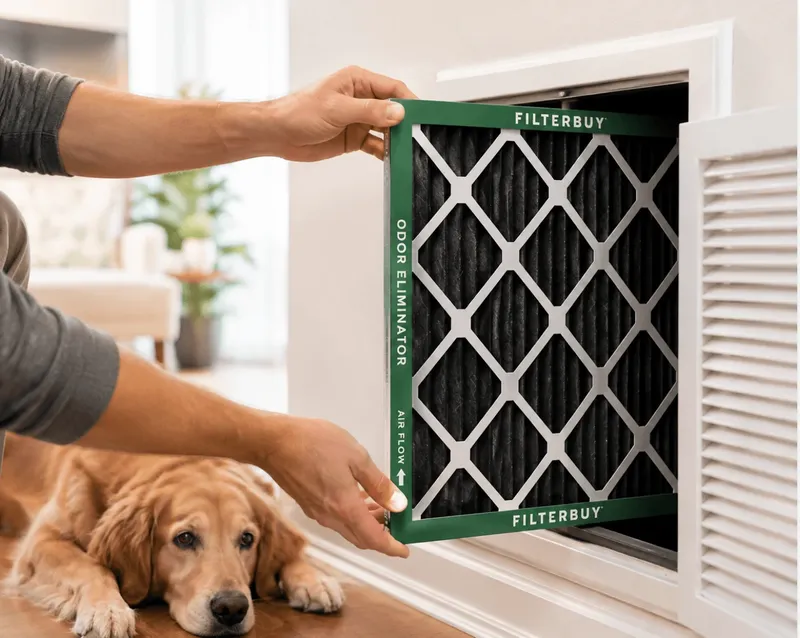
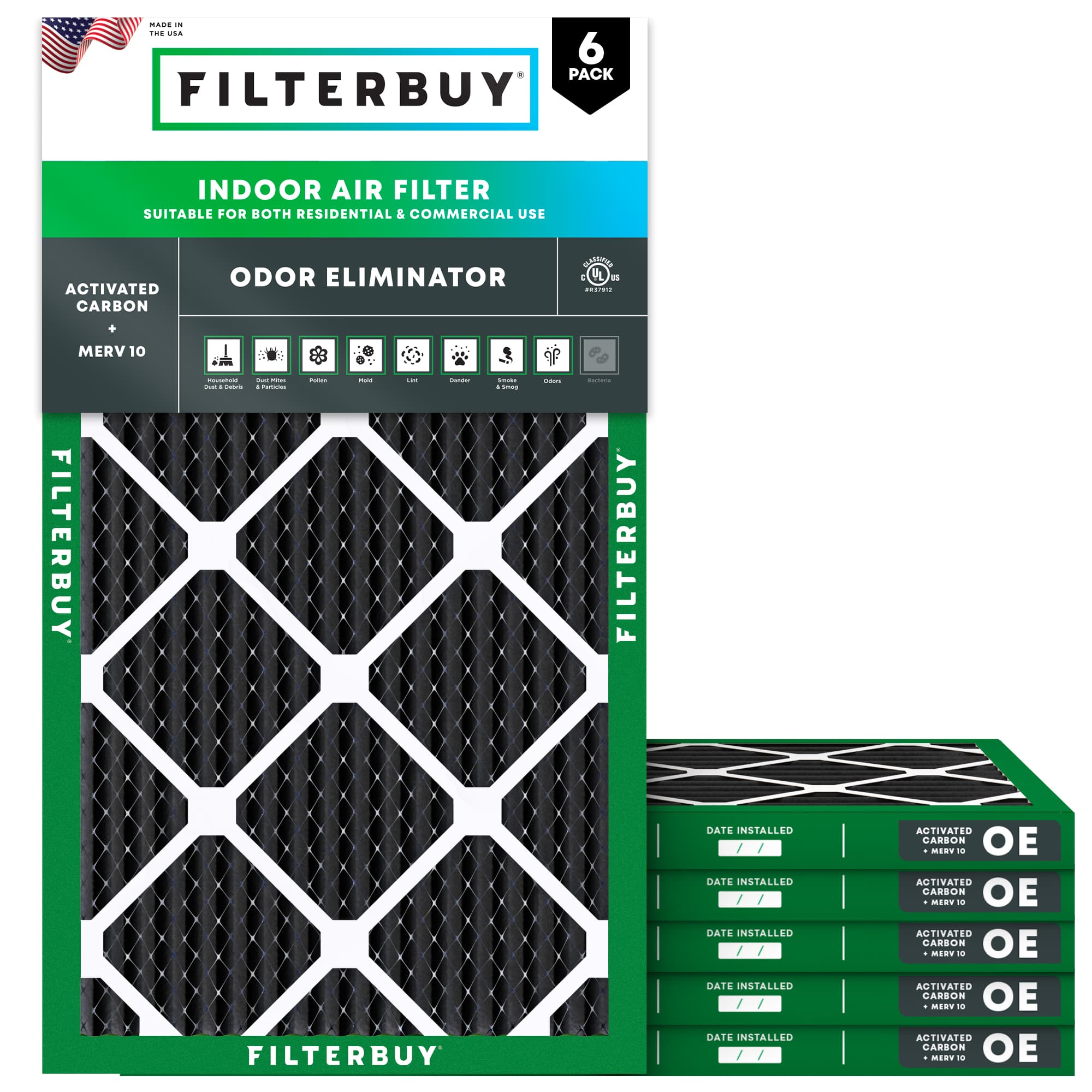
The Filterbuy 12x20x1 Odor Eliminator is a pleated HVAC filter with an activated carbon layer that adsorbs odor molecules from pets, cooking, smoke, and new furnishings instead of only trapping dust. It fits any furnace, air conditioner, or heat pump with a 12x20x1 slot. Actual size is 11 1/2" x 19 1/2" x 3/4". Carbon saturates, so the 90-day replacement window matters more than on a standard filter.
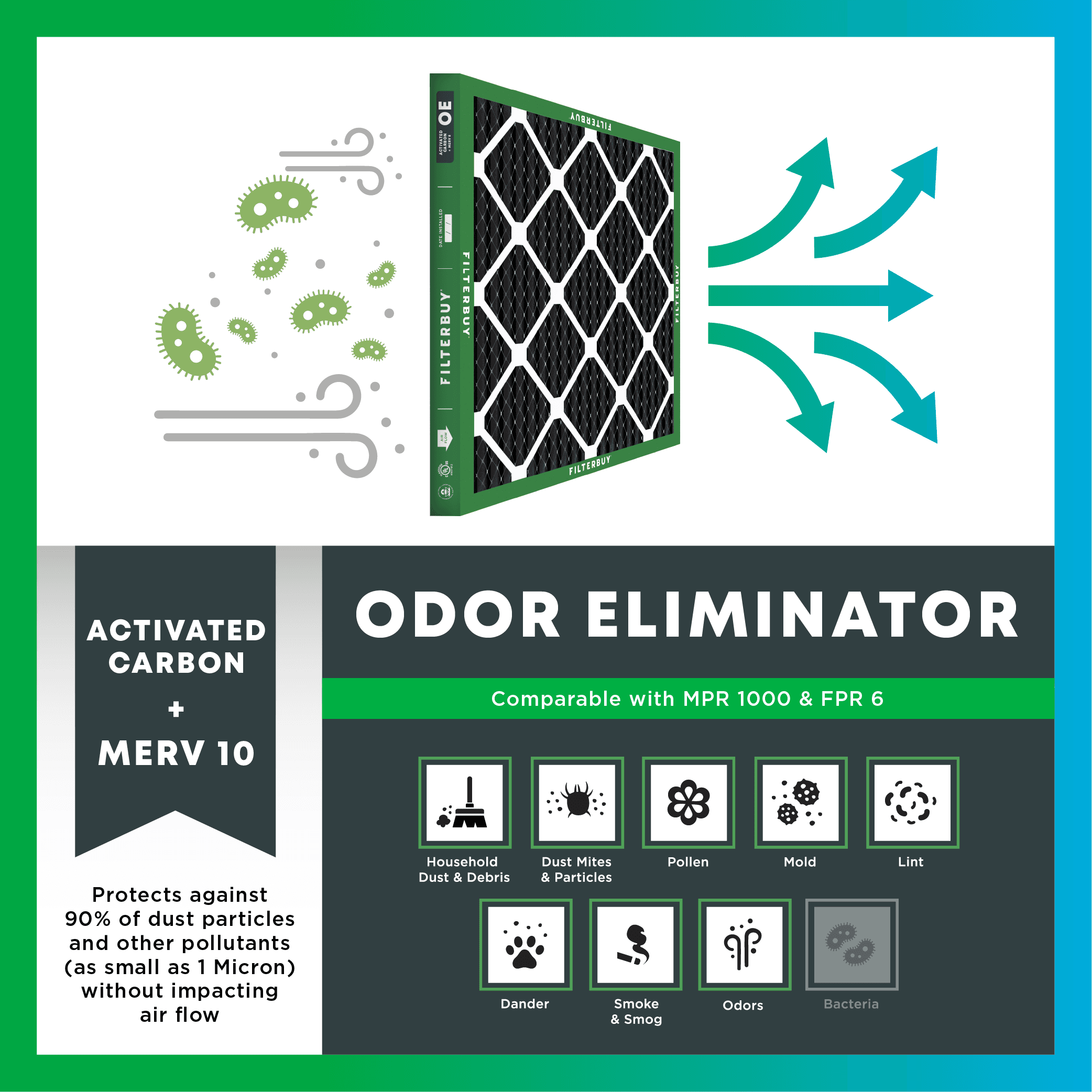
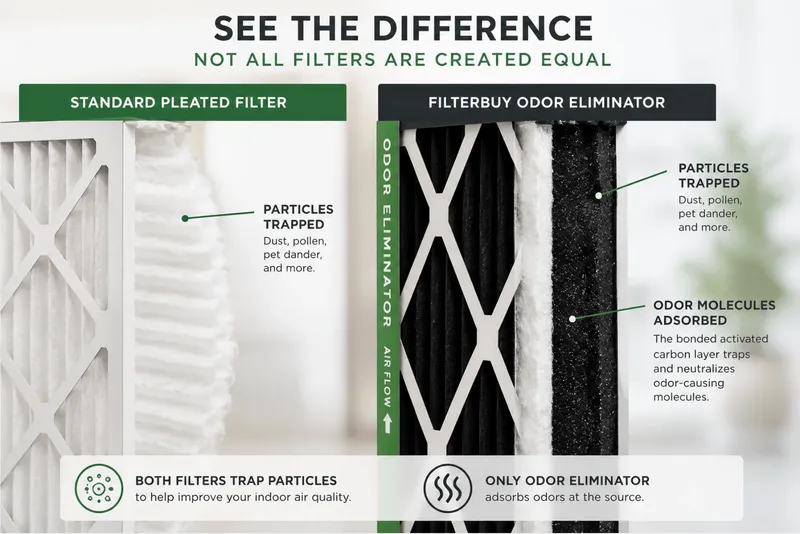
The Odor Eliminator does two jobs. Pleated media captures particles; carbon adsorbs the gas molecules that create smells.
Its media rates MPR 1000–1200 and FPR 7 and traps 95% of airborne particles, matching our MERV 11 line.
Carbon saturates without looking dirty. Odor performance fades before dust performance does.
Carbon adds about $9 per filter over MERV 11, roughly $37 a year per system.
No air filter removes carbon monoxide. A working CO alarm is the safety device.
The Filterbuy 12x20x1 Odor Eliminator is an activated carbon air filter: a pleated HVAC filter with a carbon layer bonded to one side of the media. We build it that way so the pleated side traps dust, lint, pollen, mold spores, and dander while the carbon side handles what particle media cannot, the light gas molecules that carry smell.
Odor is not a particle problem. Litter box ammonia, cigarette smoke, last night's fish, and fresh paint are volatile organic compounds and other gases, and even a high-MERV pleated filter lets them pass straight through. The EPA reports many VOCs run up to ten times higher indoors than outdoors, and up to 1,000 times during paint stripping. Same reason a pleated filter alone does nothing for gases like nitrogen dioxide.
Here is where most carbon filters cut cost: we did not bond carbon onto entry-level media. The Odor Eliminator rates MPR 1000–1200 and FPR 7 and traps 95% of airborne particles, the same particle performance as our MERV 11 line. You are not trading dust capture for odor capture.
Carbon saturates. Dust media does not. A pleated filter half loaded with dust is still filtering, and you can see it working. A carbon layer at capacity has stopped adsorbing but looks exactly as it did new. The EPA states adsorbent media have finite capacity and must be replaced regularly. CARB notes carbon can become overloaded and need replacing often.
“The question I get most is some version of ‘it still looks clean, do I really have to change it?’ With a standard filter, looking clean is decent evidence. With carbon it is none. The two sides wear out on different clocks, and only one is visible.”
A one-inch filter carries a thin carbon layer, not a deep bed. CARB notes thin charcoal reduces everyday odors but will not strip high VOC levels.
MERV measures particle capture, not odor capture. The carbon handles smell either way, so choose the MERV level for who lives in your home and what your system can take.
MERV rates particle capture. The activated carbon layer handles odor independently of the MERV number.
Choose MERV 11 with carbon for pets, allergy sufferers, or seasonal smoke: upgrade to 12x20x1 MERV 11. Choose MERV 8 with carbon if your system is older, undersized, or high on static pressure: shop 12x20x1 MERV 8 filters. Browse all odor eliminator air filters across every size we make.
“People jump MERV levels the way they'd upgrade a phone, assuming higher is always better. On a system that is already fighting static pressure, it isn't. Measure first. A carbon filter at the right MERV for your equipment will outperform a higher-rated filter your blower can't pull air through.”
Carbon adds about $9 per filter over MERV 11 at six-pack pricing. Four changes a year puts odor control at roughly $37 per system, about ten cents a day.
Pricing verified August 6, 2026. Carbon is the only difference between these two filters.
If smell is why you are shopping, that is the number to weigh. If it is not, Filterbuy 12x20x1 MERV 11 gives identical 95% particle capture for under half the price. Carbon is the only thing you pay extra for.
Activated carbon works best on everyday organic odors that recirculate through the ducts. It is weakest on gases it was never designed to capture.
Carbon monoxide is odorless and is not captured by any air filter at any rating. A working CO alarm is the safety device.
For wildfire smoke particles specifically, 12x20x1 MERV 13 is the residential standard, and the EPA confirms carbon monoxide is not captured by residential gas-phase filters. Every Filterbuy Odor Eliminator uses the same bonded carbon layer, in 12x20x1 or a custom size. We have made air filters in the USA since 2013 and hold more than 85,000 five-star reviews.
A carbon filter is the wrong tool when the odor has a source you can remove, a moisture cause, or no clear origin. The EPA ranks the fixes in order: remove the source, ventilate, then filter. Four cases where something else comes first:
A source you can remove. Litter box, garbage, damp towels. Deal with it first, or the carbon spends its capacity chasing something you could carry outside.
Cooking smells while you cook. A vented range hood removes them at the source. The filter catches only what escapes into the return.
Musty or damp smells. That is a moisture problem. A filter softens the symptom while the cause keeps growing.
A smell that appears suddenly with no source. Stop and get it identified. Some hazards, including carbon monoxide, are odorless. The CDC reports more than 400 unintentional deaths a year and over 100,000 emergency department visits.
Carbon is the right tool for odors already circulating with no source you can remove: pets, smoke, cooking that has spread, new furnishings off-gassing. That is most households, not every household.
A 12x20x1 filter fits any furnace, air conditioner, heat pump, or air handler with a 12x20x1 slot. The number on your old filter is the nominal size; the actual size is 11 1/2" x 19 1/2" x 3/4", and that gap is deliberate.
If your filter is missing, measure the slot opening and round each dimension up to the nearest whole inch.
To confirm your size, read the dimensions on your old filter. If it is missing, measure the slot and round each dimension up. Compare options on the 12x20x1 air filters page, or build a custom filter for a non-standard rack. Check the third number too: a 12x20x2 or 12x20x4 rack needs that depth, and a one-inch filter will not seal in it. If you order the wrong size, Filterbuy exchanges it free.
Replace it every 90 days as a baseline, sooner when the carbon has more work to do. On the Filterbuy Odor Eliminator the 90 days is a carbon capacity limit, not a dust limit. The EPA's guide to air cleaners gives the same 60-to-90-day window.
Carbon capacity, not visible dirt, is the limiting factor.
If faded odors come back, the carbon has reached capacity. Change it even if it looks clean. Auto-delivery ships replacement filters on your schedule, saves 5%, and removes the guesswork.
A filter cleans only the air that passes through it. The EPA states it plainly: the longer the air cleaner runs, the more air it filters. On a whole-home system that is a question of blower runtime.
On AUTO, your blower runs only during heating or cooling cycles, which in mild weather can be under two hours a day.
On ON or CIRCULATE, air keeps moving through the carbon between cycles.
If odor is your reason for buying, run the fan on ON or CIRCULATE for the first few days. It costs nothing.
It is also why nobody can promise a number. Anyone quoting a fixed 24 or 48 hours is describing their house, not yours.
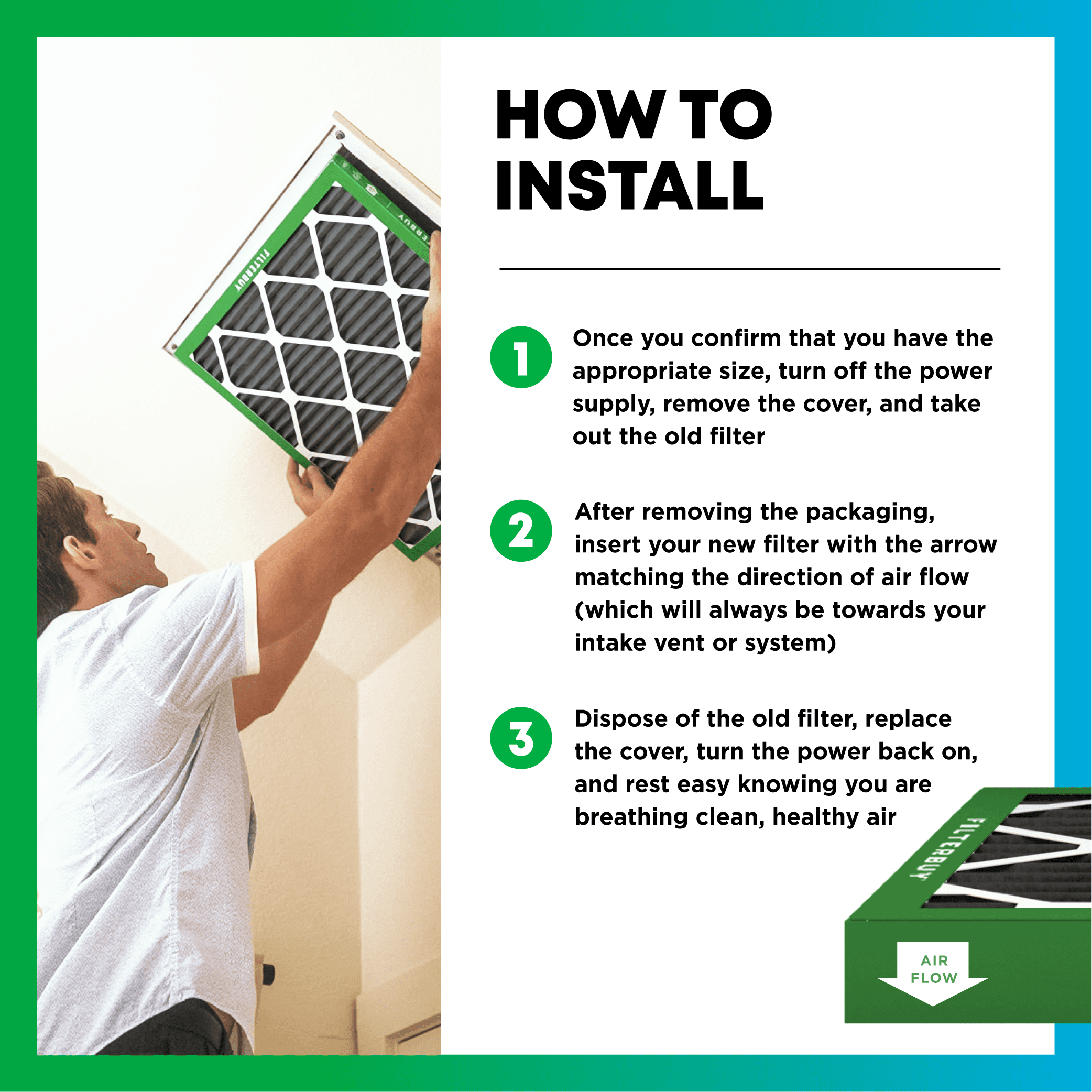
Turn off your HVAC system at the thermostat before opening the compartment.
Remove the old filter and note the airflow arrow on its frame.
Slide in the new filter with the arrow pointing the same direction as the old one. In an air handler it points toward the unit; in a ceiling or wall return it points into the duct.
Turn the system back on and note the date on the frame.
Filterbuy frames and media are recyclable. Check what your local program accepts before binning the old one.
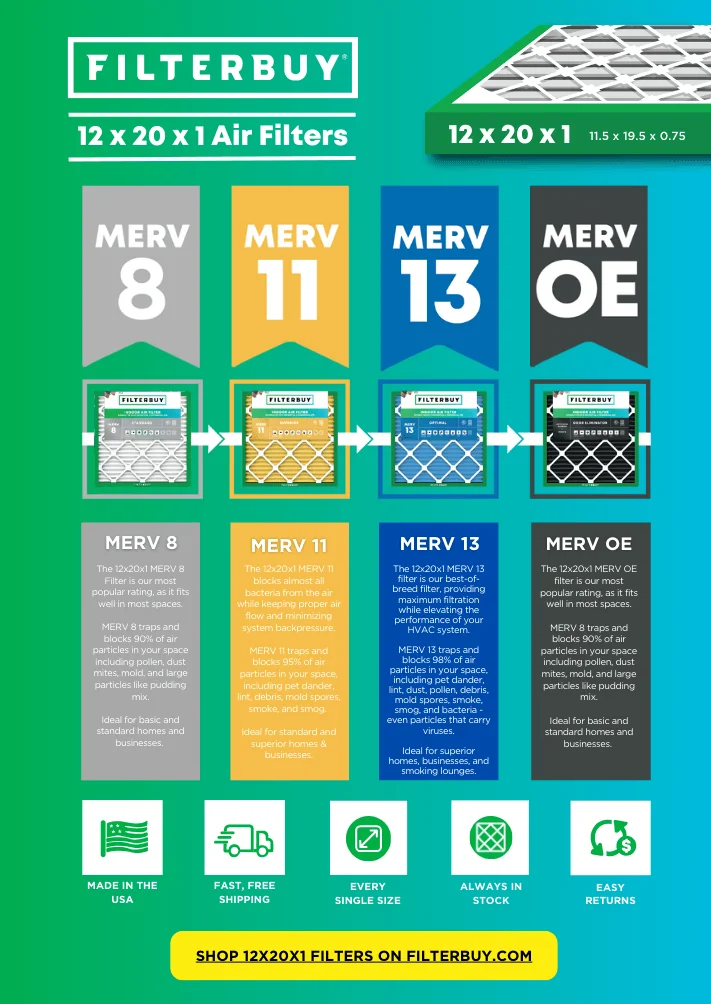
Filterbuy sells Odor Eliminator as its own type alongside MERV 8, 11, and 13. Its media is comparable to MPR 1000–1200 and FPR 7, matching our MERV 11 line on particle capture, with odor control added. Other retailers label carbon versions at various MERV levels, so check the listing.
Yes, and pet odor is the most common reason customers come to this filter. The carbon adsorbs the gas molecules behind litter box, dander, and wet-dog smells. The NIEHS reports dog and cat allergens appear in almost all American homes, including those that never had a pet. Multi-pet homes should replace every 60 days.
Partly. The carbon adsorbs the gas phase of smoke odor, which is what lingers in fabric and ductwork. Smoke particles are a separate problem, and 12x20x1 MERV 13 is the residential standard for wildfire particulate. During an active smoke event, run MERV 13 and keep windows closed. For everyday cigarette odor, the Odor Eliminator is the better fit.
No. Filterbuy Odor Eliminator filters are engineered for standard residential airflow. If your system already runs high static pressure, have a technician measure it first.
Yes. Per-filter pricing drops with pack size: $43.99 for one, $19.74 each in a 4-pack, $15.66 at twelve or more. Shop 12x20x1 Odor Eliminator filters.
Activated carbon: Carbon processed to have a very large internal surface area, used to adsorb odor-causing gas molecules.
Adsorption: Gas molecules adhering to the surface of a solid such as activated carbon, unlike absorption.
MERV: Minimum Efficiency Reporting Value, the ASHRAE 52.2 rating for particle capture. Higher numbers catch smaller particles.
MPR and FPR: Filtration scales from 3M and The Home Depot. The Odor Eliminator rates MPR 1000–1200 and FPR 7.
VOCs: Volatile organic compounds. Carbon-based chemicals that evaporate at room temperature, from paints, cleaners, and furnishings.

