
Wildfire Smoke and Schools: A Parent's Guide to District Questions and Policy
September 23, 2026
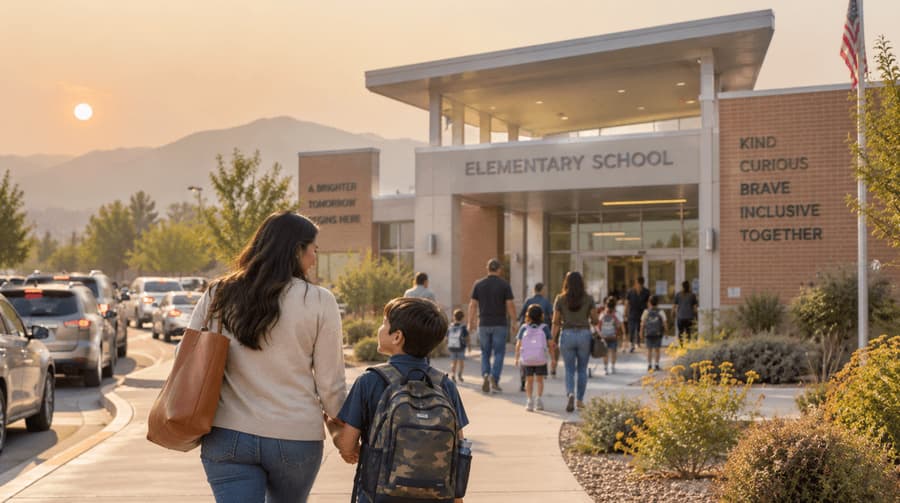
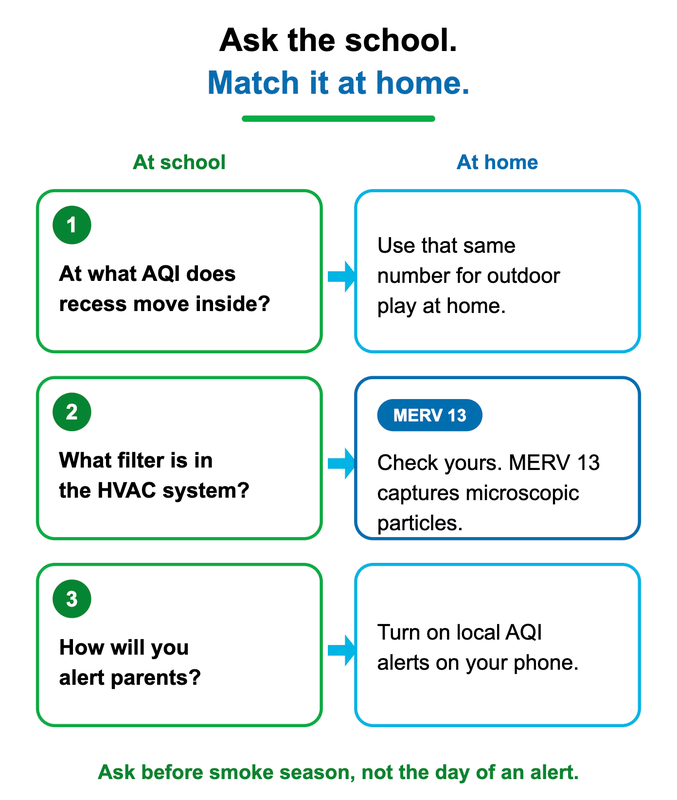
Ask your child's school how its smoke plan works before fire season, then match that plan at home. Most schools tie their plan to the Air Quality Index (AQI), which decides when recess, PE, and practice move indoors.
If your child has asthma, confirm their action plan is on file with the school nurse.
At home, start with your HVAC filter. MERV 13 captures microscopic particles and is our highest residential filtration
Not sure what fits your system? Take the quick quiz below.
Find the Right Filter for Your Home
Answer a few quick questions and we'll match you to your filter.
TL;DR
Most U.S. school districts are not legally required to have a wildfire smoke policy, and many don't have one in writing. Five questions get you the real picture: what AQI triggers what action, how they measure air quality, what MERV rating is in the HVAC, what happens to that system on a smoke day, and how they'll notify you. This guide gives you those questions, what a good answer sounds like, an email template, and the three exposure points most plans miss: the bus, the inhaler, and the closure itself.
Key Takeaways
Children face higher risk from wildfire smoke than adults because their lungs are still developing, they spend more time outdoors, and they inhale more air per pound of body weight, according to the U.S. EPA.
ASHRAE Guideline 44-2024 is the current benchmark for smoke readiness in schools. Its companion planning framework calls for a written Smoke Readiness Plan, indoor and outdoor PM2.5 sensors, MERV 13 or higher filtration, and staff communication protocols.
California, Oregon, and Washington regulate wildfire smoke exposure for outdoor workers. No equivalent federal mandate covers students, which means school policy is usually a local decision, not a legal requirement.
Closing school is not automatically the safer choice. The California Department of Education notes that school buildings often have better filtration, plus supervision, meals, and health services that a child may not have at home.
N95 respirators are not recommended for children, and surgical masks provide no protection from smoke. Cleaner indoor air is the real defense.
Three exposure points sit outside most plans: the bus ride home, whether your child can actually reach their inhaler, and what a closure costs your family. Every state allows students to self-carry an inhaler, so when a child can't reach one it's usually the paperwork that failed, not the law.
Why Wildfire Smoke Is Harder on Kids Than It Is on You
Children are more vulnerable to wildfire smoke than adults for reasons that have nothing to do with how tough they are. The EPA's guidance on at-risk groups explains that children up to age 18 are still growing lung tissue, spend more of the day outdoors, and take in more air per pound of body weight than adults do. Put simply, a kid at recess on an orange-AQI day is getting a bigger dose than you are on the same sidewalk.
The pollutant that matters most is PM2.5: fine particles under 2.5 micrometers wide, small enough to reach deep lung tissue and the bloodstream. Smoke also drifts hundreds of miles, which is why districts in Ohio and Georgia now field the questions California districts always have.
The EPA agrees that parents belong in this conversation. Its factsheet Schools as Cleaner Air and Cooling Centers tells families outright to ask school leadership whether classrooms have ventilation and filtration, and whether any of it is adjusted when smoke arrives.
The Five-Part Smoke Readiness Check for Parents
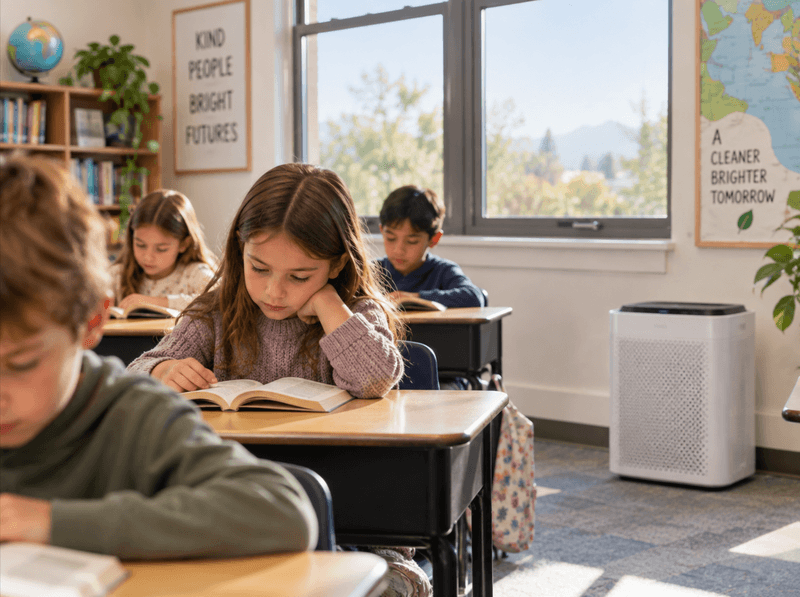
Ask your district five things: what AQI level triggers what action, how they measure air quality indoors and outdoors, what MERV rating is in the HVAC filters, what happens to that system on a smoke day, and who decides and notifies you. A district with a real wildfire smoke policy can answer all five in writing. One that can't usually doesn't have a plan yet.
ASHRAE Guideline 44-2024, published in December 2024, is the first consensus guideline written specifically for protecting building occupants from wildfire smoke, and the EPA notes it covers institutional buildings including schools. Its companion planning framework spells out a 10-element Smoke Readiness Plan and recommends MERV 13 or higher filters during smoke events.
We come at this from an unusual angle. Filterbuy has manufactured air filters in the U.S. for over a decade, and through Filterbuy Business we supply K-12 districts, including one where a single facilities director coordinates filters across 47 school buildings. That vantage point means we read ASHRAE 44 the way a facilities team does, as a purchase order and a maintenance calendar rather than a policy document. The table below is that structure, turned into board-meeting questions.
Structure adapted from ASHRAE Guideline 44-2024 and its companion planning framework, as summarized by the U.S. EPA.
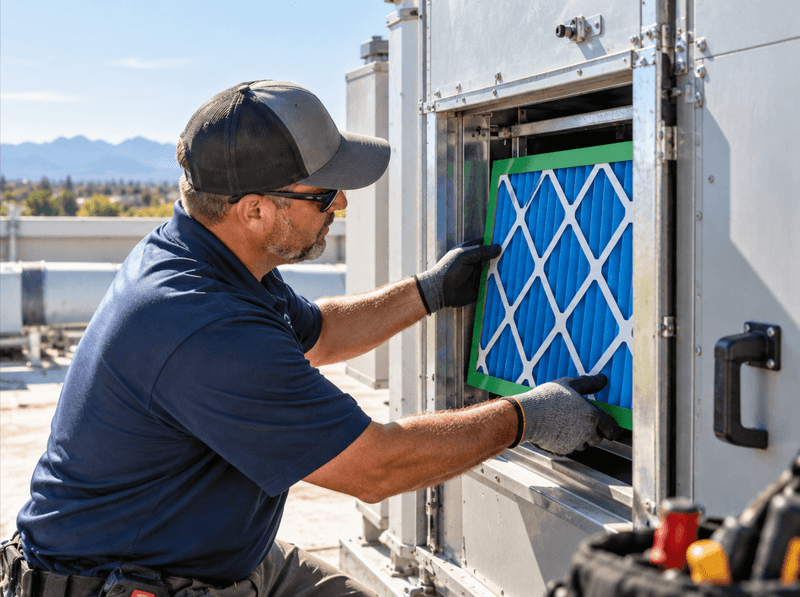
The MERV number is the easy part. Our own guidance for wildfire-prone areas is a 30-to-45-day replacement cycle during active fire season, against 90 days the rest of the year. Every smoke season, the filters that come back to us are visibly darker and heavier than the ones from clean-air months. A school that upgrades to MERV 13 in August and leaves it in until Thanksgiving bought the right filter and then ran it well past the point where it was still doing the job. That's the question a parent should be asking.
Michelle Wan, Brand Manager and Air Quality Writer, Filterbuy
That gap is why the bonus row is in the table. A filtration upgrade is a decision a district makes once, while the replacement interval is one it makes eight times a year, and the second decision is what determines whether the first one meant anything.
There's one more answer worth recognizing before you take it as a no. Older school buildings often need filter sizes nobody stocks off the shelf, so "we can't get that size" ends up sounding like "we can't do it," when the two are not the same thing at all. Custom dimensions are routine manufacturing, and Filterbuy builds them to spec for exactly this reason, so if sizing is the obstacle a district names, it's a solvable one.
A Sample Email You Can Send This Week
Send this to your principal and copy the district facilities director, since facilities teams tend to respond well to numbered questions and poorly to general worry.
SUBJECT: Question About Our Wildfire Smoke Plan Before Fire Season
Hi [Name],
I'm a parent of a [grade] student at [School]. With fire season underway, I wanted to ask a few practical questions about how the district handles smoke days. I'm not raising a concern. I'd just like to understand the plan so I can prepare at home.
- Does the district have a written wildfire smoke response plan, and can families see it?
- What AQI thresholds trigger changes to recess, P.E., athletics, and outdoor events?
- What MERV rating do the HVAC filters at [School] use, and are there portable air cleaners in classrooms or portables?
- How does the building operate differently on a high-smoke day?
- How and when will families be notified, and who makes that decision?
Happy to help if the district is working on this. Thank you for the time.
[Your name] · [Phone]
If two weeks go by with no answer, take the same questions to public comment at a school board meeting, where boards move on written records and a documented request is harder to set aside than a hallway conversation.
What the Thresholds Actually Look Like
California's school air quality guidance, built for the state's 1,026 districts with the EPA and CDC, is a useful reference for any school air quality plan, even if you live elsewhere. It scales restrictions across five levels instead of treating the day as open-or-closed.
Adapted from the California Department of Education's School Air Quality Activity Recommendations. Districts set their own numeric AQI cutoffs for each level in consultation with their local air district, so ask yours for the specific numbers.
If your district's answer is "we close when it's bad," that's a plan with one setting. Ask which framework yours borrowed from, because most districts adapt an existing state or air-district model rather than writing one from scratch, and knowing the source tells you how thorough it's likely to be.
Two Things Parents Usually Get Wrong
Two beliefs come up in nearly every conversation about school air quality, and both send families in the wrong direction.
Masks are not the answer for kids. California's guidance is direct: surgical masks provide no protection from smoke, and N95 respirators are designed for trained adults, require a tight seal, and are not recommended for children by public health agencies.
Consumer sensors aren't the gold standard. Low-cost sensors spot trends well, but California's guidance notes they tend to overestimate above AQI 150. For decisions, districts are pointed to the EPA monitors at AirNow.gov.
The Parts of the Day the Plan Forgets
District smoke policies tend to cover the same ground: recess, P.E., athletics, events. That's the school day as an adult pictures it, and it leaves out three exposure points worth raising once you've asked the five questions above.
The bus ride. A plan that moves recess indoors and then loads kids onto a school bus with the windows down has protected six hours and given back twenty minutes of it. EPA's parent factsheet says so plainly, telling families to check the transportation plan alongside everything else. Ask whether school buses recirculate, whether windows stay up, and whether routes shift on high-AQI days.
Whether your child can reach their inhaler. All 50 states and D.C. let students carry and use their own quick-relief inhaler, yet the American Lung Association notes that some children still can't reach their medication during the school day, usually because the paperwork was never filed rather than because the law is missing. Only 25 states and D.C. let schools stock backup medication at all, so for most families the form is the whole safety net. On a smoke day, the distance between a wheezing kid and a locked health office is what matters, and that gets decided in July when someone signs the self-carry form and the asthma action plan.
What happens if they close. Closing school sounds like the cautious answer, but often it isn't, since the California Department of Education notes that school filtration frequently outperforms home systems and students are supervised indoors either way. A closure also means a parent may lose a shift, a child may lose a meal, and a student with an IEP may lose services, all three of which sit on the CDE's own list of reasons closure isn't free. So if you can absorb a closed day, say so, and if you can't, say that too. The families who most need school to stay open and well-filtered are often the least likely to be in the room when it's decided.
What You Can Control at Home
Your district's plan covers roughly seven hours. The other seventeen are yours, and home filtration is the fastest win.
Start with your HVAC system, where a MERV 13 filter captures the same fine PM2.5 particles ASHRAE points schools toward. Keep windows and doors closed, and run the fan continuously rather than on auto during a smoke event, since a filter only works on the air that actually moves through it.
Then apply at home the step districts most often skip. Our replacement guidance is 90 days for a standard household but 30 to 45 days in wildfire areas during active fire season, because a filter that has worked through a smoke event is loaded, and a loaded filter performs worse than a clean one two MERV steps down. Buy the spare in July, while you're still thinking about it.
The other habit worth building is checking the Filterbuy live air quality and wildfire smoke map the night before rather than the morning of, which gives you time to pack an inhaler, sign a form, or plan an indoor afternoon before anyone is already late.
Related reading: wildfire smoke and the air quality index · how to recover after wildfire smoke exposure · what PM2.5 is and why it matters
Supporting Statistics
These are the three numbers we keep on hand when a district asks us why any of this matters. Together they explain why the answers so often aren't reassuring.
1. About 36,000 U.S. Schools Need HVAC Updates
41% of districts need to update or replace HVAC systems in at least half their schools.
54% of districts need to update or replace multiple building systems.
Why it matters: Question 3 asks what MERV rating is in the filters. For a large share of American schools, the honest answer starts with the condition of the equipment holding them.
Source: U.S. Government Accountability Office, GAO-20-494
2. About 3 Kids in a Classroom of 30 Have Asthma
5 million U.S. children have asthma, the most common chronic disease of childhood.
10 million missed school days a year, plus 767,000 emergency room trips.
Why it matters: Every classroom already holds students in the group the AQI calls "sensitive." For them, whether the inhaler is reachable matters as much as what MERV rating is in the ceiling.
Source: National Heart, Lung, and Blood Institute (NIH), Asthma in Kids
3. Nearly Half of American Children Breathe Failing-Grade Air
33.5 million children (46% of everyone under 18) live in a county with a failing grade for at least one measure of air pollution.
7.3 million children live where all three measures fail, on 2022–2024 EPA-verified data.
Why it matters: The American Lung Association names wildfire smoke as a driver of both burdens, in regions never considered fire country.
Source: American Lung Association, "State of the Air" 2026
Frequently Asked Questions
At What AQI Should Schools Cancel Outdoor Recess?
There is no national number. Most frameworks begin restricting outdoor activity for sensitive students around AQI 101, the "Unhealthy for Sensitive Groups" range that includes children, then move everyone indoors as readings climb higher. Ask your district for its own numbers in writing.
Is My Child’s School Legally Required to Have a Wildfire Smoke Plan?
Usually not. California, Oregon, and Washington have wildfire smoke rules protecting outdoor workers, but no comparable federal requirement covers students. School smoke policy is adopted locally, which is exactly why parent questions carry weight.
What MERV Rating Should a School Use for Wildfire Smoke?
EPA and ASHRAE both identify MERV 13 or higher for smoke particles in commercial and institutional buildings. Where older school equipment can't handle the added airflow resistance, portable HEPA cleaners in classrooms are the standard workaround.
Should I Keep My Child Home on a Smoky Day?
That depends on your child's health history and on how the building itself performs, so talk to your pediatrician if your child has asthma or another lung condition. For many families a well-filtered school is actually the cleaner option, which is why the useful question isn't "is it smoky?" but "what's the air like inside that building?"
Can Our School Join the EPA’s Air Quality Flag Program?
Yes, and it costs nothing. The Air Quality Flag Program has schools raise a colored flag each day matching the AQI, which makes air quality visible to students, staff, and parents at a glance. For a district with no formal plan yet, it's a reasonable first step.
Glossary
AQI (Air Quality Index): The U.S. EPA's 0-500 scale for daily air quality, green (Good) through maroon (Hazardous). AQI 101-150 is "Unhealthy for Sensitive Groups," which includes children.
PM2.5: Fine particulate matter 2.5 micrometers or smaller. It is the primary health hazard in wildfire smoke because particles this small reach deep lung tissue and enter the bloodstream.
MERV: Minimum Efficiency Reporting Value, the 1-16 scale rating how effectively an air filter captures particles, where higher numbers capture smaller ones. MERV 13 is the level associated with fine smoke particle capture.
HEPA: High-Efficiency Particulate Air, a standard capturing at least 99.97% of particles at 0.3 micrometers. Most school HVAC systems cannot accommodate HEPA filters, so it is usually delivered through portable room air cleaners.
ASHRAE Guideline 44-2024: The American Society of Heating, Refrigerating and Air-Conditioning Engineers' consensus guideline, Protecting Building Occupants from Smoke During Wildfire and Prescribed Burn Events, published December 2024. It covers commercial, institutional, and multiunit residential buildings, including schools. The guideline is sold through the ASHRAE bookstore; the EPA summarizes it free of charge.
Smoke Readiness Plan (SRP): The written building-level plan ASHRAE's framework recommends, covering sensing, filtration, HVAC operation, communication, and recovery.
AirNow.gov: The EPA-operated public air quality site, run with NOAA, the National Park Service, NASA, the CDC, and state and tribal agencies. It reports AQI from regulatory-grade monitors.
Air Quality Flag Program: A free EPA program in which schools fly a daily colored flag matching the AQI.
If your district is weighing a filtration upgrade, Filterbuy Business works with school districts on classroom MERV ratings, custom sizes for older buildings, and multi-site delivery. Feel free to forward this page to your facilities director, though the questions above matter a good deal more than where the filters end up coming from.
About the author. Michelle Wan is Brand Manager and air quality writer at Filterbuy, where she turns MERV ratings, filtration, and HVAC efficiency into plain-English advice (B.A., University of California, Santa Cruz). She works directly with Filterbuy's U.S. manufacturing team across factories in Alabama, Florida, Pennsylvania, and Utah.
Reviewed by. David Clark is a Licensed HVAC Technician with Filterbuy HVAC Solutions. His review covers the HVAC, filtration, and airflow guidance on this page. The health guidance follows EPA, CDC, and state public-health consensus and is not a substitute for medical advice.
Disclosure. Filterbuy manufactures air filters in the USA and sells them factory-direct, including the custom sizes referenced above. This page recommends a product category we sell, and it also states plainly where filtration is not the answer: masks, closures, inhaler access, and the bus ride are not problems a filter solves.
Sources: U.S. EPA, Who is at Increased Risk from Wildfire Smoke Exposure? · U.S. EPA, Wildfires and Indoor Air Quality in Schools and Commercial Buildings · ASHRAE Guideline 44-2024 · California Department of Education, School Air Quality Activity Recommendations · AirNow.gov Air Quality Flag Program