
Colorado Wildfire Smoke: Front Range Altitude, Marshall Fire, Year-Round Plan
September 23, 2026
What Air Filter Should Colorado Homes Use for Wildfire Smoke?
Use a MERV 13 filter, and at Front Range altitude, reach it with a deeper filter instead of a lower rating. The EPA recommends MERV 13, or the highest rating your system can handle, during smoke events.
At 5,280 feet, thinner air gives your blower about 20% less static pressure to work with. A 2- or 4-inch MERV 13 buys back that headroom, so you keep the filtration without straining your system.
Reviewed by David Clark, Licensed HVAC Technician
Not Sure Which Filter Fits Your System?
Answer a few quick questions and we'll match you to the right filter.
TL;DR
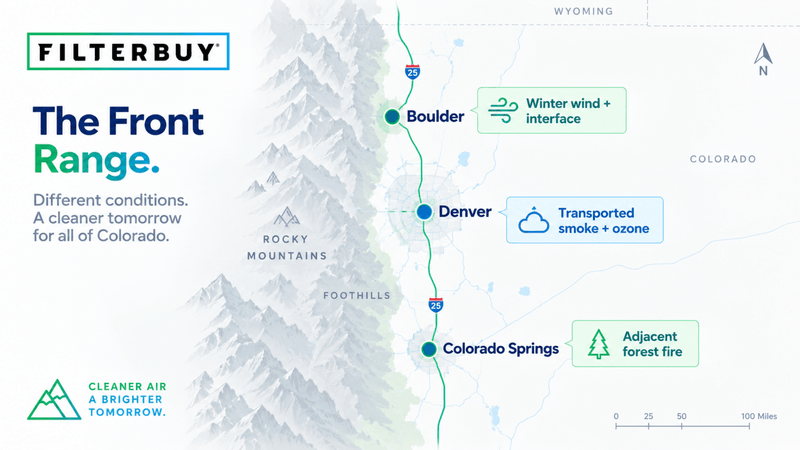
Denver, Boulder, and Colorado Springs sit within 70 miles of each other but face three different smoke problems. Denver breathes transported smoke layered on a severe ozone problem, Boulder’s defining event was a winter firestorm that drove ash into homes that never burned, and Colorado Springs takes smoke from fires it can see. All three share one constraint: at Front Range elevation, thinner air gives your blower roughly 20% less static pressure than at sea level. That changes which filter belongs in your system.
Key Takeaways
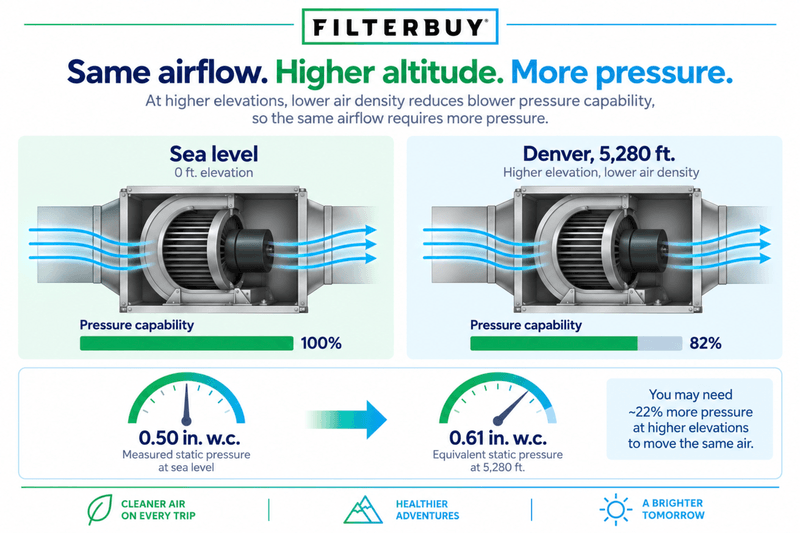
Air at Denver’s 5,280 feet is about 82% as dense as air at sea level, and a blower’s static pressure capability falls with it, so your filter has less airflow headroom here than in Houston.
To compare a Front Range static pressure reading against a manufacturer’s airflow table, multiply it by about 1.21 in Denver and 1.25 in Colorado Springs. A gauge reading 0.50 in Denver behaves like 0.61 at sea level. Filterbuy calculated the full table for six Front Range cities.
The EPA recommends MERV 13, or the highest rating the system can handle, during smoke events. At altitude, get there through filter depth rather than by dropping efficiency.
The Denver Metro/North Front Range is a Severe ozone nonattainment area under the 2008 federal standard, and smoke adds to ozone formation, so summer afternoons stack two pollutants.
After the December 2021 Marshall Fire, more than half of surveyed residents of surviving Boulder County homes reported symptoms six months later, making post-fire cleanup a source-removal problem, not a filtration one.
Three Cities, Three Different Smoke Problems
Front Range smoke is not one condition. Each city has a distinct exposure pattern, set by how close it sits to burnable fuel and how wind moves smoke in. Guidance written for “Colorado” fits none of them well.
Elevations are city-center figures. Peak risk windows reflect typical years; wind-driven fire can occur in any month along the Front Range.
The Altitude Adjustment Most Filter Advice Misses
Nearly every wildfire smoke guide was written at sea level, and closing that gap is why this page exists. Your filter and furnace behave differently at 5,280 feet, and the difference changes what you should buy.
Start with the blower. A residential blower is a constant-volume machine, so it moves roughly the same cubic feet per minute at any elevation. What changes is the static pressure it can generate, which falls right along with air density. Fan engineers have corrected for this for decades, but homeowners never see the correction, so a Front Range reading gets judged against a sea-level rule of thumb and looks healthier than it really is.
We could not find that correction published anywhere for homeowners, so we worked it out ourselves. The table below is original to this page.
Front Range static pressure correction factors, calculated by Filterbuy (from the U.S. Standard Atmosphere, for conditioned indoor air at a constant temperature)
Correction factors calculated by Filterbuy from the U.S. Standard Atmosphere barometric pressure ratio for conditioned indoor air at a constant temperature. Example: a Denver system measuring 0.50 in. w.c. operates like a sea-level system at roughly 0.61 in. w.c.
Read that as follows. A Denver system measuring 0.50 inches of water column is really operating like a sea-level system at 0.61. Most residential equipment is rated near 0.50, which puts the Front Range home closer to its limit than the gauge suggests.
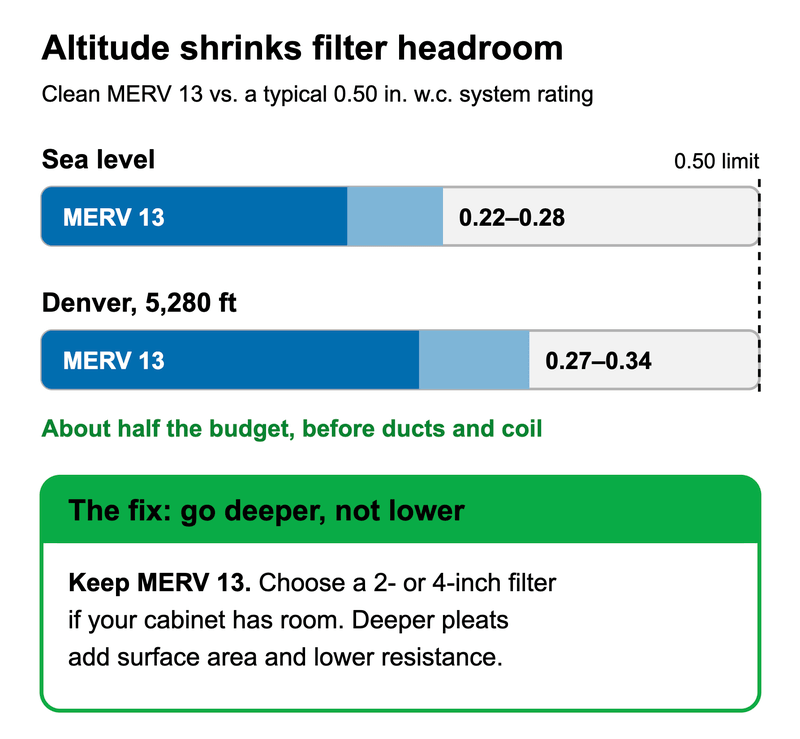
The same math runs in reverse, and that is where it starts to bite. The Filterbuy MERV air filter pressure drop chart puts a clean MERV 13 at 0.22 to 0.28 inches w.c. In Denver, that filter behaves like 0.27 to 0.34, spending half the 0.50-inch budget before the ducts and coil have taken their share.
Where that lands depends on the blower you have. Lawrence Berkeley National Laboratory found that added filter resistance lowers airflow in PSC blowers and raises power draw in variable-speed BPM blowers, so older systems quietly lose air while newer ECM systems work harder to hold it.
None of this is a reason to downgrade filtration. It is a reason to reach MERV 13 through geometry rather than by settling for MERV 8. The Department of Energy’s Building America guidance on high-MERV filters notes that deeper pleats add surface area and lower pressure drop, and it makes one point worth repeating: avoid filters from manufacturers who will not give you static pressure numbers. Filterbuy publishes ours, which is the only reason we can run this arithmetic in public instead of asking you to take it on faith. So if your return currently takes a one-inch filter and the cabinet has room for a two-inch or four-inch, the deeper filter buys back headroom and lasts longer besides.
Check Your Filter Area Before You Buy Depth
Depth helps, but face area comes first. Face velocity is how fast air moves through the media, and it is what drives resistance: system airflow divided by filter face area in square feet. Building America caps residential face velocity at 500 feet per minute and prefers 200 to 400, while residential systems are designed around 400 CFM per ton. Run those two rules together and a familiar filter size stops looking innocent.
Calculated by Filterbuy. Face velocity = system airflow ÷ filter face area in square feet, using nominal filter dimensions. System airflow assumed at the standard residential design figure of 400 CFM per ton. Green is inside the 200–400 FPM band the U.S. Department of Energy prefers; amber is above it; red is above the 500 FPM ceiling.
A 3-ton system behind a 16x25 or a 20x20 is already running 432 feet per minute, past the preferred band before altitude even enters the picture. Behind a 16x20 it reaches 540 and clears the ceiling entirely. In Denver, where the blower has a fifth less static pressure to give, that gap is what decides whether a MERV 13 filters your air or starves your system.
If the slot itself is undersized, depth will not rescue it. The fix is a larger return or a second one, which makes it a conversation with your technician rather than a purchase. Either way, check the size printed on your current filter before you order anything for smoke season. If it reads as an odd size no retailer stocks, Filterbuy cuts filters to custom dimensions, which is often how an awkward Front Range return gets a MERV 13 at all.
I don’t want anyone to feel like they need an HVAC license just to pick the right filter. My job is to give you the straight answer, explain why it matters, and let you get back to your day.
Michelle Wan, Brand Manager and Air Quality Writer, Filterbuy
The arithmetic above has one practical point. You do not have to carry any of it around. You need one static pressure reading from your technician and one multiplier from the table, and the rest is knowing which filter to put in the slot.
Denver: Transported Smoke on Top of an Ozone Problem
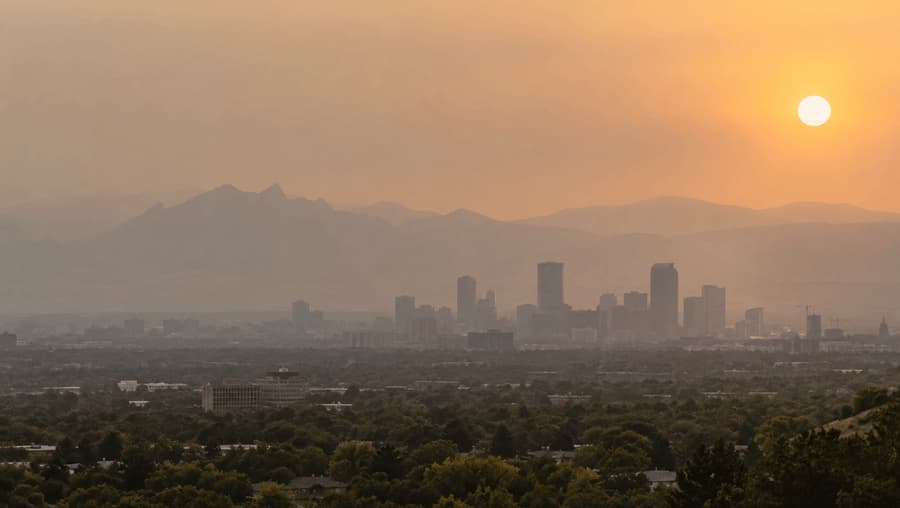
Altitude sets the ceiling on what your system can do; what fills the air underneath it varies by city. Denver’s smoke usually originates somewhere else entirely, with fires on the Western Slope and in Wyoming, Idaho, Utah, California, and Canada riding upper-level flow into the metro. The result is a city that can have hazardous air with no fire anywhere nearby.
The complication here is ozone. The Denver Metro/North Front Range is a Severe nonattainment area for the 2008 federal ozone standard and Serious for the 2015 standard. The attainment deadline for the 2008 standard is July 20, 2027. Colorado plans to request voluntary reclassification to Severe under the 2015 standard, moving that deadline to August 3, 2033. Smoke plumes react with sunlight and existing pollution to form ozone downwind, so a hot, stagnant late-July afternoon can deliver elevated ozone and fine particles on the same day.
A filter handles only one of those two problems. A MERV 13 captures fine particles but does nothing about ozone, so on stacked days the combination that actually helps is indoor filtration plus less outdoor exertion. The live Colorado AQI map beats a smoke-only view here because it reports both pollutants at once, while the Denver wildfire and smoke map is the better tool for tracking the plume itself.
Boulder: What the Marshall Fire Taught About Smoke That Gets Inside
Boulder’s defining event ran on a different calendar altogether. The most instructive Front Range smoke event on record happened on December 30, 2021. Winds near 100 miles per hour drove the Marshall Fire through Superior and Louisville, destroying more than 1,000 homes and forcing 37,000 people to evacuate.
What matters most here is what happened to the houses that survived. Researchers at CU Boulder and CIRES measured the air inside smoke- and ash-damaged homes and found that volatile organic compounds lingered for weeks, with early indoor levels comparable to a high-pollution day in 1990s Los Angeles. In a companion survey, more than half of those residents reported symptoms six months later.
Filterbuy manufactures and sells air filters, so here is the part that does not help us sell them: when a structure fire deposits ash inside a home, a filter alone will not fix it. Pleated filters capture particles, not the gases off-gassing from carpet, drywall, and upholstery. CDPHE’s guidance on indoor air quality after a fire recommends HEPA for particles paired with activated carbon for VOCs such as benzene, monthly filter changes for up to a year after cleanup, and no ozone generators in occupied homes.
The practical lesson for Boulder County is to keep spare filters on hand year-round, because a wind-driven grass fire in December is a documented local event rather than a freak one.
Colorado Springs: Fire You Can See From Your Street
Colorado Springs faces the opposite situation from Denver, because its smoke often comes from fires it can see. The city sits hard against the foothills of the Pike National Forest, inside the wildland-urban interface. Two of the state’s most destructive fires started nearby: Waldo Canyon in June 2012, which destroyed roughly 346 homes, and Black Forest in June 2013, which destroyed close to 500.
A close-in fire changes the problem in kind. Smoke arrives at higher concentration with less warning, ash loads filters far faster than haze does, and evacuation becomes a real possibility, so indoor air planning has to coexist with a go-bag.
The Palmer Divide north of the city runs 6,000 to 7,900 feet and supports the Black Forest, so smoke in northern El Paso County behaves differently from downtown on the same afternoon. That split is why Filterbuy builds city-level smoke maps for Colorado Springs: one metro AQI number averages away the difference that decides whether your windows stay shut.
Your Front Range Smoke-Season Calendar
The three city patterns share one calendar, and working from it beats reacting to a forecast.
Seasonal windows describe typical Front Range years and are not a forecast. Check current conditions on the AirNow Fire and Smoke Map before planning outdoor activity.
What to Do When Smoke Arrives
Check the AirNow Fire and Smoke Map, then follow EPA clean room guidance:
Close the house. Shut windows and doors; close any fresh-air intake or set the system to recirculate. Colorado’s dry climate makes whole-house fans and swamp coolers common, and both pull outdoor air straight in. Shut them off first.
Run the fan continuously. Switch the thermostat fan from “Auto” to “On” so air keeps cycling.
Use MERV 13, or the highest your system handles. See the Filterbuy MERV 13 vs. HEPA comparison.
Set up one clean room. Add a portable HEPA air cleaner sized for the room where you sleep. Avoid ozone-producing devices; CARB publishes a list of certified air cleaners.
Don’t add indoor smoke. Skip candles, gas-stove frying, and non-HEPA vacuuming. Replace the filter when it looks dirty, often well before your normal interval.
Cover an evaporative cooler intake. For swamp coolers you can reach safely, the EPA recommends four-inch MERV 13 media over the intake.
Supporting Statistics
Three federal and county datasets underpin the guidance above. Filterbuy verified each at its original source.
Verified at source on September 2, 2026. EPA filter figures describe central forced-air systems with the fan set to continuous.
Primary sources: EPA on reducing smoke exposure indoors, CDC on asthma visits during the 2023 smoke episodes, and Boulder County on Marshall Fire structure losses, which recorded 1,084 residential structures destroyed and an assessor-valued loss of $513.2 million.
Frequently Asked Questions
Does High Altitude Make Wildfire Smoke Worse in Colorado?
Altitude does not make smoke more toxic, but thinner air means less oxygen per breath, so the same exertion loads your lungs harder. It also cuts the static pressure your blower can generate, shrinking filter headroom. CDPHE’s wildfire smoke and health page covers exposure.
Is It Safe to Be Outside on a Colorado Smoke Day?
That depends on the reading and on you. Once AQI passes 100, EPA guidance is for sensitive groups to cut back on prolonged outdoor exertion, and above 150 that applies to everyone. If you do go out in heavy smoke, a well-fitted N95 or P100 respirator blocks fine particles while cloth and surgical masks do not. Thinner air already makes the same effort cost you more oxygen here, so ease off sooner than you would at sea level.
Do I Need to Worry About Smoke if the Fire Is 300 Miles Away?
Yes. Most Denver smoke events start well outside the county, and fine particles cross state lines easily. Track the statewide Colorado wildfire and smoke map rather than the distance to the nearest fire.
Is MERV 13 Safe for a Front Range Furnace?
Usually, but verify. Have your technician measure static pressure, apply the multiplier for your city, and compare against your equipment rating. Near the limit, move to a deeper MERV 13 rather than a lower MERV.
Glossary
AQI: Air Quality Index, the EPA’s 0–500 outdoor pollution scale. Above 100 is unhealthy for sensitive groups; above 150, for everyone.
CDPHE: Colorado Department of Public Health and Environment, which issues state air quality advisories and smoke outlooks.
Face velocity: How fast air moves through a filter, in feet per minute. Equals system airflow divided by filter face area. Lower is better for resistance.
Front Range: Colorado’s urban corridor east of the Rockies, Fort Collins to Pueblo.
MERV: Minimum Efficiency Reporting Value, the ASHRAE 52.2 scale of 1 to 16. MERV 13 captures at least 50% of 0.3–1.0 micron particles.
Nonattainment area: A region the EPA has determined does not meet a federal air quality standard.
Ozone (ground-level): A gas formed when sunlight reacts with vehicle and industrial emissions. Particle filters do not remove it.
Palmer Divide: The ridge between Denver and Colorado Springs, 6,000 to 7,900 feet, supporting the Black Forest.
PM2.5: Fine particulate matter 2.5 microns or smaller, the class that dominates wildfire smoke and reaches deep into the lungs.
PSC / ECM blower: Furnace blower motors. A PSC loses airflow as filter resistance rises; an ECM (or BPM) holds airflow by drawing more power.
Static pressure: Resistance air meets moving through ducts, coils, and filters, in inches of water column. Most systems are rated near 0.50.
VOCs: Volatile organic compounds, gases released by burned synthetic materials. Found at elevated levels in smoke-damaged Marshall Fire homes.
WUI (wildland-urban interface): Where homes sit against wildland fuel with no buffer, including western Colorado Springs and the Boulder foothills.
How We Built This Page
Filterbuy has manufactured pleated filters in the U.S. since 2013, and this page was written by our own brand and air-quality team. Three things about the method are worth stating plainly.
The altitude and face-velocity tables are calculated, not measured. Both are derived from published engineering figures and shown as arithmetic you can check. A licensed HVAC technician reviewed the reasoning.
Every statistic was verified at its source. We opened the EPA, CDC, CDPHE, and Boulder County pages rather than repeating figures quoted secondhand. One number changed while we checked: a federal ozone deadline moved from 2027 to 2033.
What we could not verify, we left out. We have no bench data comparing 1-inch, 2-inch, and 4-inch MERV 13 resistance at matched face velocities. That test would strengthen this page more than anything else, and until we run it we will not imply otherwise.
Sources
U.S. EPA, Create a Clean Room to Protect Indoor Air Quality During a Wildfire
U.S. EPA, Strategies to Reduce Exposure Indoors
U.S. EPA, Research on DIY Air Cleaners to Reduce Wildfire Smoke Indoors
U.S. EPA and U.S. Forest Service, AirNow Fire and Smoke Map
CDC, Asthma-Associated Emergency Department Visits During the Canadian Wildfire Smoke Episodes, MMWR, Aug. 25, 2023
CDPHE, Federal ozone pollution standards and Colorado nonattainment areas
CDPHE, Wildfire smoke and health
CDPHE, Colorado Smoke Outlook
Boulder County, Updated list of structures damaged and destroyed in the Marshall Fire
CU Boulder, Months after Marshall Fire, returning residents reported symptoms, poor indoor air quality (studies published in ACS ES&T Air)
U.S. DOE Building America Solution Center (PNNL), High-MERV Filters
Walker et al., Lawrence Berkeley National Laboratory, System Effects of High Efficiency Filters in Homes
California Air Resources Board, List of CARB-Certified Air Cleaning Devices
Altitude correction factors calculated from the U.S. Standard Atmosphere barometric pressure ratio for conditioned indoor air at constant temperature. Reviewed for technical accuracy by David Clark, Licensed HVAC Technician. This article is general guidance, not medical advice; if you have asthma, COPD, or a heart condition, follow your physician’s plan during smoke events.