
Air Quality in Colorado
Air quality index (AQI⁺) and PM2.5 air pollution in Colorado •


Get Alerts For Unhealthy AQI In Your Area
When air quality in your area reaches unhealthy levels, we'll send you a quick alert, along with expert tips on how to reduce your exposure.
Live Air Quality Ratings in Colorado
Live Most Polluted City Ranking
Real-time most polluted cities in Colorado
Live Cleanest City Ranking
Real-time cleanest cities in Colorado
The Right Air Filter For High AQI Days
When outdoor air quality drops, the EPA recommends upgrading to a MERV 13 filter — or the highest-rated filter your HVAC system can handle — to help capture more of the fine particulate (PM2.5) that comes with poor air quality. MERV 13 is the highest rating most residential systems can run without restricting airflow.
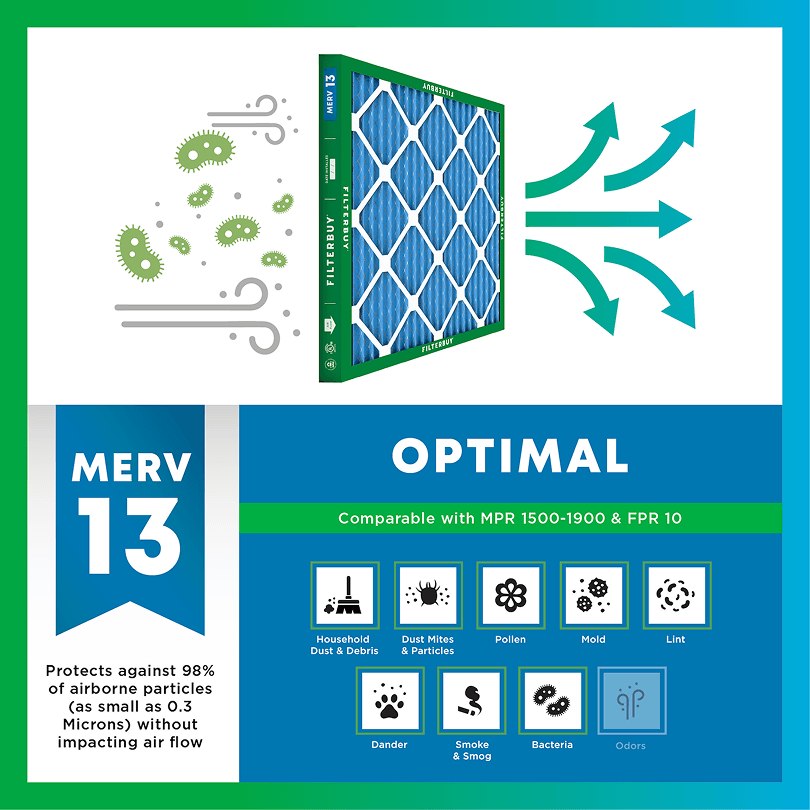

- Captures PM2.5 and other fine particulates
- Filters ash, soot, and smoke particles
- Rated to capture particles as small as 0.3 microns
- Matches the filter rating the EPA suggests during high-AQI and smoke events

AQI FAQs
What is AQI?
AQI stands for Air Quality Index, the EPA's scale for reporting daily air quality. It runs from 0 to 500. The higher the number, the greater the level of air pollution. Values at or below 100 are generally considered satisfactory; values above 100 mean air quality is unhealthy, first for sensitive groups, then for everyone as numbers climb.
What does AQI measure?
The AQI tracks five major pollutants regulated by the Clean Air Act: ground-level ozone, particle pollution (PM2.5 and PM10), carbon monoxide, sulfur dioxide, and nitrogen dioxide. The reported AQI value reflects whichever pollutant is highest at that time — most often ozone or fine particles (PM2.5).
How is AQI calculated?
Monitoring stations measure pollutant concentrations, and the EPA converts each into a standardized 0–500 score using set breakpoints. Each pollutant gets its own sub-index, and the highest sub-index becomes the reported AQI. That's why a single number can represent different pollutants on different days.
What is a good AQI?
An AQI of 0–50 is rated "Good" — air quality poses little or no risk. 51–100 is "Moderate," acceptable for most people though unusually sensitive individuals may want to limit prolonged outdoor exertion. Anything at or below 100 is generally considered satisfactory air quality.
What does an AQI of 100 (or 150) mean?
100 is the dividing line: at or below it, air quality is satisfactory for the general public. From 101–150, air is "Unhealthy for Sensitive Groups" — people with respiratory conditions, older adults, and children. From 151–200, it's "Unhealthy" and everyone may begin to feel effects.
Why is the AQI bad today?
Short-term AQI spikes usually come from wildfire smoke, temperature inversions that trap pollutants near the ground, high-ozone weather (hot, sunny, stagnant days), or heavy traffic and industrial activity. Check a real-time source like the map on this page to see which pollutant is driving today's reading in your area.
What AQI is bad for running or exercise?
Many runners follow the EPA category lines: below 50, no adjustment needed; 51–100, unusually sensitive people may shorten intense workouts; above 100, sensitive groups are advised to reduce prolonged or heavy outdoor exertion; above 150, that advice extends to everyone. Exercise increases how much air you breathe in, which is why thresholds matter more during workouts.
What AQI is safe to open windows?
A common rule of thumb is to keep windows open when the AQI is under 100 and close them when it climbs above, especially during wildfire smoke events when fine particles are elevated. When windows are closed, running your HVAC system with a fresh filter helps capture particles circulating indoors.
Should I wear a mask based on AQI?
Public health agencies generally suggest considering a well-fitted N95-style respirator outdoors when the AQI exceeds 150, particularly during smoke events. Cloth and surgical masks don't filter fine particles effectively. Follow guidance from your local health department, which may adjust recommendations during severe episodes.
Check Today's Live Real Time Air Quality Index AQI Map in Colorado Now
The region’s reputation for pristine mountain air doesn't tell the whole story. Various events impact air quality outside your door, which can change dramatically from one hour to the next.
This map shows you what residents in the region are actually breathing right now. But here's what most air quality sites won't tell you: after manufacturing millions of filters and analyzing data from over two million households in the country, we've seen firsthand how outdoor AQI spikes directly impact what accumulates inside homes. When it reaches 100, our customer service team notices an immediate uptick in calls from residents dealing with symptoms due to an increase in small particle triggers indoors.
Check current conditions below, understand what those readings mean for your family, and learn the connection between outdoor pollution and the air circulating through your home.
TL;DR Quick Answers
Live air quality index AQI map now today in Colorado
Colorado's current AQI varies by region and changes hourly. Check the live map above for real-time readings across the state.
What you need to know right now:
Front Range (Denver, Boulder, Fort Collins): Most susceptible to ozone in summer and inversions in winter
Western Slope (Grand Junction, Durango): Highest wildfire smoke impact from neighboring states
Mountain communities: Generally cleaner but vulnerable to smoke settling in valleys
Quick action guide based on current readings:
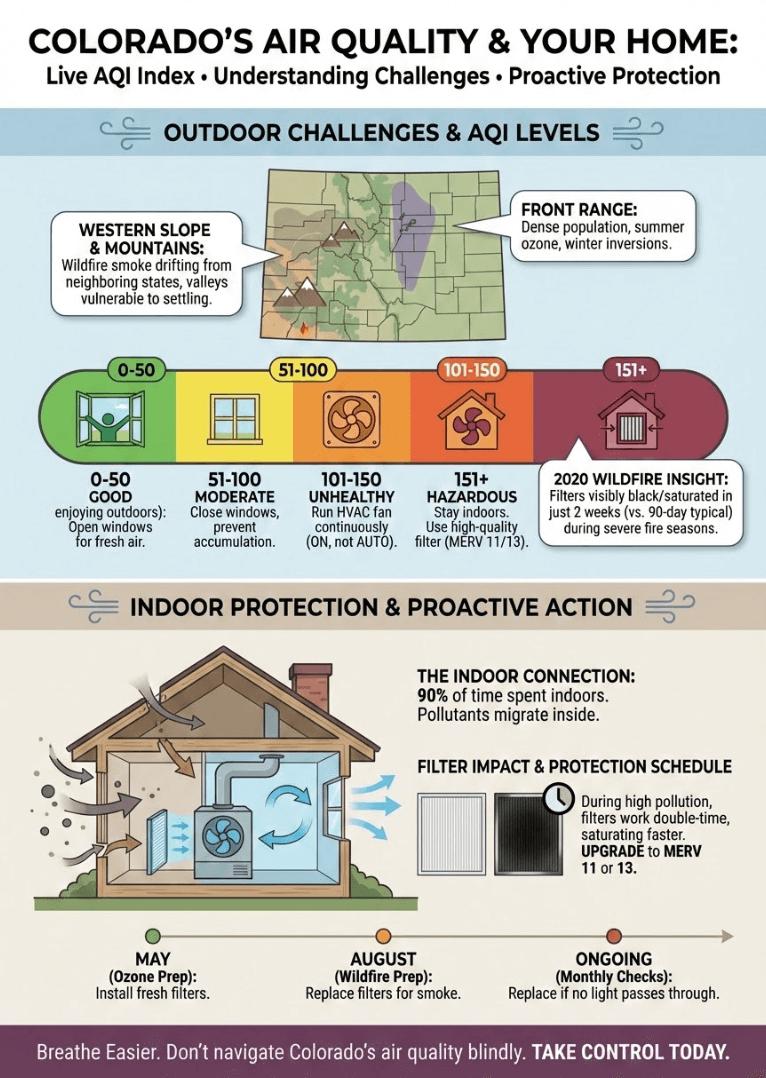
0-50: Good. Outdoor activities safe.
51-100: Moderate. Close windows to prevent particle accumulation.
101-150: Unhealthy for sensitive groups. Run the HVAC fan continuously.
151+: Unhealthy. Stay indoors with filtration running.
Top 5 Takeaways
Colorado's air quality shifts rapidly. Front Range inversions, high-altitude ozone, and wildfire smoke can push readings from good to unhealthy within hours.
Outdoor pollution migrates indoors. Air exchanges through windows, doors, and HVAC intakes. Rising outdoor AQI means rising indoor particle counts.
"Moderate" readings still affect your home. AQI between 51-100 produces measurable indoor accumulation over time—even with windows closed.
Your HVAC filter is your primary defense. Run the fan continuously during poor air quality events. Fresh filtration prevents pollutants from recirculating.
Time filter changes to Colorado's seasons. Fresh filters in May for summer ozone. Fresh filters in August for fall smoke. Proactive beats reactive.
Understanding Colorado's Air Quality Index Right Now
The air quality index measures five major pollutants: ground-level ozone, particle pollution (PM2.5 and PM10), carbon monoxide, sulfur dioxide, and nitrogen dioxide. Each pollutant receives a score from 0 to 500, and the highest individual reading becomes the overall AQI for that location.
Colorado faces unique air quality challenges that other states don't experience as intensely. The Denver metro area sits in a bowl-shaped geography where cold air traps pollutants close to the ground during winter inversions. Summer brings ozone formation when vehicle emissions react with intense high-altitude sunlight. And wildfire season—which now stretches from late spring through fall—can push AQI readings into unhealthy territory across the entire state within hours.
What Today's AQI Numbers Mean for You
0-50 (Good): Air quality is satisfactory with little or no health risk. Enjoy outdoor activities freely without concern.
51-100 (Moderate): Acceptable for most people, though unusually sensitive individuals may want to limit prolonged outdoor exertion.
101-150 (Unhealthy for Sensitive Groups): Children, older adults, and those with respiratory conditions such as asthma or COPD should reduce outdoor activity. Active adults may also want to limit prolonged exertion outdoors.
151-200 (Unhealthy): Everyone should limit prolonged outdoor exertion. Consider moving workouts indoors and keeping windows closed, even if the weather seems pleasant.
201-300 (Very Unhealthy): Avoid outdoor physical activity entirely. Keep all windows and doors closed and run your HVAC system to filter indoor air continuously.
301-500 (Hazardous): Remain indoors with windows sealed. Run your HVAC system continuously with quality filtration. This level represents emergency conditions where outdoor air poses serious health risks to everyone, regardless of age or health status.
These particles accumulate over time, which explains why customers often report worsening indoor allergies even when outdoor readings seem reasonable. What happens outside eventually makes its way inside—understanding these thresholds helps you take protective action before symptoms appear.
Colorado's Most Affected Regions
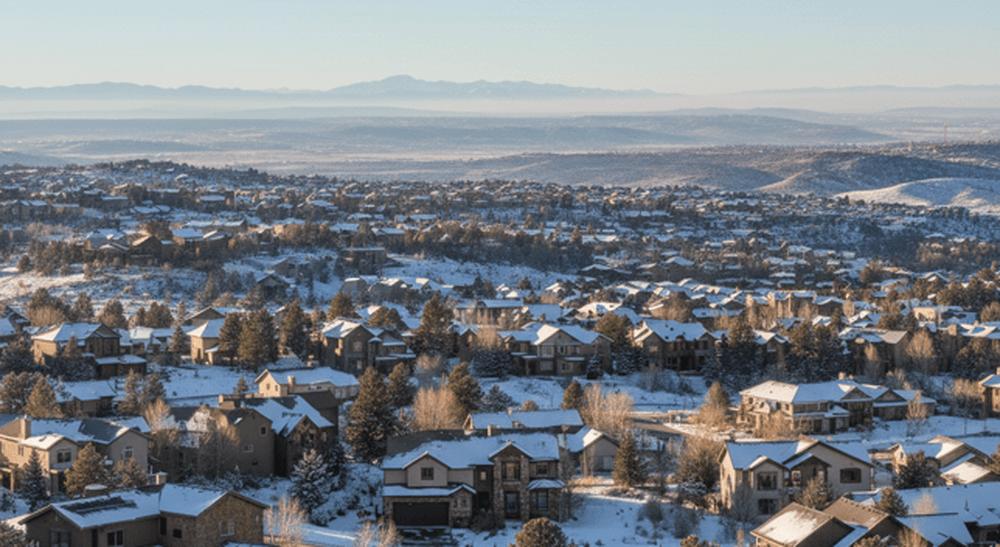
Front Range Corridor (Denver, Boulder, Fort Collins, Colorado Springs)
Population density and vehicle traffic make this region prone to ozone alerts duringthe summer months. Winter inversions trap pollution in the metro area, sometimes for days at a time. Residents here benefit most from monitoring AQI before morning commutes and outdoor exercise.
Western Slope (Grand Junction, Montrose, Durango)
Wildfire smoke impact hits this region hardest, often drifting in from fires in Utah, Arizona, and California. During active fire seasons, we've seen Western Slope customers increase their filter replacement frequency by nearly double compared to their normal schedules.
Mountain Communities (Summit County, Eagle County, Routt County)
Generally cleaner air at elevation, but not immune to smoke events that can settle into mountain valleys. High-altitude residents sometimes assume they're protected, but topography can trap smoke in ski towns just as effectively as urban inversions trap pollution along the Front Range.
When Outdoor Air Quality Affects Indoor Air
During Colorado's 2020 wildfire season, we tracked a significant pattern across our Front Range customer base. Households that maintained regular filter changes reported noticeably better indoor conditions during smoke events compared to those running older, saturated filters. The difference wasn't subtle. Filters pulled from homes during that period came out visibly darker within two weeks rather than the typical 60 to 90 days.
This is why checking outdoor AQI matters even if you plan to stay inside. Elevated outdoor readings signal that your HVAC filter is working harder than usual, trapping more particulates with each cycle. Running your system's fan continuously during poor air quality days helps filter indoor air even when heating or cooling isn't needed.
Practical Steps When Colorado AQI Rises
Immediate actions for unhealthy air days:
Keep windows and doors closed, even if temperatures are mild. The natural ventilation that feels refreshing actually introduces the pollutants you're trying to avoid.
Run your HVAC fan continuously. Your system's filter becomes your primary defense against outdoor particles migrating indoors. Setting the fan to "on" rather than "auto" circulates air through filtration even between heating and cooling cycles.
Check your current filter's condition. A filter that's been in place for two or three months has reduced its capacity to capture additional particles during air quality events. If you're approaching your replacement date, swap it early rather than waiting.
Avoid activities that add indoor pollutants. Cooking, especially frying or grilling, vacuuming without a HEPA-equipped machine, and burning candles all add particles to the air that's already compromised.
Longer-term considerations:
Households in wildfire-prone areas or along the Front Range corridor benefit from upgrading to MERV 11 or MERV 13 filtration. Higher MERV ratings capture smaller particles, including the fine PM2.5 particulates most associated with wildfire smoke and vehicle emissions.
Consider your replacement schedule relative to Colorado's seasons. A filter installed in May will work hardest during the summer ozone season and early fall fire season. Timing changes to occur before these peak periods ensures maximum filtration capacity when you need it most.
Beyond the Map—Protecting Your Indoor Environment
Your HVAC system processes hundreds of cubic feet of air every hour it runs. The filter you choose determines what gets captured versus what recirculates through your living spaces. When outdoor conditions deteriorate, that filter becomes the barrier between Colorado's air quality challenges and the air your family breathes at home.
We built Filterbuy on the belief that everyone deserves access to clean indoor air, regardless of what's happening outside. Check the current conditions on the map above, take appropriate precautions when readings climb, and make sure your home's filtration is ready to handle whatever Colorado's air brings next.
"After analyzing filter conditions from thousands of Colorado homes during the 2020 wildfire season, we discovered that households checking outdoor AQI and running their HVAC fans continuously saw dramatically less particulate buildup indoors—their filters told the story of proactive protection versus reactive damage control."
— Filterbuy Air Quality Team
Essential Resources for Protecting Your Family from Colorado's Air Quality Challenges
Don't take your indoor air for granted—and don't navigate outdoor air quality blindly either. After helping over two million households breathe easier, we know that informed homeowners make better decisions about protecting their families. These resources give you the tools to monitor conditions and take action before poor air quality affects your home.
AirNow.gov: The Official AQI Source We Reference Daily
When our customer service team fields calls about air quality concerns, this is the same data we're looking at. The EPA's certified monitoring stations provide the most reliable baseline readings across Colorado—bookmark this one.
Source: https://www.airnow.gov
Colorado Department of Public Health & Environment: Your State's Air Quality Headquarters
Colorado faces unique challenges from Front Range inversions to Western Slope wildfire smoke, and this agency tracks them all. Their alerts tell you when conditions warrant keeping windows closed and HVAC systems running.
Source: https://cdphe.colorado.gov/air-quality
EPA Fire and Smoke Map: See Exactly Where Wildfire Smoke Is Heading
During fire season, we watch this map as closely as our Colorado customers do. It shows active fires, smoke plume direction, and how air quality in Utah or Arizona today might affect your home in Denver or Grand Junction tomorrow.
Source: https://fire.airnow.gov
National Weather Service Denver: Plan Instead of Reacting
Checking tomorrow's AQI forecast is just as important as checking today's reading. Ozone action day alerts and inversion warnings help you schedule outdoor activities wisely and prepare your home's filtration before conditions deteriorate.
Source: https://www.weather.gov/bou
PurpleAir: Neighborhood-Level Data Official Sensors Miss
Government monitors can't cover every community, especially in Colorado's mountain towns. This crowdsourced network fills the gaps with hyperlocal readings—because air quality two miles from your house might differ significantly from the nearest official station.
Source: https://map.purpleair.com
American Lung Association State of the Air: Understand Your County's Bigger Picture
Daily readings fluctuate, but long-term trends reveal whether your area is improving or declining. This annual report grades Colorado counties on air quality and helps you understand the ongoing challenges your HVAC filter works against year after year.
Source: https://www.lung.org/research/sota
EPA Air Quality Health Guidelines: Know Exactly When Your Family Should Stay Inside
What does an AQI of 120 actually mean for your kids or aging parents? These guidelines translate numbers into specific actions for sensitive groups—the same thresholds we reference when advising customers on filter upgrades and replacement timing.
Source: https://www.epa.gov/air-quality
What the Data Tells Us About Colorado Air Quality
The patterns we see in our Colorado customer data align with what researchers have documented for years. These numbers confirm why so many Front Range and Western Slope households contact us about upgrading their filtration.
90% of Your Time Is Spent Breathing Indoor Air
The EPA reports Americans spend roughly 90 percent of their time indoors, where pollutant concentrations can run two to five times higher than outdoor levels.
What we see firsthand:
Filters from Colorado homes during high-AQI periods become visibly saturated in half the normal timeframe
90-day filters often need replacement at 45 days when outdoor conditions deteriorate
Particulate accumulation on used filters tells us exactly what families have been breathing
Source: U.S. Environmental Protection Agency https://www.epa.gov/report-environment/indoor-air-quality
Denver Metro Ranks 8th Worst Nationally for Ozone Pollution
The American Lung Association's 2024 report gave failing grades to counties where over 2.8 million Colorado residents live.
What we see firsthand:
Summer ozone season generates measurable spikes in Front Range customer calls
Common complaints include stuffy air, lingering odors, and sudden allergy symptoms
Call volume patterns track directly with published ozone rankings
Source: American Lung Association - State of the Air 2024 https://www.lung.org/research/sota/city-rankings/most-polluted-cities
70+ Days of Wildfire Smoke Impact Colorado Annually
State data shows smoke now affects air quality for over 70 days per year—a number that is steadily increasing each decade.
What we see firsthand:
Western Slope and mountain community customers have shifted purchasing patterns
Households that once ordered quarterly now schedule more frequent fire-season deliveries
Filter loading during August and September has increased noticeably over the past five years
Source: Colorado Department of Public Health & Environment https://cdphe.colorado.gov/air-quality
Final Thought: Why Monitoring Outdoor Air Changes How You Protect Indoor Air
Most air quality websites give you a number and leave you to figure out the rest. We think that misses the point entirely.
After manufacturing millions of filters and serving over two million American households, we've learned something: AQI maps alone can't teach you. Outdoor air quality data only becomes valuable when you connect it to action inside your home.
The reality for Colorado households:
Colorado's air challenges aren't getting simpler. Wildfire seasons stretch longer. Ozone days along the Front Range increase. Winter inversions keep trapping pollution in the metro bowl. This isn't temporary—it's the new normal.
What separates protected homes from struggling ones:
Consistent monitoring before symptoms appear—not after
Understanding that "Moderate" readings still introduce particles that accumulate indoors
Treating your HVAC filter as active protection, not passive maintenance
Adjusting replacement schedules to match Colorado's ozone and fire seasons
Our perspective after years of working with Colorado families:
The households that breathe easiest aren't necessarily in the cleanest zip codes. They're the ones who pay attention, prepare proactively, and treat indoor air protection as an ongoing priority.
Checking this map is a smart first step. Translating that information into how you manage your home's air—that's where real protection begins.
Next Steps: Protect Your Indoor Air Starting Today
Checking Colorado's current AQI is the first step. Taking action based on what you find is what actually protects your family.
Right now—based on today's readings:
AQI below 50: Open windows if desired. Save your HVAC system for when you need it.
AQI 51-100: Close windows. Run the HVAC fan on "auto" for baseline filtration.
AQI above 100: Close all windows. Switch the fan to "on" for continuous filtration. Avoid cooking smoke and candles.
AQI above 150: Stay indoors. Check your filter condition immediately.
This week—prepare for ongoing challenges:
Locate your current filter and hold it up to the light. If you can't see through it, capacity is compromised.
Note the size printed on the filter frame for replacement.
Assess household risk factors: pets, allergies, respiratory conditions, or Front Range location.
Evaluate your current MERV rating
This season—build a proactive plan:
Install fresh filters in May before the summer ozone season
Replace again in August before fall wildfire smoke peaks
Set monthly calendar reminders for visual filter inspections
Frequently Asked Questions
Q: What is the Air Quality Index, and how is it measured in Colorado?
A: The AQI is a standardized 0-to-500 scale measuring five pollutants:
Ground-level ozone
Particle pollution (PM2.5 and PM10)
Carbon monoxide
Sulfur dioxide
Nitrogen dioxide
EPA-certified monitoring stations throughout Colorado provide readings. The highest individual pollutant score becomes the overall AQI.
After years of correlating these readings with filter conditions from Colorado homes, we've found PM2.5 and ozone measurements most directly predict what accumulates on filters—especially along the Front Range.
Q: Why does Colorado's air quality change so dramatically from day to day?
A: Colorado's geography creates rapid shifts:
Winter inversions trap pollutants in the Front Range bowl for days
Summer sunlight at high altitude converts vehicle emissions into ozone
Wildfire smoke drifts in from neighboring states within hours
Our customer service team sees these patterns in real-time call volume. Quiet periods suddenly spike when inversions settle or smoke rolls over the mountains. The geography that makes Colorado beautiful also makes its air unpredictable.
Q: At what AQI level should I keep my windows closed and stay indoors?
A: Official guidance suggests limiting exposure above 100. We recommend closing windows once readings pass 50.
Why the difference?
After analyzing thousands of filters from Colorado homes, we've observed that even "Moderate" readings (51-100) produce measurable particulate accumulation indoors. Customers report worsening allergy symptoms during extended moderate-AQI periods despite staying inside.
Our recommendations by level:
AQI 50+: Close windows
AQI 100+: Run HVAC fan continuously
AQI 150+: Remain indoors with the system running
Q: How does outdoor air quality in Colorado affect the air inside my home?
A: Your home isn't sealed. Air exchanges constantly through:
Gaps around windows and doors
Electrical outlets
HVAC fresh air intakes
What we witnessed during Colorado's 2020 wildfire season:
Filters normally lasting 90 days arrived visibly black after two weeks
Front Range homes showed the heaviest accumulation
Households running HVAC fans continuously had noticeably less filter saturation
Outdoor AQI directly predicts how hard your filter works—and how quickly it exhausts.
Q: How often should I check Colorado's AQI, and what sources are most reliable?
A: Checking frequency depends on conditions:
Normal conditions: Once daily before outdoor activities
Fire season or ozone alerts: Multiple times daily
Most reliable sources:
AirNow.gov — Official EPA-certified data (we keep this open in our offices during summer)
EPA Fire and Smoke Map — Essential when Western fires ignite
PurpleAir — Fills gaps between official stations for mountain communities
Our customers in mountain towns tell us conditions often differ significantly from those of the nearest government monitor miles away. Build AQI checking into your routine like checking the weather.
Take Control of Your Indoor Air Quality Today
Now that you know what Colorado's air quality looks like outside, make sure your home's filtration is ready to handle it. Find your filter size at Filterbuy.com and breathe easier knowing your family is protected.