Heating a Tiny Home or ADU: Why a Single-Zone Mini Split Is the Default
October 21, 2026

How to Heat a Tiny House or ADU
For most on-grid tiny houses and ADUs, a single-zone ductless mini split is the simplest way to heat: one wall unit heats and cools, and it burns nothing indoors. It moves heat instead of making it, so it delivers two to four times more heat than the electricity it uses. Get the size right and plan for fresh air, and you’re set. Not sure which size fits? Take the quick quiz below.
- Size it to the space. Filterbuy’s 12,000 BTU system covers up to 550 sq ft; homes under 300 sq ft often need a smaller unit.
- Plan for fresh air. A mini split brings in no outdoor air, so add exhaust fans or an ERV/HRV.
- Skip unvented fuel heaters. They release carbon monoxide into the room, and no air filter removes it.
Shop Mini Split Systems Find My Size
From $749 · Free 2-day delivery on in-stock systems · 7-year compressor / 3-year parts warranty · Heats down to 5°F · Professional installation required
| Heat source | Heats and cools? | Burns fuel indoors? |
|---|---|---|
| Single-zone mini split Primary heat for on-grid homes | Yes | No |
| Electric resistance heat Backup or very mild climates | Heat only | No |
| Direct-vent propane Off-grid homes | Heat only | Yes, vented |
| Wood stove Rural off-grid homes | Heat only | Yes, vented |
| Unvented propane or kerosene heater Not recommended | Heat only | Into the room |
Find the right mini split for your space
Answer a few quick questions and we’ll match you to the right mini split for your space.
TL;DR
For most tiny houses and ADUs, including garage apartments, the best heat source is a single-zone ductless mini split. Filterbuy, a filter maker that also sells mini splits, sees heating as an air quality choice, and a mini split burns nothing indoors. Get the size right, because small spaces are easy to oversize, and plan for ventilation, because a mini split brings in no fresh air.
Key Takeaways
A single-zone ductless mini split is the best default heat source for most tiny houses and ADUs, including garage apartments.
When sizing a mini split for a small space, check the unit's minimum heating output as closely as its maximum.
A mini split moves heat instead of making it, so it uses far less electricity than an electric heater.
Even with a mini split, a tight tiny home needs exhaust fans or an ERV/HRV, because mini splits bring in no fresh air.
Unvented propane and kerosene heaters release carbon monoxide into the room, and no air filter can remove it.
Why Is a Mini Split the Best Way to Heat a Tiny House?
For most on-grid tiny houses, a single-zone mini split is the simplest complete answer, since one wall-mounted unit heats and cools while burning nothing indoors.
We come at heating from the air side. Filterbuy manufactures air filters in the USA, our HVAC Solutions team services ductless systems in Florida and Texas homes, and we sell our own single-zone mini splits, so we can say plainly where they fit and where they don't. In a tiny house, that makes the heat source the biggest air quality decision, because anything burned indoors has only a few hundred square feet to spread into.
Efficiency is the other reason: a mini split moves heat from outdoor air, delivering two to four times more heat than the electricity it uses. Filterbuy's mini split vs. baseboard heat comparison gives an example: a 1,500-watt electric heater running eight hours a day costs roughly $66 a month at the 2026 national average of 18.2¢ per kWh, and a mini split delivers the same heat for roughly $26. Your costs will depend on your rates, climate, and usage.
How Does a Mini Split Compare to Other Tiny House Heaters?
A mini split is the only common tiny house heat source that both heats and cools without burning fuel indoors.
The EPA lists unvented gas and kerosene heaters as sources of carbon monoxide, nitrogen dioxide, and particles. Filterbuy makes air filters, and no air filter removes carbon monoxide, so the safest choice is not to burn fuel indoors.
How Do You Size a Mini Split for a Tiny House or ADU?
Start with a heat-loss calculation (a Manual J) rather than floor area, and check a unit's minimum heating output as closely as its maximum. Building scientist Allison Bailes explains at Green Building Advisor that mini splits ramp down but never reach zero, so a unit that's too big short-cycles and controls humidity poorly.
We'll be honest about our own line. Filterbuy's smallest system is 12,000 BTU, and a well-insulated tiny house under 300 sq ft is often better off with a smaller unit. We would rather tell you that than sell you one that short-cycles. See Filterbuy's mini split sizing guide for the math.
Pro Tip: Filterbuy mini splits provide reliable heating down to 5°F. If your winters regularly drop below that, choose a cold-climate model or plan on backup heat. See how mini splits perform in cold weather.
"We publish both our -4°F operating range and our 5°F heating rating because the first tells you when the unit stops running, and the second tells you when you need a backup plan," says Michelle Wan, Brand Manager at Filterbuy.
What Should You Plan For When Installing a Mini Split in a Tiny House, ADU, or Garage Apartment?
An install needs a licensed installer, a dedicated circuit, a small wall opening for the line set, and a level spot outdoors. Filterbuy mini splits ship with free 2-day delivery on in-stock systems. Professional installation is required, the warranty is void if self-installed, and permit requirements vary by jurisdiction. Converting a garage? Insulate the slab edge, walls, and door first; see how to heat a garage.
Voltage. Filterbuy's 12,000 BTU mini split comes in 115V or 230V, hardwired to its own circuit either way. See our mini split electrical requirements.
Incentives. The 25C credit was terminated for systems placed in service after December 31, 2025; confirm eligibility with a tax professional. Our guide to heat pump rebates and incentives in 2026 covers state and utility programs.
What's Different About Setting Up a Mini Split in a Tiny House?
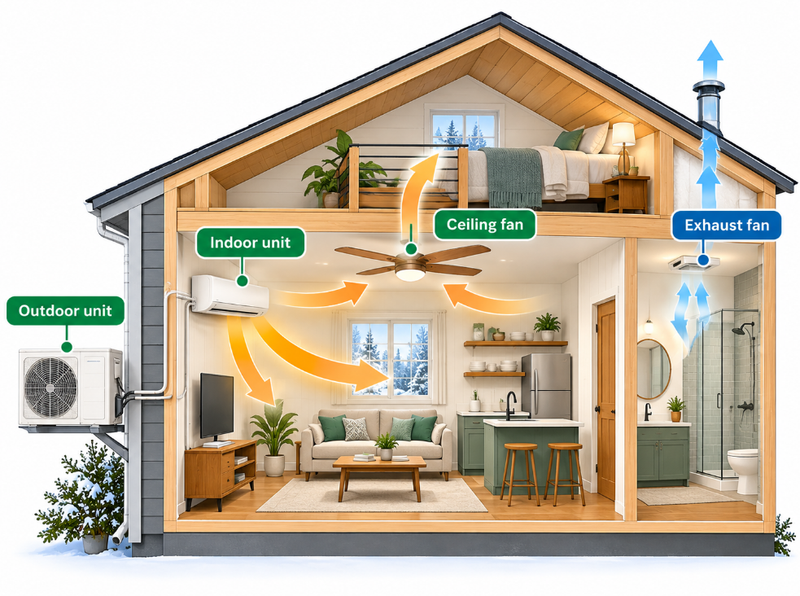
In a one-room home, the bed sits feet from the indoor unit and warm air drifts up into the loft. Filterbuy recommends this setup for its 12,000 BTU system:
Let the remote read the loft. Its Follow Me sensor reads the temperature wherever the remote sits, so keep it in the loft overnight.
Use Mute Mode near the bed. It runs as low as 28 dB in Mute Mode; aim the louvers away from your pillow.
Plan the bracket for weight. On a trailer every pound counts, and the outdoor unit weighs 61 lb. If the house moves, have a technician reconnect it.
Keep the line set short. The system comes pre-charged for up to 25 ft, and longer runs may need added refrigerant.
Let it dry itself. A 55°C self-cleaning cycle dries the coil.
Why Does a Tiny House Need Ventilation if It Has a Mini Split?
A mini split heats and cools the air already inside, but it doesn't bring in fresh outdoor air. Of all the mini split questions Filterbuy fields, that fact surprises people most. In a few hundred square feet, cooking and showering push humidity up quickly and breathing adds carbon dioxide.
Run a bath fan and range hood that vent outdoors.
In a tight build, add a small ERV or HRV.
Keep indoor humidity between 30% and 50%, per Filterbuy's guide to indoor air quality metrics; window condensation is an early warning.
Install smoke alarms, plus a carbon monoxide alarm if anything in the home burns fuel.
How Do You Keep a Mini Split Running Clean in a Small Space?
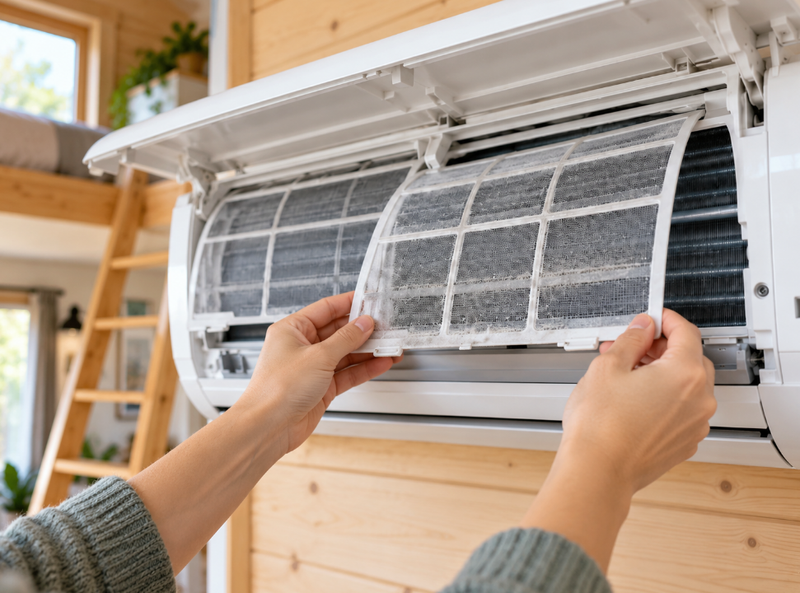
Across the ductless systems our team services, the most common failure isn't a broken part. It's a filter nobody checked. Filterbuy's service data shows a dirty mesh filter can cut efficiency by 5% to 30%. With pets, clean it every one to two weeks, and don't wait for it to look gray: Filterbuy's factory testing found fine dust under 10 microns is harder on a system than visible dirt.
The mesh pre-filter protects the coil; it isn't built to clean the air. "The pattern I see most often is people assuming the screen in their mini split is doing the same job as the filter in a furnace. It is not, and it was never built to," says David Heacock, Filterbuy's founder and CEO. In a ductless tiny house, a portable air purifier sized for the room handles that job. See how to clean mini split filters and mini split vs. an air purifier.
The Filterbuy take: On the grid, start with a right-sized single-zone mini split and add ventilation alongside it. Shop Filterbuy ductless mini split systems by coverage area, or answer a few quick questions to find your match.
Supporting Statistics
42% of U.S. home energy use goes to space heating. In 2020, propane-heated homes spent an average of $1,010 on it, versus $396 for electrically heated homes. Source: U.S. EIA, 2020 RECS
3,049 kWh saved per home, per year. That was the average when ductless heat pumps were metered in 95 electrically heated Northwest homes. Source: NEEA field metering report (2012)
About 15,000 ER visits and nearly 500 deaths a year. That is the U.S. toll of unintentional carbon monoxide poisoning, and 53.5% of exposures happen November through February, mostly at home. Source: CDC MMWR
Frequently Asked Questions
Can a Mini Split Heat a Tiny House in Winter?
Yes, in most climates. Below 5°F, keep a small electric heater as backup.
What Size Mini Split Do I Need for a 400 sq ft Tiny House or Garage Apartment?
Filterbuy's sizing guide starts at 20 to 25 BTU per square foot, or roughly 8,000 to 10,000 BTU for 400 sq ft. Adjust for insulation and climate, then confirm with a load calculation.
Is It Safe to Use a Propane Heater in a Tiny House?
Only a direct-vent model that sends exhaust outside, paired with a working CO alarm. Unvented models release carbon monoxide straight into the room.
How Do You Heat a Tiny House Off-Grid?
Most off-grid tiny homes use a direct-vent propane heater or a small vented wood stove, because a mini split needs steady power.
How Much Does a Mini Split for a Tiny House Cost?
Filterbuy publishes its prices: the 12,000 BTU single-zone system is $749 with free 2-day delivery on in-stock systems and a 7-year compressor / 3-year parts warranty. Professional installation is required and costs extra; Filterbuy's baseboard heat comparison puts installed mini splits at about $2,000 to $7,000 per zone.
Can One Mini Split Heat an Entire ADU?
In an open-plan studio, yes. If bedroom doors stay closed, a multi-zone system works better; Filterbuy's line is single-zone only.
Glossary
ADU (accessory dwelling unit): A second home on the same lot as a main house.
BTU (British thermal unit): A unit of heat energy.
Ductless mini split: A heat pump with outdoor and indoor units and no ductwork.
Single-zone vs. multi-zone mini split: One outdoor unit serving one indoor unit, or serving two or more.
Short-cycling: Frequent on-off cycling, often from oversizing.
Manual J: The ACCA standard for calculating a home's heating and cooling load.
ERV / HRV: Ventilators that trade stale indoor air for fresh air while recovering heat.
Unvented heater: A fuel-burning heater that exhausts into the room.
Sources
U.S. Energy Information Administration: 2020 RECS End-Use Release
Northwest Energy Efficiency Alliance: Ductless Heat Pump Field Metering Report
Green Building Advisor: Can You Oversize a Mini-Split Heat Pump?