Mini Split vs. Air Purifier: Do You Need Both for Clean Indoor Air?
August 3, 2026

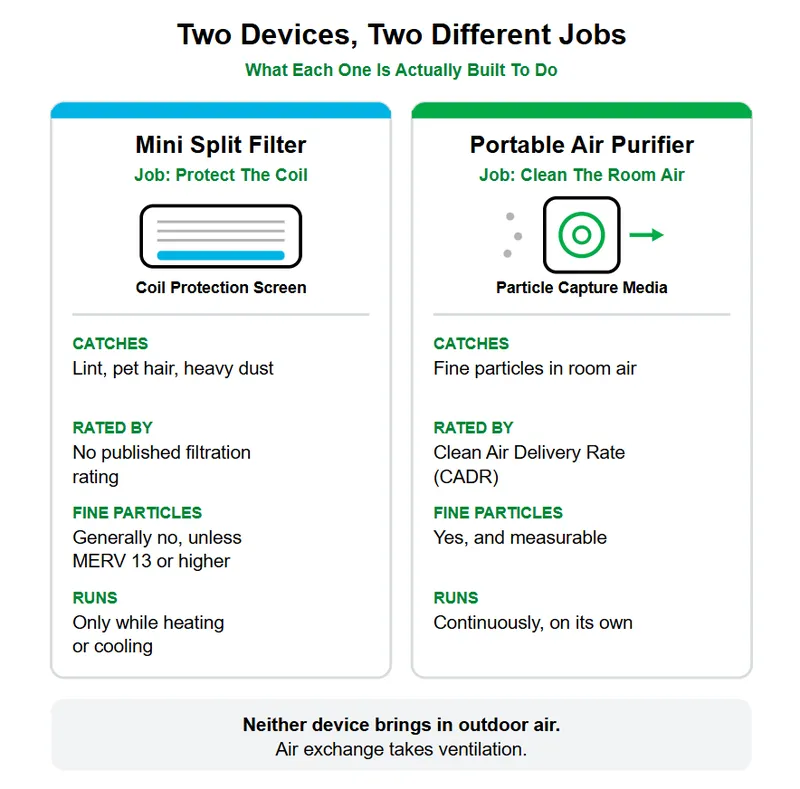
Households with allergies or asthma need both, because the two devices do different jobs. The U.S. Environmental Protection Agency states that ductless mini splits generally do not filter fine particles, because the filter inside the head unit exists to keep lint and pet hair off the coil. A portable air purifier is built to capture fine particles in the room where it sits.
- Mini split filter: catches lint, pet hair, and heavy dust to protect the coil.
- Portable air purifier: captures fine particles, rated by Clean Air Delivery Rate.
- Fine particle claims: check the mini split filter for a documented rating of MERV 13 or higher.
- Neither device: no outdoor air exchange, which takes ventilation instead.
Take the quiz below and we will point you to the setup that fits your rooms.
Answer a few quick questions and we will match you to the right mini split for your space.
A mini split filter and an air purifier do two different jobs. The U.S. Environmental Protection Agency states that ductless mini splits generally do not filter fine particles, because the filter inside them exists to keep lint and pet hair off the coil. A portable air purifier is built to capture fine particles. Households with allergies or asthma need both.
TL;DR
Your mini split filters the coil rather than your lungs. Federal guidance holds that stock mini split filters do not capture fine particles unless the filter carries a documented rating of MERV 13 or higher. A portable air purifier rated by Clean Air Delivery Rate does capture them, in the room where it sits. Allergy and asthma households should run both, and should check any ionizing add-on for ozone before buying it.
Key Takeaways
The U.S. Environmental Protection Agency states that ductless mini split filters are designed to keep large debris such as pet hair and lint off the equipment rather than to remove fine particles.
The U.S. Department of Energy lists lower air filtration among the disadvantages of minisplits and notes that a separate filtered air cleaner device may be necessary.
Verify any mini split filtration claim by checking the filter for a documented rating of MERV 13 or higher on the Minimum Efficiency Reporting Value scale.
Size a portable air purifier by Clean Air Delivery Rate, at a minimum of two-thirds of the room square footage.
A portable HEPA cleaner reduced mean PM2.5 by 78.8 percent in the room holding the unit and by 57.9 percent one room away.
Check any ionizer, plasma, or UV module sold as a mini split upgrade against the California Air Resources Board certified list before purchase.
What A Mini Split Filter Actually Captures
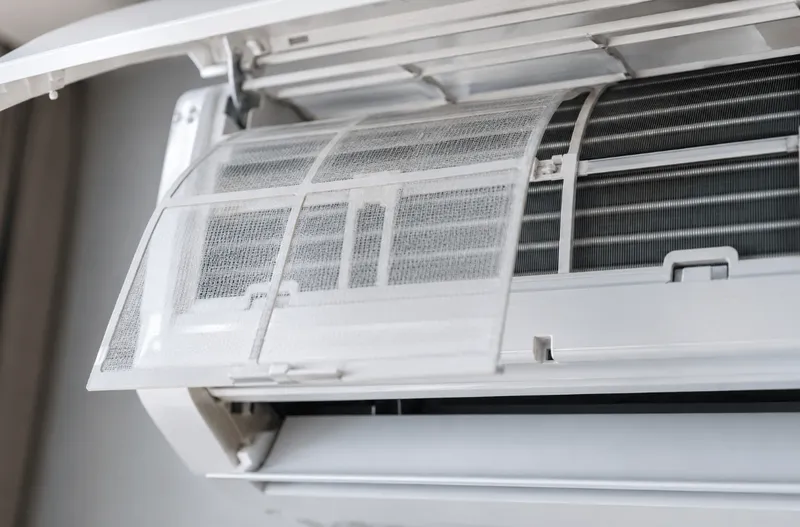
The mesh screen behind the front panel of a ductless head unit is a coil guard. It stops hair, lint, and heavy dust from coating the evaporator, which protects capacity and keeps the drain clear. The U.S. Environmental Protection Agency is direct about the limit of that design, stating that ductless mini split heat pumps generally do not filter fine particles from the air passing through the device.
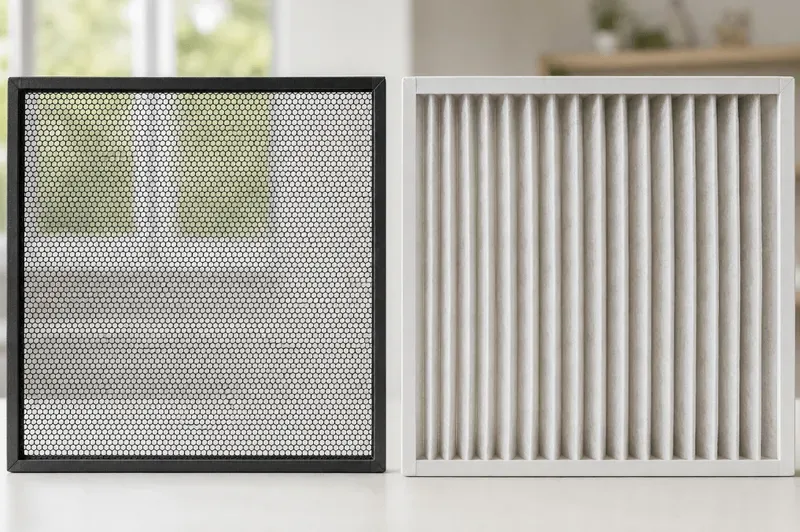
Some manufacturers market higher-efficiency filter options. The EPA gives one test for those claims, which is a documented rating of MERV 13 or higher. For comparison, a MERV 13 pleated filter is rated to capture particles down to roughly one micron. A filter without that rating has not demonstrated fine particle capture, whatever the marketing describes.
Two limits apply even to a mini split that does carry a high-efficiency filter. It treats only the room where the head unit is mounted, and it treats that room only while the system is running.
What A Standalone Air Purifier Adds
A portable air purifier is engineered around the job the mini split screen was never given. It pulls room air through dense pleated or HEPA media and returns it with the fine fraction removed. Because that is its only function, the industry rates it on output rather than on airflow.
Clean Air Delivery Rate is that rating. Certified by the Association of Home Appliance Manufacturers, CADR reports how many cubic feet of particle-free air a unit delivers each minute, with separate scores for smoke, dust, and pollen. The practical rule is that CADR should reach at least two-thirds of a room area in square feet, and should match the full square footage during wildfire smoke.
Mini Split Vs. Air Purifier At A Glance
How To Compare Two Products Rated On Different Scales
The comparison breaks before it starts because the two products are rated in incompatible ways. Purifiers carry a Clean Air Delivery Rate. Mini splits carry a BTU rating and a CFM airflow figure. A homeowner standing between them has no shared number.
Filterbuy sits on both sides of that gap. We manufacture pleated filter media in Talladega, Alabama, and we also sell ductless equipment, which means we have no commercial reason to inflate what a mini split filter captures and none to understate it either. Here is the conversion, and you can run it on your own equipment.
Clean air delivered equals airflow multiplied by single-pass efficiency.
Largest room served in square feet equals clean air delivered in CFM multiplied by 1.5625, at an eight-foot ceiling and the 4.8 air changes per hour AHAM uses to set certified room sizes.
That first equation is why airflow alone tells you nothing. A device can move a great deal of air and deliver almost no clean air, if the medium it moves that air through captures almost nothing. The airflow is high while the capture stays low, which is the mechanism behind the EPA position.
Take the high fan speed CFM from your own mini split spec sheet and run it against a range of capture rates. At 20 percent single-pass efficiency the equipment serves roughly a fifth of the room its airflow suggests. At 5 percent it serves a twentieth. The number that decides the answer is single-pass capture efficiency, and mini split manufacturers do not publish it.
Check Any Ionizing Add-On Before You Buy It
Aftermarket modules sold as mini split air purification upgrades frequently rely on ionizers, plasma, photocatalytic reaction, or ultraviolet light. Those are a different product category with a different risk profile, and four checks separate them from filtration.
Confirm the device appears on the California Air Resources Board certified list, which tests against an ozone emission limit.
Check whether the product generates ions or ozone rather than capturing particles in a medium. The American Lung Association advises against ultraviolet radiation, disinfection features, and ionizers on health grounds.
Look for a Clean Air Delivery Rate. Devices without airflow-based particle removal often carry none, because there is nothing to measure.
Treat any product that cannot clear the first three as a separate purchase decision rather than as a filtration upgrade.
Filterbuy builds filters that capture particles in a physical medium and hold them there. Devices that generate ions or ozone are attempting something different, and the certified lists exist because that difference carries a health consequence.
What Neither Device Does
A mini split and a portable air cleaner both recirculate the air already in the room, and neither introduces outdoor air. A household that buys both has improved particle capture and has done nothing about carbon dioxide, cooking fumes, or off-gassing from furnishings and cleaning products. Those need ventilation, which the American Lung Association ranks ahead of filtration and behind only removing the source.
Carbon media narrows part of the gap. Filterbuy carbon media built for odors and VOCs adds activated charcoal to standard particulate filtration, which helps with cooking smells and some gases. It still exchanges no air, so ventilation remains the answer for carbon dioxide.
If you are still choosing equipment rather than working with what you have, review what to look for in a ductless system before you buy, since filter access varies widely between models.
Why Mini Split Filtration Is A Sizing Problem First
A homeowner who reads the EPA guidance and decides to upgrade hits a physical obstacle immediately. Mini split filter openings are not built to the nominal sizes the filter industry standardizes around. Filterbuy stocks more than 600 sizes and cuts custom dimensions for the ones that fall outside that range, and the mini split case is exactly why that capability exists.
Measure the opening before shopping for a rating, then build a filter to your exact measurements rather than trimming one to fit. A trimmed filter leaks around its own cut edges and captures less than its rating promises.
It also helps to understand how nominal and actual filter sizes differ before ordering, since the number printed on a frame is not the number you measure.
"After manufacturing filters for over a decade and serving more than two million households, the pattern I see most often is people assuming the screen in their mini split is doing the same job as the filter in a furnace. It is not, and it was never built to. That screen protects the coil. Capturing fine particles is a different job with a different rating behind it, and the honest answer is that most stock mini split filters do not carry that rating."
David Heacock, Founder and CEO, Filterbuy
Essential Resources
Confirm Whether Your Mini Split Filters Fine Particles At All
The U.S. Environmental Protection Agency answers this question directly and sets the MERV 13 verification test for any filtration claim.
Understand The Filtration Trade-Off Built Into Ductless Equipment
The U.S. Department of Energy lists lower air filtration among minisplit disadvantages and notes that a separate air cleaner may be necessary.
Source: https://www.energy.gov/node/1265871
Spend Your Money On The Fix That Works First
The American Lung Association ranks air cleaning third, behind source removal and ventilation, and lists six selection criteria.
Source: https://www.lung.org/clean-air/indoor-air/protecting-from-air-pollution/air-cleaning
Learn The One Number That Makes Purifiers Comparable
The Association of Home Appliance Manufacturers defines Clean Air Delivery Rate and publishes the two-thirds sizing rule.
Source: https://ahamverifide.org/ahams-air-filtration-standards/
Match A Purifier To Your Room Size In One Table
ENERGY STAR pairs room area from 100 to 600 square feet with a minimum CADR and lists certified models with running costs.
Source: https://www.energystar.gov/products/air_cleaners
Check Any Ionizing Add-On Against The Ozone Certified List
The California Air Resources Board certifies indoor air cleaners against an ozone emission limit and publishes the approved list.
Choose Equipment That Holds Up For An Allergy Household
The Asthma and Allergy Foundation of America separates CADR from MERV and explains how ionizers and UV differ from mechanical filtration.
Source: https://community.aafa.org/blog/air-cleaners-what-you-need-to-know
Supporting Statistics
Individual Units Are The Primary Cooling Equipment In Half Of Northeast Homes
In the 2020 Residential Energy Consumption Survey, 50 percent of Northeast households used individual AC units as their primary cooling equipment.
That category covers mini splits, window units, and portable units.
Nationally, two-thirds of households cool with a central system instead.
Source: https://www.eia.gov/todayinenergy/detail.php?id=52558
A Portable HEPA Cleaner Works, And It Works Mostly In Its Own Room
Mean PM2.5 fell 78.8 percent in the room holding the unit and 57.9 percent one room away.
Measured across 29 occupied homes in a single-blinded randomized cross-over trial against a sham condition with the filters removed.
Source: https://pmc.ncbi.nlm.nih.gov/articles/PMC11014421/
Asthma Affects 8.6 Percent Of Adults And 6.5 Percent Of Children
Current asthma prevalence is 8.6 percent among U.S. adults and 6.5 percent among U.S. children, from 2024 National Health Interview Survey data.
The Centers for Disease Control and Prevention last reviewed the page February 20, 2026.
Source: https://www.cdc.gov/nchs/fastats/asthma.htm
Frequently Asked Questions
Do mini splits filter the air?
Mini splits filter large debris such as lint and pet hair to protect the coil. The U.S. Environmental Protection Agency states that they generally do not filter fine particles unless the unit carries a documented MERV 13 filter or higher.
Can i put a hepa filter in my mini split?
Most head units have no cabinet depth or blower static pressure for HEPA media. Check the manufacturer documentation first, and treat a portable purifier as the practical route to HEPA-grade capture.
Do mini splits bring in fresh air?
No. Mini splits recirculate the air already inside the room. Outdoor air exchange requires ventilation, an energy recovery ventilator, or open windows.
What CADR do i need for a bedroom?
Multiply the room square footage by two-thirds. A 150 square foot bedroom needs a smoke CADR of about 100. During wildfire smoke, match the full 150 instead.
Are mini split ionizer add-ons safe?
Check the California Air Resources Board certified list before buying. Ionizers, plasma devices, and UV lamps can emit ozone, and the American Lung Association advises against those features.
Is a mini split good for allergies?
A mini split helps by avoiding dusty ductwork and by holding humidity in a range that limits dust mites and mold. For airborne allergen capture, pair it with a purifier sized to the room.
Glossary
Air Changes Per Hour (ACH). The number of times the full volume of air in a room is replaced or filtered in one hour. AHAM sets certified room sizes at 4.8 air changes per hour.
Clean Air Delivery Rate (CADR). The certified measure of how many cubic feet of particle-free air a portable air purifier delivers each minute, scored separately for smoke, dust, and pollen.
Ductless Mini Split. A heating and cooling system with an outdoor compressor connected to one or more indoor head units, requiring no ductwork.
HEPA. High Efficiency Particulate Air. A filter grade that captures at least 99.97 percent of particles at 0.3 microns, the most penetrating particle size.
MERV. Minimum Efficiency Reporting Value. The 1 to 16 scale rating how well a filter captures particles. MERV 13 is the EPA threshold for fine particle capture.
Ozone Generator. A device that intentionally produces ozone. The California Air Resources Board advises against home use because ozone irritates and damages lung tissue.
PM2.5. Fine particulate matter 2.5 microns and smaller, including wildfire smoke and combustion particles, small enough to reach deep into the airways.
Single-Pass Efficiency. The share of particles a filter removes from the air in one pass through the medium. Multiplied by airflow, it gives clean air delivered.