
Is the Flu Airborne? How Flu Actually Spreads Inside Your Home
November 9, 2026
TL;DR
Yes, flu can travel through the air. Most people catch it at close range, within about 6 feet, from respiratory droplets. Smaller aerosols can carry live virus too and linger longer in dry, closed-up winter homes. At Filterbuy, we treat these as two separate problems: distance and a flu shot protect you up close, while filtration and humidity near 40% protect the air your family shares.
Key Takeaways
Droplets cause most flu infections. The CDC says flu spreads mainly at close range.
Flu aerosol transmission is real. A 2018 PNAS study found live virus in 39% of fine-aerosol breath samples, with no coughing required.
Dry air keeps airborne flu infectious longer. In a CDC/NIOSH study, flu kept 71–77% of its infectivity at 23% humidity or lower, but only 15–22% at 43% or higher.
MERV 13 is rated for the particle sizes flu travels in. Under ASHRAE Standard 52.2, it must catch at least 85% of 1–3 micron particles.
No filter replaces a flu shot. Filtration cleans the air but can't stop close-range or surface spread.
Is the Flu Airborne?
The flu is partly airborne. Larger droplets cause most infections, usually within about 6 feet. Smaller aerosols stay in the air longer and can be breathed in across a room. Health agencies agree it spreads through the air at close range; how much long-range spread adds is still debated.
For decades, flu was classed as a "droplet" disease, and the CDC's current guidance still names droplets as the main route.
Newer research complicates that picture. In 2018, a team led by Dr. Donald Milton at the University of Maryland School of Public Health sampled the breath of 142 people with confirmed flu. Their study, published in Proceedings of the National Academy of Sciences (PNAS), found live virus in 39% of fine-aerosol samples, and coughing wasn't necessary to produce it.
In April 2024, the World Health Organization and four public health agencies, including the U.S. CDC, updated their language to match. They now call all of them "infectious respiratory particles" (IRPs), with no single size cutoff.
Airborne vs. Droplet Transmission: What's the Difference?
Droplets land on you at close range, while aerosols stay suspended and get breathed in, sometimes after the sick person has left the room.
Size cutoffs vary by study; the 5-micron line matches the 2018 PNAS study. WHO now treats particle size as a continuous range.
How Does the Flu Spread Through a Home? A Sick-Week Timeline
Flu moves through a household in three ways: close-range droplets (the main route), inhaled aerosols, and, less often, contaminated surfaces. According to the CDC, people are contagious from about a day before symptoms start until roughly a week after, and they're most contagious in the first three days. Filterbuy maps that week inside a home like this:
Sources: CDC contagious-period guidance and the 2018 PNAS breath study, which found exhaled aerosol virus highest on day 1 of symptoms and lower on days 2 and 3.
How Far Do Flu Droplets Travel, and How Long Do Aerosols Linger?
Droplets usually fall within about 6 feet, the distance the CDC has long used for flu. Aerosols ride air currents for minutes or longer, so keeping your distance won't fully protect you in a shared room.
Humidity plays a big role in how long airborne flu stays dangerous. In a 2013 study by the CDC's National Institute for Occupational Safety and Health (NIOSH), a coughing manikin released flu virus into a simulated exam room. Here is how much could still infect cells an hour later:
Source: Noti et al., PLOS ONE, 2013 (CDC/NIOSH). Flu virus released by a coughing manikin in a simulated exam room.
Why Does Flu Spread More Easily Indoors in Winter?
Flu transmission indoors rises in winter because homes get drier and stuffier at the same time:
Dry air. Furnace heat adds no moisture, so many homes drift to 15–25% humidity in winter. That's the range where the NIOSH study found flu stayed most infectious.
Less fresh air. Closed-up winter homes trade less air with the outdoors, so exhaled particles hang around longer.
At Filterbuy, we see winter's toll on the filters themselves. Our team has pulled used filters from customers' systems in February that were completely black after just 30 days.
CDC surveillance for the week ending October 24, 2026 showed flu activity rising earlier than usual, and flu typically peaks from December to February.

How Can You Lower Airborne Flu Levels in Your Home?
The goal is to remove virus-carrying particles faster than a sick person adds them. As a U.S. air filter manufacturer, Filterbuy focuses on the four levers you control: filtration, airflow, fresh air, and humidity.
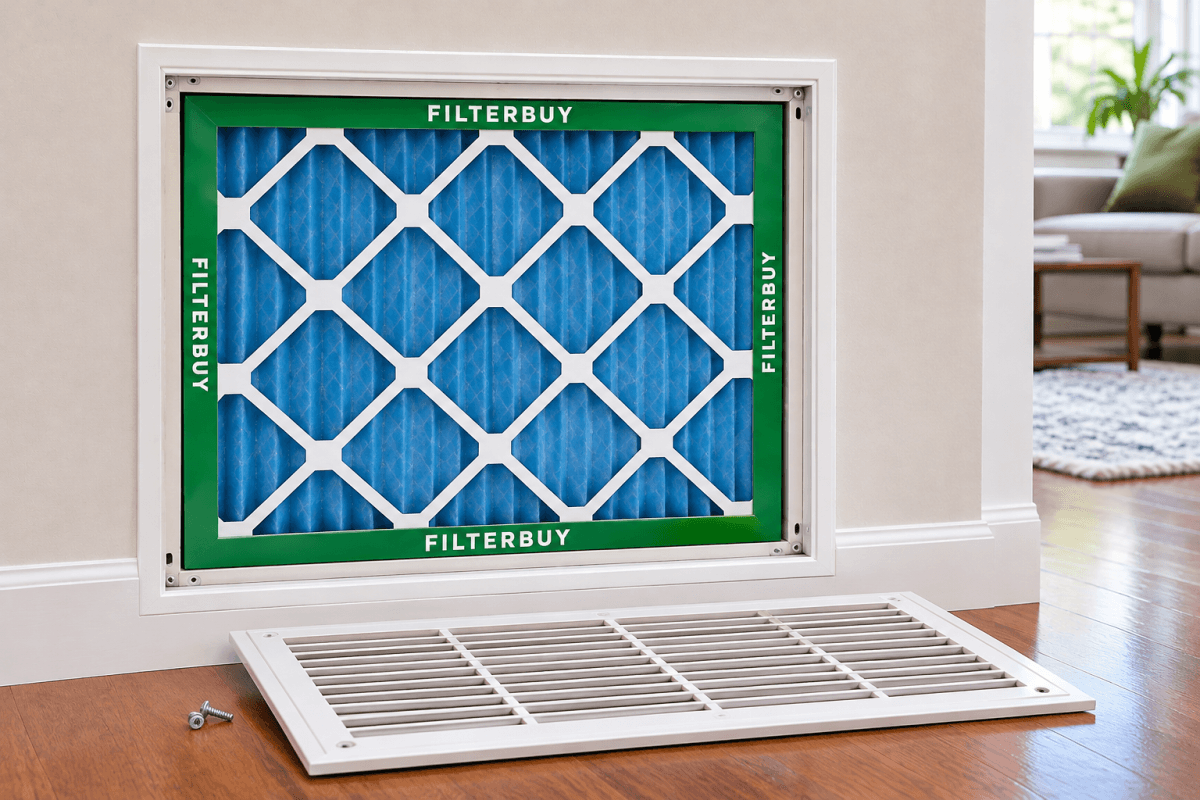
Upgrade to MERV 13 if your system supports it. The EPA recommends at least MERV 13, or the highest rating your system can handle. Filterbuy builds its MERV 13 to the ASHRAE 52.2 minimums, capturing at least 50% of particles at 0.3–1 micron and 85% at 1–3 microns. That covers the size of fine flu aerosols. See our guide to the best air filters for viruses.
Run the fan, not just the heat. The EPA says most systems run less than 25% of the time. In Auto mode, your filter works about 6 hours a day; set the fan to "On" and it can work all 24. The EPA suggests running the fan longer or continuously, and it's the one step we recommend that costs nothing.
Replace a dirty filter now. A clogged filter restricts airflow, so less air gets cleaned. See how often to change your air filter.
Make sure the filter fits. Air that slips around the frame skips filtration. Filterbuy cuts every filter half an inch under its nominal size so it seats snugly. As Michelle puts it, “a rating describes the media, not the gap around it.” See how to measure your air filter.
Hold humidity near 40%. Check with a hygrometer, and add a humidifier if readings fall into the 20s. Then use Filterbuy's dial-down rule: aim for 40% when it's above 20°F outside, and drop about 5 points for every 10°F colder. “In winter it’s a moving target,” Michelle says. “Your windows tell you when you’ve gone too far.” On the coldest days, when 40% would fog the glass, lean more on filtration and the fan.
Bring in fresh air. Run exhaust fans, and crack a window when weather allows.
Create a sick room. Keep the sick person in one room with the door closed, and run a portable HEPA purifier close to the bed. Placement matters: in CDC testing, units near the source cut exposure by 65%, compared with 49% when placed high on the room's sides. See how air filters and air purifiers work together.
Filterbuy Pro Tip
Set up Filterbuy auto-delivery so a fresh filter shows up before you need it, not in the middle of a sick week.
Supporting Statistics
At home, 9.7% of exposed family members caught the flu.
Study: 328 Michigan households with children, followed through the 2010–2011 season (CDC-funded).
Finding: Flu reached 24% of homes and spread more often where no humidifier was used.
Why it matters: Humidity is a real household defense.
Source: CDC Stacks household study
Portable HEPA air cleaners cut aerosol exposure by up to 65%.
Test: CDC/NIOSH, 2021, with two HEPA units and breathing manikins in a meeting room.
Note: The test used simulated COVID-19 aerosols rather than live flu.
Why it matters: A purifier near the bed helps in a sick room.
Flu caused an estimated 51 million U.S. illnesses in 2024–2025.
Toll: 710,000 hospitalizations and 45,000 deaths.
Severity: The first high-severity season since 2017–2018.
Why it matters: Vaccination prevented about 10 million illnesses. No filter replaces it.
Source: CDC 2024–2025 season summary
Ready for flu season? Shop Filterbuy MERV 13 filters, made in the USA in 600+ sizes.
Frequently Asked Questions
Can the Flu Spread Through the Air?
Yes. Flu spreads through droplets at close range and through aerosols that linger in dry, poorly ventilated rooms.
Does an Air Filter Stop the Flu?
An air filter can't stop the flu, but it lowers the amount of virus in your air. A MERV 13 filter or HEPA purifier captures virus-carrying particles as air passes through, yet it can't block close-range droplets or surface spread. Pair it with vaccination and handwashing, and see Filterbuy's guide to air filter myths during cold and flu season.
Glossary
- Influenza (Flu)
- A contagious respiratory illness caused by influenza viruses.
- Respiratory Droplets
- Larger particles that usually fall within about 6 feet.
- Aerosols
- Particles roughly 5 microns or under that can stay airborne.
- Airborne Transmission
- Infection from inhaling virus-carrying particles in the air.
- Droplet Transmission
- Infection when larger particles land on the eyes, nose, or mouth at close range.
- Infectious Respiratory Particles (IRPs)
- WHO's 2024 term for all virus-carrying particles people exhale, regardless of size.
- Relative Humidity (RH)
- Air moisture as a percentage of the most the air can hold at that temperature.
- MERV (Minimum Efficiency Reporting Value)
- A 1–16 ASHRAE rating of how well an HVAC filter captures particles.
- HEPA (High-Efficiency Particulate Air) Filter
- A filter that captures at least 99.97% of 0.3-micron particles, common in portable purifiers.
- HVAC
- Heating, ventilation, and air conditioning.
- Filterbuy
- A family-owned U.S. manufacturer of HVAC air filters, made to order in 600+ sizes.
- CDC, NIOSH, EPA
- U.S. Centers for Disease Control and Prevention, its National Institute for Occupational Safety and Health, and the Environmental Protection Agency.
- ASHRAE, WHO, PNAS
- The American Society of Heating, Refrigerating and Air-Conditioning Engineers; the World Health Organization; Proceedings of the National Academy of Sciences, a peer-reviewed journal.
Sources
Centers for Disease Control and Prevention. How Flu Spreads. Updated September 17, 2024.
Yan J, Grantham M, Pantelic J, et al.; Milton DK. Infectious virus in exhaled breath of symptomatic seasonal influenza cases from a college community. Proceedings of the National Academy of Sciences, 2018;115(5):1081–1086.
World Health Organization. Leading health agencies outline updated terminology for pathogens that transmit through the air. April 18, 2024.
Noti JD, Blachere FM, McMillen CM, Lindsley WG, et al. High humidity leads to loss of infectious influenza virus from simulated coughs. PLOS ONE, 2013;8(2):e57485.
U.S. Environmental Protection Agency. What kind of filter should I use in my home HVAC system?
U.S. Environmental Protection Agency. Guide to Air Cleaners in the Home. Updated October 1, 2026.
Centers for Disease Control and Prevention. Weekly U.S. Influenza Surveillance Report, Week 42, ending October 24, 2026.
Petrie JG, Ohmit SE, Cowling BJ, et al.; Monto AS. Influenza Transmission in a Cohort of Households with Children: 2010–2011. PLOS ONE, 2013;8(9). CDC Stacks.
Lindsley WG, Derk RC, Coyle JP, et al. Efficacy of Portable Air Cleaners and Masking for Reducing Indoor Exposure to Simulated Exhaled SARS-CoV-2 Aerosols. MMWR, 2021;70:972–976.
Centers for Disease Control and Prevention. 2024–2025 Influenza Season Summary: Severity, Disease Burden, and Burden Prevented. Updated March 12, 2026.
This article is for general education and is not medical advice. If you or a family member has flu symptoms and is at higher risk for complications, contact a healthcare provider.