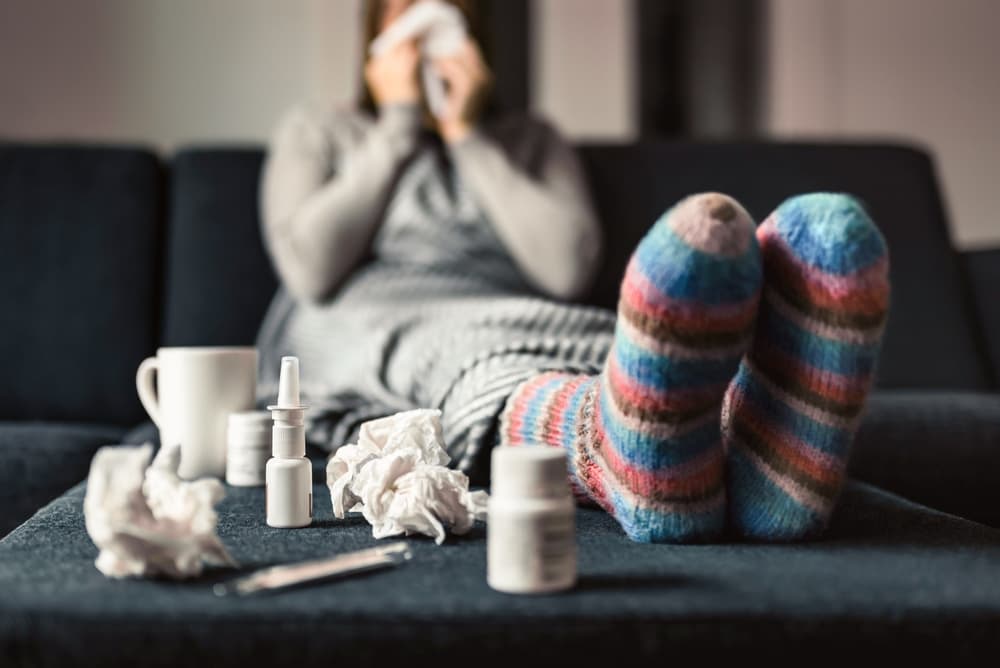
To improve indoor air quality during flu season, change your HVAC filter on schedule, pick a MERV rating your system can handle, ventilate when the weather allows, run a HEPA air purifier in the rooms you use most, keep humidity in a healthy range, adjust your HVAC fan setting, cut back on indoor pollutants, and clean shared surfaces often. None of these steps will prevent illness on their own, but together they create a healthier indoor environment alongside standard flu-season precautions.
Why Does Indoor Air Quality Matter During Cold & Flu Season?
Respiratory viruses spread easily in enclosed spaces. When several people share a home for long stretches, as most families do from fall through early spring, exhaled particles build up in the air instead of escaping outdoors.
Poor ventilation makes this worse. A home sealed tight against the cold also traps dust, pet dander, and other everyday pollutants. Heating systems dry out the air as well, which can leave your nose and throat feeling scratchy and irritated.
It helps to understand the difference between ventilation and filtration.
→Ventilation
Replaces indoor air with fresh outdoor air, whether you open a window, run an exhaust fan, or use a mechanical ventilation system.
●Filtration
Captures particles already floating around inside, usually through your HVAC air filter or a portable air purifier.
You need both, and one can’t stand in for the other. Running your HVAC fan, for example, pushes indoor air through the filter, but it doesn’t pull in any fresh air from outside.
8 Ways to Do for Cleaner and Better Air During Cold & Flu Season
1
Replace Dirty HVAC Air Filters Regularly
Your HVAC air filter traps dust, pollen, pet dander, and other particles every time your system runs. Once it’s clogged, it catches less and restricts airflow, which forces your system to work harder.
Since your heating runs more often in winter, filters fill up faster than they do in mild weather. As a general rule, replace 1-inch filters every 1 to 3 months, and closer to monthly if you have pets, allergies, or someone sick at home. Thicker 4- or 5-inch filters can last 6 to 12 months. Your filter’s packaging will list a specific recommendation.
A fresh filter won’t wipe out airborne viruses, but it keeps your system filtering at full strength. Setting a calendar reminder for each swap, or signing up for a filter subscription, makes it easier to stay on schedule as temperatures drop.
2
Choose an HVAC Filter With the Right MERV Rating
MERV (Minimum Efficiency Reporting Value) measures how well an air filter captures particles of different sizes on a scale of 1 to 16. The higher the number, the smaller the particles it can catch. Higher-rated filters can also restrict airflow in systems that weren’t designed for them, so check your system’s specifications before you upgrade.
| MERV Rating | Particle Capture | Best For |
|---|
| MERV 8 | Larger particles like dust, pollen, lint, and mold spores | Standard residential use |
|---|
| MERV 11 | Smaller particles, including pet dander and fine dust | Households with pets or seasonal allergies |
|---|
| MERV 13 | Very fine particles, including many bacteria, smoke, and a share of virus-carrying droplets | Households that want finer filtration and have a system that can support it |
|---|
Choose MERV 11 if pet dander or seasonal allergies are your main concern. Choose MERV 13 if you want to catch a broader range of fine particles and your HVAC system can handle the extra airflow resistance. Confirm compatibility first, since a filter that’s too restrictive for your system can lower efficiency and strain the blower.
3
Let Fresh Outdoor Air In When Conditions Allow
Opening windows for even 10 to 15 minutes a day, when the weather and outdoor air quality allow, swaps stale indoor air for fresh air and dilutes particles that have built up inside. This is true ventilation, something your HVAC fan alone can’t provide.
On very cold days, crack a window during the warmest part of the afternoon. Opening windows on opposite sides of the house for a few minutes creates a cross-breeze that exchanges air faster than leaving one window open longer. Kitchen and bathroom exhaust fans also help by pushing indoor air outside with little heat loss.
4
Use a Portable HEPA Air Purifier in High-Use Rooms
True HEPA (High-Efficiency Particulate Air) filters capture at least 99.97% of particles 0.3 microns in size, which is the particle size that’s hardest to trap. A HEPA purifier works well alongside your HVAC system, especially in bedrooms and living rooms where your family spends the most time.
When shopping, look at the purifier’s CADR (clean air delivery rate). This tells you how much filtered air the unit delivers, with separate ratings for smoke, dust, and pollen. A common rule of thumb is to choose a smoke CADR of at least two-thirds of the room’s square footage, assuming 8-foot ceilings. A 300-square-foot room, for example, calls for a smoke CADR of about 200 cfm or higher.
Keep your expectations realistic. A HEPA purifier only cleans the air that moves through it. It reduces airborne particles in the room, but it won’t remove every virus, and it doesn’t replace other precautions when someone in your household is sick.
5
Keep Indoor Humidity at a Comfortable, Controlled Level
The EPA recommends keeping indoor relative humidity between 30% and 50%. Air that’s too dry can irritate your nose and throat, while air that’s too humid encourages mold and dust mites.
A hygrometer, which many smart thermostats have built in, lets you track humidity at a glance. When the heat dries out your home, a humidifier can bring levels back into range. Just avoid overdoing it, since humidity above 50% can lead to condensation and mold growth. Clean your humidifier regularly, too, so it doesn’t release bacteria or mold into the air.
Some laboratory studies suggest flu viruses stay infectious longer in very dry air and lose their ability to infect faster when humidity sits around 40% or higher. That’s promising, but humidifiers haven’t been proven to prevent the flu at home, so treat humidity control as a comfort and air quality measure first.
6
Your thermostat’s fan setting controls how often air passes through your filter. It affects filtration, not ventilation. Here’s how the common settings compare:
| Fan Setting | What It Does | When to Use It |
|---|
| AUTO | Fan runs only when the system is actively heating or cooling | Everyday use when energy savings are the priority |
|---|
| ON | Fan runs continuously, even when the system isn’t heating or cooling | When you want steadier filtration, such as during flu season or when someone is sick |
|---|
| CIRCULATE | Fan runs for part of each hour on a set schedule | A middle ground between AUTO and ON |
|---|
Switching to ON sends air through your filter more often, so your system catches more particles throughout the day. It can raise your energy bill, especially with older single-speed blower motors, so many homeowners save it for times when someone in the house is sick. For the best results, pair it with occasional ventilation.
7
Reduce Indoor Pollutants That Make Air Quality Worse
Your daily habits shape your indoor air, too. Scented candles, aerosol sprays, plug-in air fresheners, and harsh cleaning chemicals release particles and volatile organic compounds (VOCs) into the air you breathe. In winter, when fresh airflow is already limited, cutting back on these sources makes a noticeable difference.
A few simple swaps help: use fragrance-free cleaning products, vacuum with a HEPA-filter vacuum so dust doesn’t blow back into the room, and dust with a damp cloth instead of a dry one. Washing pet bedding often and keeping litter boxes clean also cuts down on dander and odors.
8
Keep Shared Spaces Clean and Limit Exposure When Someone Is Sick
Flu viruses can survive on hard surfaces for up to 48 hours. Wipe down frequently touched spots like doorknobs, remote controls, light switches, faucet handles, and kitchen counters on a regular basis, and daily if someone at home is sick.
If a family member comes down with the flu, have them stay in a separate room as much as possible and use their own bathroom if you have more than one. Avoid sharing cups, utensils, towels, and bedding, and remind everyone to wash their hands often. Improving airflow in the sick person’s room with an open window, an exhaust fan, or a purifier also helps lower exposure for the rest of the household.
Which Air-Cleaning Methods Make the Biggest Difference?
Every household has different priorities. Use this table to match your main concern with the step that helps most:
| Homeowner Concern | Recommended Action | Why It Helps |
|---|
| Stale, stuffy indoor air | Ventilate with fresh outdoor air when conditions allow | Dilutes particles that build up indoors |
|---|
| Pet dander or dust buildup | Upgrade to a MERV 11 filter or higher | Captures more fine particles than basic filters |
|---|
| Someone in the household is sick | Set your HVAC fan to ON and isolate the sick person | Increases filtration while limiting close contact |
|---|
| Dry, irritated airways | Keep relative humidity between 30% and 50% | Supports respiratory comfort |
|---|
| Limited whole-home filtration | Add a HEPA purifier in high-use rooms | Targets the rooms where people spend the most time |
|---|
| General seasonal air quality | Replace your HVAC filter on schedule | Keeps filtration consistent all season |
|---|
What Should You Do First if Someone in Your Home Already Has the Flu?
If the flu makes its way into your household, start with these steps:
1Isolate the sick person in a separate room, and have them use a separate bathroom if possible.
2Ventilate that room when the weather allows, or run an exhaust fan to help clear airborne particles.
3Filter the air by setting your HVAC fan to ON or running a portable HEPA purifier in the sick person’s room.
4Clean frequently touched surfaces daily with a household disinfectant.
5Contact a doctor early if the sick person is at higher risk of complications, including children under 5, adults 65 and older, pregnant women, and people with chronic health conditions. Antiviral medication works best when started within 48 hours of symptoms. Seek emergency care right away for warning signs like trouble breathing, chest pain, confusion, or symptoms that improve and then return worse.
These steps help create a healthier home environment, but they don’t replace medical care, especially when symptoms are severe.
Keep Your Home’s Air Cleaner All Season With Filterbuy
A clean, well-maintained HVAC filter is one of the simplest ways to support better indoor air quality all winter long. Filterbuy offers a wide range of replacement HVAC air filters across different MERV ratings, so you can choose the filtration level that fits your household’s needs and your system’s specifications.
Not sure which size you need? Use Filterbuy’s filter sizing tool to find the right fit and keep your system running efficiently through flu season and beyond. Good indoor air habits matter long after March.
Shop Air Filters
Find Your Filter Size
Frequently Asked Questions
Can an HVAC air filter help reduce airborne flu particles?
An HVAC air filter can capture some airborne particles as air moves through your system, including dust and some respiratory droplets, especially at MERV 13. However, it can’t prevent the flu, colds, or RSV, and it only cleans the air that circulates through your HVAC system, not every corner of your home.
What MERV rating is best for cold and flu season?
MERV 11 to 13 filters are a popular choice during cold and flu season because they capture finer particles than basic filters. Before upgrading, check that your HVAC system can handle the added airflow resistance of a higher-rated filter.
Should I run my HVAC fan continuously during flu season?
Setting your fan to ON sends air through your filter more often, which means steadier filtration throughout the day. Since it only recirculates indoor air, it works best when paired with occasional ventilation. It can also raise your energy use, so some homeowners only switch to ON when someone at home is sick.
Is opening windows helpful during cold and flu season?
Yes. Opening windows for even a few minutes, when the weather allows, swaps stale indoor air for fresh outdoor air and dilutes particles that have built up inside. Your HVAC system can’t do this on its own, since it mostly recirculates the air already in your home.
Does a HEPA air purifier help when someone at home has the flu?
A HEPA air purifier can capture most airborne particles that pass through its filter, which may help reduce particles in the room where it runs. It won’t eliminate every virus in the space, so use it alongside other precautions like isolation, handwashing, and surface cleaning.
What is the ideal indoor humidity during flu season?
The EPA recommends keeping indoor relative humidity between 30% and 50%. This range keeps your home comfortable and helps prevent mold and dust mites. Some research suggests moderate humidity may shorten how long flu viruses stay infectious in the air, but a humidifier alone isn’t a proven way to prevent the flu.
Sources: