
How to Sleep With a Stuffy Nose (And Why It's Worse at Night)
November 23, 2026
TL;DR
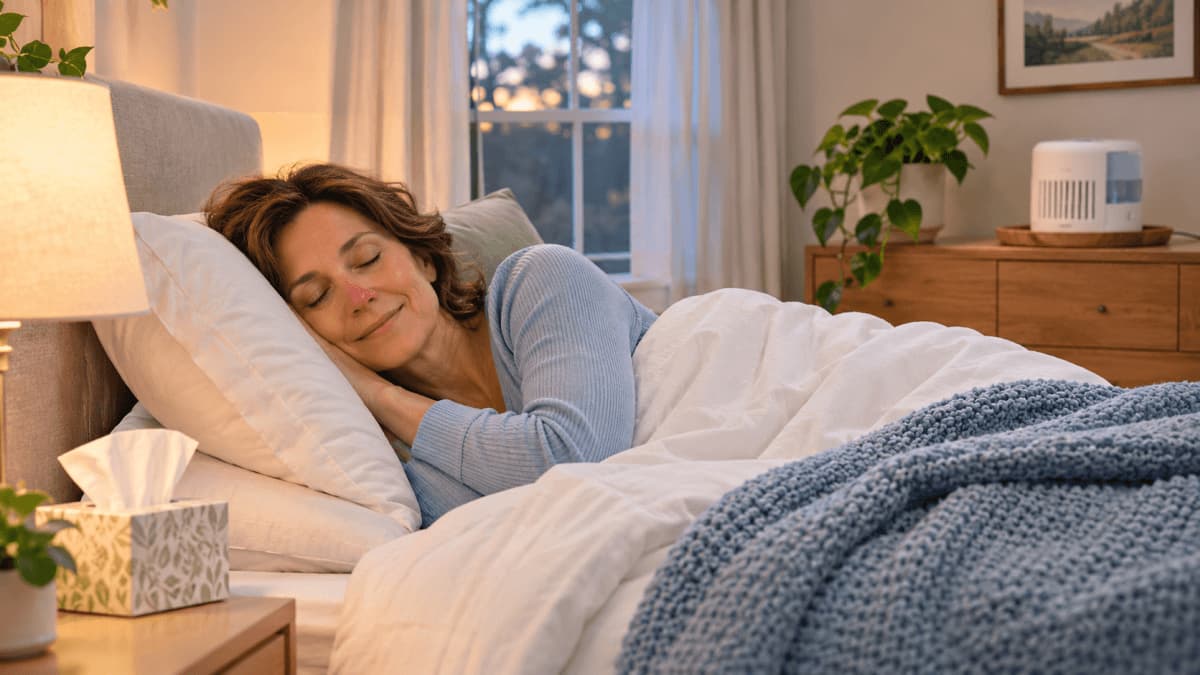
To sleep with a stuffy nose, rinse with saline before bed, then sleep with your head and shoulders raised and the blocked nostril facing up. Congestion gets worse at night because lying flat sends more blood to the swollen tissue in your nose and keeps mucus from draining. Filterbuy's advice is to keep bedroom humidity at 40% to 50% and the air filter fresh.
Key Takeaways
Lying down makes congestion worse. Nasal tissue swells, and mucus stops draining.
Side sleeping helps one-sided stuffiness. The lower nostril often congests, so keep the blocked side up.
Heated winter air is drier than most people think. By Filterbuy's math, 20°F outdoor air heated to 68°F drops to about 11% relative humidity before any moisture is added.
Never prop up a congested baby. The American Academy of Pediatrics says babies should sleep flat on their backs.
Filterbuy's point of view: most stuffy-nose guides stop at your nose. We've built air filters in our own U.S. factories since 2013, so we started with the room: how dry heated bedroom air gets, and the HVAC steps health sites skip.
How to Sleep With a Stuffy Nose: A Bedtime Plan
The best way to sleep with a stuffy nose is to clear it with saline first, then lie down with your head raised and the blocked nostril facing up. Moist, clean bedroom air helps the relief last all night, with no medicine needed.
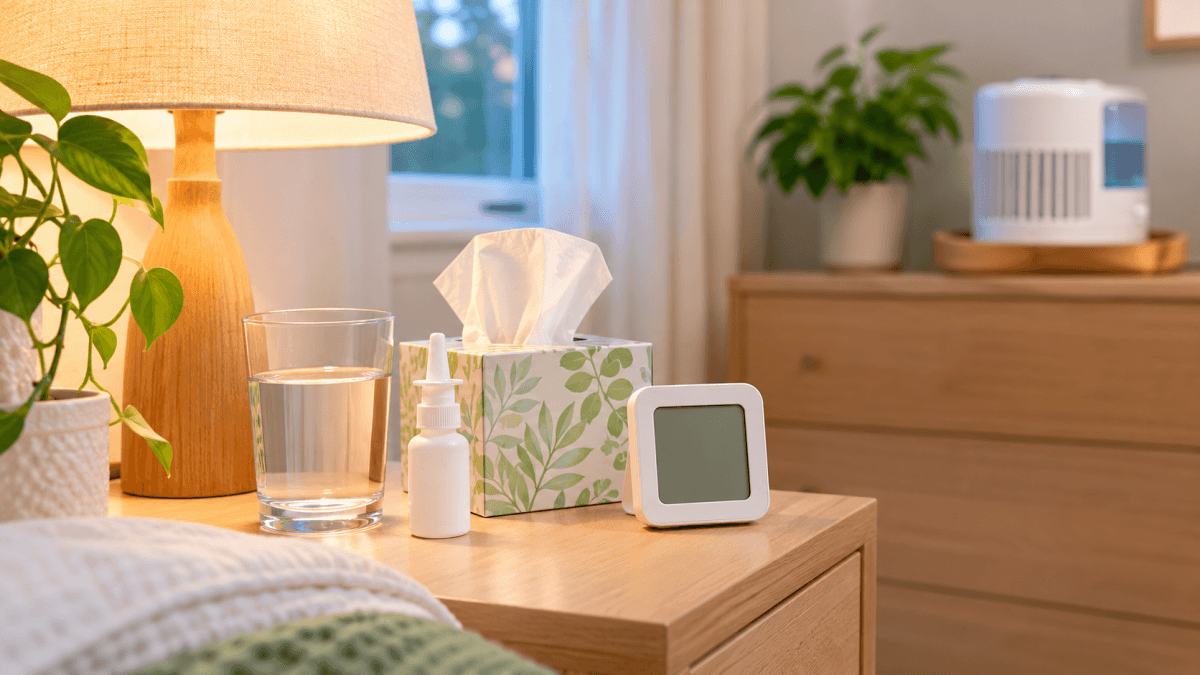
An hour before bed, check the hygrometer. If humidity is under 40%, start a clean humidifier.
Thirty minutes before, take a warm shower and drink water.
Right before bed, use a saline spray or rinse, then blow your nose gently.
In bed, raise your head and shoulders, and turn so the stuffier nostril faces the ceiling.
If you wake up blocked, sit up for a few minutes, then switch sides.
Why Is Congestion Worse at Night?
Congestion is worse at night mainly because of posture. When you lie flat, more blood flows to your head, so the turbinates, the blood-rich ridges inside your nose, swell and narrow the airway. Gravity stops helping mucus drain, and bedroom allergens and dry air make a stuffy nose at night worse.
Filterbuy's nighttime stuffiness check matches the fix to what you're actually noticing.
Sources: Filterbuy nighttime stuffiness check, built from Henry Ford Health, UPMC and Cleveland Clinic.
Itchy eyes? See our allergies vs. a cold guide.
What Filterbuy noticed: none of the hospital guides we reviewed mention the HVAC system, even though it moves bedroom air all night.
Best Sleeping Position for a Stuffy Nose
The best sleeping position for a stuffy nose is on your side or back, with your head and shoulders raised on a wedge or two pillows. If only one nostril is blocked, sleep on the opposite side so the blocked nostril faces up. Stomach sleeping is the worst for sinus drainage. The right choice depends on the cause, so Filterbuy's guide sorts positions by symptom.
Sources: Filterbuy position guide, built from UPMC, Cleveland Clinic and Henry Ford Health.
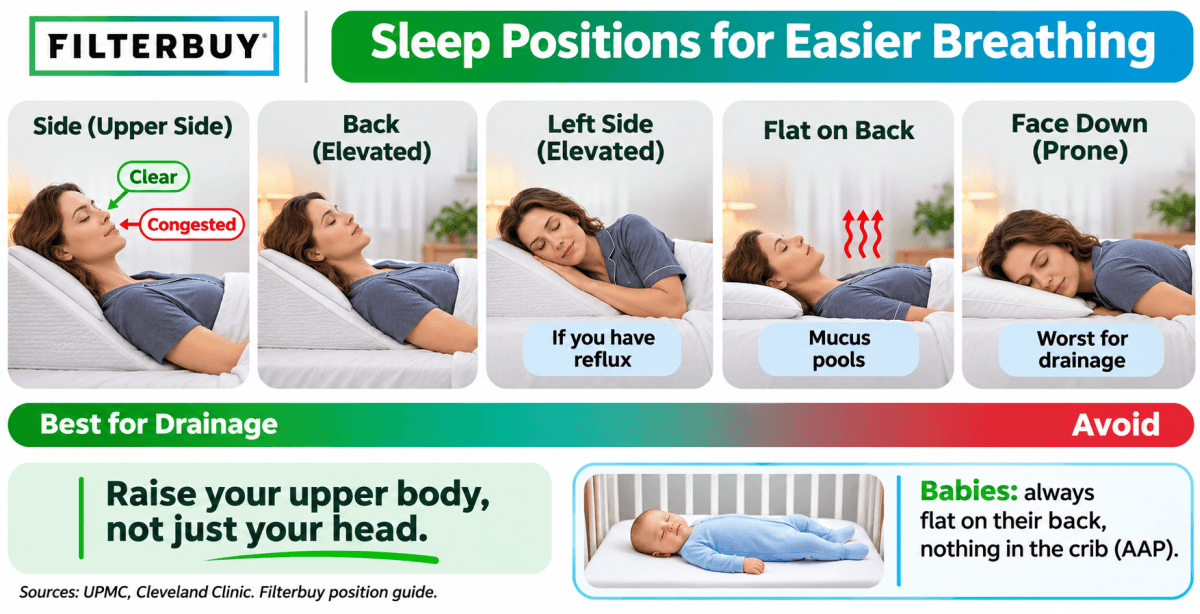
Babies are the exception. The American Academy of Pediatrics (AAP) warns against propping a baby up on towels or pillows or tilting the mattress. Use saline drops and a bulb syringe instead.
Bedroom Humidity for Congestion: What to Aim For
The best bedroom humidity for congestion is 40% to 50% relative humidity, measured with a hygrometer. Moist air keeps your nasal passages from drying out and helps loosen mucus. Don't go above 50%, where dust mites and winter mold problems thrive. MedlinePlus suggests the same range, and the U.S. Environmental Protection Agency (EPA) says not to humidify past 50%.
"Dry winter air" is too vague to act on, so Filterbuy ran the numbers. Cold air holds little water. Heat it indoors, and its relative humidity drops sharply.
Source: Filterbuy calculation using the Magnus formula for saturation vapor pressure. It assumes no indoor moisture; showers, cooking and breathing add some, so a hygrometer usually reads higher.
What surprised Filterbuy was how early the drop starts: a mild-feeling 40°F night already leaves heated air near 25%.
That led to Filterbuy's forecast rule: check tonight's low before bed. Below 40°F, plan on running the humidifier. Below 20°F, watch the window; if the glass fogs, settle for 30%–40%.
Place a clean cool-mist or evaporative humidifier about 6 feet from the bed, per MedlinePlus, and clean it every third day, per the EPA. For more on the two ranges, see what humidity your house should be in winter and dry air in your house in winter.
How to Clean Up Bedroom Air for Easier Breathing
Cleaner bedroom air means fewer particles landing on swollen nasal tissue. As a filter maker, Filterbuy keeps the advice simple: change your HVAC filter on schedule, and use MERV 11 or MERV 13 if your system can handle it. Washing bedding weekly in hot water helps too. Humidity matters as well: the American Lung Association calls it the biggest factor in a home's dust mite levels. See how indoor air quality affects sleep.
Filter: a fresh MERV 13 filter for cold and flu season captures most fine particles. MERV filters for sleep explains which rating your system can handle.
Fan: switching the furnace fan to On or Circulate overnight filters more air. It costs more to run, so check the filter monthly.
Purifier: run a HEPA air purifier sized for the bedroom on low.
Bedding and pets: use allergen-proof covers and keep pets out of the bedroom, as Henry Ford Health and Cleveland Clinic advise. Filterbuy's dust mite guide covers the rest.
Supply vent: if a vent blows onto the bed, add a deflector rather than closing it.
If the outdoor AQI is over 100, switch to an EPA-recommended MERV 13 filter if you have an HVAC system, and run HEPA air purifiers in each room with windows closed.
When someone tells me they wake up stuffy, I check three things in the bedroom first: an overdue filter, a supply vent blowing across the pillow, and a humidifier set too high.
How to Sleep With a Cold
These tips for sleeping with a cold target the stuffy nose and cough that keep you up. Start with saline and honey, and save decongestant sprays for no more than 3 days. Filterbuy kept only tips with a clear source and a stated safety limit.
Rinse safely. For a neti pot or rinse bottle, the U.S. Food and Drug Administration (FDA) says to use only distilled, sterile or previously boiled water, never plain tap water.
Try honey for a cough, but only for ages 1 and up, per the CDC.
Go easy on decongestant sprays. MedlinePlus says not to use oxymetazoline for more than 3 days.
Try a nasal strip. Henry Ford Health calls strips a low-risk option, though not a cure.
Check with a pharmacist before combining cold medicines.
When to See a Doctor
Most cold symptoms clear up on their own with rest and fluids. See a doctor if any of the warning signs listed by the Centers for Disease Control and Prevention (CDC) appear:
Trouble breathing or fast breathing
Dehydration
A fever lasting longer than 4 days
Symptoms lasting more than 10 days without improving
Symptoms that improve, then return or worsen
A chronic medical condition that gets worse
Not sure what you have? See our cold vs. flu guide. In a baby, wheezing or labored breathing can mean RSV rather than a cold. In an emergency, call 911.
Supporting Statistics
1. 2–3 Colds a Year
2–3 colds per U.S. adult each year. Children often get more.
A leading reason for missed school and work.
Filterbuy's take: set up your bedroom once for the whole season.
Source: Centers for Disease Control and Prevention (CDC), About Common Cold
2. 4 Times the Cold Risk With Short Sleep
164 adults wore sleep monitors for 7 nights, then were exposed to a cold virus.
4.24 times the odds of a cold at 5–6 hours of sleep, versus 7+ hours.
4.50 times the odds under 5 hours.
Source: Prather et al., Sleep, 2015, National Library of Medicine
3. Dust Mites in 4 of 5 Homes
4 in 5 U.S. homes have dust mite allergens in at least one bed.
Humidity is the biggest factor in mite levels.
Filterbuy's take: keep bedroom humidity at or below 50%.
Source: American Lung Association
Frequently Asked Questions
Why Does One Nostril Get Blocked at Night?
Your nose naturally shifts airflow from one side to the other, and lying on your side tends to congest the lower nostril. Roll over so the blocked side faces up.
About the Author and Reviewer
Michelle Wan writes about indoor air quality for Filterbuy, which has manufactured air filters in the U.S. since 2013. She built this page's position guide and stuffiness check and ran its humidity math. David Clark, a Licensed HVAC Technician, reviews Filterbuy's HVAC guidance.
More from Filterbuy: Does air quality affect your sleep?
Breathe Easier Tonight
A stuffy night is only half about your nose; the other half is your bedroom air. Filterbuy makes MERV 11 and MERV 13 filters in 600+ sizes in our own U.S. factories, so your HVAC system sends cleaner air to your bedroom all night.
Glossary
Turbinates: Ridges of blood-rich tissue inside the nose that warm and moisten air and swell when congested.
Nasal cycle: The natural back-and-forth in which one nostril carries more air than the other.
Rebound congestion: Stuffiness that returns or worsens after overusing decongestant sprays.
Relative humidity (RH): Water vapor in the air compared with the most it can hold at that temperature.
Hygrometer: A small gauge that measures indoor humidity.
MERV: Minimum Efficiency Reporting Value, the 1–16 scale for HVAC filters; MERV 13 captures most fine particles.
HEPA: High-efficiency particulate air, a filter standard for portable air purifiers.
AQI: Air Quality Index, the EPA's 0–500 scale for outdoor air pollution.