
How Long Is a Cold Contagious? The Days That Matter Most
November 9, 2026

TL;DR
A cold is contagious from a few days before symptoms start until they clear, which usually takes one to two weeks. You're most likely to pass it on during the first two to three days of symptoms, when sneezing and a runny nose are at their worst. The Centers for Disease Control and Prevention (CDC) says you can return to normal life after 24 hours of improving symptoms and no fever.
Key Takeaways
A cold can spread before you feel sick. You can pass it on a few days before the first scratchy throat.
Symptom days 1 to 3 are the peak. That's when spreading it is most likely.
Match your plan to the day: contain the peak on days 1–3, keep cleaning on days 4–7, then reset the house.
Filterbuy, a U.S. air filter maker, puts clean hands first. A filter is the layer that keeps working, not a cure.
How Long Is a Cold Contagious?
A cold is contagious from a few days before symptoms appear until they've cleared, according to the UK's National Health Service (NHS). Most adults recover in 7 to 10 days (Mayo Clinic), so the whole window usually runs one to two weeks.
Babies and young children can stay infectious even longer, the NHS notes. See Filterbuy's winter indoor air quality tips for kids and seniors.
The Cold Contagious Period, Day by Day
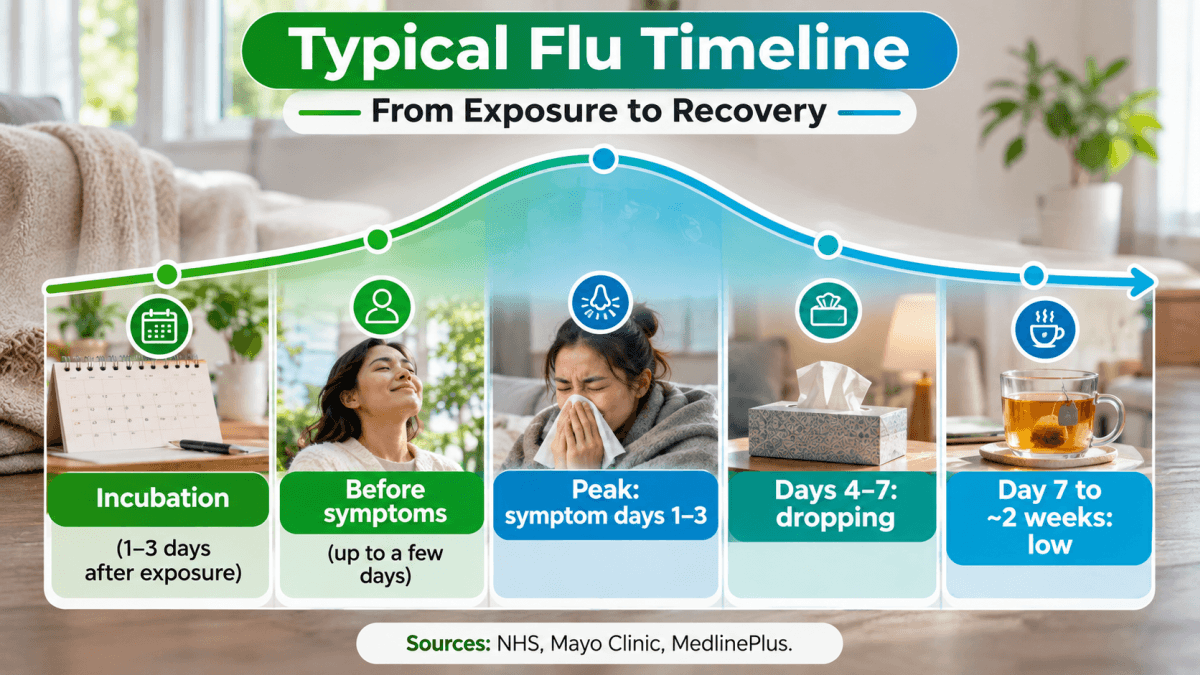
A cold moves through five rough stages, from a quiet incubation period to a long, low-risk tail.
Sources: NHS, Mayo Clinic, MedlinePlus and CDC. Filterbuy built this timeline from published ranges to show which days call for staying home and which call for stepping up cleaning. It is not a clinical standard.
When Is a Cold Most Contagious?
The first two to three days of symptoms carry the highest risk, according to MedlinePlus, the National Library of Medicine's site. The CDC says cold symptoms usually peak within two to three days of infection, and more sneezing and coughing put more virus-carrying droplets into the air and onto shared surfaces.
Can You Spread a Cold Before Symptoms Start?
Yes. The NHS says a cold can spread a few days before symptoms begin. Because symptoms usually appear one to three days after exposure (Mayo Clinic), people often pass the virus along while they still feel fine.
Are You Contagious After a Cold?
You can still spread a cold while symptoms last, but the risk drops sharply after the first few days, and MedlinePlus says a cold is usually not contagious after the first week.
How Long Should You Stay Home With a Cold?
Stay home until your symptoms have been getting better for at least 24 hours and you've gone 24 hours without a fever, with no fever-reducing medicine masking it, per CDC guidance. For five days after you return, keep taking extra care, such as wearing a mask or washing your hands more often.
How long to stay home with a cold: a quick check. You're ready to go back when all three are true:
Your symptoms have been getting better for 24 hours.
You've gone 24 hours without a fever, and without fever reducers.
You can take extra care around others for the next five days.
If a fever comes back, the CDC says to stay home again and restart the count.
How to Keep a Cold From Moving Room to Room at Home
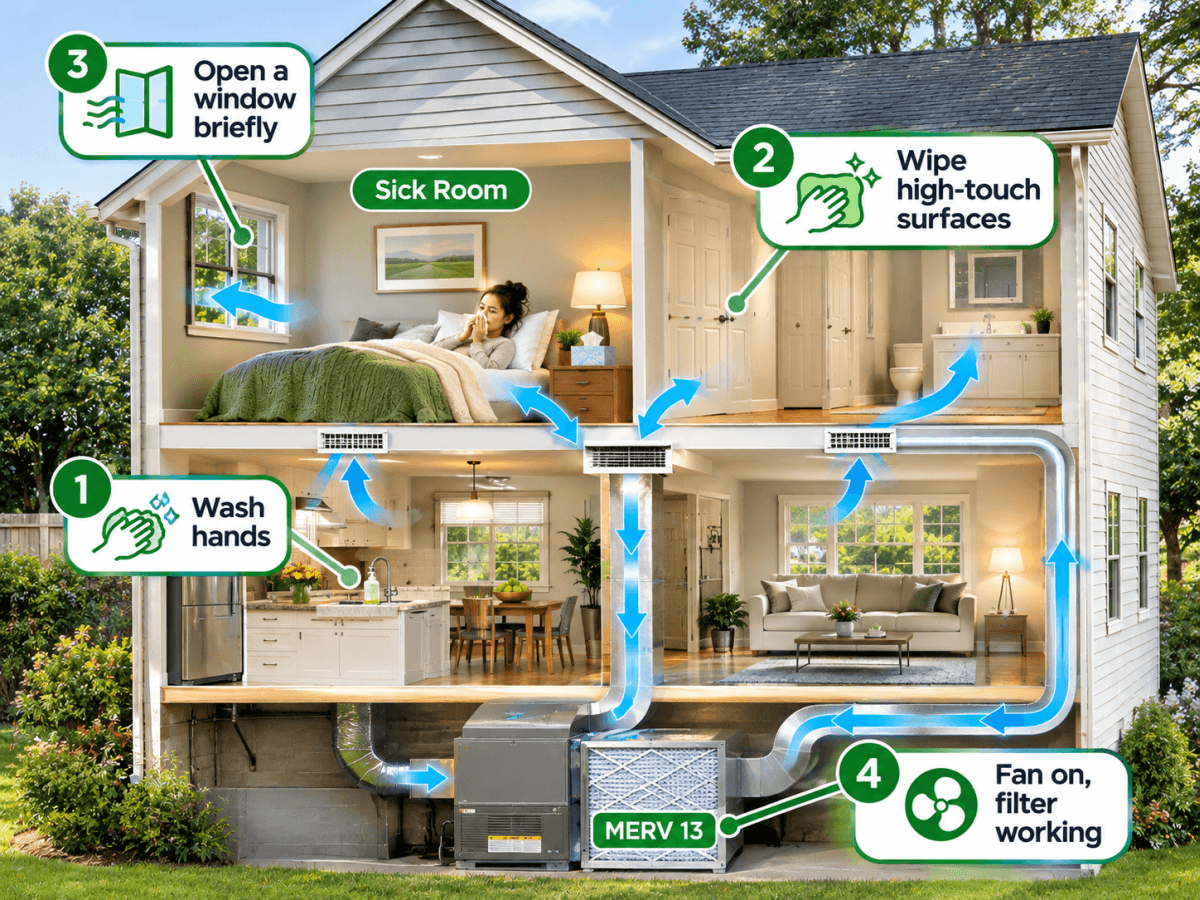
At home, a cold travels two ways: through droplets in the air and through hands and shared surfaces. No single step stops it, but timing each step to the stage of the cold makes it count.
The Filterbuy sick-week plan follows the timeline above, the way our team would walk a neighbor through it:
Days 1–3: Contain the peak.
Give the sick person their own room, towel and cups.
Wash hands with soap for at least 20 seconds, especially after nose-blowing (Mayo Clinic).
Switch the thermostat fan from “Auto” to “On” so more air passes through the filter.
Days 4–7: Keep the pressure on.
Wipe doorknobs, switches, faucets, phones and remotes daily, since germs can live on hands and surfaces for up to 24 hours.
Open a window for a few minutes. The CDC counts cleaner air as a core prevention step.
Day 7 and beyond: Reset the house.
Resume normal routines once you meet the CDC's 24-hour rule.
Pull the HVAC filter and hold it up to a light. If it looks gray or loaded, replace it.
Why the fan setting matters. An HVAC filter only cleans air while the system is running, and the U.S. Environmental Protection Agency (EPA) says most systems run less than 25% of the time during heating and cooling season. Setting the fan to “On” keeps air moving through the filter. That uses a bit more electricity and loads the filter faster, hence the final filter check.
No spare bedroom? These changes still go a long way:
Have the sick person wear a well-fitting mask in shared rooms, as the CDC suggests when you can't stay fully apart.
Swap the shared hand towel for paper towels in a shared bathroom (MedlinePlus).
Run a portable HEPA purifier where they rest. Going by the EPA's sizing chart, a 12-by-12 bedroom needs a clean air delivery rate (CADR) of roughly 95.
Choosing the filter. The CDC recommends MERV 13 or better when your system is compatible. MERV 13 air filters capture at least 85% of particles 1 to 3 microns in size, the size of many respiratory droplets (ASHRAE).
Filterbuy has made filters in the USA since 2013, and the mistake we see most often isn't the MERV rating. It's the size. When a filter is even slightly too small, air slips around the frame and never gets filtered.
Our Take: Why Filterbuy Says Start With Your Hands
At Filterbuy, we make air filters for a living, and we still tell families to start with their hands. Colds spread mostly through close contact and touch, so the free steps come first. A filter is the layer that keeps working while everyone sleeps.
We won't oversell it, either. As the Filterbuy cold and flu season air filter guide puts it, no filter prevents a cold on its own. A NIOSH-funded study did find that MERV 13 filters cut modeled airborne infection risk by roughly 42% compared with MERV 8, but it tested COVID-19 in railcars, not colds at home. If your system can't handle MERV 13, MERV 11 air filters or a portable HEPA purifier in the sick room are solid alternatives.
Cleaner indoor air starts with the right filtration. A properly fitted, regularly replaced air filter helps capture airborne allergens like dust, pollen, and pet dander, reducing their circulation throughout your home. Choosing the right MERV rating for your HVAC system is a simple step toward a more comfortable, allergy-conscious home.
Supporting Statistics
Three U.S. government figures back these habits:
Colds are everywhere. Americans catch more than 500 million colds and similar infections each year.
Together, they cost close to $40 billion annually.
Source: NIH Director's Blog, citing a 2003 national survey.
Clean hands cut colds. Handwashing education lowers colds and other respiratory illnesses by 16–21%.
Source: CDC Handwashing Facts.
Indoor air is shared air. Americans spend roughly 90% of their time indoors.
Indoors, some pollutants run 2–5 times higher than outside.
Source: EPA Report on the Environment.
When to Call a Doctor About a Cold
Most colds clear up on their own. The CDC recommends medical care if you or your child has:
Trouble breathing or fast breathing.
Signs of dehydration.
A fever that lasts longer than four days.
Symptoms that last more than 10 days without getting better.
Symptoms, such as fever or cough, that improve and then return or get worse.
A chronic medical condition that gets worse.
Colds are also the most common trigger of wheezing in children with asthma (MedlinePlus), so keep a close eye on breathing. For newborns up to 12 weeks old, Mayo Clinic advises getting care right away for a fever of 100.4°F or higher.
Frequently Asked Questions
Is A Cold Contagious?
Yes. Colds spread through droplets in the air and through contaminated hands or surfaces.
How Long Are You Contagious With A Cold?
Usually one to two weeks, with the highest risk in the first two to three days of symptoms.
Is A Cold More Contagious Than The Flu?
Not exactly. A cold can stay contagious longer because its symptoms linger, but flu comes on faster and hits harder. The NHS compares cold and flu symptoms side by side.
Is My Old Air Filter Contagious After A Cold?
Not in any lasting way. Viruses need a living host, so they don't multiply in a filter or in your ducts, and they die off over time (ASHRAE). Bag the old filter, throw it away and wash your hands.
Do Air Filters Help Stop Colds From Spreading?
They lower the number of airborne particles, but they can't stop a cold by themselves. The CDC recommends MERV 13 or better HVAC filters when your system is compatible.
Breathe a Little Easier This Cold Season
If your system can handle it, a MERV 13 air filter is an easy upgrade for cold season. Filterbuy makes filters in the USA in more than 600 sizes and ships them free. With auto-delivery, the next one shows up right on time. Questions? Real people at Filterbuy can help.
About the Author and Reviewer
Michelle Wan is Filterbuy's Brand Manager and Air Quality Writer. She works directly with Filterbuy's U.S. manufacturing team. Read more from Michelle.
David Clark is a Licensed HVAC Technician with Filterbuy HVAC Solutions and reviews Filterbuy's technical content.
Glossary
- Common Cold
- A mild viral infection of the nose, throat and upper airways, usually lasting 7 to 10 days.
- Incubation Period
- The time between catching a virus and first noticing symptoms; for a cold, usually one to three days.
- MERV (Minimum Efficiency Reporting Value)
- A 1 to 16 rating, defined by ASHRAE Standard 52.2, for how well an air filter captures particles; higher numbers capture more. See Filterbuy's MERV rating chart .
- CADR (Clean Air Delivery Rate)
- A rating for how much filtered air a portable air purifier delivers; a higher CADR serves a bigger room.
- HEPA (High-Efficiency Particulate Air)
- A filter standard that captures at least 99.97% of particles 0.3 microns in size ( ASHRAE ), used in many portable air purifiers.
This article is for general information and isn't a substitute for medical advice. If you're worried about your symptoms or a family member's, talk with a healthcare provider.