
How Does a Furnace Work? Operation Explained for Gas and Electric Furnaces, Key Components, Step-by-Step Heating Process
October 18, 2026

TL;DR
How does a furnace work? It heats your home by warming air and blowing it through your ducts. A gas furnace burns fuel inside a sealed heat exchanger that keeps exhaust out of your air. An electric furnace warms air with resistance coils. In both, a blower pulls air through the filter and pushes heated air back out your vents.
Key Takeaways
• Gas and electric furnaces run the same basic loop: thermostat call, heat, circulation, shutdown.
• A gas furnace checks for safe venting, ignition, and a lit flame before it heats, or the gas shuts off.
• AFUE, the share of fuel that becomes heat, runs about 80% for standard gas furnaces, 90% to 98.5% for condensing gas furnaces, and 95% to 100% for electric furnaces.
• In Filterbuy's lab testing, a clogged MERV 8 filter (MERV is a filter efficiency rating) held back more airflow than a clean MERV 13.
Most furnace guides start at the burner. At Filterbuy, an American air filter manufacturer, we start with airflow, because we make the filter your furnace's air passes through first.
“We print that arrow on our own line. After a decade of printing it, I can tell you the arrow was never the confusing part. Knowing which way the air moves is.”
Michelle Wan, Brand Manager and Air Quality Writer, Filterbuy
What Is a Furnace?
A furnace is a forced-air heating appliance that creates heat and distributes it through a home's ductwork. About 46% of U.S. households used a gas furnace as of 2020, according to the Appliance Standards Awareness Project. Unlike a boiler, which heats water, or a heat pump, which moves existing heat, a furnace heats air directly. For the basics, see Filterbuy's What Is a Furnace? guide.
Key Furnace Components: Gas vs. Electric
Gas and electric furnaces share the parts that move air, but only gas furnaces need the parts that manage a flame.
Go deeper with Filterbuy's guides to heat exchangers and limit switches, furnace igniters, and furnace blower motors.
How a Gas Furnace Works: The Step-by-Step Heating Cycle
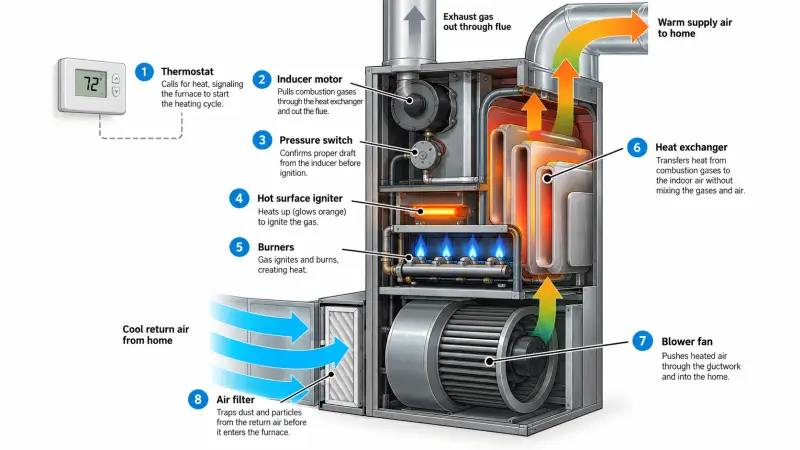
A gas furnace runs the same eight-step sequence each time it turns on.
1. The thermostat calls for heat. A low-voltage signal tells the control board to start.
2. The inducer motor starts. This small fan clears old gases and starts exhaust moving up the flue, the furnace's vent pipe. You'll hear a low hum.
3. The pressure switch proves draft. If the vent is blocked, the furnace won't light.
4. The igniter heats up. Most use a hot surface igniter that glows orange. Listen for a click.
5. The gas valve opens and the burners light. Gas flows to the burners and ignites with a soft whoosh.
6. The flame sensor proves the flame. No flame signal means the control board closes the gas valve and retries or locks out.
7. The blower starts. After a short delay so it doesn't blow cold air, the blower pulls household air through the filter and across the hot heat exchanger, then pushes it out your vents. In a healthy furnace, combustion gases stay sealed off from this air and exit through the flue.
8. The furnace shuts down. Once the thermostat is satisfied, the gas valve closes and the inducer clears the last exhaust. The blower keeps running briefly to pull leftover heat off the heat exchanger.
Throughout the cycle, the high-limit switch, an overheat safety switch, shuts off the burners if the cabinet gets too hot, usually from restricted airflow. Condensing furnaces add a second heat exchanger that pulls heat from exhaust water vapor, so they vent through PVC pipe and need a drain for that water.
Pro Tip from the Filterbuy HVAC team: In our experience, cleaning the flame sensor fixes most furnaces that light and then shut off within seconds. Turn off power first. Still short cycling? Clean it again and check that its wire is snug.
How an Electric Furnace Works
An electric furnace heats air with resistance coils instead of a flame.
1. The thermostat calls for heat and signals the control board.
2. The sequencer, a timed switch, turns on the coils in stages, and the blower pushes filtered air across them and into your ducts.
3. The thermostat is satisfied. The coils switch off in sequence while the blower clears residual heat.
An electric furnace needs no gas line, flue, or heat exchanger and produces no carbon monoxide.
Gas vs. Electric Furnace: How the Operation Compares
Gas and electric furnaces move air the same way but create heat differently. Electric scores higher on AFUE but often costs more to run. Compare costs in Filterbuy's electric vs. gas furnace guide.
AFUE ranges: U.S. Department of Energy. Actual operating cost depends on local fuel and electricity rates.
What AFUE Tells You About Furnace Efficiency
AFUE (annual fuel utilization efficiency) is the percentage of fuel energy a furnace turns into usable heat over a typical year. An 80% AFUE gas furnace turns 80% of its fuel into heat and loses 20% through the flue. AFUE excludes duct losses, which the U.S. Department of Energy says can reach 35% when ducts run through attics or garages.
ENERGY STAR certified gas furnaces must reach at least 95% AFUE in southern states and 97% in northern states.
A DOE final rule requires indoor gas furnaces manufactured on or after December 18, 2028 to reach 95% AFUE. In June 2026, the Supreme Court sent the legal challenge back for review, and DOE has proposed a delay. The rule doesn't require replacing a working furnace.
Where the Heating Cycle Stalls: Filterbuy's Step-by-Step Troubleshooting Map
Filterbuy built this map around the eight-step gas furnace cycle. Because a furnace runs in a fixed order, where it stops tells you where to look.
• Nothing happens (Step 1): check thermostat batteries and settings, the breaker, and the panel door.
• Inducer runs, no ignition (Step 3): a blocked vent, faulty pressure switch, or clogged condensate drain. Clear outdoor vents; call a pro if it persists.
• Igniter glows, burners don't light (Step 5): a gas supply or valve issue. Call a pro.
• Burners light, then quit within seconds (Step 6): usually a dirty flame sensor. See our flame sensor guide or schedule a technician.
• Burners cycle on and off with weak airflow (Step 7): a clogged filter tripping the high-limit switch. Replace the filter first.
Safety first: If you smell gas, leave your home and call your gas utility from outside. If a carbon monoxide alarm sounds, get everyone outdoors and call 911. The U.S. Consumer Product Safety Commission recommends a yearly professional inspection of fuel-burning heating systems, including flues and vents, plus CO alarms on every level of the home and outside sleeping areas.
Why Your Air Filter Matters at Every Step
The filter sits right before the blower, so the air your furnace heats passes through it first. A clogged filter starves the system of air, which can trip the high-limit switch and cause short cycling.
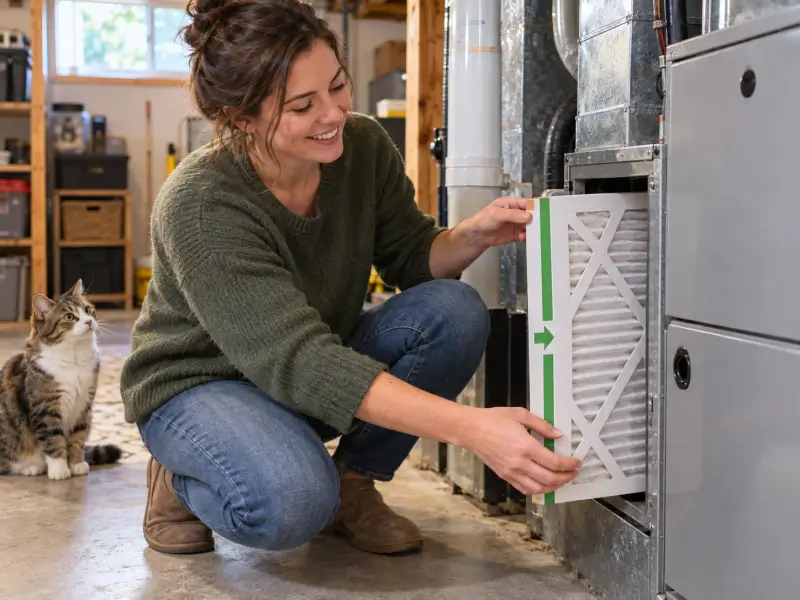
Pro Tip: Check your furnace filter monthly during heating season. Hold it up to a light; if light doesn't pass through the pleats, replace it. Filterbuy recommends starting with a 90-day replacement schedule for most pleated filters, and every 1 to 2 months for family homes with pets. Not sure where it is? See where the furnace filter is located and which way the filter goes in.
Before you order, check your HVAC manual for the filter size and MERV rating your system takes, the same way you'd confirm any fit.
Three Filter Lessons From Filterbuy
1. Change your filter on schedule. In Filterbuy's lab testing, a clogged MERV 8 filter held back more airflow than a clean MERV 13. See our MERV test results.
2. Use the thickest filter your system takes. In our lab, a 4-inch MERV 13 let air through more easily than a 1-inch MERV 11, because the deeper frame holds more pleated surface. If your furnace has a 4-inch filter cabinet, use a 4-inch filter.
3. Order your exact size. Finding it is easy: read the size printed on your old filter's frame. That's the nominal size you order, and the actual filter is cut a little smaller by design so it slides in snugly. No old filter? Measure the slot. If your size isn't listed, Filterbuy cuts custom sizes to the eighth of an inch.
Filterbuy filters are cut, pleated, and framed to order in our own US plants. Find your furnace filter size, then set up Filterbuy auto-delivery so a fresh filter arrives on time.
Supporting Statistics
1. 400+ deaths a year. Unintentional carbon monoxide poisoning not linked to fires kills more than 400 Americans annually.
• 100,000+ emergency department visits
• 14,000+ hospitalizations
• Source: CDC, Carbon Monoxide Poisoning Basics (January 2026)
2. 25% of home energy use. Space heating is about a quarter of U.S. residential energy consumption.
• Source: Appliance Standards Awareness Project, Furnaces
3. 1.5 tons of CO2 saved per year. Savings from upgrading a gas furnace from 56% to 90% efficiency in an average cold-climate home.
• Source: U.S. Department of Energy, Furnaces and Boilers
Frequently Asked Questions
Why Does My Furnace Blow Cold Air When It First Turns On?
Air sitting in the ducts reaches your vents before heated air does. If it stays cold all cycle, check the filter and call a technician.
Does a Gas Furnace Need Electricity to Work?
Yes. A gas furnace's control board, igniter, inducer, and blower run on electricity, so it can't heat during an outage without backup power.
What Is the Difference Between Single-Stage, Two-Stage, and Modulating Furnaces?
A single-stage furnace runs at full output whenever it's on. A two-stage furnace adds a low setting for milder days. A modulating furnace adjusts output in small increments for steadier, quieter heat.
Glossary
• AFUE (annual fuel utilization efficiency): The percentage of a furnace's fuel energy that becomes usable heat over a typical year.
• Carbon monoxide (CO): A colorless, odorless, poisonous gas produced by incomplete fuel combustion.
• Condensing furnace: A gas furnace rated 90% AFUE or higher that captures extra heat from water vapor in its exhaust.
• Heat exchanger: The sealed chamber that heats air while keeping exhaust separate.
• High-limit switch: A safety switch that cuts heat if the furnace overheats.
• MERV (Minimum Efficiency Reporting Value): A 1–16 rating for how well a filter captures airborne particles.
About the Author and Reviewer
Michelle Wan is Brand Manager and Air Quality Writer at Filterbuy (B.A., University of California, Santa Cruz). She works directly with Filterbuy's U.S. manufacturing teams.
David Clark is a licensed HVAC technician with Filterbuy HVAC Solutions who reviewed this guide for technical accuracy.
Sources
• U.S. Department of Energy, Furnaces and Boilers (AFUE definition, efficiency ranges, duct losses, upgrade emissions savings)
• ENERGY STAR, Furnaces Key Product Criteria (95% and 97% AFUE certification levels)
• Federal Register, Energy Conservation Standards for Consumer Furnaces (95% AFUE rule, December 18, 2028 compliance date)
• ACHR News, 95% Furnace Efficiency Rule to Get New Hearing (June 2026 Supreme Court remand)
• Appliance Standards Awareness Project, Furnaces (household gas furnace share, space heating share of residential energy)
• U.S. Consumer Product Safety Commission, Keep Warm and Safe This Winter (annual inspection, CO alarm placement)
• Centers for Disease Control and Prevention, Carbon Monoxide Poisoning Basics (annual CO deaths, ER visits, hospitalizations)
• Centers for Disease Control and Prevention, Furnace Safety Fact Sheet (carbon monoxide prevention)