
Furnace Flame Sensor Replacement Guide: Costs, Cleaning Tips, DIY Repair Steps & Bad Sensor Symptoms
February 5, 2026
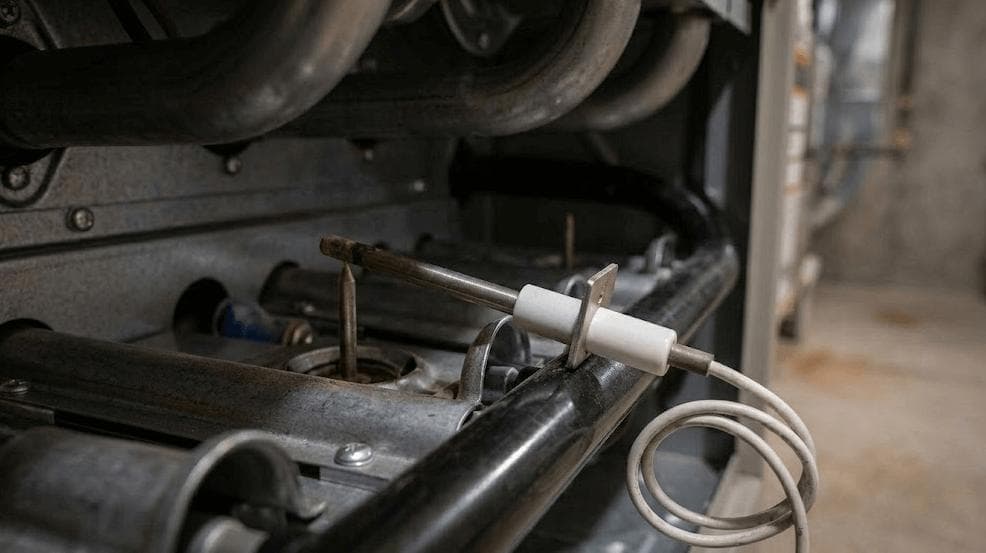
When your furnace kicks on and shuts right back off, a dirty or failing flame sensor is usually the reason. We've seen it countless times while working with homeowners on their HVAC systems. This small, inexpensive part causes more middle-of-the-night panic calls than almost any other furnace component.
Here's what most people don't realize: a flame sensor issue rarely means a major repair. In our experience, a quick cleaning with fine-grit sandpaper or steel wool solves the problem about 80% of the time no technician required. And if the sensor does need replacing, the part itself typically runs $10 to $30, with professional installation bringing the total to roughly $75 to $250, depending on your system and location.
Below, we'll break down exactly how to spot a bad flame sensor, clean or replace it step by step, and know when it's time to call a pro. At Filterbuy, we believe taking care of your HVAC system shouldn't feel overwhelming, and understanding a simple component like the flame sensor is a great place to start protecting both your comfort and your indoor air quality.
TL;DR: Quick Answers
Furnace Flame Sensor Replacement
What it is: Removing a faulty or carbon-coated flame sensor from your furnace and installing a new one in its place.
Why it's needed: The flame sensor confirms gas is actually burning when your furnace fires up. When carbon buildup insulates the rod or the sensor cracks or corrodes, it can't detect the flame. Your furnace shuts down within seconds as a safety precaution, leaving you with no heat.
The telltale sign: Your furnace ignites, runs for 3–10 seconds, then shuts off. Repeat the cycle 2–3 times, then lock out completely.
What it costs:
DIY: $10–$30 for the part
Professional: $75–$250 including labor
How long it takes: About 15 minutes with a single nut driver.
What we've learned helping homeowners: Try cleaning the sensor first, with fine-grit emery cloth, to resolve it in the majority of the time on a first occurrence. But if you've cleaned it more than once in the same heating season, skip the cleaning and replace it. Each abrasive cleaning roughens the metal, which accelerates future corrosion and shortens the time between failures.
Our #1 recommendation: Replace the sensor after the first failure, keep a spare next to your furnace, and swap in a fresh air filter at the same time. A furnace that completes full heating cycles with clean airflow runs safer, more efficiently, and does a far better job of filtering the air your family breathes every day.
Top Takeaways
A furnace that lights but won't stay on? Check the flame sensor first. It's the most common cause of short-cycling. A quick cleaning with an emery cloth fixes it about 80% of the time in under 30 minutes.
Don't keep cleaning, replace it. Abrasive cleaning exposes raw metal that corrodes faster. The part costs $10–$30. Replace it after the first failure and keep a spare next to your furnace.
This is a safety issue, not just a comfort issue. The flame sensor prevents unburned gas from accumulating in your home. Over 200 Americans die annually from CO poisoning linked to consumer products like furnaces. A working sensor isn't optional.
A neglected sensor costs you money every month. Short-cycling wastes gas, wears out components, and can cut system efficiency by up to 30%. Fixing the sensor and swapping your filter is one of the highest-ROI moves in home maintenance.
Build a simple routine, not an annual scramble. Change your filter every 60–90 days. Glance at the flame sensor during each swap. Book your tune-up before the heating season. Small habits prevent emergencies, and that's exactly the kind of easy, proactive maintenance Filterbuy was built to support.
What Is a Furnace Flame Sensor and What Does It Do?
Your furnace flame sensor is a thin, metallic rod usually about two to four inches long, mounted near the burner assembly. Its only job is to detect whether a flame is present after the gas valve opens. If it senses a flame, the furnace continues running normally. If it doesn't, the control board shuts the system down within a few seconds to prevent unburned gas from building up inside your home.
It's a straightforward safety mechanism, but it's also one of the most failure-prone parts in any gas furnace. Because the sensor sits directly in the flame path, carbon residue and oxidation build up on its surface over time. That buildup acts as an insulator, preventing the sensor from detecting the flame—even when one is clearly burning. From what we've seen helping homeowners troubleshoot their HVAC systems, this single issue accounts for a significant share of "my furnace won't stay on" service calls every heating season.
Symptoms of a Bad Furnace Flame Sensor
A failing flame sensor doesn't usually give you a dramatic warning. Instead, it creates a frustrating pattern that's easy to misdiagnose if you don't know what to look for. Here are the telltale signs we see most often:
Short cycling is the number one indicator. Your furnace ignites, runs for three to ten seconds, then shuts off completely. It may attempt this cycle several times before locking out. If your furnace lights but won't stay lit, the flame sensor should be the first thing you check.
Yellow or irregular burner flames can sometimes accompany a sensor issue, though this can also point to a dirty burner or gas pressure problems. It's worth noting the flame color when you're troubleshooting.
Furnace lockout codes on your control board can also help confirm the issue. Many modern furnaces flash an LED error code when the flame sensor fails to detect ignition. Check your owner's manual for the specific code—on most systems, it's a two- or three-flash sequence indicating a flame sense failure.
No heat despite the thermostat demand is the result. The furnace tries, fails, locks out, and your home stays cold. If your system has power, the blower works, and you can hear the igniter click, but the unit won't sustain a flame, a dirty or faulty sensor is the most likely explanation.
One thing we always tell homeowners: don't confuse a flame sensor problem with an igniter problem. If your furnace never lights at all, no click, no glow, no brief flame, the issue is more likely your hot surface igniter, not the sensor. The sensor only comes into play after ignition occurs.
How to Clean a Furnace Flame Sensor (Step by Step)
In our experience, cleaning the flame sensor resolves the issue the majority of the time. It's a quick job that most homeowners can handle with minimal tools and in about 20 to 30 minutes.
What you'll need: a quarter-inch or five-sixteenths-inch nut driver or socket (depending on your furnace model), fine-grit emery cloth or light steel wool, and a clean, dry cloth.
Step 1: Turn off the power to the furnace. Flip the switch on the unit or shut off the breaker. This is non-negotiable—you're working near gas components and electrical connections.
Step 2: Locate the flame sensor. Open the furnace access panel (usually the lower panel). The sensor is a thin metal rod mounted near the burners, typically held in place by a single screw. It will have one wire connected to it.
Step 3: Remove the sensor. Disconnect the wire and unscrew the mounting screw. The sensor should slide right out. Handle it carefully; the rod can bend easily.
Step 4: Clean the rod. Gently rub the metal rod with fine-grit emery cloth or light steel wool until you see clean, bare metal. You're removing the grayish carbon buildup that's insulating the sensor. Don't use anything too aggressive; you want to clean it, not scratch it down to nothing. Wipe it with a clean cloth when finished.
Step 5: Reinstall and test. Reinsert the sensor, tighten the mounting screw, reconnect the wire, close the panel, and restore power. Turn your thermostat up and watch for a normal heating cycle. If the furnace stays running past the ten-second mark, you've solved it.
Pro tip from our HVAC team: if you've cleaned the sensor and the furnace still short-cycles, try cleaning it once more and also check that the wire connection is snug. A loose wire can mimic the same symptoms as a dirty sensor.
How to Replace a Furnace Flame Sensor
If cleaning doesn't fix the problem or if you notice the rod is cracked, heavily corroded, or visibly damaged, it's time for a replacement. The good news is that swapping a flame sensor is just as straightforward as cleaning one.
Finding the right replacement part is the most important step. Look for the model number on your furnace's data plate (usually inside the access panel or on the side of the cabinet). Search for that model number plus "flame sensor" to find the exact OEM part. Universal flame sensors are available and work on many systems, but we always recommend matching to your specific furnace model when possible for a reliable fit.
Installation follows the same steps as removal: power off, remove the old sensor, install the new one in the same position, reconnect the wire, and test. The entire job takes about 15 minutes once you have the part in hand.
One thing worth noting: if your new sensor also fails to resolve the short-cycling issue, the problem may be elsewhere, a cracked igniter, a faulty control board, or even a grounding issue. At that point, it's time to bring in a qualified HVAC technician.
Furnace Flame Sensor Replacement Costs
Understanding what you should expect to pay can save you from overpaying or panicking when the issue first shows up.
DIY cost for the sensor itself typically runs between $10 and $30, depending on the brand and whether you're buying OEM or universal. It's one of the most affordable furnace parts you'll ever purchase.
Professional replacement generally falls in the $75 to $250 range, which includes the part and labor. The wide range depends on your location, the technician's service call fee, and whether the visit is during regular hours or an emergency call. Weekend and after-hours visits can push costs toward the higher end.
When to invest in a pro: if your furnace is still under warranty, having a licensed technician handle the work ensures you don't accidentally void coverage. It's also the right call if you're uncomfortable working around gas components, or if the flame sensor replacement doesn't solve the problem and deeper diagnostics are needed.
For context, a full furnace ignition system repair or control board replacement can run $300 to $600 or more—so confirming the flame sensor is the issue first (either by cleaning or swapping it yourself) can save you real money by narrowing down the problem before a technician arrives.
The Connection Between Your Flame Sensor and Indoor Air Quality
Here's something most furnace guides won't tell you: a malfunctioning flame sensor doesn't just affect your comfort, it can impact your indoor air quality, too.
When a furnace short-cycles repeatedly, it never completes a full heating cycle. That means the air in your home isn't being pulled through your HVAC filter as consistently as it should be. Your filter needs steady airflow to do its job, trapping dust, pollen, pet dander, and other airborne particles. Interrupted cycles mean less filtration and more pollutants circulating through your living spaces.
Additionally, repeated start-stop cycling puts extra stress on your entire HVAC system, reducing its efficiency and lifespan over time. A furnace that runs properly in complete cycles heats more evenly, filters air more effectively, and uses less energy doing it.
That's why we always recommend addressing flame sensor issues quickly and pairing that fix with a fresh, properly sized air filter. At Filterbuy, we carry over 600 sizes with free shipping direct to your door, making it easy to keep your HVAC system running the way it was designed to. A well-maintained furnace and a quality air filter working together are your home's best defense against poor indoor air.
When to Call an HVAC Professional
While flame sensor cleaning and replacement are DIY-friendly tasks, there are situations where calling a professional is the smartest move. If you've cleaned and replaced the sensor and your furnace is still short-cycling, the issue could involve the gas valve, control board, wiring, or venting, all of which require specialized training and equipment to diagnose safely.
You should also call a technician immediately if you smell gas at any point during the process, if you notice soot or scorch marks inside the furnace cabinet, or if your carbon monoxide detector goes off. These are signs of more serious combustion problems that go beyond a simple sensor issue.
A good HVAC technician can run a flame microamp test on your sensor to confirm whether it's functioning within spec (typically between 1.5 and 6 microamps, depending on the system). This quick diagnostic takes the guesswork out of the equation and can save you time chasing the wrong problem.
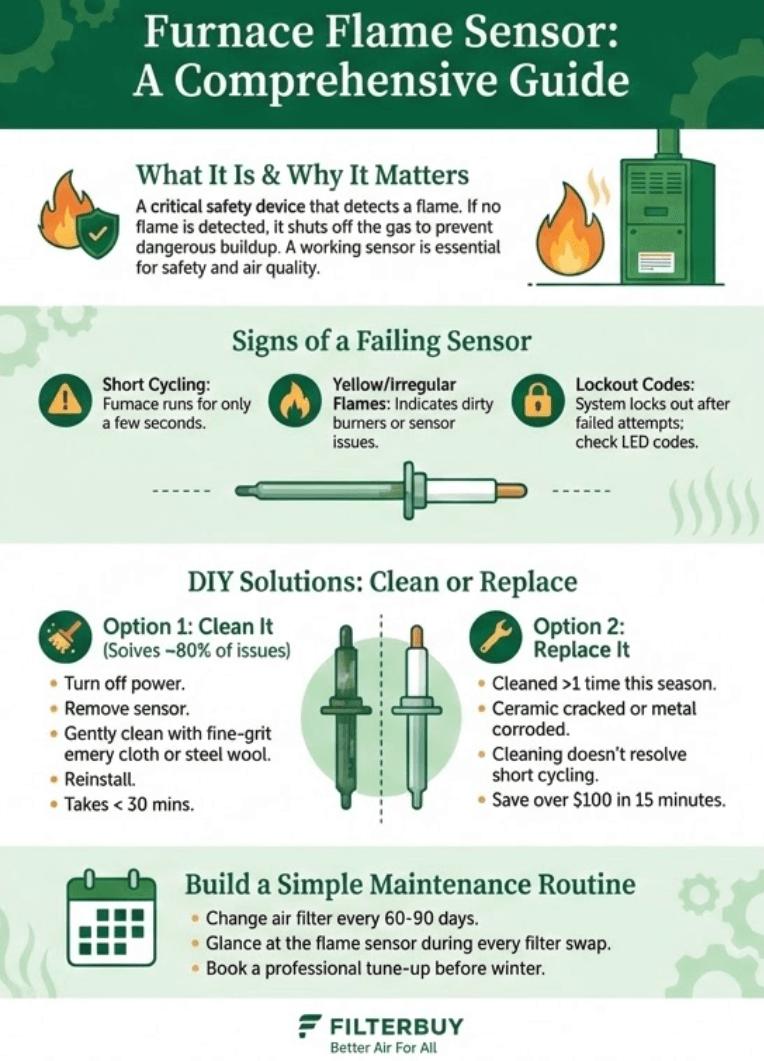
"In over a decade of helping homeowners maintain their HVAC systems, we've found that a dirty flame sensor is the single most common reason a furnace lights but won't stay running—and in the vast majority of cases, a five-minute cleaning with emery cloth is all it takes to get your heat back on and your air flowing properly again."
— Filterbuy HVAC Solutions Team
7 Resources That'll Save You Time, Money, and Stress When Replacing a Furnace Flame Sensor
Look, we get it, your furnace just quit on you, and you're trying to figure out what's going on without overpaying or making things worse. We've been helping homeowners navigate HVAC issues for over a decade, and we know that having the right information upfront is half the battle. These are the seven resources we'd point you to if you were standing in our shop asking for advice.
1. Start With Safety—Because Gas Furnace Work Isn't Something to Wing: U.S. Consumer Product Safety Commission (CPSC)
Before you grab a screwdriver, take five minutes with this one. The CPSC recommends that homeowners have a qualified heating contractor or gas company technician inspect fuel-burning appliances every year, and for good reason, gas components, carbon monoxide risks, and electrical connections all deserve respect. Even if you're comfortable with DIY repairs, knowing the safety baseline protects you and your family.
Why it matters: You wouldn't skip a seatbelt just because you're a good driver. The same logic applies here: know the risks before you dive in.
2. Understand the Bigger Picture—Your Furnace Is More Than Just One Part: U.S. Department of Energy (DOE)
Here's something we tell homeowners all the time: a flame sensor problem is usually a symptom of a system that needs a little more attention overall. The DOE's furnace guide walks you through efficiency ratings, proper ventilation, and the kind of professional maintenance that keeps your heating system running safely and economically for the long haul.
Why it matters: Fixing the sensor is great. Understanding how it fits into your whole system? That's how you avoid the next emergency call at 2 a.m. in January.
Source: https://www.energy.gov/energysaver/furnaces-and-boilers
3. Know What You're Paying For When a Tech Shows Up: ENERGY STAR Maintenance Checklist
We've heard from too many homeowners who paid for a "full tune-up" and got little more than a filter swap and a handshake. This checklist fixes that. ENERGY STAR lays out exactly what a proper professional inspection should cover, including checking all gas connections, gas pressure, burner combustion, and the heat exchanger. Print it out. Bring it to your appointment. You'll be glad you did.
Why it matters: When you know what a thorough inspection looks like, you can tell the difference between a technician who's doing the job right and one who's cutting corners.
Source: https://www.energystar.gov/saveathome/heating-cooling/maintenance-checklist
4. Find Out Why Your Cleaned Sensor Keeps Failing: Technical Hot & Cold Parts
This is the resource we wish more homeowners would read before they clean the same flame sensor for the third time in one winter. Here's the thing most people don't realize: once you clean a flame sensor with abrasive material, the exposed raw metal corrodes faster when it meets acidic combustion gases, meaning it'll fail again sooner and need cleaning more and more often. Their advice lines up with ours: once it's failed, just replace it. They're cheap, and your peace of mind is worth more than the $15 you'd save trying to squeeze one more season out of it.
Why it matters: Cleaning a sensor is a great short-term fix. But if you're doing it repeatedly, you're spending more time on your furnace than you need to. Replace it, keep a spare next to the unit, and move on with your life.
5. Skip the Random Google Search and Find a Contractor You Can Actually Trust: ACCA Contractor Directory
We know the feeling, it's freezing, your furnace is down, and you're scrolling through a dozen contractor listings with no idea who's legit. The Air Conditioning Contractors of America (ACCA) takes the guesswork out of it with a zip code-searchable directory of quality-assured HVAC contractors. These aren't just anyone with a van and a business card; they're professionals who've been vetted by the industry's leading trade association.
Why it matters: Your home is your biggest investment. When you need someone working on your gas furnace, you want to know they've earned the right to be there, not just that they had the best-looking ad.
Source: https://hvac-contractors.acca.org/qa-contractors
6. Make Sure Your Technician Actually Knows Their Stuff: NATE Certified Contractor Locator
If your flame sensor replacement didn't solve the problem or if the issue turned out to be something more involved, like a control board or gas valve, you need a technician with real, verified expertise. NATE-certified technicians have met the industry's highest standards by passing rigorous, real-world competency exams developed by a committee of industry authorities. Think of NATE certification like a board certification for your doctor; it means they've gone the extra mile to prove they know what they're doing.
Why it matters: A wrong diagnosis on a gas furnace isn't just expensive, but it can be dangerous. NATE certification is the clearest signal that your technician has the training to get it right the first time.
What We've Learned About Furnace Maintenance—Backed by the Numbers
After more than a decade helping homeowners protect their HVAC systems, we've seen firsthand what happens when routine maintenance gets ignored. The consequences go beyond discomfort; they're costly and dangerous. These three federal statistics reinforce what our experience has taught us every heating season.
1. Heating Fires Are Far More Common Than Most Homeowners Realize
Nearly every homeowner we talk to is surprised by this one.
According to the U.S. Fire Administration (USFA/FEMA), from 2017 to 2019:
An estimated 34,200 heating fires in residential buildings are reported each year
These fires caused an estimated annual average of 165 deaths, 600 injuries, and $367 million in property loss
80% occurred in one- and two-family residences, just like yours
Operational deficiency, including equipment malfunction and failure to maintain equipment, contributed to nearly 23% of the more serious nonconfined heating fires.
What we've seen: A furnace that short-cycles due to a failing flame sensor is a furnace under stress, and stress on heating components is what leads to bigger problems. In our experience, a five-minute sensor cleaning or a $15 replacement part is one of the simplest ways to keep your family out of that statistic.
Source: U.S. Fire Administration (USFA/FEMA) — Heating Fires in Residential Buildings (2017–2019) https://www.usfa.fema.gov/downloads/pdf/statistics/v21i10.pdf
2. Carbon Monoxide Deaths Spike Every Winter—And Your Flame Sensor Is a Key Line of Defense
This one is personal for us at Filterbuy. We've heard from too many customers who didn't know their furnace could be a carbon monoxide source until something went wrong.
The U.S. Consumer Product Safety Commission (CPSC) reports:
More than 200 Americans die every year from CO produced by non-automotive consumer products, including malfunctioning furnaces
Heating systems were the second largest contributor to non-fire CO poisoning deaths
More than half of all CO fatalities occurred during November, December, January, and February, exactly when your furnace runs hardest.
What we always tell our customers: If your furnace won't stay lit after two or three attempts, stop resetting it and start diagnosing. When homeowners keep manually restarting a furnace with a bad flame sensor, they're unknowingly extending the window where unburned gas can accumulate before the safety lockout kicks in. The sensor exists to prevent exactly that. A dirty flame sensor is the most common culprit—address it immediately rather than hoping the next cycle sticks.
Source: U.S. Consumer Product Safety Commission (CPSC) — Carbon Monoxide Fact Sheet https://www.cpsc.gov/safety-education/safety-guides/carbon-monoxide/carbon-monoxide-fact-sheet
3. Your Furnace Is Likely Your Biggest Energy Expense—And a Neglected Sensor Makes It Worse
Most homeowners we work with drastically underestimate how much of their energy bill goes to heating and cooling.
ENERGY STAR (U.S. EPA) puts a number on it:
The average home spends nearly $1,900 per year on energy, with close to half going to heating and cooling
Dirt and neglect are the top causes of heating and cooling system failure and inefficiency
Poor maintenance or improper installation can reduce HVAC system efficiency by up to 30%
What we've watched happen: Small problems snowball into expensive ones. Every failed ignition attempt from a dirty flame sensor wastes gas, accelerates wear on your igniter and control board, and prevents your system from reaching steady-state efficiency. Multiply that across an entire winter, and you're paying for heat you never received.
That's why we always recommend tackling both issues at once:
Clean or replace the flame sensor so your furnace completes full heating cycles
Swap in a fresh air filter so your system can move clean, conditioned air the way it's designed to
At Filterbuy, we've made step two as easy as possible: over 600 sizes, fast free shipping from our U.S. factory, and auto-delivery so you never fall behind.
Source: ENERGY STAR (U.S. EPA) — How to Keep Your HVAC System Working Efficiently https://www.energystar.gov/products/ask-the-experts/how-keep-your-hvac-system-working-efficiently
Final Thought: The Smallest Parts Often Make the Biggest Difference
If there's one thing we've learned after years of helping homeowners take better care of their HVAC systems, it's this: the problems that cause the most frustration are rarely the expensive, catastrophic failures people worry about. They're the small, overlooked things—a $15 sensor coated in carbon buildup, a clogged filter that hasn't been changed in six months, a tune-up that never made it onto the calendar.
The furnace flame sensor is the perfect example. It's a thin metal rod no bigger than a pencil. Most homeowners have never heard of it until their heat stops working on the coldest night of the year. Yet this single, inexpensive component handles one of the most critical safety jobs in your entire heating system—confirming that gas is actually burning before your furnace keeps pumping it into the combustion chamber.
When it fails, everything stops. When it's ignored, the risks compound.
Where Most Homeowners Go Wrong
Here's our honest take: most people treat furnace maintenance as reactive instead of preventive. The typical pattern we see looks like this:
The flame sensor gets cleaned once during an emergency
The furnace kicks back on, and the problem feels "fixed."
The now-roughened sensor starts corroding faster than before
The dirty filter that was already restricting airflow never gets swapped
The underlying habit of waiting for something to break doesn't change
We also think the HVAC industry shares some responsibility. Too much online advice is either overly technical or designed to push homeowners toward expensive service calls they may not need. A homeowner who's perfectly capable of cleaning a flame sensor in 20 minutes shouldn't feel like they need a $200 diagnostic visit. At the same time, someone who smells gas or sees repeated lockout codes shouldn't be encouraged to keep tinkering.
The Approach We Believe In
Our philosophy at Filterbuy is straightforward: empower homeowners with honest, practical knowledge so they can handle the simple stuff confidently and recognize when a professional is the right call. That's what this guide was built to do. Not to replace your HVAC technician, but to help you understand your system well enough to make smart decisions.
One Piece of Advice That Goes Beyond the Flame Sensor
If we could leave you with a single takeaway, it would be this: stop thinking about HVAC maintenance as a once-a-year event and start treating it as a simple routine.
Here's what that looks like in practice:
Change your air filter every 60 to 90 days. It's the easiest and most impactful thing you can do for your system.
Glance at your flame sensor during each filter swap. It takes ten seconds and lets you catch buildup before it becomes a problem.
Schedule your professional tune-up before the heating season, not during the first cold snap when every technician in your area is booked solid.
These aren't big tasks. They don't require special tools or technical expertise. But in our experience, the homeowners who build these small habits are the ones who rarely end up in emergencies and who consistently enjoy lower energy bills, fewer repairs, and cleaner indoor air.
That's Why We Built Filterbuy
We're not here to sell you a filter and disappear. We're here to make it as easy as possible to stay ahead of the maintenance curve:
Over 600 sizes, so you always find the right fit for your system
Fast, free shipping direct from our U.S. factory to your door
Auto-delivery on whatever schedule works for your household
Because when your furnace is running right, and your filter is doing its job, everything else falls into place—comfortable temperatures, efficient operation, and air your family can breathe easily knowing it's clean.
A flame sensor is a small part. But taking care of it and the system it protects is one of the smartest things you can do as a homeowner.
Next Steps: What to Do Right Now
You've got the knowledge. Here's how to put it to work, whether your furnace is acting up right now or you're getting ahead of future problems.
If Your Furnace Is Short-Cycling Right Now
Follow these steps in order before calling a technician:
Confirm the symptom. Furnace ignites, runs 3–10 seconds, shuts off? That's the flame sensor. Never ignites at all? More likely the igniter.
Kill the power. Flip the furnace switch or shut off the breaker. Non-negotiable.
Locate the flame sensor. Open the lower access panel. Look for a thin metal rod near the burners.
Inspect it. Carbon buildup or discoloration? Clean it. Cracked or visibly damaged? Replace it.
Clean with fine-grit emery cloth. Gently rub until you see bare metal. Wipe with a dry cloth. Reinstall.
Test. Turn the thermostat up. If the furnace runs past ten seconds, you're good.
Still short-cycling? Replace the sensor. Match the part to your furnace model number. They run $10–$30.
Replacement didn't fix it either? Call a licensed HVAC technician. The problem may be your control board, gas valve, or wiring.
If Your Furnace Is Running Fine
Prevention is always cheaper than repair. Start these habits today:
Check your air filter this weekend. Hold it up to the light. Can't see through it? Time to swap it.
Inspect the flame sensor at every filter change. Pop the panel, glance at the rod, and note any buildup. It takes ten seconds.
Order a spare sensor now. $10–$30. Smaller than a screwdriver. Keeps you from waiting on a part in the middle of winter.
Book your annual tune-up in September or early October. Technicians have open schedules, and you'll have time to address anything before the first freeze.
Set Up Your Air Filter on Auto-Pilot
The most common HVAC mistake we see? Forgetting to change the filter. A dirty filter restricts airflow, strains every component in your system, including the flame sensor,r and lets dust and allergens circulate freely.
Fix it in four steps:
Find your size. Check the dimensions printed on your current filter or measure your return vent.
Search for your size at Filterbuy. Over 600 options available.
Pick your MERV rating:
MERV 8 — Everyday dust and debris
MERV 11 — Pet dander, pollen, and mold spores
MERV 13 — Fine particles for allergy and respiratory concerns
Set up auto-delivery. Choose every 30, 60, or 90 days. Free shipping. Shows up on schedule. Done.
Need Help Choosing a Filter?
Picking the right size and MERV rating doesn't have to be complicated. Visit Filterbuy.com or contact our customer support team, real people, based in the U.S, who can walk you through it and find the right fit for your system and your home.
The best time to take care of your HVAC system is before it gives you a reason to worry.
FAQ on Furnace Flame Sensor Replacement
Q: How do I know if my furnace flame sensor needs to be replaced or just cleaned?
A: Start with cleaning it, which resolves the issue for the vast majority of the time on a first occurrence.
How to test:
Remove the sensor and rub the rod with fine-grit emery cloth until you see bare metal
Reinstall and run the furnace
If it completes a full heating cycle, you've solved it
When to replace instead:
You've cleaned the same sensor twice in one heating season
The rod is cracked, bent, or heavily pitted
Buildup returns noticeably faster after each cleaning
The insight most guides miss: Each abrasive cleaning roughens the metal surface, giving combustion byproducts more texture to grip. The sensor fails faster each time. At $10–$30 for the part, replacement is almost always the smarter long-term call.
Q: How much does it cost to replace a furnace flame sensor?
A: This is one of the first questions homeowners ask us, and the answer is almost always a relief.
Cost breakdown:
DIY replacement: $10–$30 for the part (universal or OEM match)
Professional installation: $75–$250 (includes service call, labor, and part)
Emergency/after-hours visit: Consistently toward the top of that range, sometimes double a weekday appointment
Our money-saving advice:
Diagnose the issue yourself using this guide
Order the correct part matched to your furnace model number
Handle the swap yourself or book a technician during regular business hours
That one decision alone can save you $100 or more on a repair that takes a pro about 15 minutes.
Q: How often should a furnace flame sensor be replaced?
A: Most manufacturers suggest 3–5 years, and that generally matches what we've observed. But what we've found matters more than a fixed timeline is your home's environment.
Sensors fail faster in homes with:
Older or leaky ductwork
Furnaces in dusty basements or utility closets
What we recommend instead of guessing:
Inspect the sensor every time you swap your air filter, roughly every 60–90 days
Pull the access panel, glance at the rod, and note how quickly the buildup is forming
If the buildup is accumulating faster than it used to, replace it before it fails
Keep a spare sensor next to your furnace so you're never waiting on a part while your family goes without heat
Q: Can a bad flame sensor cause carbon monoxide problems?
A: There's an important nuance most people miss on this one.
What the sensor actually does: It's a safety device. When it detects no flame, it shuts off the gas flow within seconds. That's exactly its job, and it's one reason modern furnaces are as safe as they are.
Where the real risk comes from: Homeowner behavior after the sensor fails. The instinct is to keep resetting a furnace that won't stay lit. We've talked to homeowners who reset their furnace 10–15 times in one evening. Each reset opens the gas valve briefly before the safety lockout engages.
Our standing advice:
If your furnace won't stay lit after 2–3 attempts, stop resetting it
Diagnose the flame sensor using the steps in this guide
Confirm you have working carbon monoxide detectors on every floor, no exceptions
That combination of knowledge and basic precaution is your best protection.
Q: Can I replace my furnace flame sensor myself, or do I need to hire a professional?
A: We'll be straight with you—this is one of the easiest furnace repairs a homeowner can tackle.
What you need:
A quarter-inch or five-sixteenths-inch nut driver
About 15 minutes
The correct replacement part for your furnace model
The process: One screw, one wire, swap the part, done. We've walked countless first-time DIYers through it, and the feedback is almost always the same: "I can't believe I was about to pay someone $200 for that."
When to call a pro instead:
You're not comfortable working near gas components
Your furnace is under warranty, and you want to protect the coverage
A new sensor doesn't stop the short-cycling. The issue may be your control board, gas valve, or wiring
A qualified technician can run a microamp test and diagnose deeper issues safely
What we've learned: The smartest DIYers aren't the ones who fix everything themselves. They're the ones who know exactly where their comfort zone ends and aren't afraid to hand it off from there.
Now That You Know How to Handle a Furnace Flame Sensor Replacement, Keep Your Entire HVAC System Running at Its Best
A working flame sensor paired with a clean, properly sized air filter is the simplest recipe for a furnace that runs safely, efficiently, and delivers the clean indoor air your family deserves. Shop over 600 filter sizes at Filterbuy.com with fast, free shipping and auto-delivery. Staying ahead of your HVAC maintenance has never been easier.