
How Warm Should Air From a Heat Pump Be? Normal Vent Temperatures in Winter
October 23, 2026

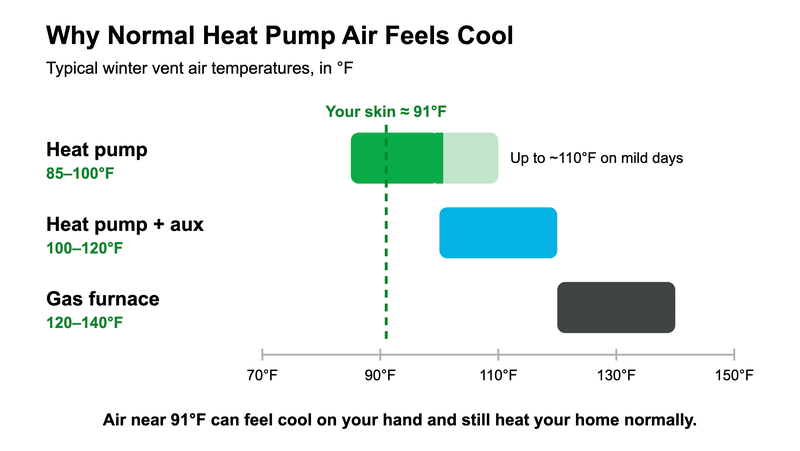
Heat pump air usually leaves the vents at about 85–100°F in winter, and up to about 110°F on mild days. That's close to your skin temperature of about 91°F, so normal air can feel cool on your hand.
A gas furnace runs much hotter, often 120–140°F.
A clogged filter cuts airflow and heat, so check yours first. Take the quick quiz below to find your filter match.
Find the Right Filter for Your Mini Split
Heating with a ductless mini split heat pump? Answer a few quick questions and we'll match you to the right filter.
Heat pump air usually leaves the vents at about 85–100°F in winter and climbs toward 100–110°F on milder days. A gas furnace runs much hotter, often 120–140°F, while heat pump air lands close to your skin temperature of about 91°F. That is why a healthy system can feel cool on your hand.
TL;DR
Heat pump supply air usually runs 85–100°F in winter, close enough to skin temperature that it often feels cool. Worry only if the air stays below room temperature for more than 15 minutes outside a defrost cycle, or if your home can't hold the thermostat setting.
Key Takeaways
Normal winter range: Expect 85–100°F at the vents in winter and up to about 110°F on mild days.
Why it feels cool: Skin averages about 91°F, so moving 90°F air feels neutral or slightly cool.
Defrost is normal: A few minutes of cool air usually means the outdoor unit is melting frost off its coil.
Check airflow first: A clogged filter cuts heating and leans harder on backup heat.
Why Does Heat Pump Air Feel Cool?
Heat pump air feels cool because it arrives close to your own skin temperature. The average temperature of human skin is about 91°F (33°C). At Filterbuy, we call this the skin-temperature line. When 88–92°F air blows across your hand, it pulls away a little heat, so it reads as cool even though it is 20 degrees warmer than the room. Your hand is really measuring your skin.
A furnace sends short bursts of hotter air, while a heat pump moves heat and warms the house steadily over longer cycles. According to the U.S. Department of Energy, an air-source heat pump can deliver up to three times more heat than the electricity it uses, and lower air temperature is part of that efficiency.
A better test is the room itself. If your home holds the thermostat setting, the heat pump is doing its job.
Heat Pump vs. Furnace: Supply Air Temperature Compared
Heat pump air runs roughly 30–40 degrees cooler than furnace air, so the system moves more of it. Filterbuy ran the numbers with the standard HVAC formula (BTU per hour = 1.08 × cfm × temperature rise). To deliver 30,000 BTU/h at a 25°F rise, a heat pump moves about 1,100 cfm. A furnace with a 55°F rise needs only about 500 cfm. That extra airflow is why heat pump air feels breezier, and why a clean filter matters so much. For more, see Filterbuy's guide to heat pumps vs. furnaces and air conditioners.
Table 1: Heat pump vs. furnace supply air temperature
Typical ranges, not a spec for every unit. Exact numbers depend on system size, airflow, and the manufacturer's performance data.
What's Normal at Your Vents This Winter: The Vent Temperature Decoder
Vent temperature depends on the weather, since a heat pump has less outdoor heat to draw from on a 20°F morning than on a 50°F afternoon. In Contracting Business, Rob "Doc" Falke of the National Comfort Institute shows a typical heat pump producing a 13°F rise on a 20°F morning and a 31°F rise that afternoon, both normal. That is why Filterbuy built the decoder below: a vent reading means little without the outdoor temperature.
Table 2: Winter vent temperature decoder
Readings assume a standard air-source heat pump with no backup heat unless noted. *Normal as long as your home holds the thermostat setting. If changing the filter doesn't fix a "Check filter" result, call a licensed HVAC technician.
Real-world reading: Building scientist Allison Bailes, PhD, of Energy Vanguard measured 105°F supply air from his own heat pump on a 32°F evening, with no backup heat running.
How to Make Heat Pump Air Feel Warmer Without Wasting Energy
A heat pump will never blow furnace-hot air, but these free adjustments keep it from feeling colder than it is.
Set the thermostat fan to "Auto," not "On." On keeps the blower moving air between heating cycles, and that air feels cool. The Department of Energy recommends "Auto" unless your system has a variable-speed blower.
Aim registers away from where you sit. Energy Vanguard's first rule of duct design is don't blow air on people. Angled louvers let warm air mix with the room first.
Raise the thermostat 1–2 degrees at a time. Bigger jumps can bring on costly backup heat strips.
Give air a way back. The Department of Energy notes that closed bedroom doors can cut off a central return, so keep them open or ask about transfer grilles.
How to Measure Your Heat Pump's Vent Temperature
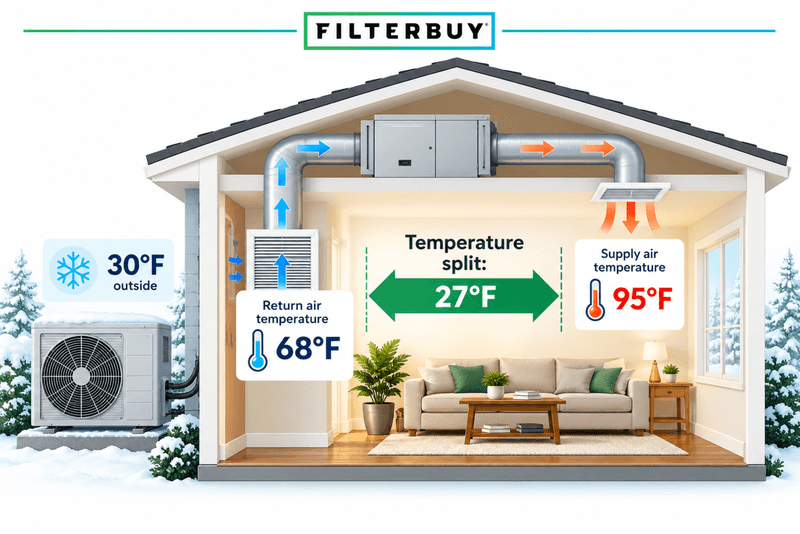
The temperature split, the difference between return and supply air, tells you far more than a single vent reading. You need 10 minutes and a digital probe thermometer.
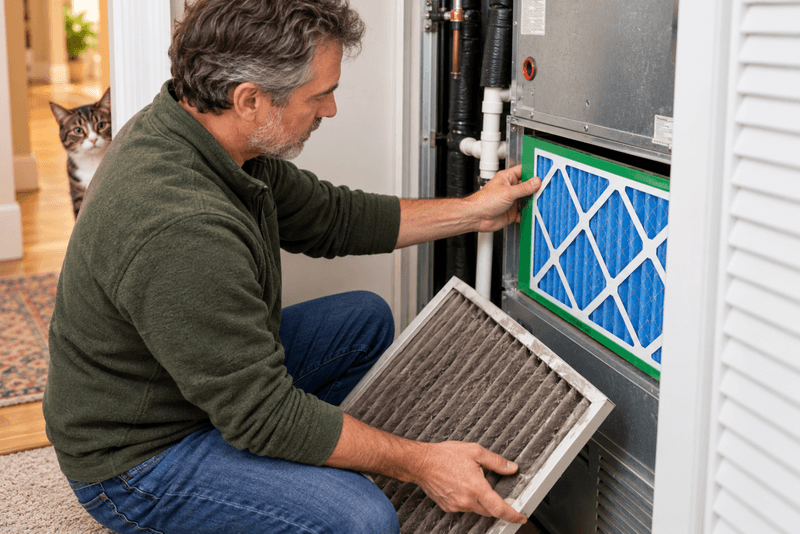
Start with the air filter. Replace it if it looks gray or clogged.
Set the thermostat to "Heat," not "Emergency Heat." Raise it 2–3 degrees above room temperature so the system runs steadily.
Let it run for 10–15 minutes. Startup and defrost readings won't tell you much.
Measure the return air at the return grille, the large vent that pulls air back in.
Measure the supply air at the register closest to the indoor unit, holding the probe about an inch into the airstream for a minute.
Subtract and compare. Supply minus return gives you the split. Note the outdoor temperature and whether "aux" is showing, then check the decoder.
Pro tip: Leave the infrared "laser" thermometer in the drawer. It reads the surface of the metal grille and can be off by several degrees.
Manufacturer capacity tables, as Filterbuy reads them, put a normal split at roughly 13–31 degrees without backup heat, smaller in deep cold and larger in mild weather. A split under 10 degrees on a mild day deserves a closer look.
Can a Dirty Air Filter Make a Heat Pump Blow Cooler Air?
Yes. As an American filter maker, Filterbuy treats the filter as part of the heating system, because every bit of heat your heat pump delivers rides on air that passed through the filter first. The Department of Energy (DOE) says heat pumps need about 400–500 cubic feet per minute (cfm) of airflow per ton, and performance drops off well below 350 cfm per ton. DOE also says a neglected heat pump can use 10–25% more energy than a well-maintained one.
With less airflow, less heat reaches your rooms and backup heat runs longer. Some units even shut off on a safety limit.
In the field, the filter rarely gets blamed for the thing it actually caused. A frozen coil or a blower running long gets written up as a refrigerant or thermostat problem, when the real cause was a loaded filter nobody changed.
David Clark, Licensed HVAC Technician, Filterbuy HVAC Solutions
Check your filter monthly during heating season, and replace a standard 1-inch filter every 60–90 days, or every 30–45 days if you have pets. Filterbuy's guide on how often to change your air filter has the full schedule, and its heat pump winter prep checklist covers the rest of the system.
For most heat pumps, a pleated Filterbuy MERV 8 or MERV 11 filter strikes the right balance between capture and airflow. Considering MERV 13? Check our MERV pressure drop chart first.
See how to measure your air filter, or set up filter auto-delivery so the right one arrives on time. Every Filterbuy filter is made in the USA and ships free.
When Should You Call an HVAC Technician?
Call a licensed technician when a fresh filter and a clear outdoor unit don't solve the problem. Nearly every December complaint Filterbuy hears involves one of those two. Signs to watch for:
Air stays at or below room temperature for more than 15 minutes, outside a defrost cycle.
The outdoor unit stays fully iced over for hours.
Aux heat runs nearly all the time, or your electric bill jumps unexpectedly.
You hear grinding or loud buzzing.
The system turns on and off every few minutes.
In Florida, Filterbuy HVAC Solutions technicians handle these calls. If you have a dual-fuel system with a gas furnace backup, the CDC recommends CO detectors near every sleeping area.
Supporting Statistics
1. 42% of U.S. households heated mainly with electricity in 2024, helped in part by better heat pumps.
Source: U.S. Energy Information Administration, October 2025
2. Heat pumps can cut heating electricity use by up to 75% compared with electric resistance heat.
Source: U.S. Department of Energy, Heat Pump Systems
3. Nearly half of a home's energy goes to heating and cooling, which is why ENERGY STAR recommends checking your filter every month.
Source: ENERGY STAR (U.S. EPA and DOE), Heat & Cool Efficiently
When I started digging into heat pump questions from our customers, I expected complicated answers. Most came back to two simple habits: change the filter on time, and stop cranking the thermostat.
Michelle Wan, Brand Manager and Air Quality Writer, Filterbuy
Frequently Asked Questions
Why Does My Heat Pump Blow Cold Air for a Few Minutes, Then Warm Up?
That is usually a defrost cycle, a brief reversal that melts frost off the outdoor coil, often with steam rising outside.
What Is the Difference Between Aux Heat and Emergency Heat?
Aux heat comes on automatically when the heat pump needs a boost. Emergency heat is a manual setting that runs only backup heat, usually after the heat pump fails.
Do Cold-Climate Heat Pumps Blow Warmer Air?
They hold more capacity in deep cold, but vent air can still feel moderate. Learn more about how heat pumps work in cold climates.
Glossary
Heat pump: An electric system that heats and cools by moving heat with refrigerant.
Air-source heat pump: A heat pump that draws heat from outdoor air.
Supply air: The conditioned air leaving your HVAC system through the room vents (registers).
Return air: Room air pulled back into the system through the return grille, where the filter usually sits.
Temperature split (delta T): Supply air temperature minus return air temperature.
Defrost cycle: A short reversal that melts frost off the outdoor coil.
Auxiliary (aux) heat: Backup electric heat strips that switch on automatically to support the heat pump.
CFM (cubic feet per minute): A measure of airflow volume through the system.
MERV (Minimum Efficiency Reporting Value): A 1–16 rating of how well a filter captures particles.
Dual-fuel system: A heat pump paired with a backup gas or propane furnace.
About the author and reviewer: Michelle Wan, Brand Manager and Air Quality Writer, works directly with Filterbuy's U.S. manufacturing team. David Clark, President of Filterbuy HVAC Solutions, is an EPA-certified technician.
This article is for general information. Your system's performance data and a licensed technician are the final word on your equipment.