
Furnace Maintenance Before Winter: Your Pre-Season Checklist
October 28, 2026
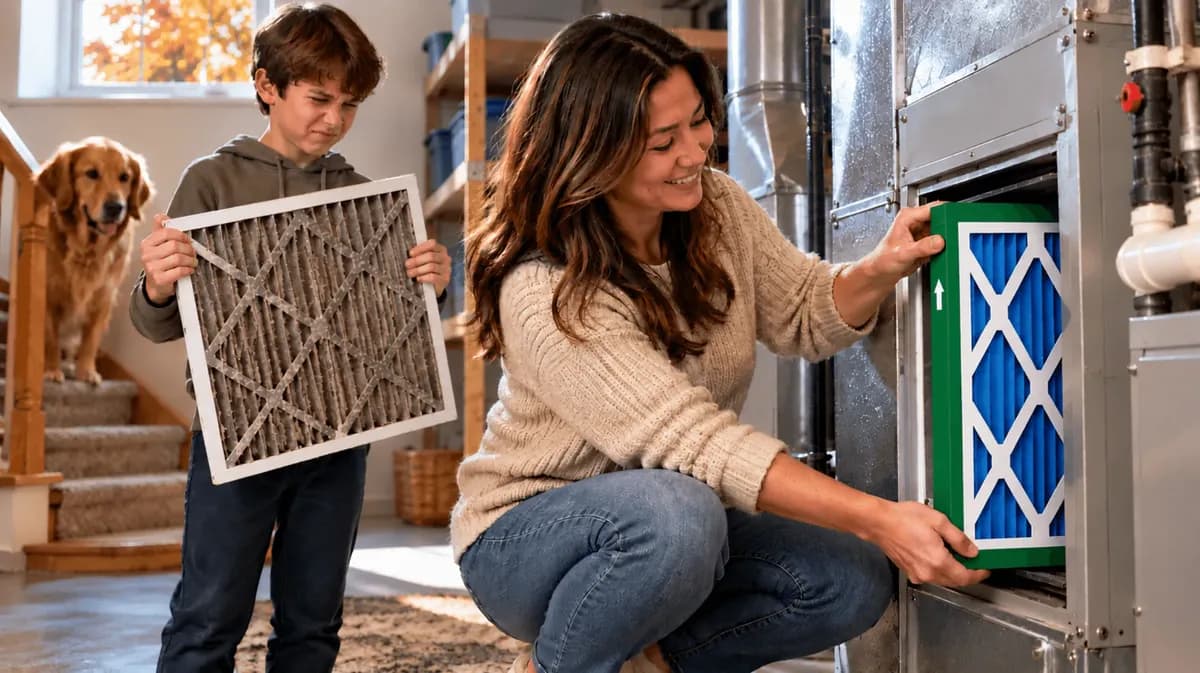
The easiest way to prep your furnace for winter is to split the work: quick airflow and safety checks you do yourself, and a pro’s look at the gas and electrical parts. Book that pro 4–6 weeks before your first freeze, then do your own checks a week or two before the heat comes on for good.
Start with the filter. A filter that truly fills its slot matters more than its rating, and depth is the size we see ordered wrong most often.
Not sure which filter your home needs? Take the quick match quiz below.
Pre-winter furnace prep has two parts
You
30–45 minutes · no special tools
- ✓Fresh filter that fits
- ✓Clear 3 ft around it
- ✓Test CO and smoke alarms
- ✓Open and vacuum vents
- ✓Test-run the heat
Licensed pro
Annual tune-up · gas and electrical
- ✓Gas pressure and burners
- ✓Heat exchanger
- ✓Wiring and controls
- ✓Flue and vent pipes
- ✓Condensate drain
Book the tune-up in early fall, before contractors get busy.
Answer a few quick questions and we’ll match you to the right MERV rating for your home.
TL;DR
Getting your furnace ready for winter takes 30 to 45 minutes of homeowner checks plus an annual tune-up from a licensed technician. You handle the filter, clearance, alarms, vents, and a test run, while the technician inspects the gas and electrical parts. Book that visit in early fall.
Key Takeaways
Start with a fresh filter that fits your slot, depth included, and check it monthly.
Book your tune-up in early fall, before contractors get busy.
Test your carbon monoxide alarms. Gas furnaces and boilers are the top heating-system cause of CO deaths, per the U.S. Consumer Product Safety Commission (CPSC).
Keep 3 feet of clearance. The National Fire Protection Association (NFPA) recommends it around heating equipment.
Run the heat before you need it. A brief dusty smell is normal. If you smell gas, leave and call your gas utility.
What Does Pre-Winter Furnace Maintenance Include?
Pre-winter furnace maintenance has two parts: you handle the airflow and safety checks, and a licensed technician handles the gas and electrical work.
Why this checklist starts with airflow: At Filterbuy, we've built pleated air filters in our own U.S. plants since 2013, and the factory floor has taught us a few things:
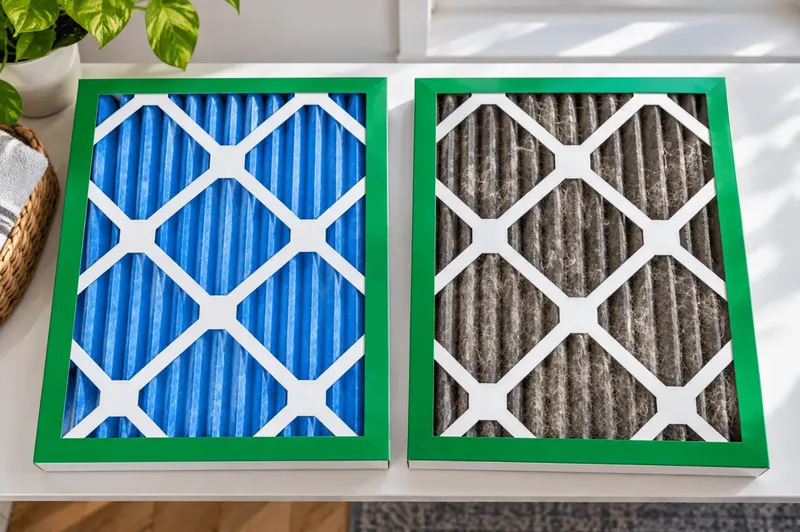
Our filter media leaves the line white, so when one comes back black, the color came from the home.
Depth is the size Filterbuy's team sees ordered wrong most often. A 1-inch slot won't take a 4-inch filter.
Fit matters more than rating. We cut every standard filter half an inch under its labeled size, so a slot that runs large lets air slip around the edges.
Times are typical estimates for a standard forced-air system.
Your DIY Pre-Winter Furnace Checklist
The homeowner checklist takes 30 to 45 minutes and no special tools. Do it a week or two before you turn the heat on for good, and switch the furnace off at its breaker before opening any panel.
Replace the air filter. Order the full size printed on the old frame, depth included, or measure your air filter if the label is gone. Point the airflow arrow toward the furnace, as the Department of Energy's Building America guide shows. Odd size? Order Filterbuy custom air filters.
Clear the area. The NFPA heating safety tip sheet recommends keeping anything that can burn at least 3 feet away from the furnace.
Test CO and smoke alarms. Test each one and put in fresh batteries. The CPSC recommends CO alarms on every level of the home and outside sleeping areas.
Open and vacuum vents and return grilles. A blocked return starves the furnace of air just as a clogged filter does.
Check outdoor intake and exhaust pipes. High-efficiency furnaces vent through plastic pipes outside. Keep them clear of leaves and snow, since the CPSC warns that animals nesting in vents can push exhaust back indoors.
Check the condensate drain line. A plugged drain can cause water damage, ENERGY STAR notes, so flag any standing water for your technician.
Set the thermostat. Switch it to heat and put in fresh batteries before you update the schedule.
Do a test run. Raise the thermostat and confirm warm air reaches every room. A faint dusty smell is common, but a gas smell or one that lingers means stop and check the warning signs below.
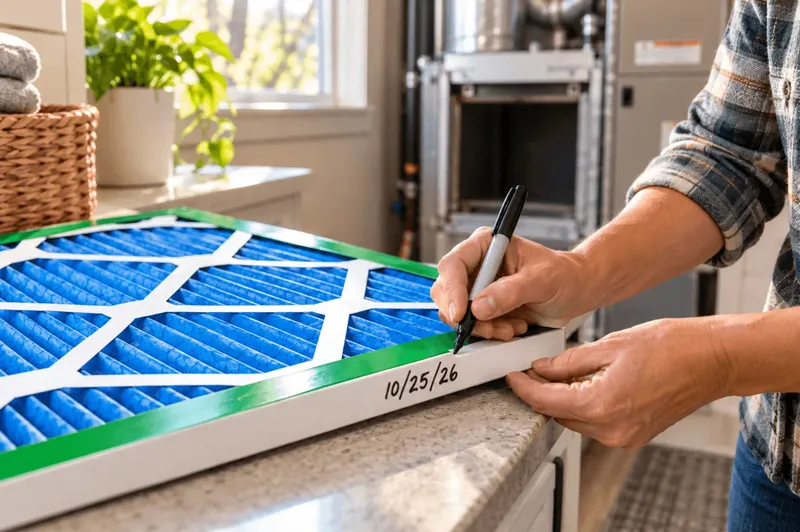
Pro Tip: Date the filter frame, as the Building America guide recommends. When Filterbuy compared a new filter with the same 1-inch filter after 90 days of normal use, it had loaded an even gray. If yours turns black, see what a black furnace filter means.
From the author, Michelle Wan, Brand Manager and Air Quality Writer at Filterbuy: "The question I get most is which MERV to buy. The one to ask first is whether the filter you are holding actually fills the slot. A rating describes the media, not the gap around it."
What Should an HVAC Pro Inspect During a Fall Tune-Up?
A tune-up is an annual professional check of the parts that burn fuel and move air. According to the ENERGY STAR maintenance checklist from the U.S. EPA, it should cover:
Gas connections, gas pressure, burner combustion, and the heat exchanger
Electrical connections and motor readings, since loose ones are unsafe
Lubrication of moving parts to cut friction
Controls and the starting cycle
The condensate drain
The CPSC also recommends checking the chimney and flue for blockages and loose or corroded sections. Electric furnaces and heat pumps skip the gas checks but still need everything else.
4 Questions to Ask at Your Tune-Up
Most checklists stop at "book a tune-up." These questions get you more from the visit:
"Did you test for carbon monoxide and inspect the flue?" The CPSC says both belong in the annual inspection.
"Can you measure static pressure with my filter in place?" Most home systems are designed for 0.5 in. w.g. or less in total, per Filterbuy's pressure drop chart. The reading tells you whether a higher-MERV or thicker filter will work.
"What filter depth does my cabinet take?" Write it on the furnace so you never order the wrong size.
"How is the heat exchanger holding up?" Gas furnaces typically last 15 to 20 years; see gas furnace lifespan.
Bring your filter's install date and a photo of the empty slot, too. Filterbuy's reviewer, David Clark, asks for that photo because old filters often never fit.
When Should You Schedule Furnace Maintenance Before Winter?
Early fall is the best time to schedule furnace maintenance. ENERGY STAR suggests booking before contractors get busy, around the fall clock change. Risk climbs in winter, too: NFPA data show U.S. fire departments responded to an average of 37,365 home heating equipment fires a year from 2020 to 2024, and those fires peak in winter.
We suggest a simple countdown:
4–6 weeks before your first freeze: Book the tune-up while appointments are still open.
1–2 weeks before: Work through the DIY checklist and keep a spare filter on hand.
Before the first cold night: Finish your test run so any problem shows up on a mild day.
Which Furnace Filter Should You Use This Winter?
The right winter filter fits your slot exactly and carries a MERV rating your system can handle. With the blower running longer in winter, check the filter monthly and replace it once it looks gray. See when to change your furnace filter in winter.
Check your furnace manual or ask your technician before moving to a higher MERV rating.
Shop Filterbuy MERV 8 filters, MERV 11 filters, or MERV 13 filters in your exact size.
Because Filterbuy makes MERV 8, 11, and 13 on the same lines, we gain nothing when you move up a rating. Depth is what we'd look at first. A Filterbuy 1-inch filter carries 14 pleats per foot and the 4-inch only 8, yet the 4-inch lasts longer because depth, more than pleat count, sets filter life. Depth also lowers airflow resistance: in Filterbuy lab testing, a 20x25x4 MERV 13 filter showed half the initial resistance of a 20x25x1 MERV 13 (0.11 vs. 0.22 in. w.g. at 1,000 CFM), per our MERV pressure drop chart. Thicker filters only fit cabinets built for them.
Warning Signs Your Furnace Needs a Pro Now
If your carbon monoxide alarm sounds, the CPSC advises getting outside to fresh air right away and calling 911. If you smell gas, leave without touching any switches and call your gas utility or 911 from outside.
Otherwise, call a technician soon if you notice:
A yellow or flickering burner flame instead of a steady blue one
A burning or electrical smell that lasts past the first hour
Short cycling, where the furnace turns on and off every few minutes
Banging or squealing from the blower
Soot or scorch marks near the furnace or on the filter itself (why a furnace filter turns black)
Cold rooms or weak airflow even with a fresh filter
Water pooling around the furnace
From the reviewer, David Clark, Licensed HVAC Technician and President of Filterbuy HVAC Solutions: "In the field, the filter rarely gets blamed for the thing it actually caused. A frozen coil or a blower running long gets written up as a refrigerant or thermostat problem, when the real cause was a loaded filter nobody changed. Before paying for a diagnosis, pull the filter and hold it up to a light."
Supporting Statistics
1. Heating Uses the Most Energy in U.S. Homes
Space heating uses 42% of home energy.
Why it matters: Winter is when your furnace works hardest.
2. Poor Airflow Wastes Energy
Airflow problems can cut a system's efficiency by up to 15%.
Why it matters: Fresh filters and open vents protect it.
3. Newer Gas Furnaces Still Need Inspections
Gas furnaces and boilers were linked to 51% of heating-system CO deaths in 2015.
Gas central furnaces heat 50.3 million U.S. homes.
Furnaces involved in CO incidents averaged just 9.6 years old.
Why it matters: A newer furnace isn't automatically a safe one.
Source: U.S. Consumer Product Safety Commission, Federal Register
Frequently Asked Questions
Do I Really Need a Professional Furnace Tune-Up Every Year?
Yes, especially if you heat with gas. The CPSC recommends an annual professional inspection to help prevent carbon monoxide poisoning.
How Often Should I Change My Furnace Filter in Winter?
Check it every month. Filterbuy's schedule calls for replacing a 1-inch pleated filter every 60 to 90 days, or every 30 to 45 days with pets, with heavy winter use pushing most homes to the short end. Air filter auto-delivery keeps you on schedule.
Is a Burning Smell Normal When I First Turn On the Heat?
Yes, for a little while. Summer dust on the heat exchanger burns off within about an hour. Call a technician if it lingers. If you smell gas, leave and call your gas utility or 911 from outside.
Can I Do All of My Furnace Maintenance Myself?
Not all of it. You can handle filters, clearance, vents, alarms, and the thermostat, but gas and electrical checks need a licensed technician.
Where Should I Install Carbon Monoxide Alarms?
Put one on every level of your home and outside each sleeping area, as the CPSC carbon monoxide fact sheet recommends. The CPSC also advises against placing alarms in kitchens or directly above fuel-burning appliances, and says to keep them away from heating vents.
Glossary
Heat exchanger: The sealed chamber that heats your air while keeping exhaust out; a crack can leak CO.
Carbon monoxide (CO): An odorless, poisonous gas from incomplete burning.
CO alarm: Sounds when CO builds up; the CPSC recommends UL 2034-listed models.
High-efficiency (condensing) furnace: A gas furnace that pulls extra heat from its exhaust and vents through plastic pipes.
MERV (Minimum Efficiency Reporting Value): A 1–16 rating of how well a filter captures particles.
Pressure drop: A filter's airflow resistance, in inches of water gauge (in. w.g.).
Static pressure: Total airflow resistance across the system, measured by a technician with a manometer.
Filterbuy: A U.S. maker of pleated HVAC air filters with plants in Alabama, Florida, Pennsylvania, and Utah.
ENERGY STAR and EIA: The EPA's efficiency program and the U.S. Energy Information Administration.
About the author and reviewer: Michelle Wan works with Filterbuy's U.S. plants; David Clark is an EPA-certified HVAC technician with 10+ years of experience.