
At What AQI Should You Stay Inside?
September 16, 2026
Author: Michelle Wan, Brand Manager and Air Quality Writer, Filterbuy
Reviewer: David Clark, Licensed HVAC Technician, Filterbuy HVAC Solutions
Published: September 16, 2026 | Updated: September 16, 2026
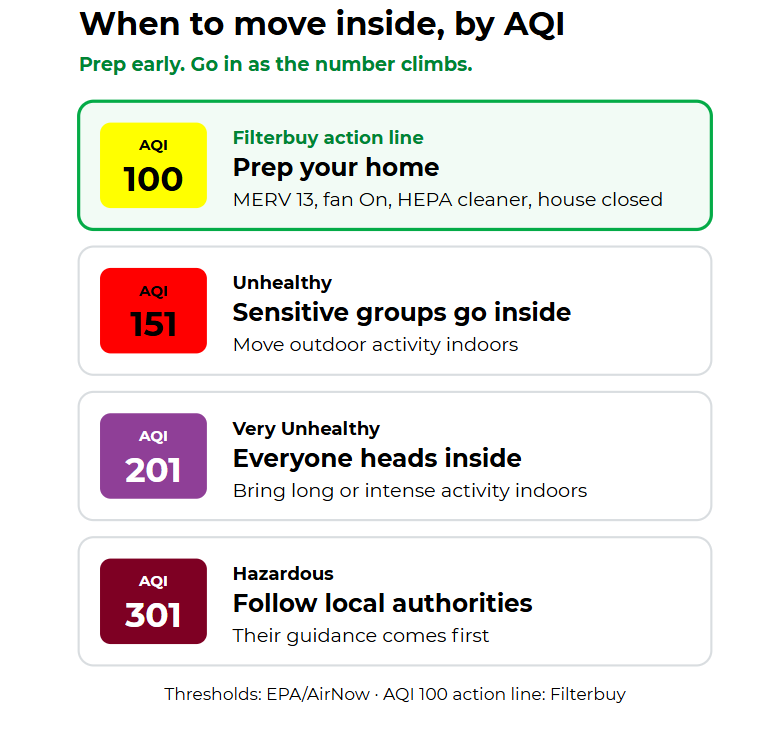
Sensitive groups should move outdoor activity inside once the AQI passes 150. Above 200, everyone should bring long or intense activity inside. At 301 (Hazardous), follow your local authorities first.
Going inside only helps if your indoor air is cleaner. That's why Filterbuy's action line is AQI 100: a MERV 13 filter in your HVAC, the thermostat fan set to On, a portable HEPA air cleaner in each occupied room, and the house closed up. Take the quick quiz below to find the right filter for your home.
Get your home ready before the next alert.
Answer a few quick questions and we'll match you to the right filter.
Already know your size? Shop air filters at Filterbuy
TL;DR
Once the Air Quality Index (AQI) passes 150, sensitive groups should move outdoor activity inside. Above 200, everyone should move long or intense activity inside, and at 301, follow local guidance first. Going inside only helps if the air in your home is cleaner. That's why Filterbuy's action line is AQI 100: MERV 13 in the HVAC, the thermostat fan set to On, a portable HEPA air cleaner in each occupied room, and the house closed up.
Key Takeaways
There's no single AQI threshold for staying indoors. AirNow guidance moves sensitive groups indoors at 151, everyone's strenuous activity at 201, and sensitive groups inside at 301.
Filterbuy's action line is AQI 100. That's where we tell customers to prep the house. AQI 100 is still the top of the Moderate range.
Indoor air isn't automatically clean. A PNAS study of more than 1,400 California buildings found average indoor PM2.5, the fine particles in smoke, nearly tripled on wildfire days.
The map can lag behind the smoke. AirNow's hourly reading blends several recent hours, so close up the house when you smell smoke.
At What AQI Should You Stay Inside?
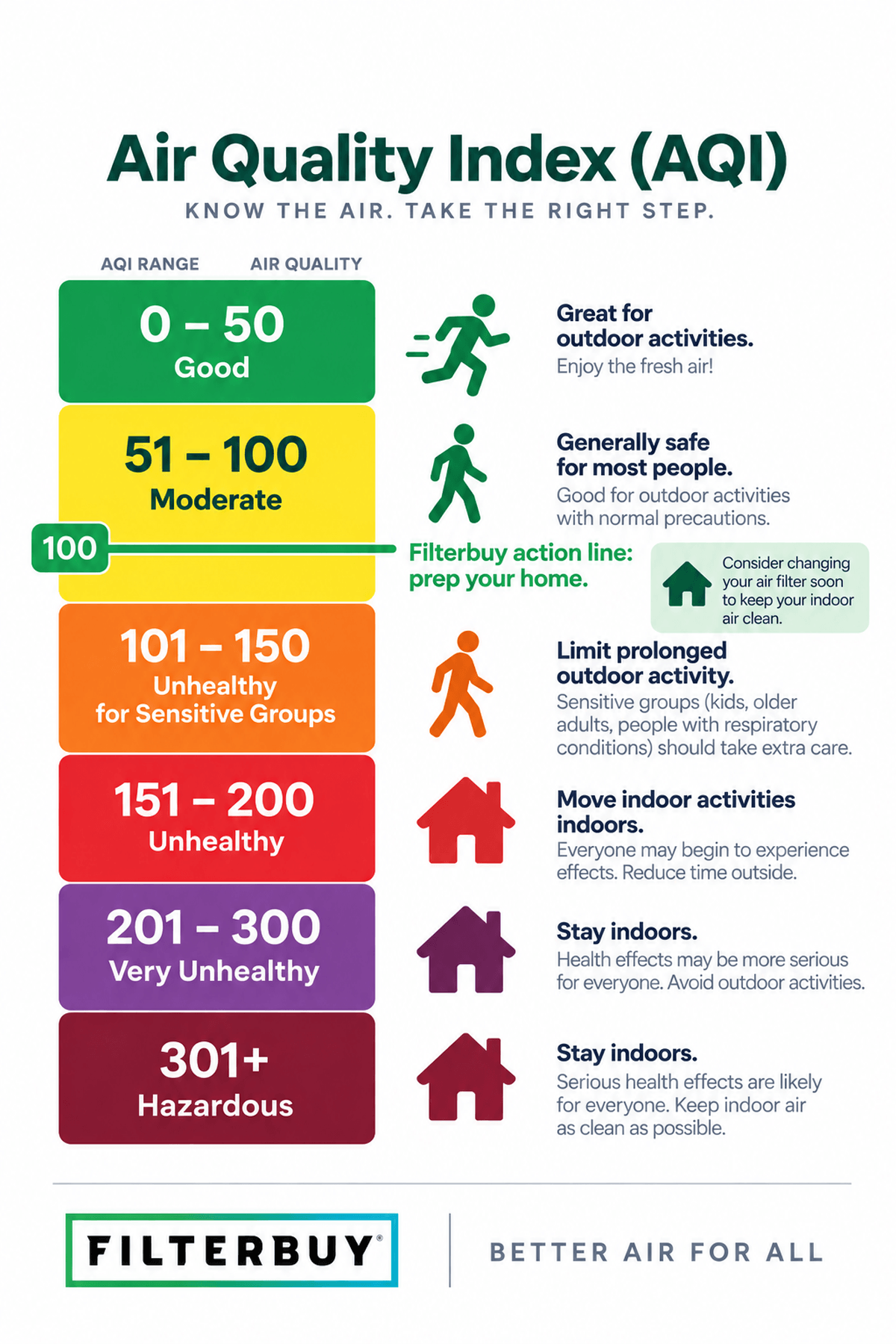
When to stay indoors depends on who you are. AirNow suggests sensitive groups move activities indoors at 151 (Unhealthy) and avoid outdoor physical activity at 201 (Very Unhealthy). Healthy adults can wait until 201 to bring long or intense activity inside. At 301 (Hazardous), follow local authorities first. Filterbuy's action line comes earlier: at AQI 100, switch to MERV 13, set the thermostat fan to On, run a portable HEPA air cleaner in each occupied room, and close the house up.
The table below follows EPA's Air Quality Guide for Particle Pollution. Its categories span the 0 to 500 AQI scale. The last column is Filterbuy's routine at each level.
Source: EPA/AirNow Air Quality Guide for Particle Pollution. The last column and the AQI 100 action line are Filterbuy recommendations.
Should You Stay Inside When Air Quality Is Bad?
Yes, but staying inside only lowers exposure; it doesn't guarantee clean air. Smoke and fine particles still leak in, and indoor PM2.5 can reach unhealthy levels unless you filter the air in your home. Two studies show how much.
In a 2021 PNAS study, Liang and colleagues tracked low-cost PurpleAir air sensors inside and outside more than 1,400 California buildings. When people closed up their homes on wildfire days, the share of outdoor PM2.5 getting inside dropped by about half. Even so, average indoor PM2.5 nearly tripled during wildfire events.
A University of Southern California study of the January 2025 Los Angeles fires found the same pattern. Outdoor PM2.5 spiked above 130 micrograms per cubic meter (µg/m³), and indoor levels still peaked around 60 µg/m³.
What those peaks mean in AQI terms. We ran both numbers through the EPA's 2024 PM2.5 AQI breakpoints:
Outdoors, 130 µg/m³ comes out near AQI 205 (Very Unhealthy).
Indoors, 60 µg/m³ comes out near AQI 154. That's less than half the outdoor level, yet still Unhealthy.
The AQI was designed for outdoor air, so treat these as reference points. Closing the door is a good start, and filtration reduces what still gets in.
Does the pollutant driving the AQI change the answer?
Yes. Check your AQI report's dominant pollutant.
Ground-level ozone: The EPA notes indoor ozone can fall to about 10% of outdoor levels with the windows closed and the AC on. Particle filters don't capture ozone, so keeping the house closed is the best move, and the California Air Resources Board warns against ozone generators.
PM2.5 (wildfire smoke, soot): Fine particles slip indoors and linger, so a high-efficiency filter matters most.
Why can the AQI lag behind the smoke you smell?
AirNow shows a NowCast, a weighted average of the past 12 hours that leans on the latest hours when air changes fast (AirNow technical guidance). Fast-moving smoke can arrive before the number catches up. If you smell smoke while the map still shows yellow, close up the house and check again soon.
How to Make Your Home the Safer Place to Be
Start with official guidance: check AirNow and follow your local air agency, especially if you're told to stay in or leave. Filterbuy's routine starts at AQI 100 and adds to it.
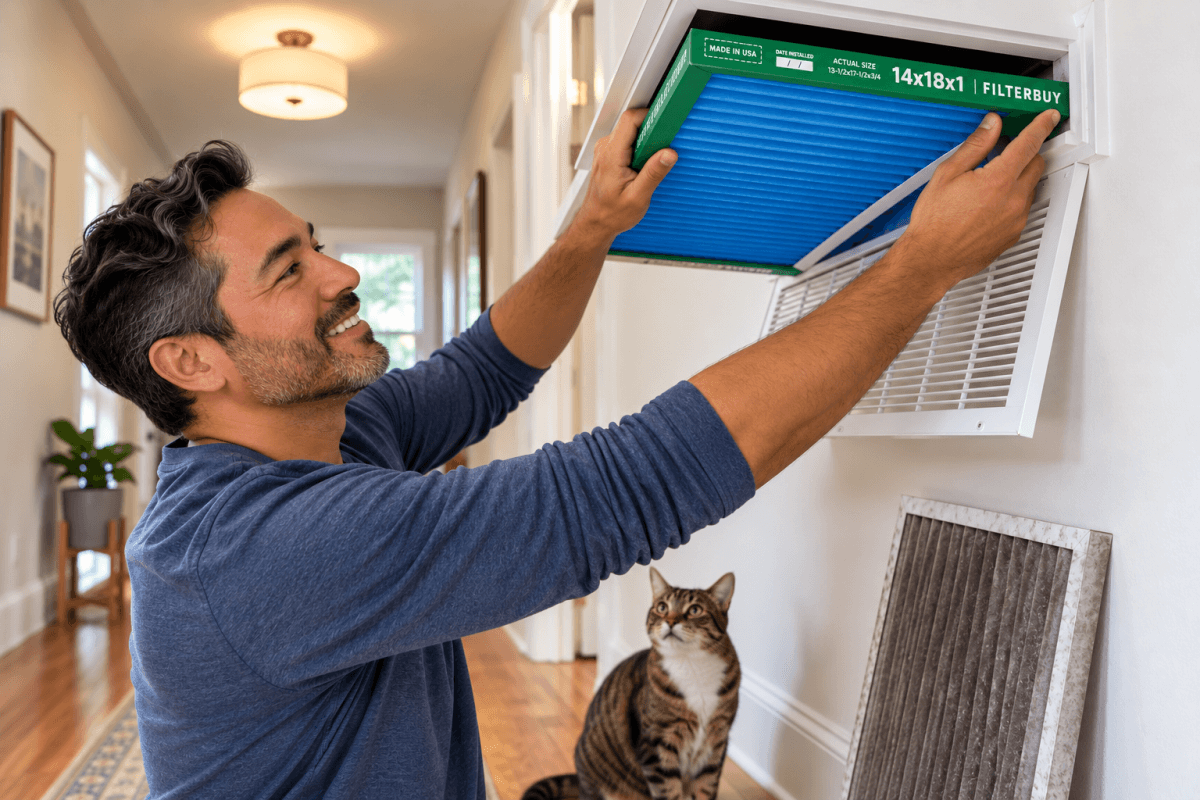
Put a MERV 13 air filter in your HVAC. This is the whole-home layer, since your central system moves far more air than a portable unit. EPA smoke-exposure guidance recommends a filter rated MERV 13 or higher during smoke events. Find your size on our air filter size chart.
Set the thermostat fan to On. On Auto, air only passes through the filter while the system heats or cools. On filters continuously.
Run a portable HEPA air cleaner in each occupied room, bedrooms first. It treats that room harder than the central system can. Per EPA's cleaner air room guidance, a 300-square-foot bedroom needs a smoke CADR of at least 200 (two-thirds of the square footage). Choose a CARB-certified model, because EPA advises against air cleaners that produce ozone.
Close the house up. Shut windows and doors, set your AC to recirculate to keep wildfire smoke out of your house, and skip candles, frying, smoking, and non-HEPA vacuuming.
Will MERV 13 work in your system?
Most likely. EPA notes that most furnaces and HVAC systems can use a MERV 13 filter without equipment problems, as long as the filter is replaced often. The only check is fit: the filter should slide in snugly without bending.
How often should you change the filter during smoke?
Check it during a smoke event and replace it when it looks dirty, dark brown or black. That can be well before the normal interval, so keep spares on hand.
How Should the Plan Change for Your Home?
Most AQI advice assumes central air, but plenty of homes don't have it. In an apartment or a home without ductwork, there's no whole-home layer, so portable HEPA air cleaners are your primary defense. If your home gets dangerously hot without AC, or smoke keeps getting in, the EPA advises seeking shelter elsewhere.
Source: EPA clean room and wildfire smoke guidance.
If you can't get a certified air cleaner yet, a DIY box fan air cleaner built with MERV 13 filters is a reasonable stopgap. In one smoke-event test cited by the EPA, a DIY unit cut PM2.5 roughly 56% in a larger room after 90 minutes and roughly 99% in a smaller room within an hour (May et al., 2021). Use a certified fan made in 2012 or later, and don't leave it running unattended.
If coughing, chest tightness, or shortness of breath continues indoors, call your health care provider.
How Do You Know Your Indoor Air Is Actually Cleaner?
Measure it. The EPA suggests indoor air sensors during smoke events. Compare yours with Filterbuy's live air quality and wildfire smoke map, and aim for indoor PM2.5 well below outdoor, ideally 9.0 µg/m³ or lower. If both rise together, check the filter seal, then look for leaks or indoor sources.
Supporting Statistics: The Research Behind This Guide
Americans spend about 90% of their time indoors. Source: EPA Report on the Environment
152.3 million Americans (44%) live where the air earns a failing grade. Source: American Lung Association, State of the Air 2026
With the house closed, indoor PM2.5 runs roughly 55–60% of outdoor levels during smoke. That's without an air cleaner running, and results range from 30% to 100% by home. Source: EPA wildfire smoke guidance
Frequently Asked Questions
Is it safe to go outside when the AQI is 150?
For most healthy adults, yes. AQI 150 tops the Unhealthy for Sensitive Groups range above AQI 100, and AirNow advises sensitive groups to keep activity short and light.
Should I open my windows when the AQI is over 100?
No. Air the house out once the outdoor reading drops below your indoor monitor's reading. No monitor? Wait for the AQI to return to Good.
Does an air purifier help if I stay inside?
Yes. A portable HEPA air cleaner reduces fine particles in the room where it runs, while a MERV 13 HVAC filter treats air across the whole house. They do different jobs, so use both (MERV 13 vs. HEPA for wildfire smoke).
What AQI is too high to go outside, and what if I have to?
At 301 or higher, the AQI is Hazardous, so follow AirNow and your local authorities first. Their guidance is for everyone to avoid outdoor physical activity. If you have to go out in smoke, the EPA recommends a snug-fitting NIOSH Approved N95 respirator. EPA says not to rely on dust masks or bandanas, and children under 2 shouldn't wear respirators.
Glossary
Air Quality Index (AQI): EPA's outdoor air scale. It runs 0 to 500, from Good (0–50) to Hazardous (301+).
NowCast: AirNow's hourly AQI method, which weights recent hours more when air quality changes quickly.
PM2.5: Fine particles 2.5 micrometers or smaller, the main harmful component of wildfire smoke.
Ground-level ozone: A smog-forming gas created when sunlight reacts with emissions.
Sensitive groups: People with heart or lung disease, older adults, children, pregnant people, and outdoor workers.
MERV (Minimum Efficiency Reporting Value): The 1 to 16 rating for how well an HVAC filter captures airborne particles.
HEPA air cleaner: A portable purifier with a High-Efficiency Particulate Air filter.
Keep Your Home Ready for the Next Bad Air Day
Filterbuy has built air filters in U.S. factories since 2013. Stock a spare MERV 13 before fire season.