
Walking Your Dog When Air Quality Is Bad: A Practical Plan
September 14, 2026
How Long Is Safe?
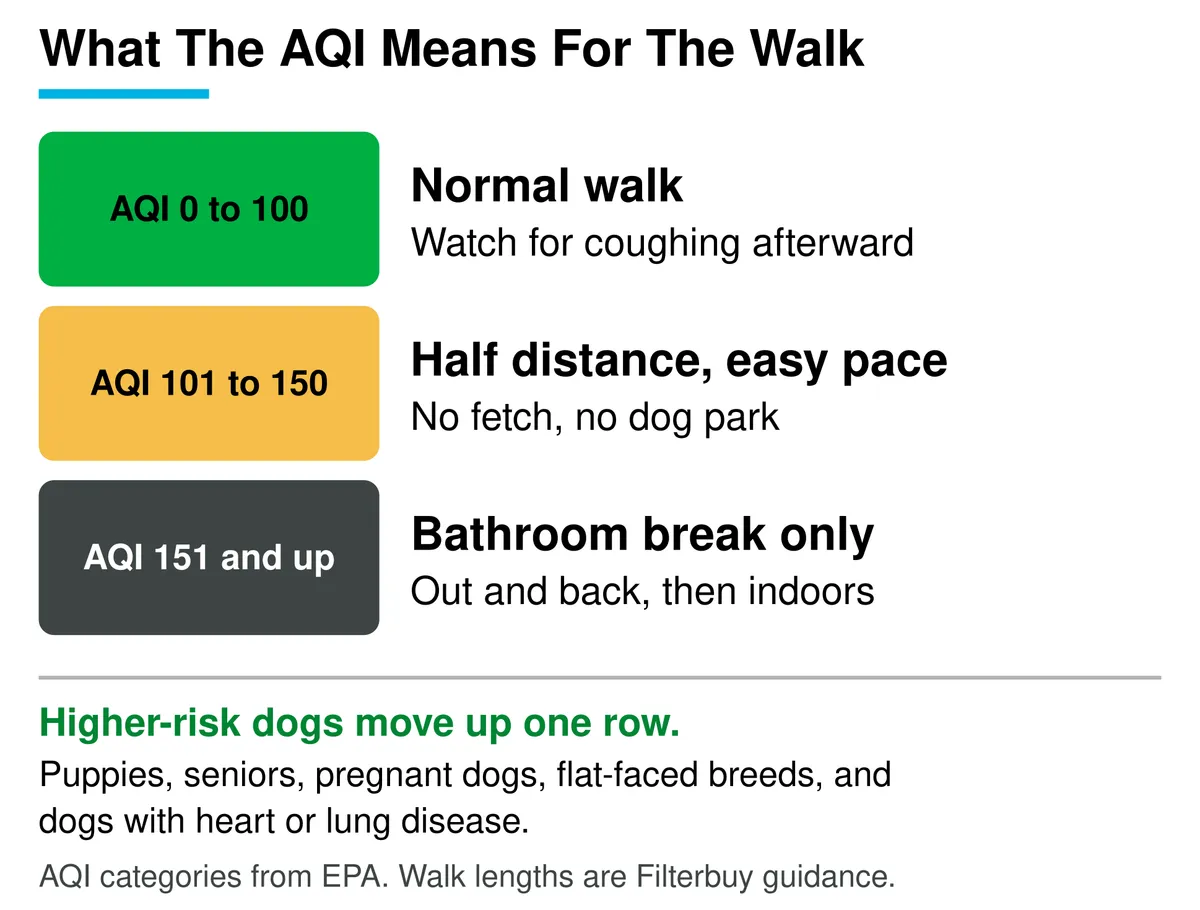
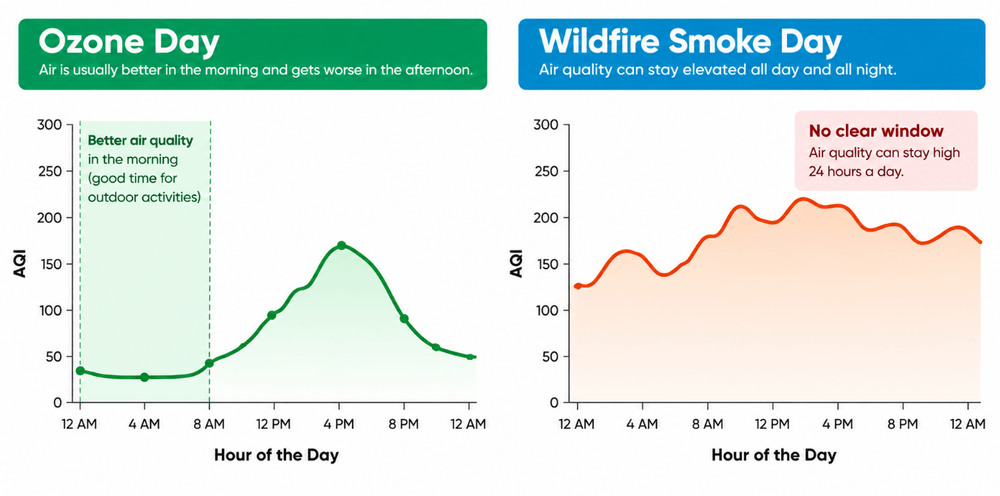
Most dogs can still go out at AQI 101 to 150, as long as the walk is shorter, slower, and off the busy road. Past AQI 150, the walk becomes a bathroom break. Check which pollutant is driving the number as well, because ozone peaks in the afternoon and wildfire smoke keeps no schedule at all.
AQI 0 to 100: normal walk, watch for coughing afterward.
AQI 101 to 150: half distance, easy pace, no fetch and no dog park.
AQI 151 and up: bathroom break only, then back indoors.
Higher-risk dogs move up one band: puppies, seniors, pregnant dogs, flat-faced breeds, and dogs with heart or lung disease.
AQI categories come from EPA. The walk lengths are Filterbuy guidance, and your veterinarian's advice for your dog outranks both.
A shorter walk only helps if the air waiting indoors is cleaner. Answer a few quick questions and we will match you to the right filter for your home.
TL;DR
Most dogs can still go outside when the Air Quality Index climbs past 100, but the walk has to change: shorter, slower, off the busy road, and timed around whichever pollutant is driving the number. Once the AQI passes 150, the walk becomes a bathroom break. Energy your dog does not burn outdoors has to go somewhere, so plan the indoor half of the day before you shorten the outdoor half.
Key Takeaways
The Air Quality Index runs from 0 to 500 across six categories, and 101 to 150 is the Unhealthy for Sensitive Groups range where owners should start cutting walk length.
EPA tells pet owners to limit outdoor activity when it is smoky and warns that smoke plus heat is worse than smoke alone.
Neither EPA nor the American Veterinary Medical Association says for how long, which is the gap this page fills.
Ground-level ozone peaks in the afternoon and early evening, so an ozone day has a usable morning window. Wildfire smoke keeps no schedule at all.
Puppies, senior dogs, pregnant dogs, flat-faced breeds, and dogs with heart or lung disease need a lower threshold than a healthy adult dog.
Should You Walk Your Dog When Air Quality Is Bad?
Yes for most dogs, with the walk shortened and slowed. Between AQI 101 and 150, keep it brief and easy, and skip the run, the fetch, and the dog park. Above AQI 150, a bathroom break replaces the walk. Dogs with heart or lung disease, puppies, seniors, and flat-faced breeds should drop a category earlier than that.
EPA guidance on protecting pets from wildfire smoke tells owners that if you feel the effects of smoke your pet probably does too, and that a smoky day is no day for a run. The American Veterinary Medical Association guidance on wildfire smoke and animals goes further during an alert and advises brief bathroom breaks only.
Filterbuy makes air filters, not veterinary advice, so every threshold above traces to EPA and the AVMA, not to us. What Filterbuy knows first-hand is the other half of the problem, the air waiting indoors when the walk ends. A person can wear a respirator and say when their throat starts to burn. A dog can do neither, so the call belongs to whoever holds the leash.
Read The Pollutant, Not Just The Number
The Air Quality Index reports the single worst pollutant of the hour on one 0 to 500 scale, and which one it is decides when the air will be cleanest. Ground-level ozone forms in sunlight and peaks in the afternoon and early evening. Fine particle pollution from wildfire smoke keeps no daily schedule. Two identical AQI readings can call for opposite walk times.
AirNow, the EPA air quality service, names the responsible pollutant alongside the number. The AirNow AQI Basics page lists the six categories, and the Filterbuy explainer on how the AQI picks a dominant pollutant covers why the worst single reading becomes your number instead of an average.
On an ozone day, walk early. The New York State Department of Health ozone guidance states that ozone is most likely to be unhealthy from the afternoon through early evening on hot, sunny days, and recommends scheduling outdoor activity in the morning when levels are lower. A 7 a.m. walk and a 5 p.m. walk are not the same walk.
On a smoke day, that timing rule does not hold. PM2.5 answers to wind and plume position instead of sunlight, and can sit high overnight and into the morning. Check the current hourly value right before you clip the leash on. Here is how to check the AQI near you in under a minute.
The Filterbuy Dog Walk Decision Table
Every authority stops at the words limit activity and none says how long, which is why Filterbuy built this table. The categories are EPA's. The walk lengths in the two right columns are Filterbuy's, not an EPA recommendation, and your veterinarian's advice for your dog outranks both.
"Most people check the number and stop there. The number tells you how bad the air is. The pollutant behind it tells you when the air will be better, and that decides whether the walk happens at seven in the morning or not at all."
— Michelle Wan, Brand Manager and Air Quality Writer, Filterbuy
Which Dogs Need A Lower AQI Threshold?
EPA identifies animals that are older, younger, or pregnant, and those with heart or lung disease, as especially at risk whenever air quality is poor. EPA also singles out short-nosed dogs such as pugs and bulldogs, which can struggle to breathe when smoke or heat is present, and advises extra caution there.
Short-nosed dogs are called brachycephalic, and the anatomy behind that word matters. AKC Canine Health Foundation research on thermoregulation in brachycephalic breeds found these dogs work harder to shed body heat through breathing and hold a normal temperature less successfully under heat stress. English Bulldogs, French Bulldogs, Pugs, Boston Terriers, Shih Tzus, and Boxers belong in the higher-risk column.
Heat matters on its own too. EPA notes that smoke and heat together are worse than smoke alone, so a 95-degree smoke day calls for a shorter outing than a 65-degree one.
Where To Walk When The Air Is Bad
Route choice changes exposure on its own, whatever the AQI says. Areas near high-traffic roadways carry much higher pollution than the rest of the community, per American Lung Association guidance on transportation pollution, so a four-lane arterial delivers more than the neighborhood reading suggests. Interior streets or a park set back from traffic beat the main road.
How To Burn Dog Energy Indoors
A shortened walk leaves an energy debt, and indoors it comes down faster through the nose than the legs. Scent games, food puzzles, and short training sets tire most dogs without raising their breathing rate, which is the trade you want.
Scatter feed. Toss part of the day's kibble across a rug or snuffle mat and let the dog work it out.
Hide and find. Put the dog in a stay, hide three treats in another room, release, then make it harder.
Food puzzles. A frozen stuffed toy buys 20 quiet minutes and works the jaw while the lungs rest.
Short training sets. Five minutes of sit, down, stand, and hand targeting is mentally heavy, physically light.

Skip the treadmill and long indoor fetch, since both raise the breathing rate you are trying to keep down.
One day of this is manageable. Four is a different problem, and most guides skip it. Rotate the games rather than repeating one, split the day's food into three or four scatter sessions, and expect the dog to settle less easily by day three.
Warning Signs To Turn Around And Call Your Veterinarian
EPA lists specific signs of smoke and heat exposure in pets, and any of them ends the walk. Watch the breathing first, whether it turns open-mouthed, noisy, or fast. Then look for coughing or gagging, red or watery eyes, nasal discharge, heavy panting, weakness, stumbling, and a drop in appetite or thirst.
Symptoms can lag. A dog that looked fine on a short walk can start coughing that evening, so watch breathing and appetite and call your veterinarian if anything seems off.
Making The Indoor Air Worth Coming Home To
A shorter walk only helps if the air indoors is cleaner, and that is not automatic. Keep windows and doors closed, run the HVAC on recirculate with a filter rated for fine particles, and stop adding particles indoors while the smoke lasts.
During a smoke event EPA advises against frying or broiling, vacuuming, burning candles, using a fireplace or woodstove, and smoking or vaping, since each adds particles indoors.
This is the part Filterbuy builds for. MERV 13 air filters capture 98 percent of airborne particles, which is the level that matters for fine smoke particles, and they load faster during a smoke stretch, so change them sooner. Filterbuy makes MERV 8, 11, and 13 in standard and custom sizes, so an odd opening is a measuring job.
No ductwork? A ductless home, an apartment on window units, or a room served by a mini split has no central filter to upgrade. Put a portable air cleaner in the room where the dog sleeps, sized for that room, and keep the door shut. The Filterbuy guide to running an air purifier on a high-AQI day covers fan speed and placement.
One caution on devices. Avoid ionizers and any air cleaner that intentionally produces ozone, which is a lung irritant and works against the dog you are trying to protect.
Supporting Statistics
Three findings behind the guidance above.
17% higher asthma emergency visits on wildfire smoke days
Across 19 wildfire smoke days in 2023, CDC found asthma-related emergency visits ran 17 percent above expected levels nationwide. CDC counted a smoke day as any day a monitor hit AQI 101, the threshold this page uses to start shortening a walk.
Source: CDC Morbidity and Mortality Weekly Report on asthma visits during the 2023 wildfire smoke episodes
4 straight years at number one for a flat-faced breed
American Kennel Club registration data ranked the French Bulldog the most popular U.S. breed for the fourth year running in 2025. America's most-registered dog is brachycephalic, so the decision table's lower threshold covers a large share of households.
Source: American Kennel Club rankings of the most popular dog breeds
3,044 dogs and more than 650,000 biological samples
Morris Animal Foundation has tracked those dogs for 14 years in the largest prospective canine health study in the U.S. In September 2025 it funded a Colorado State University team to test whether wildfire smoke shortens canine lifespans, since the long-term effects remain unmeasured.
Source: Morris Animal Foundation Golden Retriever Lifetime Study
Frequently Asked Questions
Is It Safe To Walk My Dog At An AQI Of 150?
AQI 150 sits at the top of the Unhealthy for Sensitive Groups band, and EPA advises limiting outdoor activity for pets when it is smoky. A short, flat, slow bathroom walk is reasonable for a healthy adult dog. A run, a hike, or the dog park is not. Higher-risk dogs go out only to eliminate.
Can Dogs Wear Masks For Wildfire Smoke?
Dogs cannot use human respirators, and a covering that does not seal adds heat and stress without filtering anything. Ask your veterinarian before putting anything on a dog's face.
How Long Can A Dog Be Outside At An AQI Over 200?
Long enough to eliminate. At 201 and above the AQI is Very Unhealthy or Hazardous, and both EPA and the American Veterinary Medical Association advise keeping pets indoors with bathroom breaks short.
When Can We Go Back To Normal Walks?
Wait for the AQI to hold below your threshold, not the first hour it dips, since smoke often returns overnight. If your dog coughed or tired easily, allow a few gentle days before hard exercise and call your veterinarian if a cough persists.
What AQI Is Too High For A Puppy Or A Senior Dog?
Treat 101 as the line for puppies, senior dogs, pregnant dogs, and dogs with heart or lung disease rather than 151. EPA names younger, older, and pregnant animals, and those with heart or lung disease, as especially at risk when air quality is poor.
Glossary
Air Quality Index (AQI): the EPA scale from 0 to 500 that reports outdoor air quality across six categories, from Good to Hazardous. See what the Air Quality Index measures.
PM2.5: fine particulate matter 2.5 micrometers and smaller, the dominant pollutant in wildfire smoke and the one that travels deepest into the lungs. More on PM2.5 and fine particles.
Ground-Level Ozone: a gas formed when sunlight reacts with vehicle and industrial emissions, commonly called smog. It peaks in the afternoon and early evening.
MERV: Minimum Efficiency Reporting Value, the ASHRAE rating that describes how efficiently an HVAC filter captures airborne particles.
Sources
U.S. Environmental Protection Agency, Protect Your Pets from Wildfire Smoke. https://www.epa.gov/wildfires/protect-your-pets-wildfire-smoke (Last updated July 24, 2026)
American Veterinary Medical Association, Wildfire Smoke and Animals. https://www.avma.org/resources-tools/pet-owners/emergencycare/wildfire-smoke-and-animals (Accessed September 10, 2026)
AirNow, Air Quality Index Basics. https://www.airnow.gov/aqi/aqi-basics (AQI categories and ranges)
New York State Department of Health, Ozone and Health. https://www.health.ny.gov/environmental/outdoors/air/ozone.htm (Revised October 2023)
AKC Canine Health Foundation, Grant 01188-A, Capacity for Respiratory-Based Thermoregulation in Brachycephalic Breeds. https://www.akcchf.org/grant-directory/01188-a/ (Davis, Oklahoma State University)
American Lung Association, Transportation. https://www.lung.org/clean-air/outdoors/what-makes-air-unhealthy/transportation (Last updated January 15, 2026)
CDC, MMWR 72(34), Asthma-Associated Emergency Department Visits During the Canadian Wildfire Smoke Episodes, United States, April-August 2023. https://www.cdc.gov/mmwr/volumes/72/wr/mm7234a5.htm (Published August 25, 2023)
American Kennel Club, Most Popular Dog Breeds. https://www.akc.org/most-popular-breeds/ (2025 registration rankings)
Morris Animal Foundation, Golden Retriever Lifetime Study. https://www.morrisanimalfoundation.org/golden-retriever-lifetime-study (Cohort and sample figures)