
Air Quality Precautions When You're Immunocompromised
September 24, 2026
What Air Quality Precautions Should You Take If You're Immunocompromised?
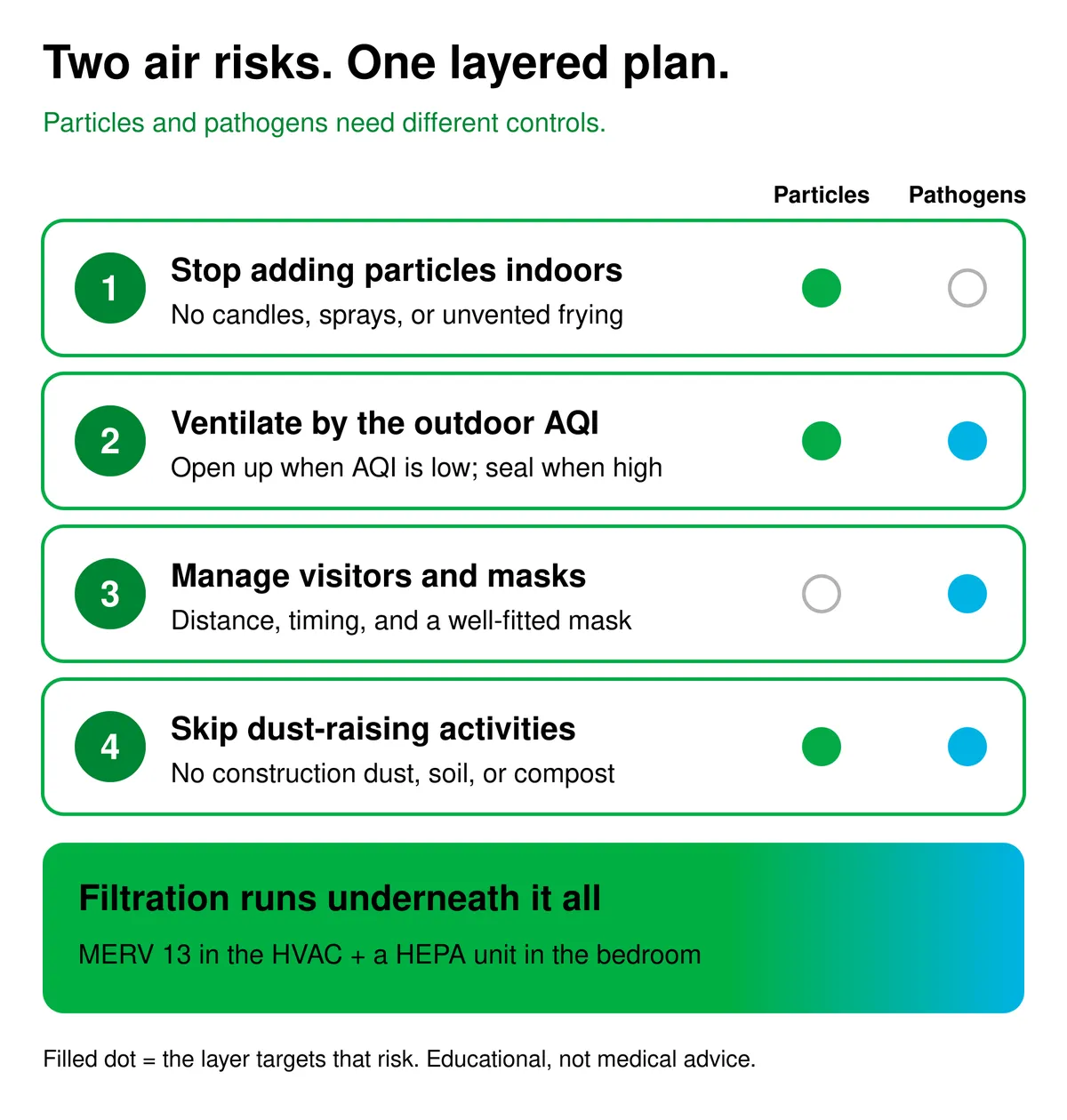
Use a layered plan: cut indoor particle sources, ventilate only when outdoor AQI is low, limit contact with sick visitors, and skip dust-raising work. Then let filtration run underneath it all.
A weakened immune system faces two separate risks: fine particles and airborne pathogens. No single device handles both. For most homes, the filtration layer is a MERV 13 filter in the HVAC system plus a HEPA portable unit in the bedroom.
Not sure which filter fits your system? Take the quick match quiz below.
Made in American factories in over 600 sizes.
Find Your Filter Match
Answer a few quick questions and we'll match you to the right filter for your home.
TL;DR
When your immune system is suppressed, indoor air carries two separate risks: fine particles that inflame already-stressed airways, and airborne pathogens your body can no longer clear on its own. No single device handles both, which is why the approach that works is a layered one. You control what you generate indoors, time your ventilation to outdoor conditions, manage exposure to people and to dust-raising work, and let filtration run underneath all of it.
Key Takeaways
Particles and pathogens are different problems. Filtration handles particles. Pathogens also need ventilation, timing, and a well-fitted mask.
Hospitals protect allogeneic transplant patients with HEPA filtration and at least 12 air changes per hour. The CDC target for ordinary occupied buildings is 5 air changes per hour, the realistic home goal.
Dust-raising activity carries the clearest documented risk. Transplant guidelines advise avoiding construction sites, excavation, soil, and compost.
Outdoor air quality decides your ventilation plan. Ventilate when AQI is low; seal and filter when it is high.
Why Compromised Immunity Changes The Air Quality Math
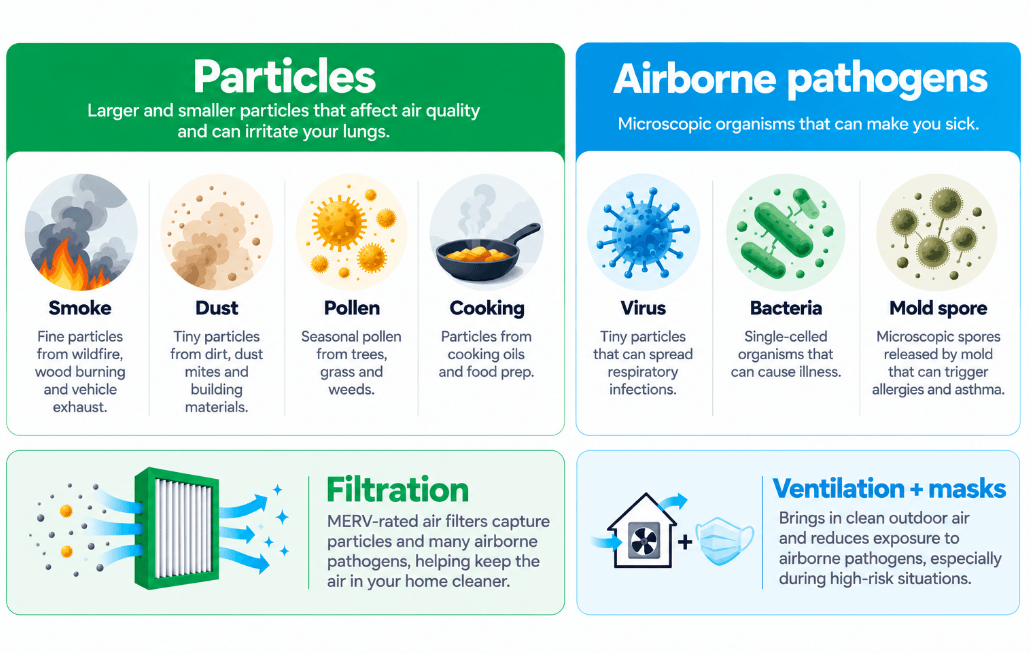
Immunosuppression changes both what the body absorbs and what it can fight off. Chemotherapy, anti-rejection drugs, high-dose steroids and biologics all blunt the immune system's ability to clear inhaled particles and organisms, and two distinct threats follow from that, each answering to a different set of controls. Most guidance still treats indoor air as a single problem; splitting it in two is what makes everything below work.
The first threat is particles. Fine particulate matter, or PM2.5, travels deep into lung tissue and crosses into the bloodstream, and research links short-term exposure to inflammation, oxidative stress and weakened respiratory defenses. A systematic review and meta-analysis in ACS Environmental Au found a 10 microgram per cubic metre rise in short-term wildfire PM2.5 was associated with a 15% increase in COVID-19 infections.
The second threat is living organisms, and respiratory viruses, bacteria and mold spores all travel in indoor air. Aspergillus is the clearest example: a mold common indoors and out, harmless to almost everyone, and a serious invasive risk to someone with prolonged neutropenia. Filtration reduces both threats, but the pathogens a visitor carries into the room are answered only by ventilation, distance, timing and masks.
What Hospitals Do, And What A Home Can Realistically Reach
Hospital protective environments set a bar no house is going to match, and naming that gap honestly is more useful than pretending a bedroom could close it. CDC's Guidelines for Environmental Infection Control in Health-Care Facilities describe protective environments for allogeneic stem cell transplant patients as HEPA filtration, more than 12 air changes per hour, and positive room pressure. HEPA filters remove at least 99.97% of particles 0.3 microns and larger.
Hospital Protective Environment Vs. Realistic Home Target
Filterbuy analysis. Hospital standard per CDC environmental infection control guidance; home target per the CDC recommendation of 5 air changes per hour, or 5 equivalent counting filtration.
In practice, that means a cleaner-air room. EPA recommends people at greater risk set up one room where smoke and particle levels are kept as low as possible, sized so the portable air cleaner's tobacco-smoke CADR is at least two-thirds of the room's area in square feet. For most households that room is the bedroom.
The Four Behavioral Layers
Layer 1: Stop Adding Particles Indoors
Source control is the cheapest improvement available to any household, and it is entirely behavioral. EPA guidance for clinicians names the common indoor particle sources as smoking and vaping, candles, gas, propane or wood stoves, aerosol sprays, cooking (especially frying and broiling), and vacuuming.
During active treatment that means no candles, incense or aerosol sprays, the range hood running whenever you cook, and either a sealed HEPA vacuum or somebody else doing it. Damp-dusting is worth the swap too, since a dry cloth lifts more than it collects.
Layer 2: Time Your Ventilation To The Outdoor Air
Ventilation dilutes the pathogens and gases that build up indoors, but it only helps when the outdoor air is clean to begin with. Check your local AQI before opening anything.
When AQI sits in the green or low yellow range, open windows on opposite sides of the house and run the exhaust fans. When it climbs into orange or worse, or smoke arrives, reverse the whole thing: close the windows and doors, set the HVAC to recirculate, and let filtration do the work. That sequence is in our guide to keeping wildfire smoke out of your house. EPA notes that indoor PM2.5 generally runs around 55% to 60% of outdoor levels during smoke events when doors and windows are closed and no air cleaner is running, which is the clearest argument there is for having one.
In offices and clinics there is a useful proxy for all of this: carbon dioxide above 1,000 ppm usually signals poor ventilation and a higher risk of pathogen spread, according to Johns Hopkins Center for Health Security guidance written for immunocompromised workers.
Layer 3: Manage The People Variable
Airborne pathogens arrive with people, so this layer is about exposure rather than equipment. Transplant safe-living guidance advises avoiding contact with anyone who has a respiratory illness, and masking whenever that contact cannot be avoided. The same Johns Hopkins guidance recommends a high-quality mask in crowded indoor settings and names N95s, KN95s and KF94s as the best options, though fit does more of the work than the label does.
Day to day, that means holding visits outdoors or in a well-ventilated room and moving the air cleaner to wherever guests sit.
Layer 4: Avoid The Activities That Raise Spores And Dust
This layer carries the strongest guideline support of the four, and it is almost entirely a matter of what you don't do. CDC advises people with weakened immune systems to avoid dusty areas like construction or excavation sites, to wear an N95 respirator where they cannot be avoided, and to avoid close contact with soil or dust, while noting plainly that these actions have not been proven to prevent aspergillosis.
Safe-living guidance from the American Society of Transplantation goes further, advising recipients avoid construction, excavation, and other dust-laden environments, and noting that home remodeling needs cautious planning because of the Aspergillus risk. It also advises avoiding soil, fertilizer, and decaying vegetation including compost, with gardening best avoided for at least the first year after transplant, or masks worn if exposure is unavoidable.
Water damage belongs in the same category. Standing water should be dealt with promptly and by someone other than the transplant recipient, and holding indoor humidity between 30% and 50% suppresses mold without drying out airways.
Which Precaution Addresses Which Threat
Filterbuy precaution-to-threat matrix, compiled from CDC, EPA and American Society of Transplantation guidance. Ratings describe exposure reduction, not clinical outcomes; mold spores count under pathogens.
If You Are The Caregiver, Not The Patient
Most of this guide gets carried out by somebody other than the patient, and the guidelines quietly assume as much: standing water is to be cleaned up by someone other than the recipient, while vacuuming, gardening and renovation are jobs to hand off rather than supervise. Three of them belong to the household rather than to the patient. The first is keeping symptomatic visitors away, and masking at home when you are the symptomatic one. The second is owning the filter calendar, since that is the task most likely to slip during a hard month. The third is taking on the dust-raising work yourself, with the patient out of the room while you do it.
What To Ask Your Care Team
Your risk is not constant, and no article can tell you where in it you sit. These are worth bringing to your next appointment:
How long will I be neutropenic, and when is my nadir?
Am I cleared for gardening, yard work, or renovation yet?
Should I mask indoors in public, and with which mask?
Where Filtration Fits: Choosing A Filter For An Immunocompromised Household
Behavior does the heavy lifting here, but filtration is what keeps working while you aren't thinking about it. For most homes the starting point is a MERV 13 pleated filter in the HVAC system, the rating CDC recommends as the minimum for occupied buildings. If you are still choosing, compare MERV ratings first.
"In most houses I walk into, the filter is fine and the slot around it isn't. Air takes the easy route around the pleats, and in a house where somebody is immunocompromised, that gap matters more than the MERV number on the box." — David Clark, Licensed HVAC Technician
Three things matter more than the number on the box:
Run the fan continuously. Switch the thermostat fan from AUTO to ON so air passes through the filter even when the system isn't heating or cooling. A filter only works on air that reaches it.
Change it more often than the label says. During an immunosuppressed period, inspect it monthly and replace it when it looks dirty rather than when the calendar says so.
Seal the filter slot. A gap around the frame lets air slip past the filter entirely, quietly undoing the upgrade you just paid for.
Add a HEPA portable unit in the bedroom, sized so its tobacco-smoke CADR is at least two-thirds of the room's area. See also our guide to the best air filters for immune-compromised households.
Filterbuy builds MERV 13 filters in over 600 sizes in American factories, at 16 pleats per linear foot, and rates them for 90 days in an ordinary home, shortening that to 30 to 45 days in active wildfire season. An immunosuppressed household is better off treating that shorter interval as its default rather than its exception. If you are setting up around someone in treatment, set up auto-delivery to remove the step most likely to get missed during a hard month.
Three Things That Can Save You Money
Filtration is worth paying for. The three below are not, however often they are marketed to this audience.
Ozone generators and “activated oxygen” air cleaners. No federal agency has approved these for use in occupied spaces. EPA finds that within public health limits ozone does not effectively remove viruses, bacteria or mold, and that it can compromise the body's ability to fight respiratory infections. For this audience, that is the wrong trade twice over.
Duct cleaning bought as an infection measure. CDC states plainly that duct cleaning has not been shown to prevent any health problems, and that EPA studies found airborne particle levels neither rise from dirty ducts nor fall after cleaning. Clean ducts if visibly contaminated; do not buy it as protection.
Filters labelled “HEPA-type” or “HEPA-grade.” HEPA is a number: at least 99.97% of particles 0.3 microns. A label that avoids stating that number is not claiming it.
Supporting Statistics
U.S. national estimates from federal agencies, compiled by Filterbuy.
Frequently Asked Questions
Is an air purifier enough protection during chemotherapy?
No. A HEPA air purifier reduces airborne particles and some pathogen-carrying aerosols in the room where it runs, but does nothing about surfaces, food, hand contact, or exposures outside the home. It is one layer of a plan that also depends on ventilation timing, source control and staying away from dust and soil.
Should an immunocompromised person open windows?
Yes, when outdoor air quality is good. Ventilation dilutes airborne pathogens and indoor gases, and is one of the few controls that works on both threats. Check the AQI first. When it is high, or smoke or pollen is heavy, keep windows closed, set the HVAC to recirculate, and rely on filtration.
How long do these precautions need to last?
It depends on the treatment and the person. Immune competence after transplant is conventionally thought to return around 24 months, absent ongoing immunosuppressive therapy or active graft-versus-host disease. Chemotherapy risk cycles with each round. Only your care team can say which window you are in.
Glossary
AQI (Air Quality Index): The EPA scale for outdoor air pollution: green (good) through yellow, orange, red, purple, maroon (hazardous).
PM2.5: Fine particulate matter 2.5 microns or smaller, small enough to reach deep lung tissue and the bloodstream.
HEPA (High-Efficiency Particulate Air): A standard requiring removal of at least 99.97% of particles 0.3 microns across.
MERV (Minimum Efficiency Reporting Value): The 1-to-16 rating scale for residential and commercial HVAC filters; higher numbers capture smaller particles.
ACH (Air Changes per Hour): How many times per hour a room's full air volume is replaced. eACH counts filtration and air treatment alongside outdoor air.
CADR (Clean Air Delivery Rate): How much filtered air a portable air cleaner delivers, rated separately for smoke, dust, and pollen.
Neutropenia: An abnormally low neutrophil count. Neutrophils fight bacterial and fungal infection; prolonged neutropenia is the main risk factor for invasive mold infection.
Protective environment: A hospital room for highly immunocompromised patients: HEPA filtration, high air change rates, positive pressure.
Aspergillus: A mold found indoors and out, harmless to most people but capable of invasive infection in people with weakened immunity.
Sources
CDC, Guidelines for Environmental Infection Control in Health-Care Facilities: Air, CDC, Reducing Risk for Aspergillosis, EPA, How to Create a Cleaner Air Room at Home, EPA, Strategies to Reduce Exposure Indoors (Wildfire Smoke and Your Patients' Health), EPA, Preventing the Spread of Respiratory Viruses in Public Indoor Spaces, Johns Hopkins Center for Health Security, Indoor Air Quality for Immunocompromised Individuals and Transplant Recipients (PDF), Mahendran et al., Wildfire-Related Air Pollution and Infectious Diseases: Systematic Review and Meta-Analysis, ACS Environmental Au (2025), American Society of Transplantation, Strategies for Safe Living Following Solid Organ Transplantation, EPA, Report on the Environment: Indoor Air Quality, EPA, Ozone Generators that are Sold as Air Cleaners, CDC, Fungal Disease Burden by the Numbers, HRSA, Organ Donation Statistics, organdonor.gov
Written by Michelle Wan. Reviewed by David Clark, Licensed HVAC Technician. Published by Filterbuy, an American air filter manufacturer. This article is educational, not medical advice. Decisions about infection precautions during immunosuppression belong with your transplant, oncology, or primary care team.