
How To Protect Children From Outdoor Air Pollution
July 30, 2026
By Michelle Wan · Technically reviewed by David Clark, Licensed HVAC Technician · Published July 30, 2026 · Updated July 30, 2026
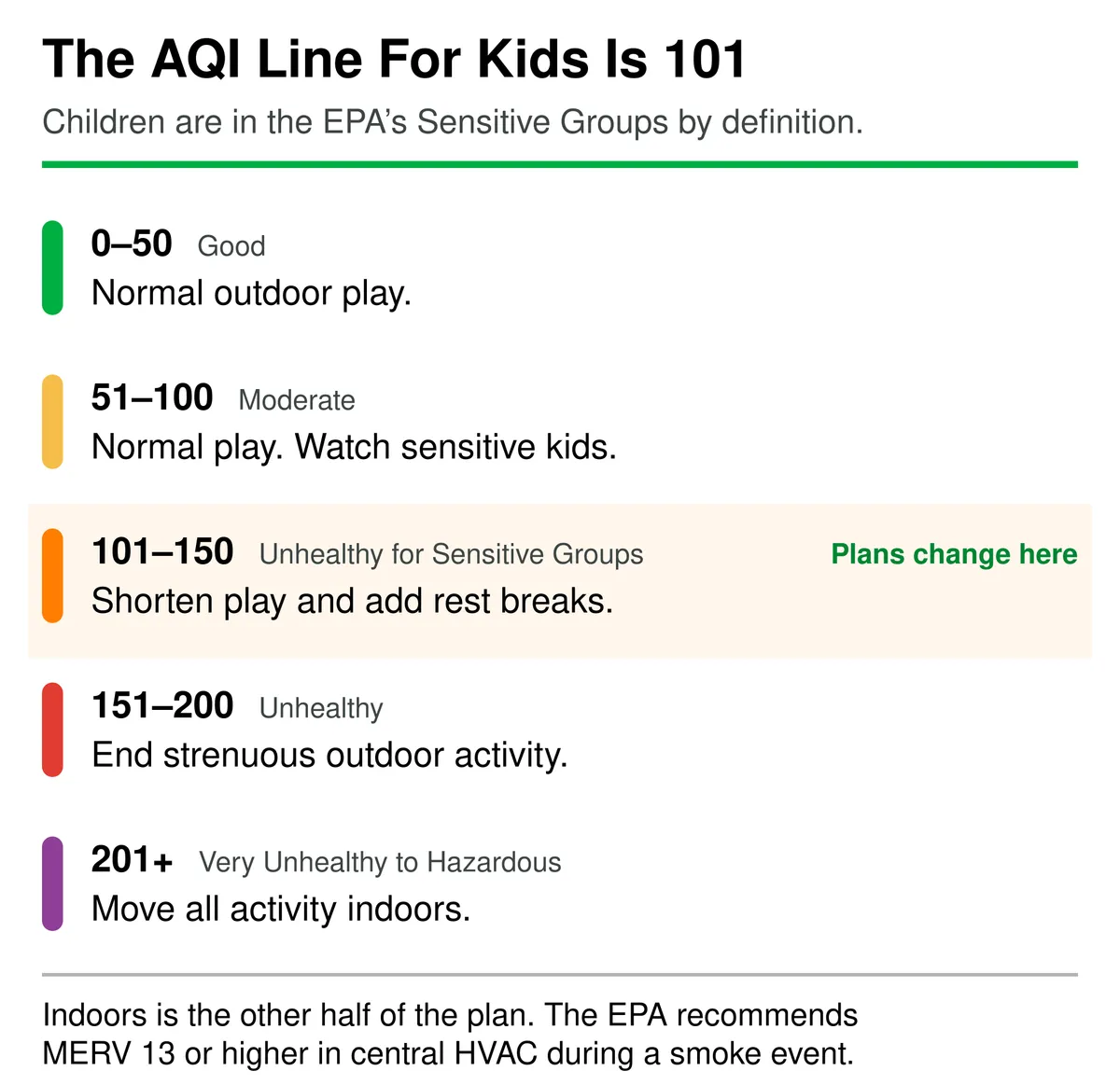
Adjust your child’s outdoor plans once the Air Quality Index reaches 101. That reading opens the EPA’s Orange category, Unhealthy for Sensitive Groups, and children belong to it by definition. The other half of the plan is indoors, where the EPA recommends MERV 13 or higher in central HVAC during a smoke event. Take the quiz below to find the size and rating your system needs.
Educational only, not medical advice.
Answer a few quick questions and we will match you to the right filter for your system.
TL;DR
Children breathe more air for their body weight than adults, their lungs keep developing into the late teens, and they spend more active hours outdoors. The same reading therefore calls for a different decision for a child than for an adult. Check the AQI before your child heads out, adjust activity at 101, and treat your home filtration as the other half of the plan.
Key Takeaways
Children inhale more air per pound of body weight than adults, so identical outdoor conditions deliver a larger dose to a smaller body.
The AQI threshold to watch for children is 101, the start of the Orange category the EPA labels Unhealthy for Sensitive Groups.
The EPA and the American Academy of Pediatrics differ on masks for children, and parents deserve both positions.
The EPA recommends MERV 13 or higher in a central HVAC system during a smoke event, replaced more often than usual.
Why Children Take In More Outdoor Air Pollution Than Adults
Children take in more outdoor air pollution than adults for three measurable reasons. They breathe more air relative to body weight, so identical conditions deliver a heavier dose. Their lungs and immune defenses are still forming. They spend more hours outdoors, more in hard play. The American Lung Association groups infants, children, and teens together for this.
A five-year-old and an adult in the same backyard are not having the same experience. The child moves a larger volume of air through a smaller body, and active play widens the gap because children breathe faster and largely through the mouth.
Filterbuy pays professional attention to what floats in household air, and the child-versus-adult gap is the starkest version of it. The EPA treats children as especially vulnerable to smoke and ash rather than as small adults because their lungs keep growing into adolescence. See also how polluted air affects the body.
The Air Quality Index Numbers That Should Change Your Child’s Day
Adjust your child’s outdoor plans once the Air Quality Index reaches 101. That value opens the Orange category the EPA labels Unhealthy for Sensitive Groups, and children sit in it by definition. Below 101, most children play normally. At 151 and above, every child comes off strenuous outdoor activity.
The table combines AirNow thresholds for schools with the tighter guidance pediatricians apply to children with a respiratory condition.
See our guide to the AQI scale from 0 to 500, the AQI levels that are unsafe for sensitive groups, and the AQI color chart.
What Your Child’s Age Changes About The Plan
Age changes which protective step works. An infant cannot wear a respirator, a preschooler will not report symptoms, a fourth grader gets most exposure at recess, and a teen athlete inhales several times the resting volume.
Our guide to protecting infants and toddlers during wildfire smoke covers the under-2 setup.
Teen athletes are the group current guidance skips. A runner moves far more air per hour than the same teenager in a classroom, so a reading merely uncomfortable for a spectator is a real exposure on the course.
Signs To Watch For And When To Call The Pediatrician
Watch for coughing, wheezing, chest tightness, trouble breathing, burning in the nose, throat, or eyes, and dizziness. The EPA lists these among the effects children may experience after breathing wildfire smoke. Symptoms should improve once a child reaches cleaner, filtered air. If they do not, seek medical care.
Seek medical care for trouble breathing, a cough that will not stop, chest pain, or symptoms that fail to improve in cleaner air. Call 911 for any medical emergency.
Infants require extra caution. A baby cannot tell you their chest feels tight, and early signs of respiratory distress under age 1 are easy to miss. Treat any change in an infant’s breathing or feeding during a smoke event as a reason to call the pediatrician rather than something to interpret at home.
If your child has asthma, follow their asthma action plan. Confirm it is current before fire season and that school staff hold a copy.
Educational only, not medical advice. This content does not replace care from a qualified healthcare provider. Contact your child's doctor with any concerns, or call 911 in an emergency.
The Children’s Mask Question, Answered Honestly
Federal and pediatric guidance do not fully agree on masks for children, and an honest answer names both. The EPA states that masks, including N95 respirators, are not made to fit children and should not be relied on for smoke. The American Academy of Pediatrics states children 2 and older can wear masks and respirators, stressing that fit decides whether one helps.
Both rest on one fact. A respirator filters only air it forces through the media, and a child’s face offers fewer places to seal.
Cloth masks and bandanas do not filter fine particles at any age. Below 2 no respirator exists, so the decision is where the child is. At age 2 and up, a well-fitted child-size respirator reduces exposure on a short trip.
The Second Number No Parent Checks
The Air Quality Index is an outdoor measurement, and nearly every decision it triggers is an indoor one. A parent reads 168, keeps a child home from practice, and that child spends fourteen hours breathing air the smoke leaked into all day. The app describes the yard. Nobody hands you the number for the bedroom.
The AQI tells you about the yard, and almost every choice a parent makes on a smoke day happens in a room. That gap is where we spend our time. A family can do everything right outdoors and still put a child to bed in air the smoke reached hours ago.
— Michelle Wan, Brand Manager and Air Quality Writer, Filterbuy
You can get that number. A low-cost particle monitor in the room where your child sleeps turns filtration from a guess into something you watch. Washington State health guidance adds a caution sensor packaging rarely does, which is that raw readings are not AQI values, so compare a room against outdoors and against itself over time.
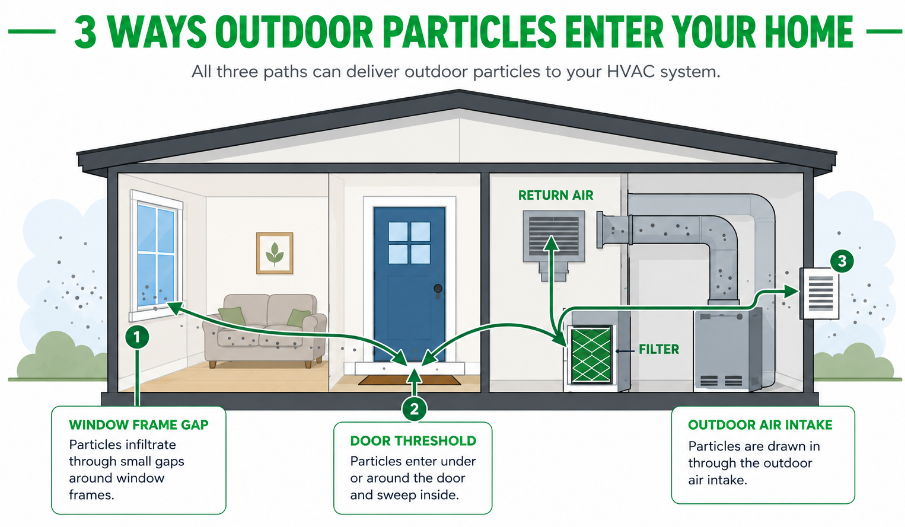
Particles enter around window frames, door thresholds, and air intakes, which is why the EPA recommends running central HVAC with a MERV 13 filter or higher during a smoke event and replacing it often.
Filterbuy manufactures pleated filters in Talladega, Alabama, in more than 600 sizes, and two questions arrive together whenever smoke moves in. What size does my system take, and will MERV 13 restrict airflow. Settle both before fire season, because a filter you cannot get is not filtration.
Four settings do most of the work.
Set the fan to On rather than Auto, so the system keeps moving air through the filter between heating and cooling cycles.
Close the fresh air intake, since an open one pulls particles straight into the return.
Replace the filter sooner than the calendar says, because loading climbs fast in smoke and restricts airflow.
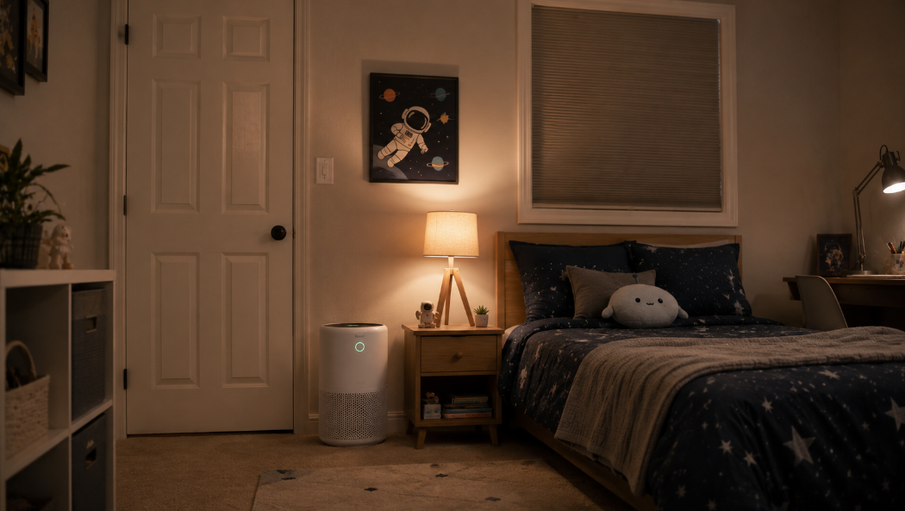
Build one clean air room where your child sleeps, using a closed door and a portable air cleaner sized for it.
MERV 13 is a high-efficiency pleated rating and it is not HEPA, and our primer on how MERV ratings work explains the scale.
Confirm your filter size now and keep a spare on hand. Filterbuy makes them to order, so you can shop MERV 13 pleated filters made in Alabama.
Four Measures That Feel Protective And Are Not
Each of these is named in federal or pediatric guidance as a measure to skip.
Humidifiers. The American Academy of Pediatrics states they do not prevent inhaling wildfire smoke. Moist air is not filtered air.
Breathing through a wet cloth. Named alongside humidifiers in the same guidance, a folk remedy rather than a filter.
Ozone generators and ionizers. The EPA warns these emit a lung irritant into the room you are protecting and do not remove particles.
A closed-up house. Shutting windows is step one rather than the plan, because smoke still enters and filtration lowers the count.
Five Questions To Ask Your Child’s School Or Childcare
Most schools have an air quality policy and most parents have never read it. Five questions get the whole picture, and the time to ask is before smoke season rather than the morning of an alert.
At what AQI does the school move recess and PE indoors, and who checks the number daily?
What filter is in the building’s HVAC system, and when was it last changed?
Is a filtered indoor space available when outdoor activity gets cancelled?
How does the school notify parents when it changes the plan?
For after-school sport, what threshold cancels practice, and does the coach use it?
Essential Resources
How to reduce a child’s wildfire smoke exposure at home - U.S. Environmental Protection Agency
The outdoor activity thresholds schools follow at each AQI level - AirNow
What pediatricians advise families about outdoor air pollutants - American Academy of Pediatrics
Caring for children during and after a wildfire - HealthyChildren.org
How ozone and particle pollution trigger asthma symptoms - Asthma and Allergy Foundation of America
Activity guidance for children and youth at every air quality level - Washington State Department of Health
Outdoor air quality planning for child care programs - Child Care Aware of America
Supporting Statistics
1. The American Lung Association reports that 33.5 million children in the United States live in areas with unhealthy air quality, based on its 2026 State of the Air report.
Source: American Lung Association, State of the Air 2026 national release
2. 6.5 percent of children under 18 in the United States currently have asthma, according to National Center for Health Statistics survey data for 2024.
Source: Centers for Disease Control and Prevention, National Center for Health Statistics asthma data
3. Aguilera and colleagues found that respiratory hospitalizations rose between 1.3 and 10 percent for each 10 micrograms per cubic meter increase in wildfire-specific PM2.5, compared with 0.67 to 1.3 percent for PM2.5 from other sources.
Source: Aguilera et al., Nature Communications, 2021
Frequently Asked Questions
Glossary
Air Quality Index (AQI): The 0 to 500 scale the EPA uses to report daily outdoor air quality. Higher values mean more pollution and more health concern.
PM2.5: Fine particulate matter 2.5 micrometers or smaller. It travels deep into the lungs and drives AQI readings in smoke.
Ground-Level Ozone: The main ingredient in smog. It climbs with sunlight and heat, peaks in the afternoon, and irritates the airways of active children, so morning outdoor time is safer.
MERV: Minimum Efficiency Reporting Value, the 1 to 16 scale rating how well an HVAC filter captures particles.
MERV 13: The level the EPA recommends for central HVAC during a smoke event, and the rating Filterbuy manufactures for residential systems. It is a high-efficiency pleated rating, not HEPA.
HEPA: High Efficiency Particulate Air, a standard for portable air cleaners. It captures airborne particles, not moisture or surfaces.
Sensitive Groups: Those the EPA identifies as affected first once the AQI passes 100, including children and anyone with heart or lung disease.
Clean Air Room: One room a household seals and filters so a child has lower particle levels.
Asthma Action Plan: A written plan from a pediatrician telling caregivers what medication to give and when to escalate care.