
Do Electric Vehicles Actually Improve City Air Quality? The Measured Data
September 24, 2026
Yes. Electric vehicles measurably lower nitrogen dioxide (NO2) on the streets where people drive them. They don’t end traffic pollution, though, because brakes, tires, and roads still shed particles.
Those particles drift indoors, and a MERV filter captures them. It won’t remove NO2, which is a gas.
Take the quick quiz below to find the right filter for your home.
Live near traffic? Find your filter match.
Answer 3 quick questions and we’ll match you to your perfect filter.
Already know your size?
Shop air filters at FilterbuyTL;DR
Electric vehicles measurably reduce nitrogen dioxide in the neighborhoods where people drive them, and that finding comes from satellite and ground-monitor readings, not models. What they do not do is eliminate traffic pollution, since brake wear, tire wear, and road dust continue regardless of what powers a car. Brake dust falls sharply while tire wear rises with battery weight, leaving cleaner outdoor air over a stubborn particle floor your HVAC filter still handles.
Key Takeaways
A 2026 study in The Lancet Planetary Health00257-8/fulltext) found that every 200 additional zero-emission vehicles registered in a California ZIP code area corresponded with a 1.1% decrease in annual average nitrogen dioxide, measured by satellite and replicated with EPA ground monitors.
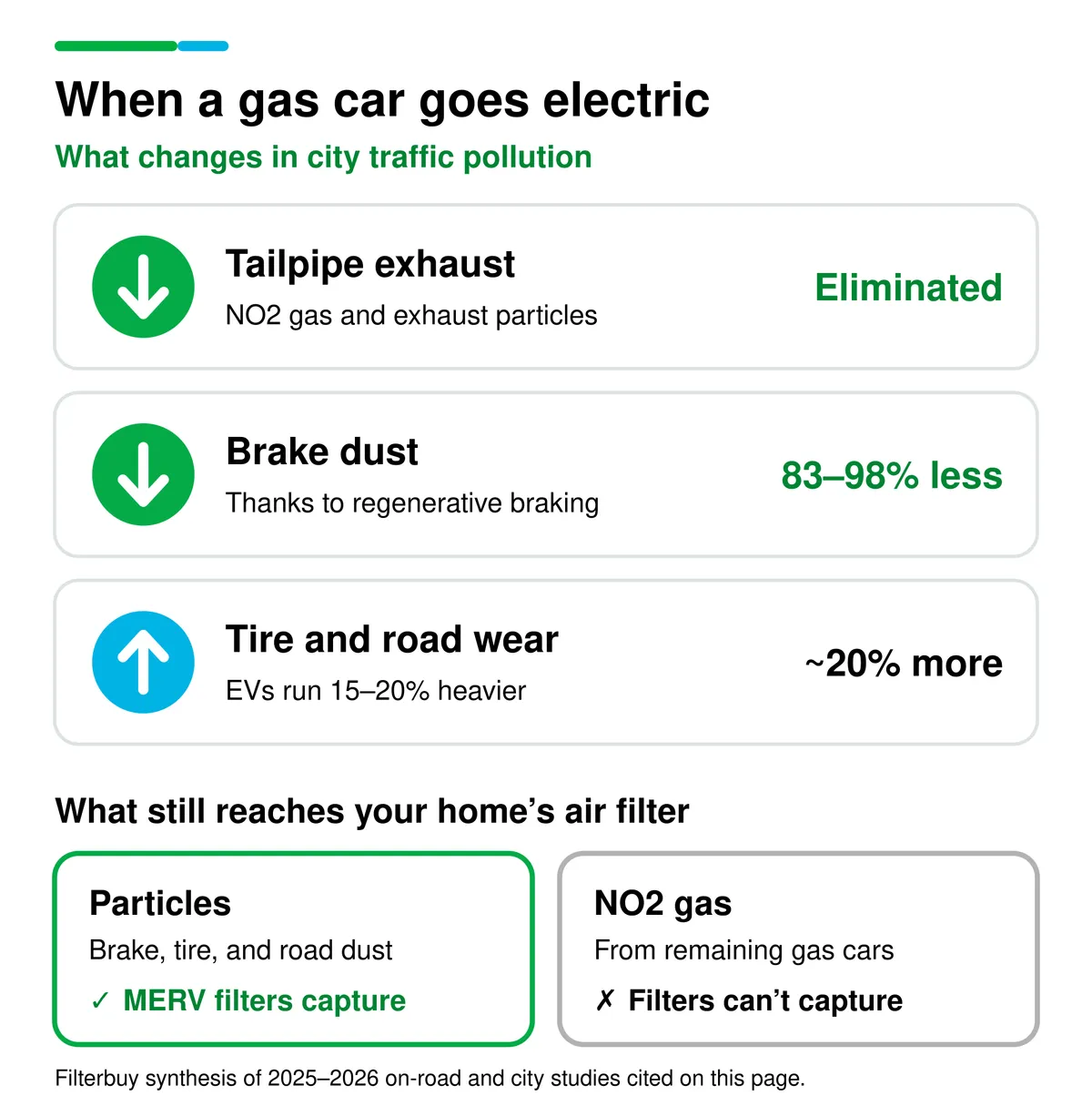
Battery-electric vehicles cut brake wear particles by 96% to 98% in 2025 on-road testing, because regenerative braking replaces most friction braking.
A study by EIT Urban Mobility with Transport for London found battery-electric vehicles produce 83% less brake wear but roughly 20% more tire wear, since they run 15% to 20% heavier than gasoline equivalents.
Air filters capture particles, not gases. A Filterbuy MERV 13 filter reduces the fine particulate that drifts indoors from brake dust, tire wear, and road dust, though it will not remove nitrogen dioxide.
What The Measured Data Actually Shows About Evs And City Air
For years the case for electric vehicles rested on projections. That changed in January 2026, when a team at the USC Keck School of Medicine published a longitudinal study in The Lancet Planetary Health00257-8/fulltext) covering 1,692 California ZIP code areas. Within a given area, an increase of 200 registered zero-emission vehicles was associated with a 1.10% decrease in annual average NO2, which the authors call the first real-world evidence of significant reductions from the light-duty electric transition.
Two details make that result hard to wave away. As a positive control, neighborhoods that added gasoline vehicles showed exactly the rise in NO2 you would predict. The team then replicated the finding across 123 EPA ground monitors going back to 2012, where it survived the exclusion of the pandemic year and adjustments for gas prices and remote work.
The health signal points the same direction. An earlier study from the same group, published in Science of the Total Environment in 2023, found that across California ZIP codes from 2013 to 2019, every additional 20 zero-emission vehicles per 1,000 residents was associated with a 3.2% drop in asthma-related emergency visits. Its NO2 estimate of 0.41 parts per billion was suggestive rather than conclusive, a distinction worth stating plainly.
One detail most coverage skips puts this in perspective. California's zero-emission share moved only from 2% to 5% of light-duty vehicles across the study window, so the gain came from a small minority of the fleet. Nitrogen dioxide responds that quickly because it comes overwhelmingly from combustion and concentrates within a few hundred feet of the road.
Non-Exhaust Emissions: What Electric Cars Still Put In The Air
No electric car is clean in the absolute. Every vehicle sheds particles from its brakes, its tires, and the road underneath, and these non-exhaust emissions are the strongest argument against calling any car "zero emission." They are also no longer a footnote. A 2025 study by EIT Urban Mobility with Transport for London found brake, tire, and road wear now account for 68% to 88% of road-transport PM10 in London, Milan, and Barcelona. The honest version has two halves that move in opposite directions.
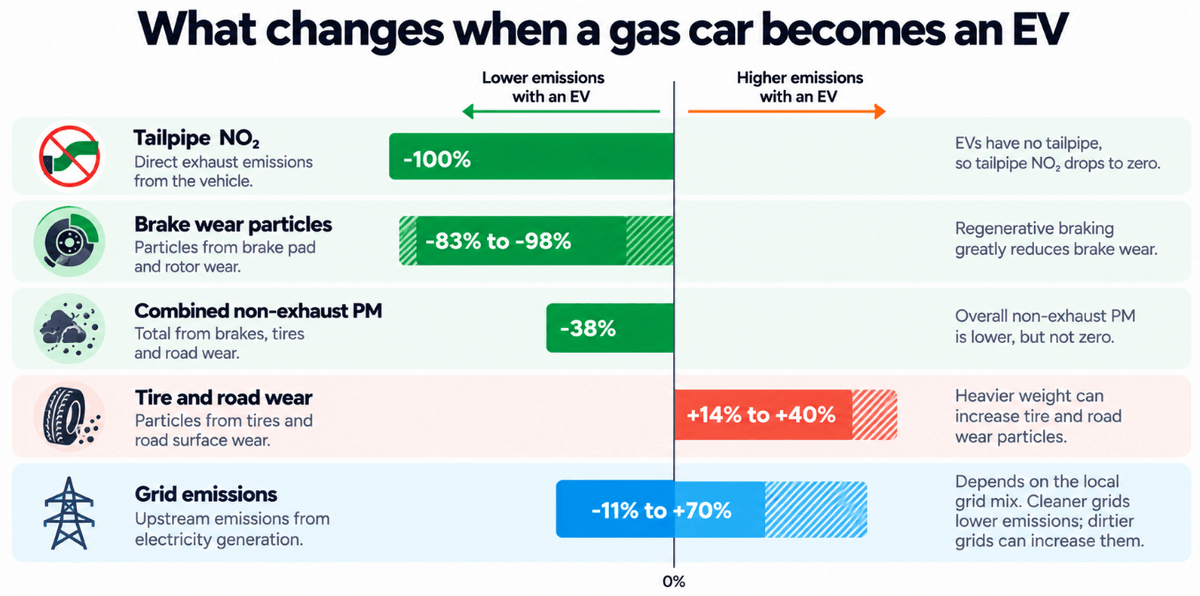
Brake dust falls sharply. On-road measurements published in 2025 found battery-electric vehicles produced 96% to 98% fewer brake wear particles than combustion vehicles, with hybrids between 61% and 82%. Regenerative braking explains it, since slowing a car by running its motor backward means the friction pads engage far less. A December 2025 Ricardo report for the UK Department for Transport reached the same result.
Tire wear rises. A battery pack weighs between 300 and 900 kilograms, making a typical electric vehicle 15% to 20% heavier than a gasoline equivalent, and the EIT Urban Mobility study estimated that weight raises tire wear by about 20%. Research published in Soft Matter in 2025 adds a wrinkle, finding that heavier, faster-accelerating vehicles produce a higher share of particles in the 1-to-10-micron range, the fraction that stays airborne long enough to inhale.
Where the balance lands depends on how you drive. A modeling study from the Virginia Tech Transportation Institute found electric vehicles produce less non-exhaust particulate once at least 15% of driving happens in city conditions. In lighter traffic the finding reverses and the heavier vehicle comes out worse, making stop-and-go driving the setting where electrification helps most.
The trade is not one for one, and it is the detail we keep returning to at Filterbuy. That same study reports over 40% of brake wear particles become airborne, while most tire wear residue settles into road dust or washes into ecosystems instead. Electrification changes which source dominates rather than swapping one for another, cutting the particles most likely to stay suspended in the air you breathe and raising those most likely to end up in soil and water.
The Filterbuy Traffic Pollution Scorecard
Original Filterbuy synthesis, September 2026. Reduction figures from the studies cited above.
Does The Electricity Grid Cancel Out The Benefit?
The grid changes the carbon math, not the street-level air quality math. The U.S. EPA states that total greenhouse gas emissions from an electric vehicle are lower than a comparable gasoline car, while noting the amount varies with how local power is generated. A 2026 MIT-led study put the lifecycle reduction at 40% to 60% across most of the United States, from roughly 0% on the dirtiest grids to 82% on the cleanest.
For the air on your own block, though, what matters is local exposure rather than total emissions. A tailpipe releases NO2 at street level, feet from sidewalks and open windows, while a power plant releases it at height, outside the urban core, under continuous controls. Even on a coal-heavy grid the pollution moves away from where people breathe most densely, which is why California saw reductions at only 5% adoption.
What Any Of This Changes Inside Your Home
Whatever happens on the street eventually finds its way indoors, and filtration is the part you control. Homes near busy roads typically see indoor PM2.5 reach 50% to 70% of outdoor levels, because a building breathes through gaps, vents, and returns even with windows shut. CARB found high-efficiency filtration removes over 90% of particles from incoming outdoor air.
"The mistake I see most is people buying the highest MERV number on the shelf and choking their system. What you want is the highest rating your equipment can move air through. Near a busy road that choice matters more, because the particles worth catching are fine ones."
— David Clark, Licensed HVAC Technician
For a house, the shift lands in a specific way. The particles electrification removes were ones a good filter already caught, while those it adds are heavier and settle out before reaching your return vent. Cleaner streets do not retire your filter so much as change its workload.
If you live within about 1,000 feet of a busy road, run the highest MERV rating your system supports without hurting airflow, check what MERV rating to use on high-AQI days, keep windows closed through rush hour, and change filters on schedule rather than on symptoms. The Filterbuy live AQI map is a good place to start.
"Filterbuy has built air filters in American factories since 2013, and customers on busy streets always ask the same thing. What is actually coming in? The EV research shifts that answer more than people realize. Less brake dust, more tire and road debris, and the fine fraction of both still reaches your return vent."
— Michelle Wan, Filterbuy Brand Manager and Air Quality Writer
The Exposure Almost Nobody Filters: Your Commute
Exposure to these particles peaks in the place people forget to think about, which is their own commute. EPA estimates the average American spends more than an hour travelling daily, most of it on major roads, where brake, tire, and road particles concentrate. Driving an electric car does not exempt you, because what you breathe in traffic is the non-exhaust output of every vehicle around you.
Between you and that air sits a single filter, and most drivers have never changed it. CARB found high-efficiency cabin filters cut in-vehicle particle concentrations by 55% to 90%, roughly twice what most factory filters manage.
So if you take one action from this page, make it two: the filter in your return vent, and the Filterbuy cabin filter in your car.
Supporting Statistics
45 million Americans live within 300 feet of a major road.
EPA notes traffic also emits brake and tire debris and stirs road dust.
Source: U.S. EPA Near Roadway Air Pollution research, June 2026.
152.3 million Americans breathe failing-grade air.
44% of the country, including 33.5 million children.
Battery-electric vehicles hit 12% of US light-duty sales in September 2025, then fell below 6%.
The first year annual battery-electric sales and share fell, after credits expired.
Why it matters: the gains above came from low adoption, not a finished transition.
Source: U.S. EIA, February 2026.
Frequently Asked Questions
Do electric vehicles reduce air pollution?
Yes, measurably. They eliminate tailpipe emissions and sharply reduce brake dust, and California satellite and monitor data confirmed lower nitrogen dioxide where adoption rose. What they do not touch is tire and road wear.
Are EV tires worse for air quality than exhaust?
Electric vehicles shed roughly 20% more tire material, per the EIT Urban Mobility study, but that is outweighed by an 83% drop in brake wear and the removal of exhaust. The balance narrows on open highways, where regenerative braking rarely engages.
Can an air filter remove NO2 from my home air?
No, because nitrogen dioxide is a gas and MERV-rated filters capture particles. Reducing indoor NO2 means limiting infiltration and controlling combustion sources such as gas stoves. Filterbuy Odor Eliminator carbon filters adsorb some gases and odors, though not nitrogen dioxide.
Will EVs make my air filter last longer?
Not meaningfully, since home filter loading is driven by dust, pet dander, pollen, and cooking far more than traffic. Check yours monthly and consider auto-delivery.
Glossary
Non-exhaust emissions: Particle pollution from brakes, tires, and road wear, plus dust resuspended by traffic. Produced by every vehicle.
NO2 (nitrogen dioxide): A gas formed by fuel combustion, concentrated near busy roads. Linked to asthma attacks, bronchitis, and cardiovascular risk.
PM2.5: Fine particles 2.5 microns or smaller, able to reach deep into the lungs. Produced by combustion, brake and tire wear, and smoke.
MERV: Minimum Efficiency Reporting Value, the ASHRAE 1-to-16 scale for how well a filter captures airborne particles. MERV 13 captures a high share of PM2.5.
Traffic pollution outside is a particle load inside. Shop Filterbuy air filters by size or go straight to MERV 13. Made in the USA, 600+ sizes, free shipping. No standard size fits? Build a custom filter.