
Does Wildfire Smoke Damage Your HVAC System? What Soot Reaches
September 22, 2026
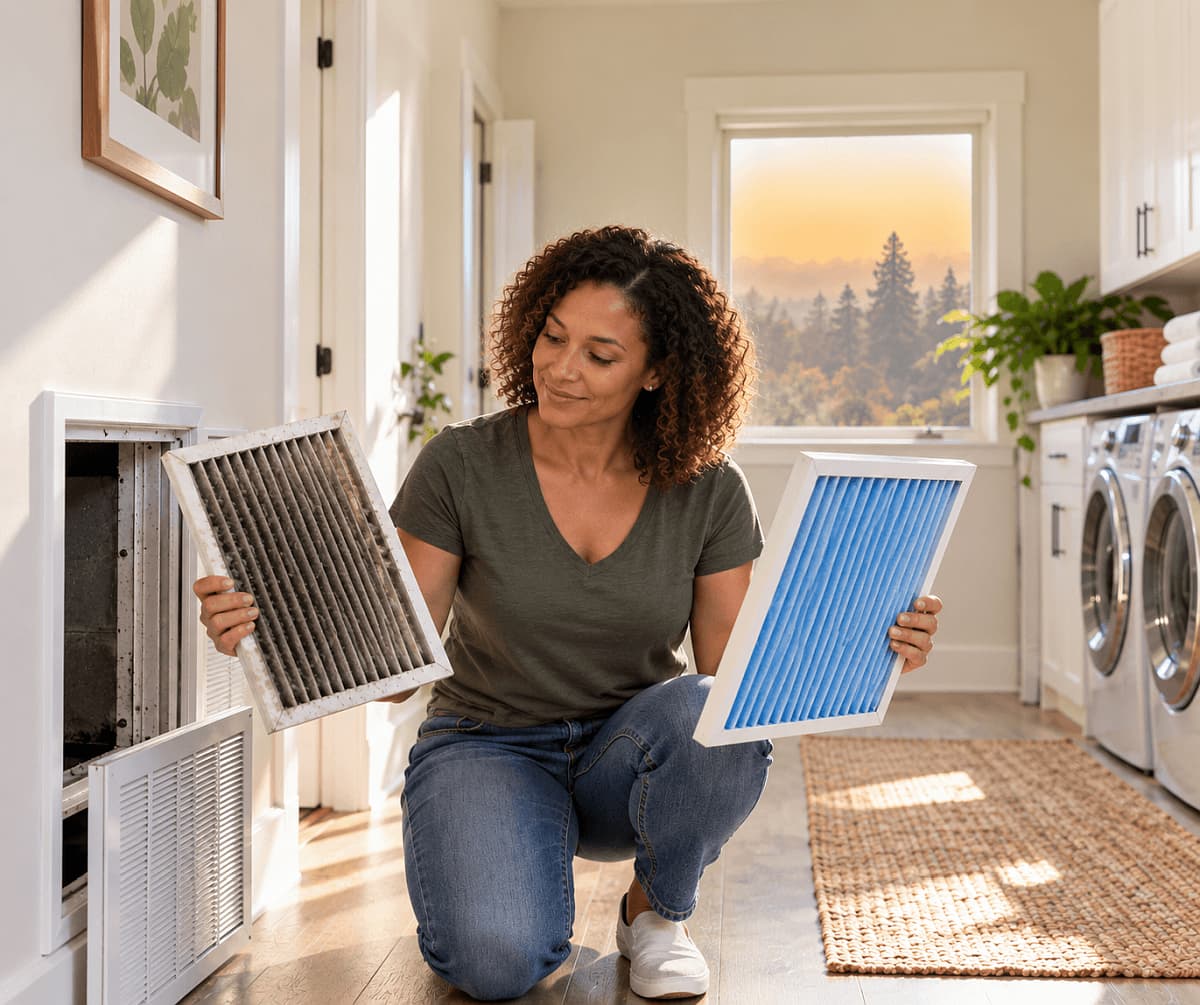
Yes, wildfire smoke can damage your HVAC system, though the damage usually builds slowly. Smoke reaches your air filter first, and soot the filter misses coats the blower, evaporator coil, and ducts.
Wet ash can also corrode the coil on your outdoor unit. Most homes need only faster filter changes and a coil check, plus a MERV 13 filter once the AQI tops 100.
Take the quick quiz below to match your system to the right filter for smoke season.
Find Your Filter Match for Smoke Season
Answer a few quick questions and we'll match you to your perfect filter.
Already know your size? Shop filters at Filterbuy.com
By Michelle Wan | Reviewed by David Clark, Licensed HVAC Technician | Published September 22, 2026 | Updated September 22, 2026
TL;DR
Yes, wildfire smoke can damage an HVAC system, though the damage usually builds slowly. We have built air filters at Filterbuy since 2013, and in our experience the filter decides how much soot reaches everything else. Soot that gets past it coats the blower, evaporator coil, and ductwork, while wet ash can corrode the outdoor coil. Most homes need only faster filter changes and a coil check; homes near a fire need a professional inspection. When the AQI goes above 100, switch to a MERV 13 filter and run a HEPA air purifier in each room.
Key Takeaways
Smoke damage starts at the air filter, which restricts airflow and strains the blower as it loads up.
Wet wildfire ash turns caustic, so rinse it off your outdoor unit before the next rain.
When the AQI is above 100, switch your HVAC to a MERV 13 filter and run a HEPA air purifier in each room. MERV 13 is the rating EPA recommends during smoke events.
The EPA recommends duct cleaning only as needed, such as when soot shows at the vents.
How Does Wildfire Smoke Get Into Your HVAC System?
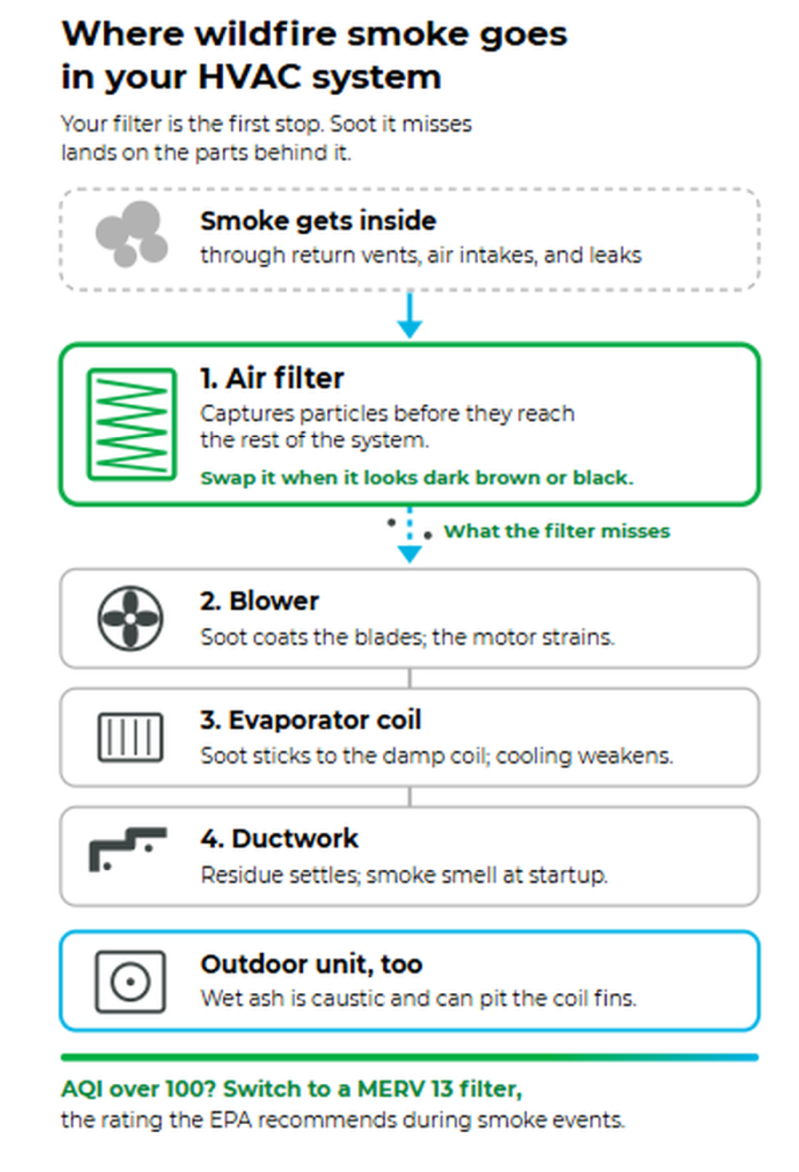
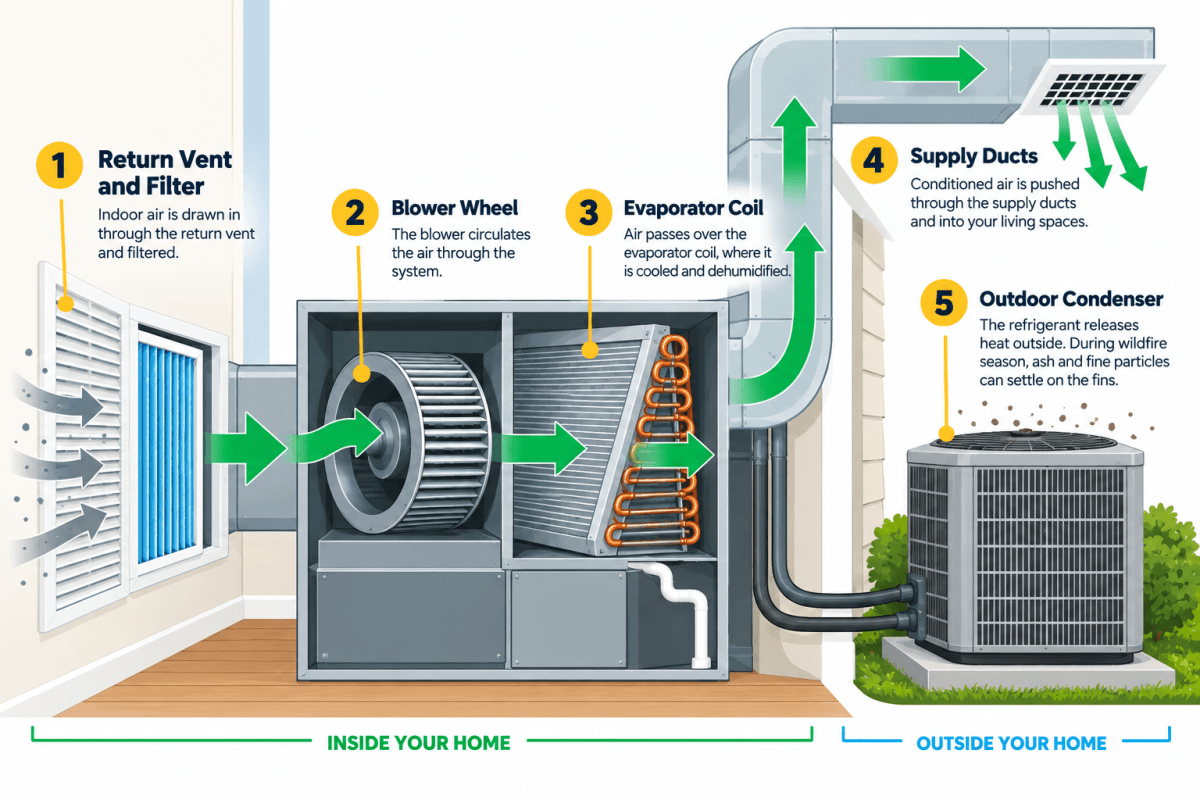
Smoke enters your HVAC system through the return vents, any fresh-air intake, and small leaks around the house, and all of it reaches the air filter first. Anything the filter misses moves past the blower and evaporator coil and out through the supply ducts.
After the 2025 Los Angeles fires, researchers found ash likely got inside through ducts, gaps, and cracks, even with windows shut.
“This is the failure which Filterbuy hears about most often: the right filter, installed correctly, sitting in a rack it does not quite fill. Air takes the gap, skips the media entirely and lands dust on the coil.”
What Does Smoke Do to Each HVAC Component?
Soot in an HVAC system follows your airflow: the filter clogs, soot coats the blower wheel and evaporator coil, residue settles in the ducts, and ash corrodes the outdoor coil.
*Filter pricing from Filterbuy. Coil and blower costs from HomeGuide; air duct cleaning costs from HomeAdvisor (2026). Prices vary by region, size, and system.
The prevention math: Even if a long smoke season means replacing your 1-inch Filterbuy MERV 13 filter six times, that's roughly $60–$180, versus $500–$2,300 for one strained blower motor.
Is Wildfire Soot Corrosive to Air Conditioners?
Wildfire ash can corrode AC equipment, especially once it gets wet. The National Park Service puts its pH at 9 to 13, the same range as ammonia or lye. When rain or sprinkler spray mixes with ash on your outdoor unit, it leaves a caustic film that can pit the aluminum fins. Coils in good condition can often be restored with a simple cleaning.
To clean the outdoor unit, turn off power at the disconnect and rinse the coil gently with a garden hose, not a pressure washer, which bends the fins. Wear gloves: California's environmental health agency (OEHHA) warns that wet ash can cause chemical burns.
A 10-Minute Smoke Check You Can Do Yourself
To check your HVAC after wildfire smoke, run these steps once the air clears.
Filter: Hold it up to a light. If no light comes through the pleats, replace it now.
Supply vents: Wipe the inside of a register with a damp white cloth. Gray or black residue means soot made it past the filter.
Startup smell: Stand near a vent as the system starts. A campfire smell means leftover residue; a burning-plastic smell means shut it off and call a technician.
How Much Smoke Did Your Home Get? A Three-Level Smoke Triage
Match your response to how much smoke your home saw.
Do You Need Duct Cleaning After Wildfire Smoke?
A little smoke in ductwork from a distant fire doesn't usually call for duct cleaning. The EPA recommends it only as needed, and it's worth doing when you can see soot at the vents or smell smoke at every startup.
After the 2025 Eaton Fire, Pasadena Public Health advised smoke-damaged households to seal gaps around the filter, keep replacing it until the smell faded, and have their ducts cleaned.
What to Ask the Pro After a Smoke Event
Duct cleaner: Find one through the NADCA professional directory, and ask to see the soot before and after the job.
Coil check: Ask the technician to shine a flashlight through the evaporator coil; per the EPA checklist, light should pass through a clean one.
Biocides: Decline routine chemical treatments, since the EPA notes none are registered for internally insulated ducts.
How to Protect Your HVAC System During the Next Smoke Event
Start with official guidance: check the AirNow Fire and Smoke Map and your local air agency, and follow any order to stay indoors, relocate, or evacuate. The EPA notes that most home systems handle MERV 13 without problems as long as the filter is replaced often.
What Filterbuy Recommends When the AQI Is Above 100
Once the AQI climbs above 100, into the orange Unhealthy for Sensitive Groups range, Filterbuy recommends two layers working together: a MERV 13 filter if you have an HVAC system, and a HEPA air purifier in each room. Take these four steps in order:
Switch your HVAC to a MERV 13 filter. It's the rating EPA recommends during smoke events, and since your central system moves far more air than any portable unit, it's your whole-home layer. If your system takes a 4-inch filter, choose it; the deeper pleats hold more smoke before airflow drops.
Set the thermostat fan to On. Auto filters only while the system heats or cools. On filters around the clock.
Run a HEPA air purifier in each room, bedrooms first. It's a separate product that works alongside your MERV 13 filter and treats one room harder than your central system can. Size it with EPA's cleaner air room guide: smoke CADR of at least two-thirds of the room's square footage, so a 300-square-foot bedroom needs a smoke CADR of about 200. Skip ionizers and any purifier that makes ozone.
Close the house up. Keep windows and doors shut, close fresh-air intakes, and skip candles, frying, smoking, and vacuuming unless your vacuum has a HEPA filter.
Then keep it working:
Check it often. Replace it when it looks dark brown or black, which can be well before its normal interval. Filterbuy's quick test: hold it up to a light, and if none comes through the pleats, swap it.
Make sure it fits its slot. Filterbuy cuts every filter slightly under its nominal size so it slides in and still seals. Measure your air filter before you order.
Keep spares on hand. Fire season runs May through October in much of the West, so set up auto-delivery before it starts. Filterbuy's wildfire season preparation checklist covers the rest.
Reset once the smoke clears. Put in a fresh filter, rinse the outdoor unit, and book a coil check if you were at Level 2 or 3.
Every Filterbuy filter is cut, pleated, and framed to order in our own plants in Alabama, Florida, Pennsylvania, and Utah, in more than 600 sizes. Find your filter size in MERV 13, and track conditions on our live wildfire smoke and AQI map.
Supporting Statistics
U.S. research and federal data back this guidance.
Wildfire smoke now makes up as much as 50% of fine-particle pollution in parts of the western U.S., up from under 20% around 2015.
A MERV 13 central system kept indoor fine-particle levels at 55% of outdoor levels.
Measured in a Portland home during the 2020 wildfires; adding a HEPA portable air cleaner lowered it to 21%.
Why it matters: the two layers work best together.
Source: Pacific Northwest National Laboratory and Portland State University, 2024
Replacing a clogged filter with a clean one can cut AC energy use by 5–15%.
Study findings and federal estimates, not guarantees for any one home.
Frequently Asked Questions
Should I Run My Air Conditioner During Wildfire Smoke?
Yes, as long as it recirculates indoor air and has a clean MERV 13 filter. Close any fresh-air intake first, and set the thermostat fan to On.
Why Does My Ac Smell Like Smoke After A Wildfire?
The smell usually comes from a loaded filter, soot on the evaporator coil, or residue in the ducts, so replace the filter first. A pleated filter captures particles, but odor is a gas, so it won't remove the smell. For odors, look at Filterbuy's Odor Eliminator line, which adds an activated carbon layer.
How Often Should I Change My Air Filter During Wildfire Season?
Replace it when it looks dark brown or black, which can be well before its normal interval. See Filterbuy's guide on how often to change your air filter when AQI is high.
What If My Home Has A Ductless Mini-Split Or Window Ac?
Without central HVAC, HEPA air purifiers are your primary defense, so run one in each room, sized with the CADR rule above. If you can't get one, EPA research found a DIY box-fan cleaner with a MERV 13 filter works as a stopgap; use a certified fan made in 2012 or later, and never leave it running unattended.
Does Homeowners Insurance Cover Smoke Damage To An Hvac System?
It depends on your policy, so ask your insurer. Either way, note the smoke dates, save AirNow Fire and Smoke Map screenshots, and photograph filters, vents, residue, and the outdoor unit.
Glossary
PM2.5: Fine particles 2.5 microns or smaller; the main particle pollutant in smoke.
Soot: Fine black carbon particles from incomplete burning that cling to HVAC surfaces.
Wildfire ash: Burned residue that settles on surfaces; caustic when wet.
MERV: Minimum Efficiency Reporting Value, a 1–16 filter efficiency scale; MERV 13 is the EPA's smoke recommendation.
Evaporator coil: The indoor coil that absorbs heat and moisture from your home's air.
AQI: The Air Quality Index, a 0–500 daily air pollution scale. It's run by the EPA.
About the author: Michelle Wan is Brand Manager and Air Quality Writer at Filterbuy. She works directly with Filterbuy's U.S. manufacturing team across factories in Alabama, Florida, Pennsylvania, and Utah, so her writing is grounded in how filters are built, tested, and used in real homes. She holds a B.A. in Sociology from the University of California, Santa Cruz.
Technically reviewed by: David Clark, Licensed HVAC Technician, Filterbuy HVAC Solutions. David reviews Filterbuy's technical air quality content for accuracy.