
Construction Dust Next Door: What's In It And How To Keep It Out
September 22, 2026
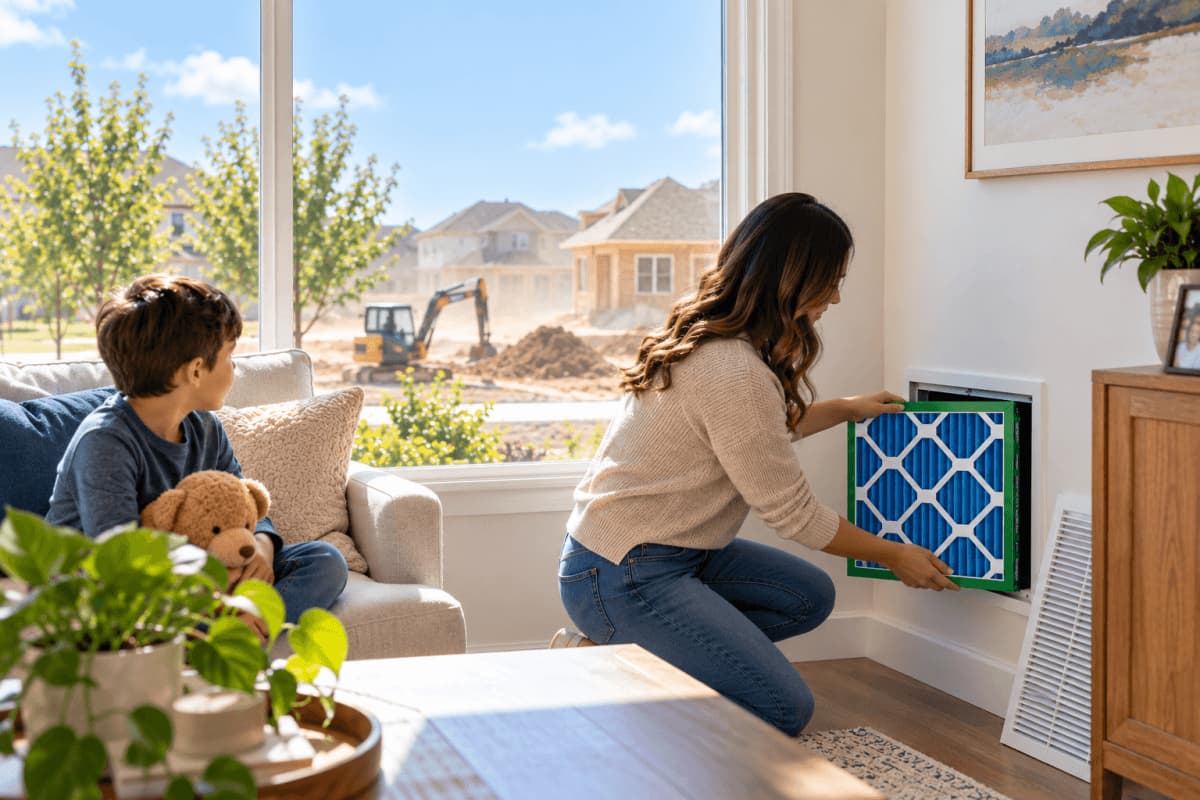
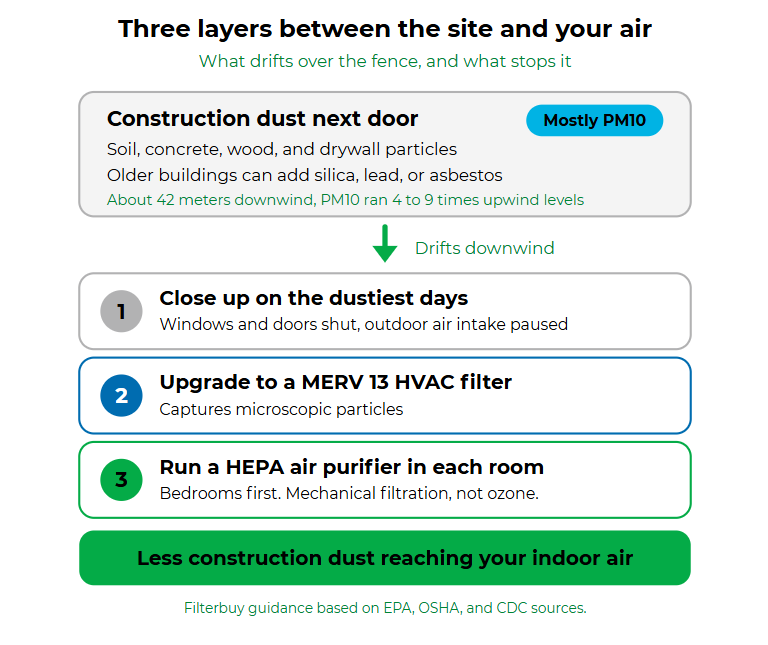
Construction dust next door is mostly coarse PM10 — soil, concrete, wood, and drywall particles — and older buildings can add silica, lead paint dust, or asbestos. Closing up on the dustiest days and upgrading your HVAC filter keep most of it out, and a properly sized air cleaner handles the rest.
When the AQI is over 100, the EPA recommends a filter rated MERV 13 or higher for fine particles. Here is the short version:
Close up. Windows and doors shut, outdoor air intake paused.
MERV 13 HVAC filter. Captures microscopic particles. Set the thermostat fan to On.
HEPA air purifier. One in each occupied room, bedrooms first.
Construction dust loads a filter faster than household dust, so check it often and keep a spare on hand. Not sure which filter your system takes? The quick match below sorts it out.
Answer 3 quick questions and we'll match you to your filter.
Already know your size? Find it at Filterbuy and get free 2-day delivery to most US states.
By Michelle Wan | Reviewed by David Clark, Licensed HVAC Technician | Published September 22, 2026 | Updated September 22, 2026
Construction dust next door is a mix of soil, concrete, wood, and drywall particles, plus whatever the old structure held, such as silica, lead paint dust, or asbestos. Much of it is coarse PM10, particles 10 micrometers or smaller, that drift through open windows. Closing up on the dustiest days and upgrading your HVAC filter keep most of it out, and a properly sized air cleaner handles the rest.
TL;DR
Demolition, grading, and concrete cutting raise PM10 downwind of a job site, and older buildings can add silica, lead, or asbestos. Local dust rules don't guarantee clean air indoors, so close up on dusty days, upgrade your HVAC filter, and run HEPA air purifiers.
Key Takeaways
Construction dust is mostly coarse PM10, and the EPA names construction sites as a direct source of particle pollution.
In a 2006 Chicago study, PM10 about 42 meters downwind of high-rise demolition ran 4 to 9 times higher than upwind levels.
Silica, lead paint dust, and asbestos turn demolition dust from a nuisance into a real concern.
OSHA's silica rule protects workers, while neighborhood dust falls under state and local air rules.
Over AQI 100, switch your HVAC to MERV 13 and run a HEPA air purifier in each room.
What's Actually In Construction Dust?
Construction dust is a blend of coarse and fine particles released whenever crews break, cut, move, or haul building materials and soil. The U.S. Environmental Protection Agency (EPA) lists construction sites among the direct sources of particle pollution, and what ends up in the air depends on the phase of work and the building's age.
At Filterbuy, we sort construction dust by phase rather than project size, because each phase releases something different. Grading kicks up soil dust, cutting concrete releases silica, and tearing down older buildings can disturb lead paint and asbestos. The guide below is Filterbuy's phase-by-phase map, built from EPA, OSHA, and CDC guidance.
Filterbuy synthesis of EPA, OSHA, and CDC guidance on construction and demolition dust.
How Far Does Construction Dust Travel?
Construction dust rides the wind, so homes directly downwind get the most. A 2006 study of high-rise public housing demolition in Chicago found PM10 about 42 meters downwind climbed to 4 to 9 times upwind levels over six-hour periods. After adjusting for background pollution, dusty days were tied to a 74% jump in PM10 about 100 meters downwind over 24 hours.
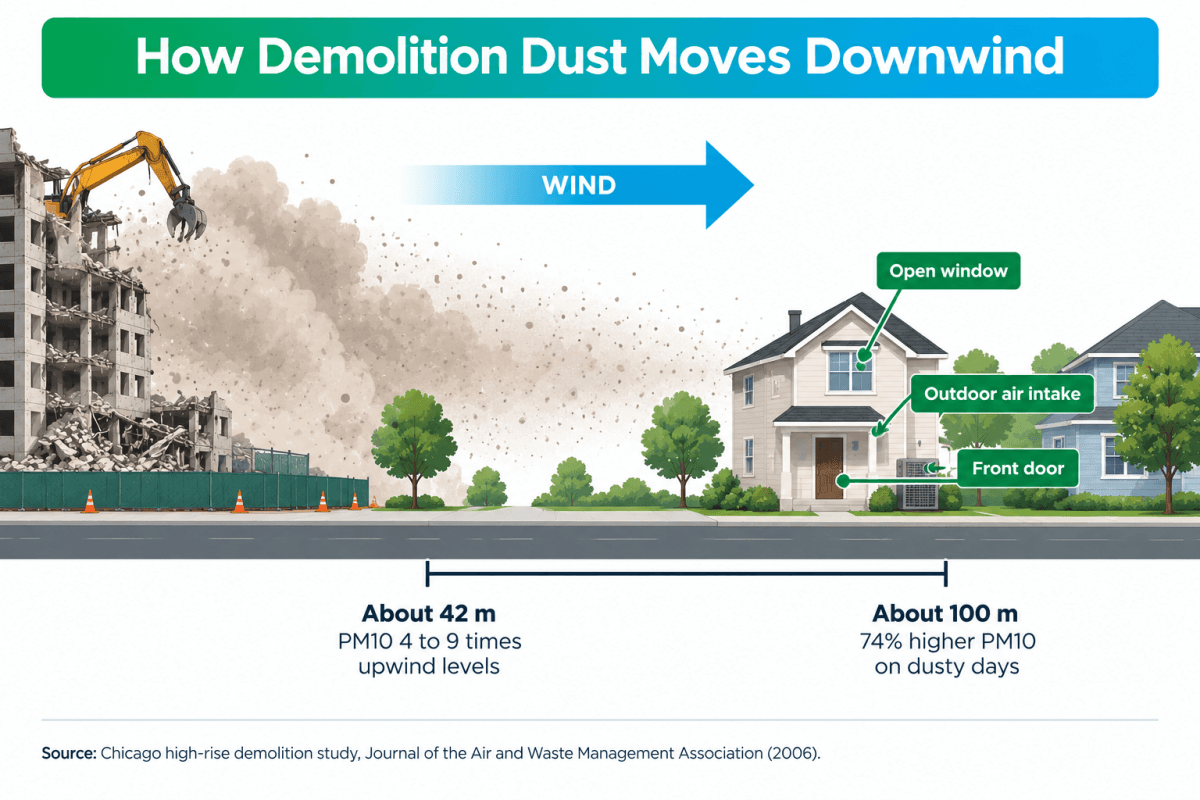
PM10 means inhalable particles 10 micrometers and smaller, and PM2.5 means the finer particles, 2.5 micrometers and smaller. In the Chicago study, downwind particles had a median size of 17.3 micrometers versus 3 in background air, and the few samples checked under a microscope showed no asbestos. Big particles settle fast and are the easiest for any pleated filter to catch.
Your regional Air Quality Index (AQI) can miss one job site, because the particle AQI is a 24-hour average from distant monitors. Filterbuy's live air quality map spots regional bad-air days, but windowsill dust is the better local signal.
Is Construction Dust Harmful To Neighbors?
Construction dust can irritate the eyes, nose, and throat, and particle pollution is linked to heart and lung effects, with children, older adults, and people with asthma most sensitive. The bigger long-term concerns are crystalline silica, lead, and asbestos.
Respirable crystalline silica is released when concrete, stone, brick, and mortar are cut, ground, or crushed. The Occupational Safety and Health Administration (OSHA) links long-term exposure to silicosis, lung cancer, and chronic obstructive pulmonary disease (COPD), and workers at the cutting point face the most.
Lead-based paint was banned in homes in 1978, yet the Centers for Disease Control and Prevention (CDC) estimates about 29 million U.S. housing units still have lead-based paint hazards, including lead-contaminated dust.
Asbestos can turn up in older insulation, flooring, and roofing, and EPA links it to lung cancer, mesothelioma, and asbestosis. If symptoms worsen during nearby work, see a healthcare provider.
What Are Contractors Required To Do About Construction Dust?
Contractors answer to overlapping rules, and there's a gap Filterbuy wants neighbors to understand. Federal silica limits protect the person holding the saw. Your protection depends on local fugitive dust rules and how well the site follows them.
Under OSHA's respirable crystalline silica standard for construction, employers must keep worker exposure at or below 50 micrograms per cubic meter of air, averaged over an 8-hour shift, or follow the rule's Table 1 controls. Spraying water on a saw blade is one of those controls, and you can spot it from the sidewalk.
Before demolition, the federal asbestos standard for demolition and renovation requires an asbestos inspection and written notice at least 10 working days ahead. Isolated homes with four or fewer units are generally exempt unless several come down as one project. Paid renovators working in pre-1978 homes must also be certified under the EPA Lead Renovation, Repair and Painting (RRP) Rule.
Most neighbor protection comes from state and local fugitive dust rules, which commonly require crews to water exposed soil, cover stockpiles, and keep dirt off public streets. Some jurisdictions also prohibit visible dust from crossing the property line.
Sources: OSHA 29 CFR 1926.1153, 40 CFR 61.145, EPA Lead Renovation, Repair and Painting Rule. Local requirements vary by jurisdiction.
How Do You Keep Construction Dust Out Of Your House?
The best way to keep construction dust out of your house is to seal the easy entry points on dusty days, then filter what gets in with a fresh HVAC filter and HEPA air purifiers. These five habits handle the entry points.
Learn the schedule. Check the posted permit or ask the site supervisor when the dustiest work is planned.
Read the wind. When wind blows from the site toward you, keep windows and doors shut.
Pause outdoor air intake. Close any outdoor air damper and pause energy recovery ventilators or whole-house fans during the dustiest work.
Run the system fan. Setting the thermostat fan to "On" sends more of your indoor air through the HVAC filter.
Cut tracked-in dust. Use entry mats and leave shoes at the door.
What To Do When The AQI Is Over 100
Follow AirNow and local agency guidance first. When the AQI is over 100, Filterbuy recommends two layers. If you have an HVAC system, switch to a MERV 13 filter and set the thermostat fan to On. Run a HEPA air purifier in each occupied room, bedrooms first, and keep windows shut. Without central HVAC, the HEPA purifiers are your main defense. The EPA recommends MERV 13 or higher for fine particles.
Upgrade And Check Your HVAC Filter
The EPA recommends a high-efficiency filter rated MERV 13 or higher to reduce indoor particles, and notes that most furnaces and HVAC systems can use one without problems when the filter is changed often. Check your system manual the same way you'd confirm a filter size.
Filterbuy manufactures MERV 8, MERV 11, and MERV 13 air filters in hundreds of standard and custom sizes. Construction dust loads a filter faster than household dust, and our own filter-change guide lists nearby construction as one reason a filter can turn dark within a week. During nearby work, check it often and replace it when it looks dirty, which can be well before the usual 90-day interval. Keep a spare on hand.
Size A HEPA Air Purifier For Each Room
A portable HEPA air purifier is the main defense in homes without ductwork and a second layer in homes with it. The Association of Home Appliance Manufacturers (AHAM) recommends a smoke CADR of at least two-thirds of the room's square footage and a closer look at the dust CADR when dust is the concern.
For a 12-by-15-foot bedroom (180 square feet), that works out to a smoke CADR of at least 120. Stick with mechanical filtration. EPA advises against air cleaners that produce ozone, so skip ozone generators and ionizers. See Filterbuy's guide to what portable air purifier filters capture.
Clean Settled Dust Without Stirring It Up
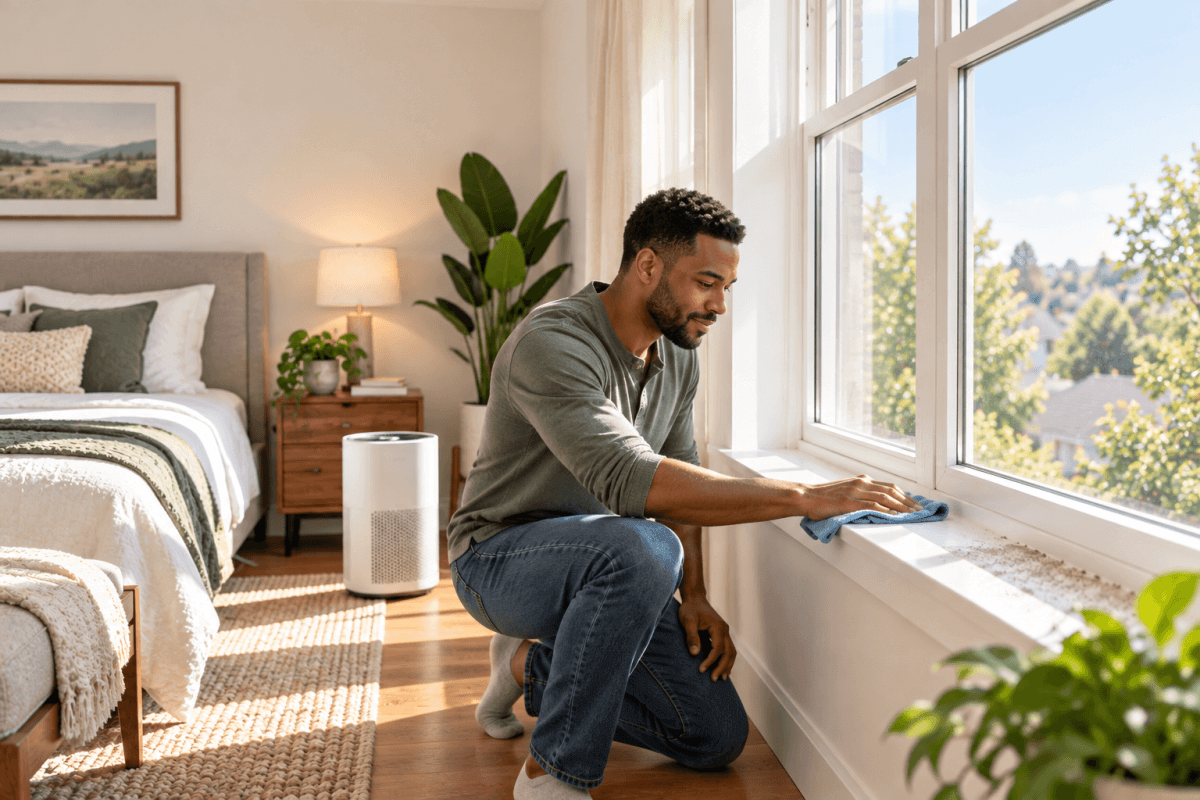
Dry sweeping just puts settled dust back in the air. A HEPA vacuum, a damp cloth on windowsills, and a wet mop work better, especially in pre-1978 homes where dust can carry lead.
What If The Dust Is From Your Own Renovation?
Building dust in your house from your own remodel is different, because the source is inside. Seal the work area with plastic sheeting and cover its vents so the HVAC system doesn't spread drywall dust.
Turn the HVAC system off during heavy sanding, or seal the work zone's returns if it has to run, then replace the filter when the dusty work wraps up. In homes built before 1978, assume the paint may contain lead until testing shows otherwise, and hire a lead-safe certified firm.
How Do You Report Construction Dust In Your Neighborhood?
To report construction dust, contact your local air district or state environmental agency, which enforces fugitive dust rules. Many sites also post a supervisor's number, which is often the fastest fix. These five questions show whether the site manages its dust and give you specifics if you escalate.
Filterbuy checklist based on OSHA, EPA, and local air agency requirements. Local rules vary.
Suspected asbestos or lead problems go to your state program, and worker dry cutting goes to OSHA.
Most construction dust advice is written for the crew holding the saw. We wrote this guide for the family next door, because they breathe what drifts over the fence and they change the filter afterward.
The American Lung Association's particle pollution guidance names construction and demolition as particle sources and notes that people who "live near the emission sources are at higher risk."
Supporting Statistics
1.275 million housing starts. That was the August 2026 annual rate, according to the Census Bureau and HUD new residential construction report. Each means grading near someone's home.
21.9 million homes with dust lead hazards (2021). That's 18.6% of U.S. housing, according to HUD's American Healthy Homes Survey II findings.
2 million silica-exposed construction workers. The Department of Labor's silica rule announcement traced that exposure to cutting concrete and stone.
Essential Resources
Final Thoughts
After more than a decade of making filters at Filterbuy, our advice is to treat an active job site like a season, not a bad day. Check filters more often and keep a HEPA purifier running in each room your family uses.
Keep Your Air Clean While The Neighborhood Builds
Find your exact filter size at Filterbuy, choose the MERV rating your system is built for, and get fast and free 2-day delivery to most US states. Set up filter auto-delivery so a fresh filter arrives before the next dusty phase begins.
Frequently Asked Questions
Is Construction Dust Harmful To Breathe?
Construction dust can irritate your airways, especially if you have asthma or heart disease. The bigger concern is dust from cut concrete, old paint, or old insulation.
Can Construction Dust Get Into My House Through The HVAC System?
Yes. Dust enters through windows, gaps, and outdoor air intakes, and your HVAC filter catches what circulates.
What MERV Rating Is Best For Construction Dust?
MERV 13. The EPA recommends a filter rated MERV 13 or higher and notes that most home systems handle one well when it's changed often. It's an HVAC rating, not True HEPA, which belongs in portable air cleaners.
Who Do I Call About Dust From A Construction Site?
Start with the site supervisor, then contact your local air district or state environmental agency.
Glossary
PM10: Inhalable particles 10 micrometers and smaller, including most visible construction dust.
Respirable crystalline silica: Tiny quartz particles released when concrete, stone, brick, or mortar is cut, ground, or crushed.
Fugitive dust: Dust escaping from open sources such as exposed soil and stockpiles.
Track-out: Dirt vehicles carry from a site onto public roads.
RRP Rule: The EPA lead-safe rule for paid work in pre-1978 homes.
MERV: Minimum Efficiency Reporting Value, the ASHRAE 52.2 scale that rates how well an HVAC filter captures particles.
CADR: Clean Air Delivery Rate, the AHAM rating for how fast a portable air purifier cleans a room.