How Many BTUs for 1,500 Sq Ft? Complete Mini Split Sizing and Zoning Guide
A 1,500 sq ft home needs about 30,000 BTUs (2.5 tons) of cooling. Most homes this size land between 24,000 and 36,000 BTUs, depending on insulation, sun, and climate. Each mini split head only cools the room it’s in, so three to five zones usually beat one big unit.
Not sure how to split your home? The quick quiz below will point you to the right setup.

Sizing zone by zone? Filterbuy single-zone systems come in 12,000, 18,000, and 24,000 BTU, with free 2-day delivery.
Shop Mini Split Systems →Find your mini split match
Answer a few quick questions and we’ll match you to the right mini split for your space.
TL;DR
A 1,500 sq ft home generally needs about 30,000 BTUs (2.5 tons) of cooling, though most land between 24,000 and 36,000 BTUs once insulation and climate come into play, and tightly built newer homes can need far less. Since each mini split head only conditions its own room, a home this size usually does best with several zoned heads instead of one large unit. Confirm the size with a Manual J before you buy.
Key Takeaways
A 1,500 sq ft home needs roughly 30,000 BTUs, or 2.5 tons, as a starting point.
ENERGY STAR's chart puts 1,500 sq ft right on the line between its 24,000 and 30,000 BTU brackets.
Most homes this size need three to five zones rather than one oversized head.
Filterbuy recommends cleaning each indoor head's filter every 2 to 4 weeks.
An oversized mini split short-cycles and leaves rooms feeling clammy.How Many BTUs Does a 1,500 Sq Ft Home Need?
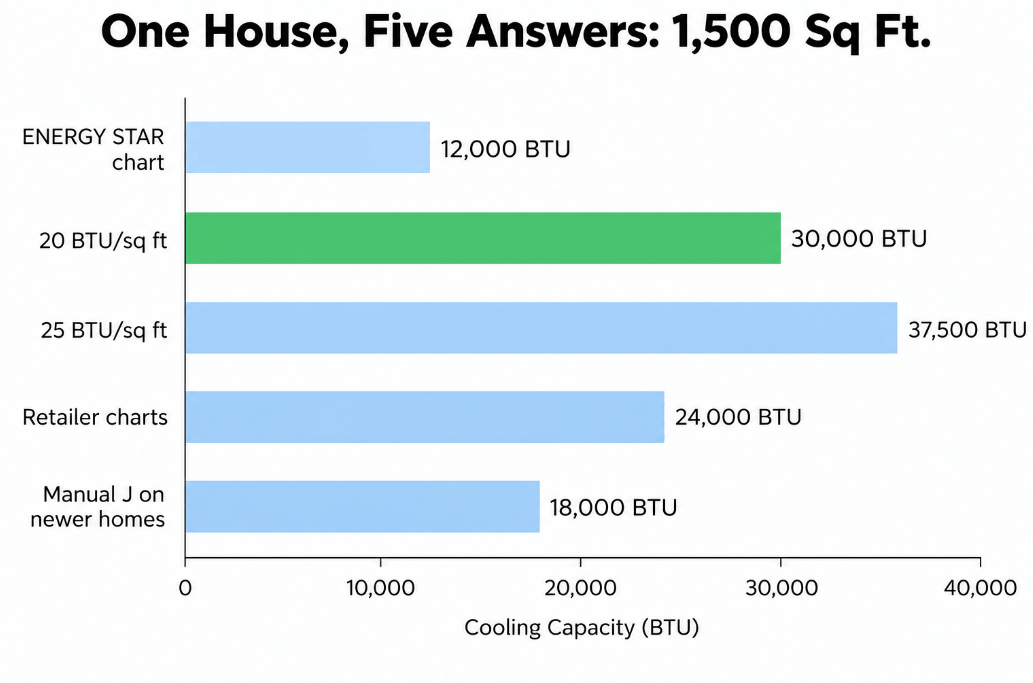
Most 1,500 sq ft homes need about 30,000 BTUs of cooling, the equivalent of a 2.5-ton system. That number comes from the 20 BTUs per square foot rule Filterbuy uses as a starting point (1,500 × 20 = 30,000). A well-insulated, shaded home may only need around 24,000 BTUs, while a sunny or poorly insulated one can need 36,000.
Filterbuy has built air filters in the U.S. since 2013. HVAC rules of thumb rarely agree at 1,500 sq ft, so we compared the common ones.
Screening estimates only.
The high estimate is roughly three times the low one. Square footage narrows the range, while insulation and air sealing set the final number. HVAC design firm Energy Vanguard's Manual J data shows why: across 75 hot-climate homes, loads averaged about 1,200 sq ft per ton, far less capacity than the old 400–600 sq ft rule suggests.
How to Calculate BTUs for 1,500 Sq Ft (Step by Step)
We recommend working zone by zone. Start with each room's base BTU from the ENERGY STAR sizing chart, then use the worksheet below for a screening estimate.
Filterbuy 1,500 Sq Ft BTU Calculator Worksheet
Adjustments from ENERGY STAR. Confirm final sizing with a Manual J load calculation.
What Size House Does a 30,000 BTU Mini Split Cool?
A 30,000 BTU (2.5-ton) mini split typically cools somewhere between 1,200 and 2,000 sq ft. A home's insulation and sun exposure decide where it lands in that range.
Low end: 25 BTU per sq ft. High end: ENERGY STAR sizing brackets.
Is a 2.5 Ton Mini Split Enough for 1,500 Sq Ft?
A 2.5-ton mini split is enough for most 1,500 sq ft homes with average insulation in a moderate climate. Heavy afternoon sun or weak insulation can justify 3 tons (36,000 BTUs); go smaller only when a Manual J confirms it.
Capacity is only part of the picture, though. A ductless mini split head conditions the room it's mounted in, and ENERGY STAR's ductless guidance notes that conditioned air struggles through open doorways and can't pass through closed ones. In a 1,500 sq ft home, where the heads go affects comfort as much as total capacity.
Oversizing causes its own problems: the unit hits its set temperature before pulling enough moisture from the air, and ENERGY STAR notes it costs more without cooling better.
How Many Mini Split Zones Does a 1,500 Sq Ft Home Need?
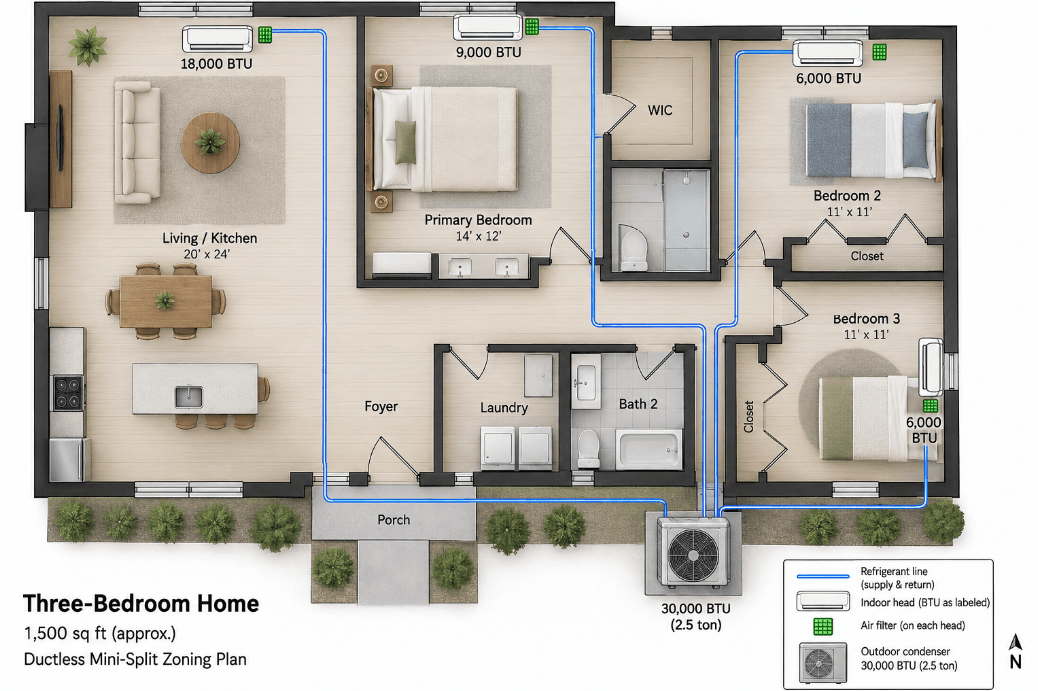
Most 1,500 sq ft homes end up with three to five zones: one for the main living area and one for each bedroom or room that's often closed off. Hallways and baths usually borrow air from neighboring zones, while the condenser is sized to the whole home's peak load. In a two-story home, give each floor at least one zone, since upstairs rooms typically run warmer in summer. For the tradeoffs, see our single-zone vs. multi-zone mini split guide.
Here's a three-bedroom example.
Illustrative example based on the ENERGY STAR sizing chart, not a load calculation for your home.
The room loads total 35,700 BTUs, more than the whole-home estimate, because small rooms carry more BTUs per square foot and rarely peak at once.
Manufacturers often allow connected indoor capacity up to about 130% of the outdoor unit's rating. Here, heads totaling 39,000 BTUs (18k + 9k + 6k + 6k) could pair with a 30,000 BTU condenser, while 45,000 BTUs of heads would call for a 36,000 BTU unit. Ratios vary by model, and the U.S. Department of Energy's Building America guidance generally advises no more than three heads per outdoor unit, so some homes split zones across two condensers.
For budgeting, David Clark, Licensed HVAC Technician at Filterbuy HVAC Solutions, puts an installed multi-zone system at roughly $6,500–$14,500 or more in 2026, versus about $3,000–$5,500 for a single zone (see our mini split installation cost guide).
Filterbuy's Take: Most sizing guides stop at a single BTU number. For a 1,500 sq ft home, we start by counting the rooms that need their own head.
How Do Filter Needs Change in a 1,500 Sq Ft Mini Split Home?
Every indoor head has its own washable filter, so a four-zone home has four filters to maintain. As a filter maker, Filterbuy watches this closely. We suggest cleaning each one every 2 to 4 weeks, as our guide on how to maintain your mini split explains, since the Pacific Northwest National Laboratory (PNNL) filter cleaning guide warns that a clogged filter can shut a unit down.
The EPA also notes that ductless mini splits generally don't filter fine particles and suggests a MERV 13 or higher filter or a portable air cleaner when that matters.
If you have a central air handler or a ducted mini split air handler, it takes a standard pleated filter. A Filterbuy MERV 11 air filter or MERV 13 air filter, made in the USA in your exact size, captures the fine dust and pet dander that washable head screens let through.
If your home is fully ductless, keep each screen clean and consider a portable air cleaner where someone with allergies sleeps.
Filterbuy's Take: A mini split's washable screen is built to protect the equipment. For cleaner air, we plan filtration room by room and put MERV 13 in any ducted equipment.
Filterbuy Pro Tip: Set a recurring reminder for each head, and use Filterbuy air filter auto-delivery for ducted equipment so replacements arrive on time. For step-by-step help, see how to clean mini split filters.
3 Multi-Zone Mistakes That Cost 1,500 Sq Ft Homes Comfort
The DOE's Building America ductless guide flags three habits that undercut a well-sized system:
Mixing modes. Keep every head on the same mode. If one room heats while another cools, some systems flip the outdoor unit back and forth, cutting efficiency.
Shutting off unused rooms. It can push the load below the condenser's minimum output and cause on-off cycling, so savings may be modest or negative.
Ignoring humidity. Newer high-efficiency ductless units tend to remove less moisture than traditional systems, so humid-climate homes may need Dry mode or a dehumidifier.
Choosing the Right Mini Split Setup for Your 1,500 Sq Ft Home
Filterbuy sells mini split equipment direct but doesn't install it, so we recommend getting a Manual J before buying anything, including from us. For a single area, Filterbuy's single-zone systems, sized from 12,000 to 24,000 BTUs, suit individual zones of roughly 450 to 1,100 sq ft.
Questions to Ask Your Installer Before You Buy
Did you run a Manual J for each zone and for the whole house?
Is this head combination on the manufacturer's approved list, and should we use one condenser or two?
How much heating capacity does this system keep at our winter design temperature?
How well does the unit dehumidify (its sensible heat ratio) in our climate?
What filters do the heads use, and how often should we clean them?
Then shop Filterbuy mini split systems or see Filterbuy's mini split sizing guide, the best mini split for 1,000 sq ft and the best mini split for a bedroom.
Supporting Statistics
~$1,900 a year: A typical household's energy bill, with almost half going to heating and cooling. ENERGY STAR certified mini splits use up to 60% less energy than standard electric radiators (ENERGY STAR).
30%+: Heating and cooling energy that duct losses can waste when ducts run through attics or crawlspaces. Ductless heads avoid those losses by sitting inside the rooms they serve (U.S. DOE).
50%+: Smallest-particle removal that MERV 13 and higher filters must demonstrate. Standard ductless filters mainly catch larger particles like pet hair and lint, so Filterbuy recommends MERV 13 for any ducted equipment (EPA).
Frequently Asked Questions
Glossary
BTU (British Thermal Unit): A unit of heat energy; HVAC capacity is rated in BTUs per hour.
Mini split: A ductless heat pump with an outdoor unit piped to one or more indoor heads.
Multi-zone mini split: One outdoor unit powering several independently controlled indoor heads.
Manual J: The Air Conditioning Contractors of America (ACCA) standard for calculating a home's heating and cooling load.
Short cycling: Frequent on-off cycling, usually from oversizing.
MERV (Minimum Efficiency Reporting Value): A 1–16 rating of how well an air filter captures particles.