Adding a Mini Split AC System in Minnesota:
Installation, Costs & Rebates (MN Guide)
By Michelle Wan, Brand Manager at Filterbuy. Reviewed for technical accuracy by David Clark, Licensed HVAC Technician (Filterbuy HVAC Solutions). Rebate amounts and program status verified against utility and Minnesota Department of Commerce sources; they change often, so confirm current figures with your utility before you buy.
In 2026, a ductless mini-split in Minnesota runs about $3,000 to $5,500 for one room (more for multiple rooms), and your rebate now comes from your electric utility, not the federal government. Xcel pays up to $2,000 on a qualifying cold-climate mini-split, and Minnesota Power pays up to $1,200. The federal $2,000 tax credit expired at the end of 2025, and gas utilities like CenterPoint don't rebate mini-splits.
- Xcel Energy: up to $2,000 (cold-climate mini-split), plus a $600 insulation bonus
- Minnesota Power: up to $1,200 (northeastern Minnesota)
- Federal tax credit: $0 (expired December 2025)
- CenterPoint (gas utility): $0 (mini-splits don't qualify)

Answer 3 quick questions and we'll match you to the right mini-split for your space.
Prefer to browse first? Shop Filterbuy mini-split systems: variable-speed, 17 SEER2, cool and heat year-round, with fast 2-day shipping.
TL;DR
Adding a ductless mini-split in Minnesota costs roughly $3,000–$5,500 for a single zone and $6,500–$14,500+ for multi-zone, installed, before rebates. A cold-climate model is essential. Good ones heat down to about −13°F to −15°F, with a backup heat source for colder nights. The federal $2,000 tax credit expired December 31, 2025 and does not apply to 2026 installs; your savings now come from your electric utility (Xcel up to about $2,000 plus a $600 insulation bonus; Minnesota Power up to $1,200 cold-climate). CenterPoint does not rebate mini-splits.
Key Takeaways
The federal credit is gone for 2026. Section 25C ($2,000 heat-pump credit) and 25D expired December 31, 2025 under the One Big Beautiful Bill Act, confirmed by the IRS. Only systems installed by that date qualify (file IRS Form 5695 with your 2025 return).
Your mini-split rebate comes from your electric utility. Xcel Energy rebates cover ductless mini-splits (about $1,600 standard / up to $2,000 cold-climate, plus a $600 insulation bonus).
CenterPoint pays $0 on mini-splits. Its heat-pump rebate applies only to dual-fuel systems paired with a 92%+ AFUE gas furnace.
Minnesota Power (northeastern MN) offers $400 standard / up to $1,200 enhanced for cold-climate ductless, via a participating contractor, capped at 75% of project cost.
You can DIY a mini-split and still get the Xcel rebate. Xcel's mini-split rebate does not require a participating contractor (Minnesota Power's does).
Minnesota's state program (Save Energy Minnesota / HEAR) has not launched and, per the Department of Commerce's June 12, 2026 update, has no launch date, and it is not retroactive.
Adding a Mini-Split AC System in Minnesota: What It Really Takes
If you've spent one July in a Minnesota bedroom with no central air, you already know why ductless mini-splits are everywhere now. A mini-split cools the rooms that actually get hot, adds efficient heat in the shoulder seasons, and installs without tearing your house apart for ductwork. This guide covers the three things that decide the project: whether it survives a real Minnesota winter, what it costs in 2026, and which rebates still pay out now that the federal tax credit is gone.
We're Filterbuy, a family-owned U.S. air-filter manufacturer since 2013, and we sell mini-splits spec'd for these exact rebate programs, so we track them closely. The rebate figures below come from the current utility and state documents we monitor, not recycled 2024 numbers.
“What we see most 2026 Minnesota guides get wrong: they still promise the $2,000 federal tax credit, which expired at the end of 2025, and they lump “heat pump rebates” together, when the truth is your mini-split money comes from your electric utility, and CenterPoint (a gas utility) pays nothing toward a mini-split. We wrote this guide to give you the straight answer.”
The Filterbuy team
Do Mini-Splits Actually Work in Minnesota Winters?
Yes. A cold-climate mini-split heats efficiently in Minnesota down to roughly −13°F to −15°F, but most homes still need a backup heat source for the coldest nights.
The technology to look for is a cold-climate air-source heat pump (ccASHP), engineered to pull usable heat from the air at subzero temperatures. Leading cold-climate models from Mitsubishi (Hyper-Heat) and Fujitsu are rated to keep heating to about −13°F and −15°F respectively, with Daikin close behind. You can confirm a model's cold-climate performance on the NEEP cold-climate product list.
The honest caveat: when Minnesota drops to −20°F or −25°F, even an excellent cold-climate unit loses capacity, and one mini-split usually can't carry a whole house. That is physics, not a defect, and it's why the Minnesota Department of Commerce notes that in most homes a backup furnace is still needed for the coldest nights. Two setups handle this:
Supplemental: the mini-split does most of the work year-round and cools all summer, while your existing furnace or boiler covers the deep cold.
Dual-fuel / backup heat: the system hands off to a backup source below a set switchover temperature, so heat is never in question.
Bottom line: for primary heat in Minnesota, cold-climate rating is mandatory; for cooling-first jobs (a bedroom, a garage), a standard unit is fine. Ask for a load calculation. Oversizing is the most common and most expensive mistake.
“In Minnesota I always spec a cold-climate unit and a backup plan. A good mini-split will carry a home to about −13°F; on a −25°F night, you want the furnace ready to take over. That's not a knock on the technology; it's how you keep a family warm here.”
David Clark, Licensed HVAC Technician, Filterbuy HVAC Solutions
What It Costs to Add a Mini-Split in Minnesota (2026)
A professionally installed single-zone mini-split runs about $3,000–$5,500 in 2026, and multi-zone systems run roughly $6,500–$14,500+ depending on how many rooms you condition.
Minnesota installs tend to land mid-to-upper range because of cold-climate equipment, snow-clearance mounting, and occasional electrical upgrades. Cold-climate models cost more up front but qualify for the larger rebates, so the net gap narrows.
2026 planning ranges; your quote varies with home, brand, and labor.
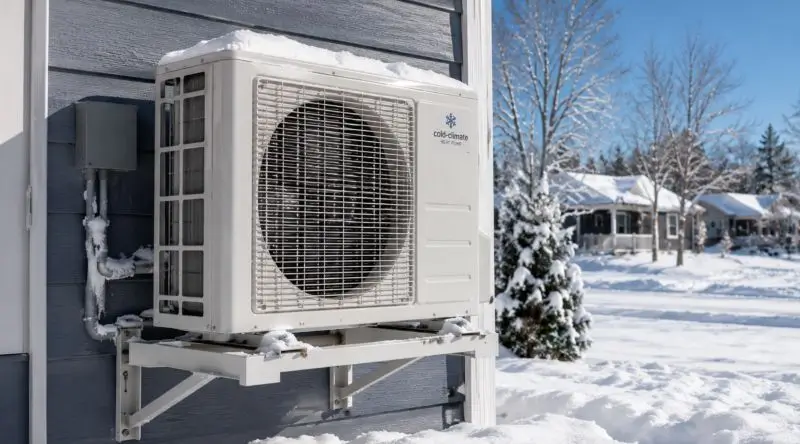
Five factors move a Minnesota quote the most: zones (the biggest driver: each indoor head adds equipment and labor); cold-climate equipment; electrical work (a dedicated circuit or panel upgrade can add hundreds to a few thousand dollars); install complexity (long line sets, brick/stucco walls, second-story mounts, raised outdoor stands); and permits (most Minnesota cities require mechanical and electrical permits). In our experience at Filterbuy, labor and electrical are the line items homeowners most underestimate. Two cold-country details we always flag, and that cheap quotes skip: mount the condenser on a tall stand or wall bracket to clear snowpack, and confirm the model has a base-pan heater to prevent defrost-cycle icing.
For the national line-by-line breakdown, see our mini-split installation cost guide.
Minnesota Mini-Split Rebates in 2026 (The Honest Map)
In 2026, mini-split rebates in Minnesota come from your electric utility, not the federal government and not your gas utility. The federal credit expired at the end of 2025, and Minnesota's state program hasn't launched. Here is who actually pays, by utility.
Federal Tax Credit: Gone for 2026
The federal Energy Efficient Home Improvement Credit (Section 25C), the one that paid up to $2,000 for a qualifying heat pump, expired December 31, 2025, so a mini-split installed in 2026 does not qualify. The One Big Beautiful Bill Act (signed July 4, 2025) pulled the end date forward; the companion solar/geothermal credit (Section 25D) ended the same day. If a 2026 quote references “the 30% federal credit,” that's a red flag. One exception: systems installed and running before the end of 2025 still qualify. File IRS Form 5695 with your 2025 return.
Xcel Energy: The Broadest Minnesota Program
If Xcel Energy is your electric utility, this is your main rebate: about $1,600 for a standard mini-split, up to $2,000 for a cold-climate mini-split, plus a $600 insulation-and-air-sealing bonus. Two details matter: mini-split rebates don't require a participating contractor, so a qualifying DIY install can still earn the rebate; and “combo” customers with Xcel electric and gas generally see the higher tiers. To hit the top cold-climate figure, the model must be on the NEEP cold-climate list (COP at least 1.75 at 5°F) and in the AHRI directory.
Minnesota Power: Northeastern Minnesota
If Minnesota Power is your electric provider (Duluth, the Iron Range, Grand Rapids), the ductless rebate is $400 standard, or an enhanced $1,200 for a cold-climate ductless system. Minnesota Power requires a participating contractor (who files for you), ENERGY STAR certification, and caps the rebate at 75% of project cost. The program deadline is December 31, 2026, and checks typically arrive in 8–10 weeks.
CenterPoint Energy: Why Your Mini-Split Won't Qualify
CenterPoint does not rebate mini-splits. CenterPoint is a natural-gas utility, and its only heat-pump rebate applies to a dual-fuel setup: a heat pump paired with a 92%+ AFUE gas furnace, programmed to switch to gas at 40°F or below. Ductless mini-splits, ground-source systems, and any full-electric replacement are excluded.
State + Local Programs
Minnesota's Save Energy Minnesota program (HEAR and HOMES, plus a state heat-pump rebate) has not launched, and as of the Department of Commerce's June 12, 2026 update there is no estimated launch date. When live, HEAR would offer income-based rebates up to $8,000 (heat pump, at or below 80% AMI) and a state rebate up to $4,000 on top, but you must be approved for HEAR first, and HEAR is not retroactive. Locally, Minneapolis Green Cost Share (administered by the Center for Energy and Environment) stacks bonus rebates on your utility rebate for 1–4 unit homes; St. Louis Park and Northfield match a portion of your utility cold-climate rebate. Don't wait on a program with no start date, but if you may be income-qualified, watch the Commerce Department before signing a contract.
Full federal detail: our 2026 mini-split tax-credit guide.
How to Stack the Savings (Step by Step)
To capture every available dollar in Minnesota, confirm your utility, spec the equipment to the rebate, install, then submit, layering local programs on top.
Identify who bills you for electricity and gas. Your mini-split rebate comes from your electric utility (Xcel, Minnesota Power, or a co-op). The Minnesota Public Utilities Commission has a utility-lookup map.
Spec for the rebate, not the code minimum. Aim for ENERGY STAR, cold-climate rated (NEEP list, COP at least 1.75 at 5°F), low-GWP refrigerant (R-32). Get the AHRI certificate. Filterbuy's mini-splits ship spec'd to that R-32, ENERGY STAR-aligned standard, with the AHRI paperwork rebate programs ask for.
Use a participating contractor where required. Minnesota Power and most local match programs require one; Xcel mini-split rebates do not.
Install and keep every document. Invoice, AHRI certificate, model/serial numbers.
Submit, then stack. File the utility rebate, then add any local (Green Cost Share, city-match) program. If Save Energy Minnesota launches and you're income-eligible, check whether it applies going forward.
What You'll Actually Pay: A Twin Cities Example
A realistic net-cost example: a 2-zone cold-climate mini-split in an Xcel “combo” household, a common Twin Cities setup. Your numbers will vary, but the math shows how the 2026 rebates actually land.
Illustrative example; your costs and rebates will vary. Minneapolis Green Cost Share and city-match programs can lower this further. Confirm current amounts with your utility.
Two things this example makes obvious. First, the cold-climate premium pays for itself: the roughly $1,350–$2,150 upgrade earns the $2,000 rebate a standard mini-split can't. Second, the $600 insulation-and-air-sealing bonus is real money most homeowners leave on the table, and sealing a leaky house also makes the mini-split work less to keep it warm. In a Minneapolis Green Zone, the city's Green Cost Share can take the net lower still.
The Best Time to Buy a Mini-Split in Minnesota
Timing changes what you pay and whether the rebate money is still there. In Minnesota, a spring or early-summer install is usually the sweet spot for both scheduling and rebate reasons.
Catch the enhanced-rebate window. In northeastern Minnesota, Minnesota Power's cold-climate ductless rebate rises to an enhanced $1,200 for installs between April 1 and June 30, 2026. If you're in their territory, plan the project for that window.
Don't wait until December. Utility rebate funds are first-come, first-served and can run out late in the year. Submit your application as soon as the install is complete.
Install in the shoulder seasons. Spring and fall are easier to schedule (contractors aren't buried in emergency AC or no-heat calls), and you'll have the system running before the next temperature extreme.
Spec for the rebate, not a seasonal sale. A cheaper non-cold-climate unit can cost you the $2,000 rebate and leave you short on heat. The rebate more than covers the cold-climate premium.
Don't delay a needed repair for HEAR. Minnesota's state program has no launch date and isn't retroactive. If you need cooling now, the utility rebate is the bird in hand.
Spec Your Mini-Split for the Rebate (And Don't Forget the Filter)
Every 2026 Minnesota rebate rewards the same thing: an efficient, cold-climate-ready heat pump with a low-GWP refrigerant, and every mini-split still needs its filter maintained.
Filterbuy's own mini-split lineup is built to that spec (R-32 refrigerant, variable-speed inverter, ENERGY STAR-aligned; 12K/18K/24K BTU).
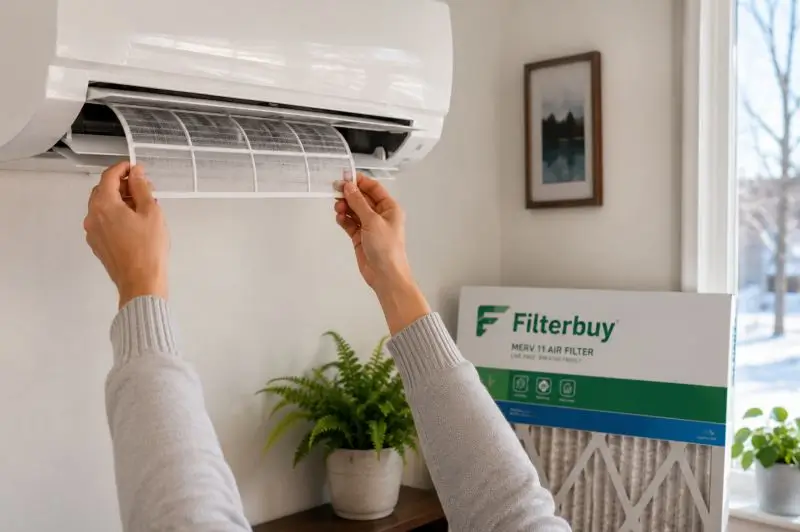
In our experience, the filter is the step homeowners skip most, and it quietly costs them. A mini-split has a washable filter in each indoor head that needs a rinse every few weeks in heavy use; skip it and you choke airflow and efficiency. And in Minnesota, because most homes keep the furnace running for the deep cold, your central system is still moving air all winter, so it still needs a real filter. A clean, correctly sized pleated filter protects that furnace and keeps your air clean, and it's what Filterbuy has built in the USA for over a decade, in 600+ sizes, for more than two million households.
“I don't want anyone to feel like they need an HVAC license just to pick the right filter. My job is to give you the straight answer, explain why it matters, and let you get back to your day.”
Michelle Wan, Brand Manager, Filterbuy
Find your exact furnace filter size and set up auto-delivery when you add the mini-split, so a fresh filter arrives on schedule. On smoky or high-pollen days, check your local air quality and step up your MERV rating if your system allows.
Before You Buy: A Minnesota Mini-Split Checklist
Save or print this before you request quotes. It captures the decisions that make or break a Minnesota install:
Confirm your electric utility. That's who pays your mini-split rebate, not your gas utility.
Pick a cold-climate model. On the NEEP list (COP at least 1.75 at 5°F), ENERGY STAR, with R-32 refrigerant.
Plan your backup heat. A furnace or dual-fuel setup for −20°F nights; a mini-split alone rarely carries a whole MN home in deep cold.
Insist on a load calculation. Right-sizing beats a rule of thumb; oversizing wastes money and hurts comfort.
Get a line-item quote. Unit, labor, electrical, and permit broken out separately, not one lump sum.
Confirm the cold-country details. A snow-clearance mount (tall stand or wall bracket) and a base-pan heater.
Use a participating contractor where required. Minnesota Power and most city-match programs require one; Xcel mini-split rebates allow DIY.
Keep every document. Invoice, AHRI certificate, and model/serial numbers. You'll need them to claim the rebate.
Don't count on two things. The federal tax credit (expired 12/31/2025) and a CenterPoint rebate (a gas utility; mini-splits don't qualify).
Submit, then stack. File your utility rebate first, then add any local (Green Cost Share or city-match) program.
Set up filter maintenance. Rinse the mini-split's washable filter every few weeks, and keep the central furnace filter fresh. Filterbuy stocks 600+ sizes with auto-delivery so you never run out.
Supporting Statistics
Three findings from U.S. government research back the claims on this page:
−13°F, no backup heat needed. A U.S. Department of Energy (Oak Ridge Lab) field test kept a home comfortable to −13°F with no electric-resistance backup, and cut heating energy up to 70% versus electric resistance.
68% gas, 14% electric. About 68% of Minnesota homes heat mainly with natural gas; only ~14% use electricity (U.S. Energy Information Administration, 2020 RECS). That's why most keep a furnace for backup, and why your rebate comes from your electric utility.
90% indoors, 2–5× the pollutants. Americans spend about 90% of their time indoors, where some pollutants run 2–5 times higher than outdoors (U.S. EPA). Keep your mini-split and furnace filters clean. Filterbuy supplies replacements for both.
Frequently Asked Questions
Glossary
Mini-split (ductless mini-split): A heating-and-cooling system with one outdoor compressor connected to one or more indoor “heads” by refrigerant lines, requiring no ductwork.
Air-source heat pump (ASHP): A system that moves heat between outdoor and indoor air to both heat and cool; a mini-split is a ductless ASHP.
Cold-climate air-source heat pump (ccASHP): An ASHP engineered to deliver efficient heat at subzero temperatures; required for reliable Minnesota winter heating.
Section 25C: A former U.S. federal tax credit of up to $2,000 for qualifying heat pumps; expired December 31, 2025.
Section 25D: A former U.S. federal credit for solar/geothermal; also ended December 31, 2025.
OBBBA (One Big Beautiful Bill Act, Public Law 119-21): 2025 federal law (signed July 4, 2025) that accelerated the expiration of the 25C and 25D credits.
HEAR (Home Electrification and Appliance Rebate): A federally funded, income-based rebate program administered by states; in Minnesota it is part of Save Energy Minnesota and has not launched.
Save Energy Minnesota: The Minnesota Department of Commerce umbrella for HEAR, HOMES, and the state heat-pump rebate; unlaunched as of June 12, 2026.
NEEP cold-climate list: The Northeast Energy Efficiency Partnerships product list utilities use to verify cold-climate performance (COP at least 1.75 at 5°F).
AHRI certificate: Documentation verifying a system's rated performance; required for most rebates.
AFUE: A gas-furnace efficiency rating; CenterPoint's dual-fuel rebate requires a 92%+ AFUE furnace.
Base-pan heater: A heating element in a heat pump's outdoor unit that prevents ice buildup during defrost, important in Minnesota.
About This Guide (E-E-A-T)
Written by Michelle Wan, Brand Manager and copywriter at Filterbuy, who covers indoor air quality, filtration, and HVAC maintenance and works directly with Filterbuy's U.S. manufacturing team. Technically reviewed by David Clark, Licensed HVAC Technician (Filterbuy HVAC Solutions). Filterbuy is a family-owned U.S. manufacturer that has made air filters in America since 2013, in factories in Alabama, Florida, Pennsylvania, and Utah, offering 600+ filter sizes shipped factory-direct and trusted by more than two million households with 75,000+ five-star reviews. That manufacturing and indoor-air-quality experience is the foundation behind this guide's filter recommendations. Rebate figures and program status were verified against the primary sources below; because they change often, this page is dated and refreshed on update.
Sources & Citations
Minnesota Dept. of Commerce: Save Energy Minnesota (HEAR / HOMES)
U.S. Dept. of Energy: Cold-climate heat pump field research (ORNL)
U.S. Energy Information Administration: Space heating fuels by state (2020 RECS)