Mini Split AC in Las Vegas, NV
Installation, Costs & Filter Guide (NV Climate)
Author: Michelle Wan, Brand Manager and Air Quality Writer | Technically Reviewed By: David Clark, Licensed HVAC Technician
Published: August 23, 2026 | Updated: August 23, 2026
Which Mini Split Size Fits Your Las Vegas Room?
Match the BTU to your room's square footage, then account for desert heat load. A 350 to 550 sq ft bedroom takes 12,000 BTU, a 550 to 850 sq ft living room or converted garage takes 18,000 BTU, and an open-plan space up to 1,200 sq ft takes 24,000 BTU. Clark County requires a Manual J load calculation on new installations, so treat these bands as a starting point rather than the final number.
- 12,000 BTU: bedrooms, offices, and smaller living rooms, 350 to 550 sq ft.
- 18,000 BTU: larger living rooms and converted garages, 550 to 850 sq ft.
- 24,000 BTU: open-plan great rooms and combined spaces, 800 to 1,200 sq ft.

Not sure which band your room falls into? Answer three quick questions and we will point you to the size that fits.
Filterbuy ships single-zone ductless mini split systems nationwide with free 2-day delivery on in-stock systems, at a published price rather than a quote request, backed by a 7-year compressor and 3-year parts warranty. The line is single zone only. Professional installation is required, and the warranty is void if the system is self-installed.
Filterbuy sells mini split systems and air filters nationwide. Filterbuy HVAC Solutions installs in Florida and Texas only, not Nevada.
A ductless mini split is a heating and cooling system that moves air between an outdoor compressor and one or more wall-mounted indoor heads without ductwork. In Las Vegas, a single-zone mini split typically runs $1,200 to $5,500 installed, and multi-zone systems for two to five rooms run $4,000 to $14,500. The federal 25C tax credit expired December 31, 2025, so NV Energy’s PowerShift rebate is now the main incentive available to Clark County homeowners.
Key Takeaways
Cost: a single-zone mini split runs $1,200 to $5,500 installed in Las Vegas; two to five zones run $4,000 to $14,500.
Incentives: the federal 25C credit expired December 31, 2025. NV Energy PowerShift is the remaining incentive, and it requires 18 SEER2 / 9 HSPF2 for ductless.
Sizing: Clark County requires a Manual J load calculation, and sustained 110F days call for a high-ambient-rated unit.
Filtration: the EPA states that mini split filters do not capture fine particles. Your central system filter or a portable air cleaner does that job.
Timing: March and April are the best install window, because rebate funding is fresh and labor is cheaper than in July.
A note on who is telling you this. Filterbuy has manufactured air filters in the United States since 2013 and now ships ductless mini split systems nationwide. Filterbuy HVAC Solutions, our installation arm, works in Florida and Texas. Not Nevada. So this guide is built to help you buy and hire well in Las Vegas, not to route you to a service call we cannot perform.
How Much Does a Mini Split Cost in Las Vegas in 2026?
Expect $1,200–$5,500 for a single zone and $4,000–$14,500 for a two-to-five-zone system, fully installed. The national average for a single-zone install sits near $3,000. Las Vegas lands mid-range: labor is moderate versus coastal metros, but summer demand tightens schedules from May through September.
Ranges are fully installed 2026 figures. Clark County mechanical permits start near $109 at the base tier and scale with project value; skipping one carries a penalty of double the original fee.
One 2026 change worth budgeting for: every mini split sold this year uses a low-GWP A2L refrigerant, either R-32 or R-454B, which adds roughly 10–15% to equipment cost versus the R-410A units you may have priced in 2024. That is a federal refrigerant transition, not a contractor markup, and it is already in the ranges above.
For a full national breakdown by zone count, see our mini split installation cost guide. If you would rather buy the equipment outright and hire a local installer, Filterbuy ships single-zone ductless mini split systems nationwide with free 2-day delivery on in-stock systems, at a published price rather than a quote request, backed by a 7-year compressor and 3-year parts warranty. The line is single zone only, so a multi-zone project goes to another brand. Professional installation is required, and the warranty is void if the system is self-installed.
What Size Mini Split Do You Need for a Las Vegas Home?
Size by room square footage first, then add capacity for desert heat load. A 350 to 550 square foot bedroom needs about 12,000 BTU as a baseline, but a west-facing Summerlin room with single-pane glass behaves nothing like the same room in Portland. Clark County requires a Manual J load calculation on new installations, so the number should come from a calculation, not a chart.
Baseline sizing only. Clark County requires a Manual J load calculation for new HVAC installations under its local energy code amendments, so this is a code requirement here, not just good practice.
Two Las Vegas-specific rules your installer should already know:
Ask for a high-ambient-rated model. Above roughly 110F, many standard mini splits lose rated cooling capacity. Las Vegas hit 120F on July 7, 2024, the hottest day in city history, with seven straight days at or above 115F that month. A unit spec’d to 105F will underperform when you need it most. Our guide to choosing a mini split system covers sizing and efficiency in more depth.
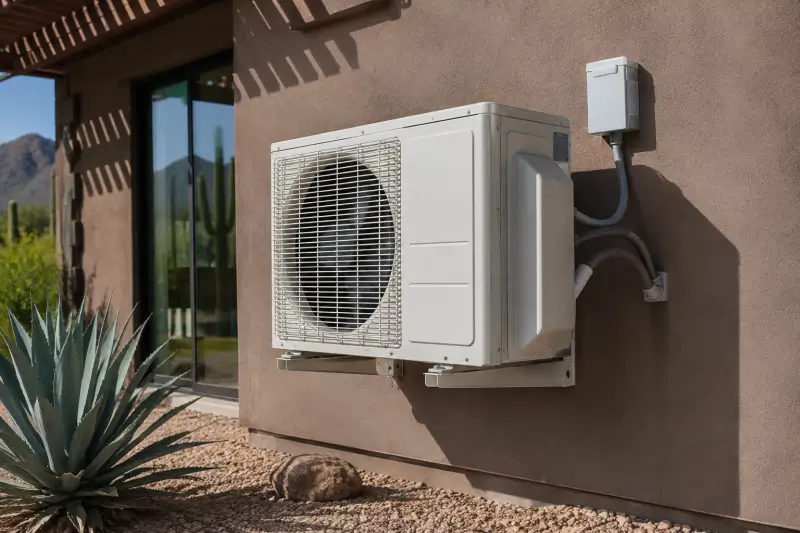
Shade the outdoor condenser, but do not choke it. Afternoon shade lowers head pressure and extends compressor life, but keep the clearance the manufacturer specifies. Boxing the unit into a tight side-yard alcove does more harm than the shade does good.
Garage conversions are the most common mini split project in the valley and the most commonly undersized. An uninsulated garage with a west-facing door is a far larger heat load than its square footage suggests.
"Our crews install ductless systems across Florida and Texas, so I want to be careful about what transfers to the Mojave and what does not. Sizing discipline transfers. The oversizing mistake we correct most often happens the same way in Henderson as it does in Houston: someone buys 24,000 BTU for a room that needs 12,000, then wonders why it short-cycles.
What does not transfer is the humidity math. In Florida I size partly for moisture removal. In Las Vegas that concern nearly vanishes, and the whole load is sensible heat coming through glass and roof. That is why I push Las Vegas homeowners toward a high-ambient-rated unit and a real Manual J rather than a square-footage chart. The chart was not built for a 115-degree afternoon."
David Clark, Licensed HVAC Technician, Filterbuy HVAC Solutions
What Rebates and Tax Credits Apply in Nevada in 2026?
The federal Section 25C credit is gone; NV Energy PowerShift is what is left. This is the detail most cost pages still get wrong, so it is worth being precise.
Section 25C expired December 31, 2025. The One Big Beautiful Bill Act (Public Law 119-21, signed July 4, 2025) ended the Energy Efficient Home Improvement Credit for property placed in service after that date. A mini split installed in 2026 does not qualify, whenever you bought it. If you installed in 2025, claim it on your 2025 return via IRS Form 5695. Confirm your own eligibility with a tax professional. More in our heat pump tax credit guide.
NV Energy PowerShift is active. It is delivered as an instant point-of-sale discount through participating contractors, so there is no waiting on a check. Ductless heat pumps generally must meet 18 SEER2 / 9 HSPF2 to qualify, a higher bar than the 15.2 SEER2 asked of ducted systems. Rebate tiers change from year to year, so confirm the current amount directly with NV Energy or your participating contractor before you sign anything.
PowerShift funding is first-come, first-served. The 2026 budget is $11.1 million and has run dry mid-year before. July 2024 needed an emergency reallocation. Spring installs have better odds than August ones.
Federal HEAR/HEEHR rebates (up to $8,000) are approved but had not launched in Nevada as of mid-2026. Nevada was allocated roughly $47.9 million. Worth watching, not worth waiting on.
Check the SEER2 rating before you assume a rebate. Plenty of well-built systems fall below 18 SEER2 / 9 HSPF2 and are still sound purchases. Ask for the AHRI certificate and read SEER2 and HSPF2 off it, not a marketing SEER figure, which is measured differently and reads higher.
PowerShift’s AC Tune-Up program is a separate thing, and it excludes mini splits. NV Energy’s subsidized AC tune-up covers central systems up to five tons; mini splits and room units do not qualify. Do not budget for it on a ductless project.
Nevada has no state income tax, so there is no state credit to stack.
For the statewide picture, see adding a mini split in Nevada, including rebates.
How Do You Hire a Licensed Mini Split Installer in Las Vegas?
Verify the contractor holds an active NSCB license in the C-21 classification before anything else. Nevada contractor licensing runs through the Nevada State Contractors Board under NRS Chapter 624, and HVAC work falls under C-21 (Refrigeration and Air Conditioning).
Your five-minute vetting checklist:
Ask for the NSCB license number and run it through the Board’s free contractor license search. It shows classification, bid limit, bond status, and complaint history.
Check the classification, not just that a license exists. C-21 covers residential and commercial HVAC. C-21B is limited to residential air conditioning. A heat pump, which is what nearly every mini split is, requires C-21, not the warm-air-heating C-1D classification. The Board publishes the full license classification list.
Confirm they are pulling the Clark County or City of Las Vegas mechanical permit. New equipment triggers a permit and inspection, and the contractor pulls it, not you. Unpermitted work fails inspection and can void your manufacturer warranty.
Ask whether they are a PowerShift participating contractor. Non-participating installers cannot apply the instant rebate.
Get an itemized quote. Equipment model and SEER2 rating, labor, line-set length, electrical, permit, and rebate should each appear separately. A lump sum hides whether this is a $1,200 job or a $5,500 one.
Filterbuy sells mini split equipment and air filters nationwide, but Filterbuy HVAC Solutions performs installations only in Florida and Texas. We have no Nevada contractor to steer you toward, and no referral fee riding on who you pick. That is exactly why this checklist is worth what you paid for it.
Will Your HOA Approve a Mini Split in Las Vegas?
Probably, but ask before you schedule the install, not after. A mini split puts a visible condenser on an exterior wall or pad, and much of the Las Vegas valley sits inside a common-interest community. Under NRS Chapter 116, Nevada’s Uniform Common-Interest Ownership Act, associations have authority to enforce architectural guidelines and review homeowner applications through an architectural review committee.
This is the step homeowners skip most often, and it is the one that can strand a paid-for system in a garage for a month.
Read the CC&Rs before you shop, not after. Guidelines usually govern where equipment can sit, whether it is visible from the street, and screening requirements. Those constraints affect line-set routing, which affects your quote.
Submit the architectural application before you book the installer. Committees often meet monthly. A four-week review is normal, and it is a painful surprise in June.
Do not assume a 35-day approval clock applies. Nevada’s 2025 solar legislation created a deemed-approved deadline for distributed generation systems. That protection covers solar, not HVAC. A mini split has no equivalent statutory timer.
Boards still have to follow their own rules. Nevada law requires associations to act in good faith and within their recorded governing documents, and to apply architectural guidelines consistently. A denial based on preference rather than a documented standard is worth questioning in writing.
Ask the committee about placement, not just permission. A board that objects to a street-facing condenser will often approve the same unit on a side or rear wall. Bring two placement options to the application. Filterbuy HVAC Solutions crews sequence Florida and Texas jobs the same way: confirm the approved location first, finalize line-set routing second.
Do Mini Splits Filter Las Vegas Dust and Wildfire Smoke?
Mostly, no, and this is the most misunderstood part of ductless systems. According to the EPA, the filters installed in ductless mini split heat pumps are designed to protect the equipment from clogging with large particles like pet hair and lint, and do not filter out fine particles.
That matters in a valley dealing with monsoon dust, year-round construction particulate, and wildfire smoke arriving from California, Arizona, and Nevada fires within hours.
Here is what we see that a spec sheet will not tell you. Filterbuy has manufactured more than 10 million filters and served over two million households since 2013, and Las Vegas is one of our highest-frequency summer reorder markets. Our order data shows valley customers reorder roughly 40% more often during high-AQI summer months, a pattern that holds across hundreds of thousands of orders. When we examine returned Las Vegas filters, we can usually read the season off the media: tan-gray surface loading from dust storms, darker uniform discoloration with a lingering odor from wildfire smoke, and degraded fibers from oxidative stress during high-ozone stretches. We have seen all three on filters pulled from a single month.
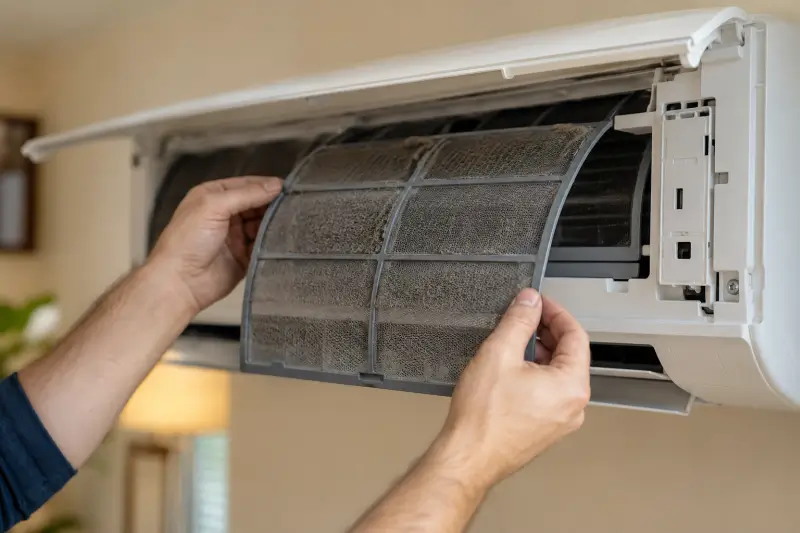
That is central-system filter media. A mini split pre-filter sits in the same air and loads on the same schedule, but it is a washable mesh screen rather than pleated media, so it clogs rather than captures. Both facts point the same direction: whatever the manual says, the Mojave sets the interval.
What to do about it:
Wash the mesh pre-filter every 2–4 weeks in summer. More often than most manuals suggest, because they were not written for the Mojave. A loaded pre-filter restricts airflow and strains the unit on a 115F afternoon.
Treat manufacturer "high-efficiency filter" claims skeptically. The EPA’s guidance is to verify the filter carries a MERV 13 or higher rating, and that it seats snugly without bending or crushing to fit. Check compatibility with your own system first, because a higher-MERV filter restricts airflow more than a lower-MERV one, and not every air handler is designed for it.
If your home also has ducted HVAC, that is where real filtration happens. A properly sized MERV 11 or MERV 13 filter in the central system does the fine-particle work your mini split heads cannot. MERV 11 handles everyday dust and dander; MERV 13 is the smoke tier. Filterbuy makes both in the U.S. in 600+ sizes, with auto-delivery if remembering the date is the hard part.
For a mini-split-only room, add a portable air cleaner. The EPA recommends exactly this when a ductless unit lacks MERV 13+ filtration, and its Guide to Air Cleaners in the Home covers sizing. A mini split only filters the room it is in, and only while running.
Check conditions before you decide how aggressive to get: see the live air quality index for Las Vegas, or which MERV rating to run at a given AQI.
"We sell mini splits and we sell filters, so the easy thing here would be to tell you a mini split cleans your air. It mostly does not, and the EPA says so plainly. The stock filter in a ductless head is a screen that protects the coil from lint and pet hair, not a device that captures PM2.5.
I would rather a Las Vegas homeowner hear that from us than find out during fire season. Buy the mini split for what it is genuinely excellent at, which is quiet, efficient, room-by-room cooling in a climate that punishes ductwork. Then handle the air separately: through your central system’s filter if you have one, or a portable air cleaner in that room if you do not. Two different jobs, two different tools."
Michelle Wan, Brand Manager and Air Quality Writer, Filterbuy
How Often Should You Clean a Mini Split Filter in Las Vegas?
The intervals below are shorter than most manuals recommend, deliberately. They reflect what Filterbuy sees in returned filters and reorder timing from this market rather than a national default. Filterbuy’s published Las Vegas guidance has been a 60-day central-filter cycle from May through October for some time, and the same logic applies to a ductless pre-filter.
Manufacturer intervals assume average conditions. Mojave dust loading routinely shortens them.
When Is the Best Time to Install a Mini Split in Las Vegas?
March and April, if you have the choice. Three things in this market move on a calendar and all three favor spring: NV Energy’s PowerShift budget is first-come and has run out mid-year before, contractor labor gets more expensive once the valley heats up, and a system installed in April is commissioned and tested before the first 110F week rather than during it.
Timing is the one lever on this page that costs nothing to pull. Rebate funding, labor rates, and your own urgency all move together in this market.
One scheduling lever most homeowners miss: if you are sourcing equipment separately, order it before you book labor. Filterbuy ships single-zone systems nationwide with free 2-day delivery on in-stock units, and having the unit on site removes a supply variable from a tight spring calendar, since contractors can quote labor against a system that is already in your garage.
The honest exception: if your only cooling has already failed and it is August, none of this applies. Replace it now and take the premium. Heat is the risk that outranks the budget.
Supporting Statistics
Three findings that bear directly on a Las Vegas mini split decision.
Clark County gets an F for short-term particle pollution.
F grade for 24-hour particle pollution. 31st worst of 224 metro areas.
Graded on EPA monitoring data from 2022 through 2024, so it is a three-year pattern, not one bad smoke season.
Ozone also scored an F, 11th of 226. But ozone is a gas. No filter removes it at any MERV rating.
Why it matters here: fine particulate is exactly what the EPA says a mini split’s stock filter cannot capture.
Duct losses can top 30% of heating and cooling energy.
Source: U.S. Department of Energy / PNNL Building America Solution Center
Applies when ducts run through unconditioned space: a vented attic, crawlspace, or garage.
Losses come from air leakage at the air handler and ducts, plus conduction through duct walls.
Ductless eliminates them, because the indoor heads sit inside the conditioned space.
Why it matters here: most Las Vegas tract housing runs ductwork through a vented attic that can pass 150F in July.
Air conditioning is roughly 19% of U.S. home electricity.
Source: U.S. Energy Information Administration, Residential Energy Consumption Survey
About 254 billion kilowatt-hours in 2020.
That is a national average across every climate zone, including regions that barely cool.
Why it matters here: Southern Nevada runs far above it. The valley saw 64 consecutive days at or above 100F in 2024, so sizing and efficiency move a larger share of the bill.
Frequently Asked Questions
About the Author
Michelle Wan is Brand Manager and Air Quality Writer at Filterbuy, where she works directly with the U.S. manufacturing teams behind the company’s Alabama, Florida, Pennsylvania, and Utah plants. She translates MERV ratings, filtration, and HVAC efficiency into plain-English advice for homeowners, and fronts much of Filterbuy’s educational video content. She earned her B.A. in Sociology from the University of California, Santa Cruz, in 2021.
Sources Cited
U.S. EPA: Do ductless mini-split heat pumps filter fine particles out of indoor air?
Nevada State Contractors Board: License Classifications (NRS 624)
American Lung Association: State of the Air 2026, Las Vegas-Henderson, NV
U.S. DOE / PNNL Building America Solution Center: Ductless (Mini-Split) Heat Pumps
U.S. Energy Information Administration: Electricity used for air conditioning (RECS)
Glossary
Terms are defined as they apply in Clark County. Efficiency thresholds, code requirements, and refrigerant rules all vary by jurisdiction.