Adding a Mini Split AC System in Nevada
Installation, Costs & Rebates (NV Guide)
By Michelle Wan · Reviewed by David Clark, Licensed HVAC Technician · Published July 8, 2026 · Updated July 8, 2026
Adding a ductless mini split in Nevada costs about $2,000–$7,000 for one room, or $4,000–$14,500 for a whole home, before rebates. The federal tax credit ended in 2025, but NV Energy's PowerShift rebate is active right now as an instant discount, with bigger HEAR rebates (up to $8,000) on the way.
Dry desert heat is easy on a mini split, as long as you pick a unit rated to cool past 110°F. Answer a few quick questions below and we'll match you to the right system for your home.

Answer 3 quick questions and we'll match you to the right mini split for your Nevada home.
TL;DR
Adding a ductless mini split in Nevada in 2026 typically runs about $2,000–$7,000 for a single zone and $4,000–$14,500 for multi-zone whole-home comfort, before incentives. The federal tax credit that used to knock $2,000 off is gone. It expired December 31, 2025. In its place, NV Energy's PowerShift rebate is available right now as an instant discount, and larger HEAR/HOMES rebates are funded but not yet open in Nevada as of mid-2026. Dry desert heat is actually easier on a mini split than humid heat, but you still need a unit rated for high outdoor temperatures.
Key Takeaways
A single-zone mini split costs roughly $2,000–$7,000 installed in Nevada; multi-zone systems run $4,000–$14,500, with labor making up about 30–50% of the bill.
The federal 25C tax credit for heat pumps ended December 31, 2025. A mini split installed in 2026 does not qualify, no matter when you bought it.
NV Energy's PowerShift is the only confirmed active heat-pump rebate in Nevada in 2026, applied as an instant point-of-sale discount through participating contractors.
Nevada's IRA-funded HEAR (up to $8,000) and HOMES rebates are approved but not yet launched. The state was allocated about $47.9M for HEAR and $48.2M for HOMES.
Nevada has no state income tax, so there is no state tax credit to stack on top.
Dry heat preserves efficiency, but above about 110°F, standard units lose capacity, so pick a model rated for high ambient temperatures and shade the outdoor unit.
Thinking about adding a ductless mini split to beat the Nevada heat? Here's the short version: expect to pay $2,000–$7,000 for one zone or $4,000–$14,500 for a whole-home multi-zone system in 2026, plan around the NV Energy PowerShift rebate (the federal tax credit is no longer available), and choose a unit rated to cool past 110°F. Below, we break down real 2026 costs, exactly which Nevada rebates you can and can't get, how these systems handle desert heat, and how to keep yours running efficiently once it's in.
A quick word on where this comes from, because it shapes what we flag. Filterbuy manufactures the filters that go inside these systems, and builds our own line of ductless mini splits. So after more than a decade serving over two million households, we tend to notice what the spec sheet leaves out. In our experience, comfort in a place like Nevada rarely comes down to the brand on the box; it comes down to the details other guides skip: sizing for real desert heat, shading the condenser, and staying ahead of the dust. That's the lens for everything below, and it's why we had our licensed HVAC technician pressure-test the guidance.
How Much Does It Cost To Add A Mini Split In Nevada In 2026?
A fully installed single-zone mini split in Nevada typically costs $2,000–$7,000, with a basic setup averaging around $3,000. Multi-zone systems that cool several rooms from one outdoor unit run $4,000–$14,500 depending on how many indoor heads you need. Labor accounts for roughly 30–50% of the total, and Nevada jobs can land 15–30% above or below the national average based on your home and local permit rules.
Here's how that breaks down by system size. These are installed prices (equipment plus labor) based on 2026 national ranges. Get itemized quotes; a mini split estimate should read like a receipt, with a line for each part and task.
Installed prices reflect 2026 U.S. averages; Nevada pricing varies with local labor and permits.
What actually drives your number in Nevada:
Zones (indoor heads). Each added head means more equipment, refrigerant line, and labor. Going multi-zone from the start is almost always cheaper than adding zones later. Bolting a second zone onto a single-zone system can mean replacing the outdoor unit entirely.
Labor. Licensed technicians run about $75–$150 per hour, and a single-zone install usually takes 4–8 hours. Multi-zone jobs can span 1–3 days.
Electrical. Many systems need a dedicated 240V circuit. If your panel is full or dated, budget for a circuit, disconnect, or subpanel. Or sidestep it: Filterbuy's 115V mini splits run on a standard household outlet, skipping the $500–$2,000 an electrician would otherwise charge to run 240V.
The desert extras. Longer line sets for a shaded condenser placement, a sturdy pad or bracket, permits, and inspection all nudge the price up.
Want the full national breakdown by BTU and brand? See our detailed mini split cost guide for 2026.
What Nevada Mini Split Rebates Can You Actually Get In 2026?
In 2026, the federal tax credit for heat pumps is gone. It expired December 31, 2025. Your best real incentive in Nevada is the NV Energy PowerShift rebate, an instant point-of-sale discount available now. Two bigger federally funded rebate programs, HEAR (up to $8,000) and HOMES, are approved for Nevada but have not launched yet. Nevada has no state income tax, so there's no state credit to add on top.
We wrote this section because we kept hearing from Nevada homeowners who'd been quoted "30% back, up to $2,000" from the IRS. That advice is now out of date and, in 2026, simply wrong. Here's the current lay of the land, program by program.
The Federal Tax Credit: Why It's No Longer An Option
The Section 25C Energy Efficient Home Improvement Credit used to give homeowners up to $2,000 (30% of project cost) for a qualifying heat pump, and ductless mini split heat pumps counted. The One Big Beautiful Bill Act, signed July 4, 2025, terminated that credit for any system placed in service after December 31, 2025. As the IRS confirms in its OBBB credit FAQ, what matters is the install (placed-in-service) date, not the purchase or contract date. A mini split that goes live in 2026 doesn't qualify, full stop. If yours was installed in 2025, you can still claim it on the 2025 return you file in 2026.
NV Energy PowerShift: Your Active Option Right Now
NV Energy's PowerShift program is the one confirmed, active heat-pump rebate in Nevada in 2026. It's delivered as an instant discount through participating contractors, so you don't wait for a check. NV Energy serves roughly 90% of the state (Las Vegas, Henderson, Reno, and Elko included), so most Nevada homeowners are eligible.
Two things to know: the rebate scales with efficiency (higher SEER2/HSPF2 earns more), and to qualify, a ductless heat pump generally needs to meet minimum efficiency ratings, commonly cited around 18 SEER2 / 9 HSPF2 for ductless systems. Funding is first-come, first-served on an annual budget, and it has run out before mid-year in past seasons, so apply early. [PLACEHOLDER: confirm exact 2026 efficiency thresholds and rebate amounts with NV Energy.]
HEAR And HOMES: Funded, But Not Open Yet
Two Inflation Reduction Act rebate programs are coming to Nevada. They just aren't live yet:
HEAR (Home Electrification and Appliance Rebates). Nevada was allocated about $47.9 million. Once open, income-qualified households (at or below 150% AMI) can receive up to $8,000 toward a qualifying heat pump, and households at or below 80% AMI can reach up to $14,000 combined across upgrades. It requires a registered contractor and ENERGY STAR–certified equipment; DIY installs don't qualify.
HOMES (Home Efficiency Rebates). Nevada was allocated about $48.2 million. It pays $2,000–$4,000 for verified whole-home energy savings (typically 20%+ or 35%+ reductions) and isn't income-restricted.
As of mid-2026, the Nevada Governor's Office of Energy is still standing these programs up, and no consumer application window has opened. HEAR and HOMES can't both pay for the same piece of equipment, but they can cover different parts of one project: HEAR for the heat pump, HOMES for insulation and air sealing. To confirm every incentive tied to your specific address, search the DSIRE database of state and utility incentives by ZIP code before you sign anything.
The savvy move: If your current system is failing or costing you a fortune every month, don't sit in the heat waiting on a rebate with no launch date. Take the active PowerShift discount now, and ask your contractor to document your install so you're ready if HEAR opens later.
What A Nevada Mini Split Really Costs After The Rebate
For a mid-size Las Vegas home, a three-zone high-efficiency ductless heat pump that runs about $8,000 installed typically nets around $6,000–$6,500 after the NV Energy PowerShift instant discount. The expired federal tax credit adds nothing in 2026. But if you're income-qualified and HEAR opens, up to $8,000 more could come off.
Ranges are useful; real numbers are better. Here's roughly how the math shakes out in 2026 for a common scenario. Treat it as an illustration, not a quote. Your exact PowerShift discount depends on the model's efficiency, and only an enrolled contractor can confirm it.
*Illustrative only. Ductless PowerShift discounts have been reported in roughly the $1,360–$2,720 range, and higher-efficiency systems earn more. Confirm your model's exact amount with an enrolled contractor. If you're income-qualified and HEAR launches, a heat-pump rebate of up to $8,000 could cut this net cost close to half again.
Will A Mini Split Keep Up With Nevada's Desert Heat?
Yes, if you choose the right unit. A properly sized ductless mini split rated for high ambient temperatures will cool a Nevada home through 110°F+ afternoons. Standard models hold full capacity up to about 95–100°F and begin to lose output above roughly 110°F; high-efficiency and premium models are rated to cool at 115–129°F. The good news: Nevada's dry heat is far kinder to efficiency than humid heat.
Here's the part most guides miss. Efficiency ratings like SEER2 are measured under standard test conditions, and real-world performance depends on outdoor temperature and humidity. Because your mini split spends almost no energy wringing moisture out of dry desert air, it runs closer to its rated efficiency here than the same unit would in a humid climate. The same system that delivers around 30 SEER2 in Arizona's dry heat can drop toward 22 SEER2 in Florida's humidity.
That doesn't mean any unit will do. To handle a Las Vegas or Reno summer:
Pick a model rated for high ambient cooling. Look for a published cooling range that comfortably clears your local design temperature (much of Nevada designs around 108–110°F). Manufacturers like Mitsubishi and Fujitsu publish derating charts showing how capacity falls as temps climb. Use them, and compare how the major brands handle hot and cold climates before you buy.
Size it right, don't oversize. Insist on a Manual J load calculation rather than a rule of thumb. An oversized system short-cycles and wastes money; a right-sized inverter unit runs longer, steadier, and cheaper.
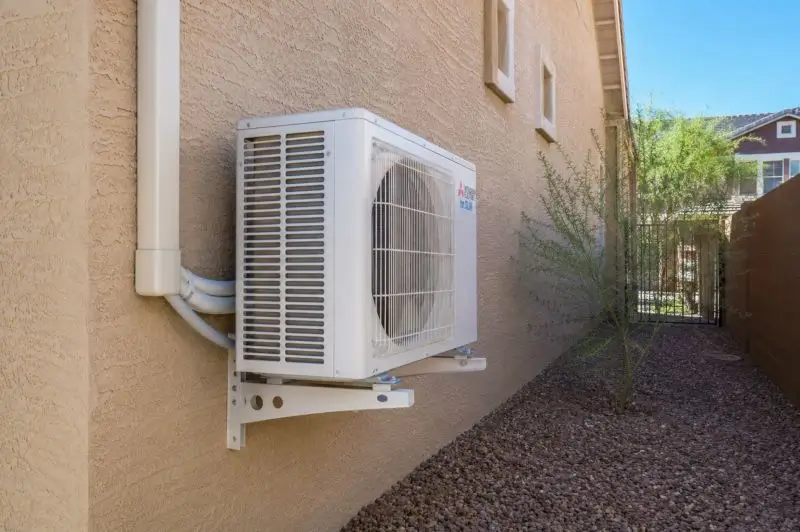
Shade and space the condenser. Mount the outdoor unit where it gets afternoon shade and unobstructed airflow with proper clearances. A baking, boxed-in condenser is the #1 avoidable cause of lost desert capacity.
Multi-zone can derate faster. Spreading load across several heads on one condenser can lose capacity quicker in extreme heat than a single-zone setup, so size the outdoor unit for realistic simultaneous demand.
"The mistake I see most in Nevada isn't the equipment. It's the install. I've stood next to condensers baking against a west-facing stucco wall with no room to breathe, shedding cooling right when the family needs it most. Shade the outdoor unit, give it clearance, and never skip the Manual J load calc. That's the difference between a mini split that holds its setpoint through a 115-degree afternoon and one that quits by 4 p.m."
David Clark, Licensed HVAC Technician
How To Add A Mini Split In Nevada, Step By Step
Adding a mini split in Nevada follows a predictable path: size the system, pick a high-ambient-rated unit, hire a licensed C-21 contractor, pull permits, run the install, and file for your PowerShift rebate. Doing it in this order protects both your rebate eligibility and your warranty.
Get a load calculation and a plan. A licensed contractor performs a Manual J calc, recommends zone count and BTU, and helps you pick a unit rated for Nevada's heat.
Confirm your rebate path. Verify your equipment meets NV Energy PowerShift efficiency minimums before you buy, and check whether HEAR/HOMES have opened. Rebates require qualifying, registered equipment, not an afterthought.
Hire a licensed C-21 (refrigeration/AC) contractor. Nevada installs need a licensed pro. DIY refrigerant work is illegal without EPA certification and voids most rebates and warranties.
Pull permits. Most Nevada jurisdictions require a permit and inspection for a mini split install. Your contractor typically handles this; confirm it's included.
Install and commission. Crews mount the indoor heads, set and shade the outdoor condenser, run and vacuum the refrigerant lines, wire the electrical, then charge, test, and commission the system.
Claim your incentive and save your paperwork. For PowerShift, the discount is usually applied at purchase through the contractor. Keep the invoice, model numbers, and efficiency documentation in case HEAR opens or you need warranty support.
Nevada Details Most National Guides Miss
National mini split guides rarely account for how installs actually go in the desert. These are the local details we see trip people up, and none of them show up on a spec sheet:
Clear your HOA before you schedule. Many Las Vegas, Henderson, and Summerlin master-planned communities require architectural-committee approval before you mount a visible outdoor condenser or run line-set covers on a street-facing wall. Read your CC&Rs and get written sign-off first. It's the most common avoidable delay we hear about.
Permits are local. Clark County, the City of Las Vegas, Henderson, and Reno/Washoe each handle mini split permits a little differently. Confirm your contractor pulls the permit for your exact jurisdiction and books the inspection, rather than assuming it's the same everywhere.
Apply in spring, not mid-summer. PowerShift runs on a fixed annual budget and has run dry before. It exhausted its 2024 funds by July. If you can, line up the install for spring while the rebate money is still there.
Change filters around the dust, not the calendar. After a haboob or a windy desert stretch, check the mini split's mesh filter and any central-system filter early. Fine desert dust doesn't wait for your 30-day reminder.
Ask every bidder two questions: "What outdoor temperature did you size this system to?" and "Where will the condenser sit, and will it get afternoon shade?" The answers tell you fast whether they're designing for a real Nevada summer or a generic one.
Keeping Your Mini Split Efficient In The Desert (And Where Filters Fit In)
Nevada's fine desert dust is the quiet efficiency killer. Mini split indoor heads use washable mesh pre-filters that clog faster here than almost anywhere, so check them roughly every two to four weeks in summer and rinse them clean. If your home also runs ducted HVAC or whole-home filtration alongside the mini split, keep those filters fresh on a tighter cadence too.
This is the part we know better than anyone, because filters are our craft. As a manufacturer, we watch how fast fine desert dust loads a filter. In plenty of the Nevada homes we serve, it's a matter of weeks, not months. A clogged filter chokes airflow, drops capacity, and drives up your bill exactly when you need cooling most. Two-part maintenance keeps a Nevada mini split at its best:
The mini split's own mesh filters: pop them out, rinse, dry, and reinstall. In peak summer, monthly is a floor, not a ceiling.
Any ducted or central system in the home: this is where a fresh, correctly sized pleated filter matters. Filterbuy makes filters in 600+ sizes, including hard-to-find and custom dimensions, manufactured in the USA and shipped factory-direct. Set up auto-delivery and a clean filter simply shows up on schedule, with no reminders and no last-minute hardware-store runs in 108° heat. For dusty desert homes, a MERV 11 or MERV 13 filter captures more of the fine particulate that rides in on the wind.
That's the whole Filterbuy promise in one sentence: protect your greatest assets (you, your home, and your HVAC) with clean air that's easy to keep up.
Set it and forget it: Find your filter size and start auto-delivery so your system breathes easy all summer.
Single-Zone Vs. Multi-Zone For A Nevada Home
Choose single-zone to cool one problem room, an addition, a garage, or a casita. Choose multi-zone for whole-home comfort from one outdoor unit. For most Nevada homes cooling more than one or two rooms, committing to multi-zone up front is cheaper and cleaner than adding zones later.
Single-zone: lowest upfront cost ($2,000–$7,000), ideal for a sunroom, home office, workshop, or a stubborn hot bedroom the central system never reaches.
Multi-zone: one condenser feeds 2–5 indoor heads, each with its own thermostat, so you're not paying to cool empty rooms. Higher upfront cost, but true room-by-room control and one tidy outdoor unit.
Whichever way you lean, Filterbuy builds factory-direct ductless systems that ship free in two days, including 115V models that install on a standard outlet. If you'd rather skip the distributor markup, buy straight from the people who also make your filters.
Supporting Statistics
The cost, efficiency, and desert-heat advice above is backed by federal and public research. Three data points stand out:
1. Las Vegas summers average 102°F and often top 110°F, with about 9 days a year hitting 110°F or higher.
Size for the extremes, not the average.
Choose a unit rated for high ambient heat.
Nevada has warmed ~2.4°F since 1900, so the trend is up.
Source: NOAA National Centers for Environmental Information, Nevada State Climate Summary
2. Ductwork wastes more than 30% of a home's heating and cooling energy.
Ductless mini splits skip the ducts, and that loss with them.
It's the core efficiency win over a long cooling season.
Keep the indoor filter clean to protect it.
Source: ENERGY STAR (U.S. EPA / DOE), Ductless Heating & Cooling
3. AC is about 19% of all U.S. home electricity, roughly 254 billion kWh a year.
One of the single largest energy uses in the home.
In desert Nevada, that share runs even higher.
So every efficiency gain and rebate dollar counts more.
Source: U.S. Energy Information Administration, Residential Energy Consumption Survey (RECS)
Frequently Asked Questions
Glossary
Mini split (ductless): A heat pump that heats and cools individual rooms without ductwork, using an outdoor condenser connected to one or more indoor air-handler "heads" by refrigerant lines.
Zone: One area served by its own indoor head and thermostat. A single-zone system has one head; a multi-zone system has several on one outdoor unit.
Air handler (head): The indoor unit (usually wall-mounted) that distributes conditioned air to a zone.
Condenser: The outdoor unit that rejects heat; performance depends on placement, shade, and airflow.
SEER2: The 2026 standard rating for cooling efficiency; higher is better. Think "miles per gallon" for air conditioning.
HSPF2: The companion rating for a heat pump's heating efficiency; higher is better.
Derating: The drop in a system's cooling capacity as outdoor temperature rises past its design limits.
Manual J: The industry-standard load calculation used to size a system correctly to a home.
PowerShift: NV Energy's rebate program offering instant point-of-sale discounts on qualifying high-efficiency HVAC equipment.
HEAR (Home Electrification and Appliance Rebates): An IRA-funded, state-administered rebate program (up to $8,000 for a heat pump) for income-qualified households; not yet launched in Nevada.
HOMES (Home Efficiency Rebates): An IRA-funded, state-administered rebate ($2,000–$4,000) tied to verified whole-home energy savings; not yet launched in Nevada.
Section 25C: The former federal Energy Efficient Home Improvement Credit for heat pumps, expired December 31, 2025.
AMI (Area Median Income): The income benchmark used to set HEAR/HOMES eligibility tiers.
C-21 license: Nevada's contractor license classification for refrigeration and air conditioning work.
Written by Michelle Wan. Reviewed for technical accuracy by David Clark, Licensed HVAC Technician.
Published July 8, 2026 · Last updated July 8, 2026.
This guide is for general information and is not tax or legal advice. Rebate amounts, program availability, and costs change, so verify current details with NV Energy, the Nevada Governor's Office of Energy, and a licensed contractor before making decisions.
Related Reading
Sources & Official References
Rebate, cost, and efficiency figures on this page draw on the following primary and authoritative sources. Verify current program details directly before making decisions.
IRS: One, Big, Beautiful Bill provisions (25C credit not allowed for property placed in service after Dec. 31, 2025).
IRS: Clean energy credit modification FAQs, FS-2025-05 ("placed in service" timing rule).
NV Energy: Save with PowerShift (active utility rebate program).
Nevada Governor's Office of Energy: Home Efficiency Rebates (HOMES) program and Home Energy Rebates overview.
Nevada Clean Energy Fund: Federal Rebates (HEAR).
U.S. Department of Energy: Ductless mini-split heat pumps.
ENERGY STAR: Ductless heating and cooling (also the source for the 30% duct-loss figure).
U.S. Energy Information Administration: How much electricity is used for air conditioning? (2020 RECS).
NOAA National Centers for Environmental Information: Nevada State Climate Summary.
DSIRE: Database of State Incentives for Renewables & Efficiency.