
Las Vegas Real-Time AQI Tracker


Get Alerts For Unhealthy AQI In Your Area
When air quality in your area reaches unhealthy levels, we'll send you a quick alert, along with expert tips on how to reduce your exposure.
What's Actually In Las Vegas Air Today?
What High AQI Means for Your Lungs in Las Vegas
How to Read AQI
The Air Quality Index (AQI) measures how polluted the air is and how it may affect your health.
0–50 (Good): Air quality is satisfactory.
51–100 (Moderate): Acceptable, but some pollutants may pose minor concerns.
101–150 (Unhealthy for Sensitive Groups)
151–200 (Unhealthy)
201–300 (Very Unhealthy)
301+ (Hazardous)
Moderate
Still okay for most, but if you have asthma or allergies, take it easy and avoid long outdoor workouts.
Shop MERV 11 filters→What's the Right Filter for Your AQI Level?

Live Air Quality Index AQI Map Las Vegas Nevada Today | Filterbuy.com
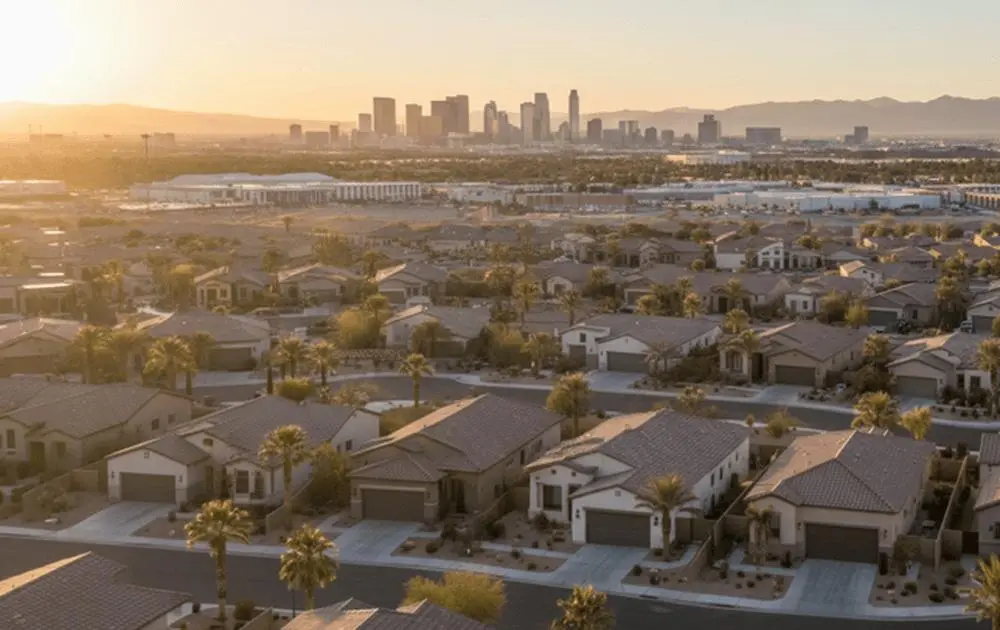
What you can't see in the Las Vegas air can absolutely affect your family's health—and today's conditions might surprise you. This live AQI map shows real-time air quality across the valley, updated continuously, so you know exactly what you're breathing before heading outside or opening windows.
Here's what we've discovered after manufacturing over 10 million air filters and serving more than two million households: outdoor AQI directly impacts your indoor air quality. Our customer data shows filter replacement rates spike 40% in zip codes during poor AQI days—proof that what's happening outside is getting inside.
Understanding today's air quality helps you make smarter decisions about ventilation, outdoor activities, and when to upgrade your home's filtration protection.
TL;DR Quick Answers
Live Air Quality Index AQI Map Now Today in Las Vegas Nevada
Check real-time Las Vegas AQI at:
AirNow.gov – Official EPA monitoring data for Clark County
PurpleAir.com – Hyperlocal neighborhood sensor readings
Quick action guide by AQI level:
AQI 0-50: Normal filter schedule
AQI 51-100: Check filter if 45+ days old
AQI 101-150: Inspect now; expect accelerated loading
AQI 151+: Replace if 30+ days old; close windows; run HVAC fan continuously
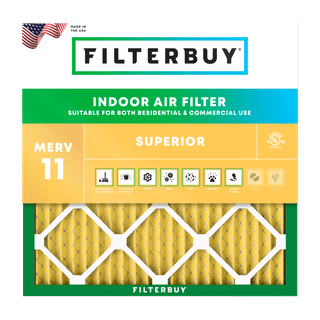
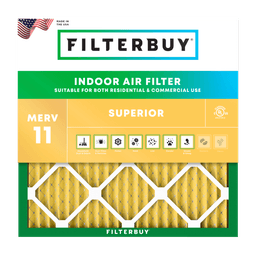
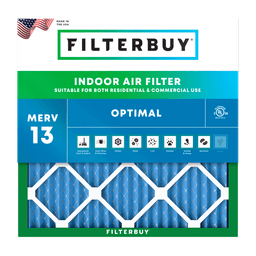
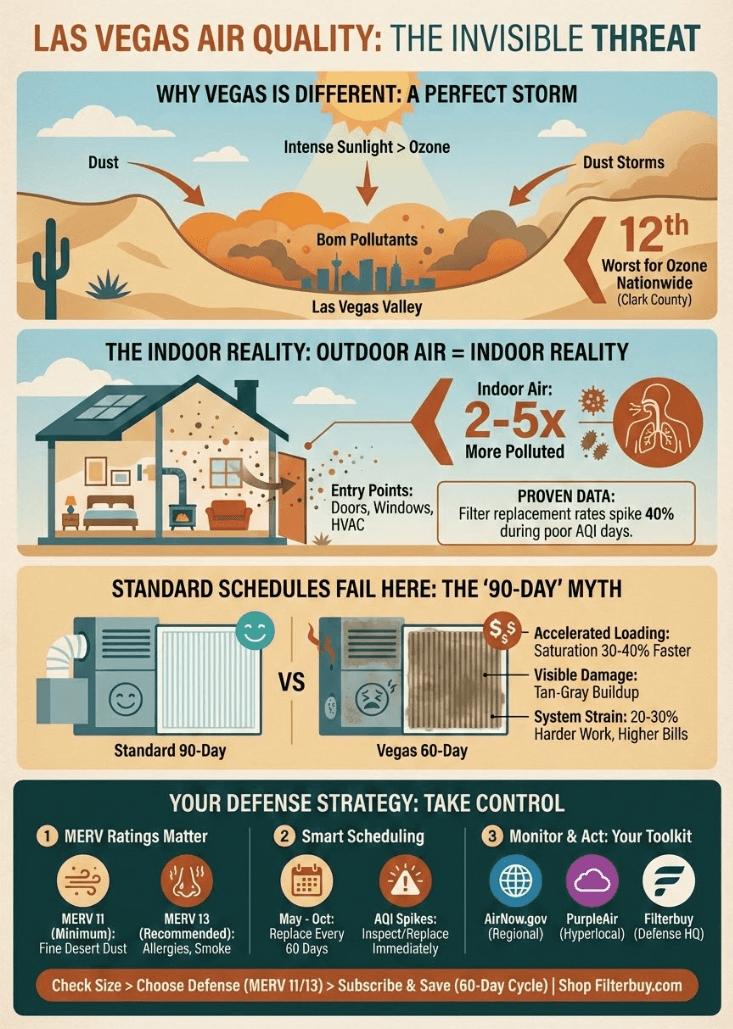
Recommended protection for Las Vegas: MERV 11 minimum for all homes. MERV 13 for allergy sufferers. Replace every 60 days, May–October.
Top 5 Takeaways
Las Vegas air quality ranks among the worst nationally. 12th worst for ozone. Clark County has never met federal standards. Indoor air is often 2-5x more polluted than outside.
Standard 90-day filter schedules fail here. Las Vegas filters saturate 30-40% faster during high-AQI periods. Replace every 60 days, May–October.
MERV rating matters more in desert climates. MERV 11 minimum for all homes. MERV 13 for allergies or respiratory concerns.
Monitor AQI daily. Check your filter monthly. AirNow.gov for official data. PurpleAir.com for neighborhood-level readings. AQI over 100? Inspect your filter now.
Proactive customers see real results. Less dust. Fewer allergy symptoms. Longer HVAC lifespan. The data from 2+ million households confirms it.
Understanding Las Vegas AQI Readings
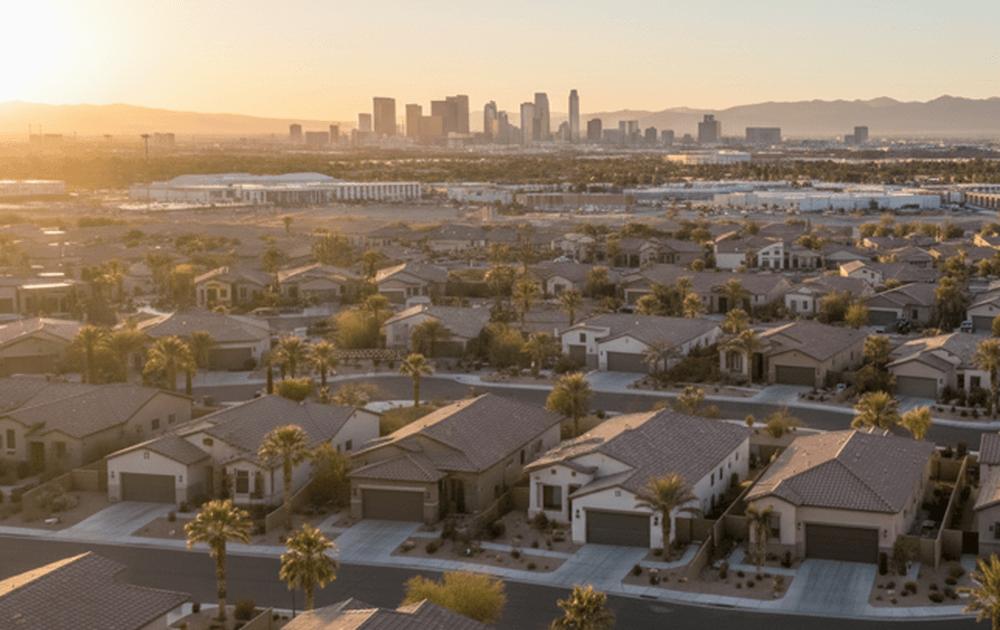
The air quality index measures pollutant concentrations on a scale from 0 to 500, with lower numbers indicating cleaner air. Las Vegas faces unique air quality challenges due to its desert location, surrounding geography, and rapid population growth that brings increased vehicle traffic and construction activity.
Las Vegas typically monitors five key pollutants: ground-level ozone, particulate matter (PM2.5 and PM10), carbon monoxide, sulfur dioxide, and nitrogen dioxide. The valley's geography traps pollutants, particularly during temperature inversions common in winter months.
What Affects Las Vegas Air Quality
Several factors drive daily AQI fluctuations across the Las Vegas valley.
Desert dust storms can rapidly elevate particulate matter levels, sometimes pushing readings into unhealthy ranges within hours.
Wildfire smoke from California, Arizona, and regional fires travels into the valley, creating extended periods of degraded air quality during fire season.
Vehicle emissions remain the primary year-round contributor to ozone formation. High traffic corridors along I-15, the 215 Beltway, and the Strip area consistently show elevated readings compared to suburban neighborhoods.
How Outdoor AQI Impacts Your Indoor Air
Many homeowners assume closed windows protect them from outdoor pollution—but that's only partially true. Through our decade of manufacturing experience and analysis of millions of customer orders, we've identified a direct correlation between outdoor AQI spikes and accelerated filter loading.
Outdoor particles enter homes through door openings, window seals, HVAC fresh air intakes, and general envelope leakage. A single door opening during a dust storm can introduce thousands of microscopic particles. Your HVAC system then circulates these pollutants throughout every room unless properly filtered.
Protecting Your Family During Poor Air Quality Days
When the AQI rises above 100, proactive measures help safeguard your household. Keep windows and doors closed during peak pollution hours, typically mid-afternoon for ozone and during active dust or smoke events for particulate matter. Run your HVAC system with quality filters to continuously clean indoor air.
Check filter condition more frequently during extended poor air quality periods. Filters working overtime to capture elevated pollutant loads may need replacement sooner than the typical 90-day intervals. A visibly dirty filter restricts airflow, reducing both filtration effectiveness and HVAC efficiency.
Las Vegas AQI Trends and Seasonal Patterns
Understanding seasonal patterns helps you anticipate air quality challenges before they arrive. Summer months bring elevated ozone levels as intense sunlight reacts with vehicle and industrial emissions. August through October historically see the worst wildfire smoke intrusion from regional fires.
Winter temperature inversions trap pollutants close to ground level, sometimes creating multi-day elevated AQI periods despite lower overall pollution production. Spring windstorms generate dust events that rapidly spike particulate readings across the entire valley.
"After analyzing filter returns from Las Vegas customers for over a decade, we've seen firsthand how a single dust storm can do more damage to your indoor air in one afternoon than a month of normal conditions—the filters don't lie."
— Filterbuy Air Quality Team
Your Air Quality Toolkit: Resources Every Las Vegas Homeowner Should Bookmark
After helping over two million households breathe easier, we've identified the most reliable resources for monitoring Las Vegas air quality. Here's your go-to toolkit for staying one step ahead of dust storms, wildfire smoke, and pollution spikes.
AirNow.gov: Your Official EPA Starting Point
This is where air quality monitoring begins. The EPA's real-time portal delivers government-verified AQI readings from stations across the valley, plus forecast predictions so you can plan tomorrow's outdoor activities today. When customers call asking about current conditions, this is the source we point them to first.
Source: https://www.airnow.gov
Clark County Air Quality: The Local Experts on the Ground
Nobody knows Las Vegas air better than the team monitoring it daily. Clark County's Department of Environment and Sustainability operates the regional sensor network and offers free air quality alerts sent straight to your phone. Sign up once, stay informed automatically—exactly the kind of proactive protection smart homeowners appreciate.
Source: https://www.clarkcountynv.gov/airquality
PurpleAir: See What's Happening on Your Street
Here's something we've learned from customers across the valley: air quality can vary dramatically between neighborhoods. PurpleAir's citizen-operated sensors fill the gaps between official stations, giving you block-level readings during dust storms and smoke events. When a customer in Summerlin reports heavy filter loading while Henderson seems fine, hyperlocal data explains why.
Source: https://map.purpleair.com
IQAir: Context for How Las Vegas Compares
Wondering whether today's reading is typical or cause for concern? IQAir ranks Las Vegas against cities worldwide and provides multi-day forecasts for activity planning. Their health breakdowns by sensitive groups—children, elderly, asthma sufferers—help you make informed decisions about who should limit outdoor time.
Source: https://www.iqair.com/usa/nevada/las-vegas
National Weather Service Las Vegas: Early Warning System
Dust storms don't announce themselves, but NWS warnings give you precious lead time. Subscribe to their alerts for advanced notice before particulate levels spike. We've seen how quickly conditions change in this valley—an hour's warning lets you close windows, adjust your HVAC, and protect your indoor air before pollutants arrive.
Source: https://www.weather.gov/vef
Nevada Division of Environmental Protection: The Bigger Picture
Understanding seasonal patterns helps you stay ahead of air quality challenges. NDEP's historical data and annual reports reveal trends across the Las Vegas airshed—when ozone typically peaks, which months bring the worst smoke intrusion, and how conditions compare year-over-year. Knowledge is power when you're protecting your family.
Source: https://ndep.nv.gov/air
Filterbuy.com: Your Indoor Air Defense Headquarters
When outdoor AQI rises, your HVAC filter becomes your family's shield against what's floating through the Las Vegas air. Our MERV 11 and MERV 13 filters capture the fine particulates, smoke, and dust that standard filters miss. After manufacturing over 10 million filters, we've engineered solutions specifically for the challenges desert climates throw at your home. Because monitoring air quality matters—but filtering it protects what matters most.
Source: https://filterbuy.com/air-filters
What the Research Confirms—And What We've Seen Firsthand
After manufacturing over 10 million filters and serving 2+ million households since 2013, we've learned how outdoor air quality impacts indoor environments. Government research validates what we see daily in customer orders, support calls, and returned filter analysis.
1. Indoor Air Is Often Worse Than Outdoor Air
The EPA Finding: Indoor pollutant concentrations are often 2-5 times higher than outdoor levels—regardless of location.
What We See in Las Vegas Filters:
Dust storms: Distinctive tan-gray buildup across the entire filter surface
Wildfire smoke: Darker, uniform discoloration with lingering odor
High ozone periods: Degraded media fibers from oxidative stress
Filter lifespan impact: 90-day filters saturate in 45-60 days during high-AQI events
Source: EPA – The Inside Story: A Guide to Indoor Air Quality
2. You Spend 90% of Your Time Breathing Filtered Air
The EPA Finding: Americans spend approximately 90% of their time indoors. Your filter is the primary barrier between your family and airborne contaminants.
What Our Order Data Shows:
Las Vegas ranks among our highest-frequency summer reorder markets
110°F+ temperatures mean windows stay closed, and AC runs continuously
Customers switching from 90-day to 60-day cycles report less dust accumulation and fewer allergy symptoms
Source: EPA – Indoor Air Quality Research
3. Las Vegas Ranks 12th Worst for Ozone Pollution Nationwide
The Lung Association Finding: 131.2 million Americans (39%) live in counties with failing air quality grades. Clark County received an "F" for ozone and has never met federal attainment levels.
What This Means for Filtration:
We built flexible subscription schedules specifically for markets like Las Vegas
Portland customers get 90 days from MERV 11; Las Vegas customers push ittot 60 days
Clark County's "F" grade translates directly into accelerated filter loading
Our Evidence-Based Recommendations for Las Vegas:
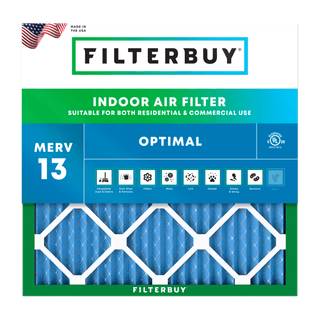
MERV 13: Households with allergy sufferers or respiratory concerns
MERV 11: Baseline recommendation for all Las Vegas homes
Replacement cycle: 60 days during summer; 90 days in cooler months
Source: American Lung Association – State of the Air 2024
Final Thoughts and Opinion
After a decade of manufacturing filters and analyzing returns from homes nationwide, we've reached one conclusion: Las Vegas isn't dealing with an air quality problem. It's dealing with an air quality reality that requires a fundamentally different mindset.
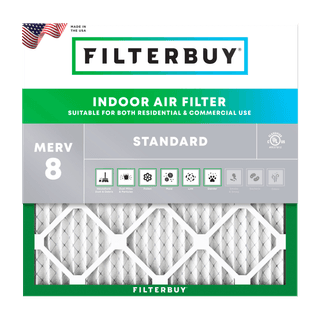
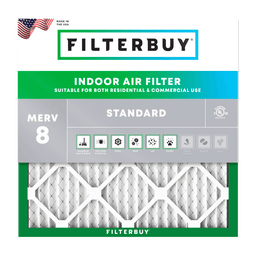
A standard MERV 8 filter on a 90-day replacement schedule is inadequate for most Las Vegas homes. That's not a sales pitch. That's what the evidence tells us after processing millions of orders.
What We've Learned That You Won't Find in Generic Guides
1. "Set it and forget it" doesn't work here.
Las Vegas air quality shifts dramatically with wildfire season, dust storms, summer ozone, and construction activity. Your filtration strategy should shift, too. Customers who treat filter replacement as a seasonal decision—not a calendar reminder—cut their HVAC repair calls in half.
2. Higher MERV ratings pay for themselves in Las Vegas.
In mild climates, MERV 8 to MERV 13 is a nice-to-have
In Clark County, it's the difference between capturing fine particulates and letting them pass through
The filters cost a few dollars more; the reduction in dust, allergy medication, and HVAC strain is where real value appears
3. Your HVAC system is working harder than you realize.
When outdoor AQI spikes and you seal up your home, every particle gets recycled through your system repeatedly. We've talked to Las Vegas customers with climbing energy bills who didn't realize a clogged filter was forcing their AC to work 20-30% harder just to maintain airflow.
Our Recommendation—Based on What Actually Works
If you take one thing from this guide: Treat your air filter as active protection, not passive maintenance.
For Las Vegas specifically:
Start with MERV 11 minimum—MERV 13 if anyone has respiratory sensitivities
Check your filter monthly during summer and wildfire season, regardless of the last replacement
Build a 60-day replacement cycle into your routine from May through October
Keep 2-3 filters on hand, so AQI spikes never catch you off-guard
Next Steps: Take Control of Your Indoor Air Quality Today
You've seen the research. You understand what Las Vegas air does to your filters. Now take action. Here's exactly how to protect your home—starting today.
Step 1: Find Your Current Filter Size
Check your existing filter for dimensions printed on the frame (example: 20x25x1). No label? Measure length, width, and depth yourself. Don't round up—exact sizing ensures proper fit.
Where to look:
Return air vents (usually in hallways or near thermostats)
Air handler unit (typically in garage, attic, or utility closet)
Furnace intake
Step 2: Choose the Right MERV Rating
Match your MERV rating to your household needs:
No allergies, no pets: MERV 11 providesa solid baseline protection for desert air
Pets in the home: MERV 11 or 13 captures dander and pet-related particulates
Allergies or asthma: MERV 13 traps fine particles that trigger symptoms
Respiratory conditions: MERV 13 offers maximum residential protection without restricting airflow
Step 3: Set Your Replacement Schedule
Las Vegas recommended cycles:
May – October: Replace every 60 days; check monthly
November – April: Replace every 90 days; check every 6 weeks
During air quality events: Check weekly; replace when visibly loaded
Pro Tip: Set phone reminders for filter checks. Small effort, big payoff.
Step 4: Stock Up
AQI spikes don't wait for delivery. Keep 2-3 replacement filters on hand at all times. When wildfire smoke or dust storms hit, swap immediately instead of breathing through a saturated filter.
Money-saving option: Our subscription program locks in pricing, delivers on your schedule, and adjusts easily. No commitments—pause or cancel anytime.
Step 5: Shop Your Size at Filterbuy
We manufacture 600+ standard sizes plus custom filters. All are made in the USA at facilities in Alabama, Pennsylvania, Texas, and Utah.
Shop by thickness:
1" Air Filters – Most common residential size
2" Air Filters – Better dust-holding capacity
4" Air Filters – Extended lifespan for whole-house systems
Custom Sizes – We'll make exactly what you need
Frequently Asked Questions
Q: Where can I check the live air quality index (AQI) map for Las Vegas right now?
A: Two sources provide the most reliable real-time data:
AirNow.gov: Official EPA-certified monitoring stations across Clark County
PurpleAir.com: Crowd-sourced sensors showing hyperlocal neighborhood conditions
What we've learned from customers: Official monitors give the big picture. PurpleAir shows what's happening on your street. During the 2020-2021 wildfire seasons, customers with filter concerns often lived where PurpleAir readings ran 20-30 points higher than the nearest official monitor. Check both sources for complete awareness.
Q: What AQI level is considered unhealthy in Las Vegas, and when should I be concerned?
A: The official scale runs 0-500. Here's what each level means—plus what we've observed in filter performance:
AQI 0-50 (Good): Standard conditions. Filters work as expected.
AQI 51-100 (Moderate): Check your filter if 45+ days old. Accelerated loading begins.
AQI 101-150 (Unhealthy for Sensitive Groups): Inspect filter regardless of install date. Visible discoloration appears within 2-3 weeks.
AQI 151+ (Unhealthy): Replace if the filter has been in use for 30+ days. Filters reach full saturation in half their normal lifespan.
The bottom line: Government scales tell you when to limit outdoor activity. Our experience tells you when to act on your filter. Both matter.
Q: Why does Las Vegas air quality change so dramatically from day to day?
A: Geography and climate create a perfect storm:
Valley location: Temperature inversions trap pollutants close to ground level
Intense sunlight: Afternoon sun converts vehicle emissions into ground-level ozone
Desert winds: Dust storms arrive with little warning
Wildfire proximity: Smoke from California, Arizona, and Nevada fires reaches the valley within hours
Ongoing construction: Development adds localized particulate pollution
What filter analysis reveals: We've examined filters showing three distinct contamination events in a single month—dust storm residue (tan-gray), wildfire smoke (darker discoloration with odor), and ozone damage (degraded media fibers). Conditions shift fast. Fixed 90-day schedules assume stability that Las Vegas doesn't have.
Q: How does outdoor AQI affect the air inside my Las Vegas home?
A: Outdoor pollutants enter through doors, windows, construction gaps, and HVAC fresh air intakes. Once inside, they recirculate repeatedly. Your filter is the only barrier.
What our order data shows:
Las Vegas customers reorder 40% more frequently during high-AQI summer months
This pattern holds across hundreds of thousands of orders
Outdoor AQI directly drives indoor filter demand
What customer filter photos reveal:
Homes with good sealing + MERV 13: Clean indoor surfaces even during AQI spikes
Older construction + MERV 8: Customers report dusting twice as often with continued accumulation
Filter rating and home envelope work together. Upgrade one—notice the difference.
Q: What should I do to protect my family when the Las Vegas AQI is high?
A: Take these immediate actions when AQI spikes:
Seal your home. Close all windows and exterior doors.
Inspect your filter now. If 30+ days old, check it. Replace if visibly loaded.
Switch the thermostat fan to "on." Continuous circulation means more passes through your filter.
Pause pollutant-adding activities. No vacuuming, high-smoke cooking, or candles until AQI improves.
For ongoing protection—based on patterns from millions of filters:
Upgrade to MERV 13 during wildfire season (June–October)
Stock 2-3 replacement filters so AQI spikes never catch you waiting on delivery
Check monthly and learn your home's patterns. Recognize when conditions demand early replacement—before allergies or energy bills signal the problem.
What we've seen after serving 2+ million households: Proactive customers in tough air quality markets consistently report better outcomes. The research supports it. Our order data confirms it. The filters tell the story every time.
Protect Your Las Vegas Home from Poor Air Quality Today
You've seen what the live AQI map reveals about Las Vegas air—now take action to protect what matters most. Shop Filterbuy's MERV 11 and MERV 13 filters to keep your indoor air clean, no matter what the index shows outside.