

2 Ton Mini Split: Sizing, Cost & What to Know Before You Buy (2026 Guide)
By Michelle Wan · Air Quality & Home Comfort Writer, Filterbuy
Reviewed by David Clark, HVAC Specialist, Filterbuy HVAC
Published: June 23, 2026 · Last updated: June 23, 2026
Is a 2 Ton Mini Split Right for Your Home?
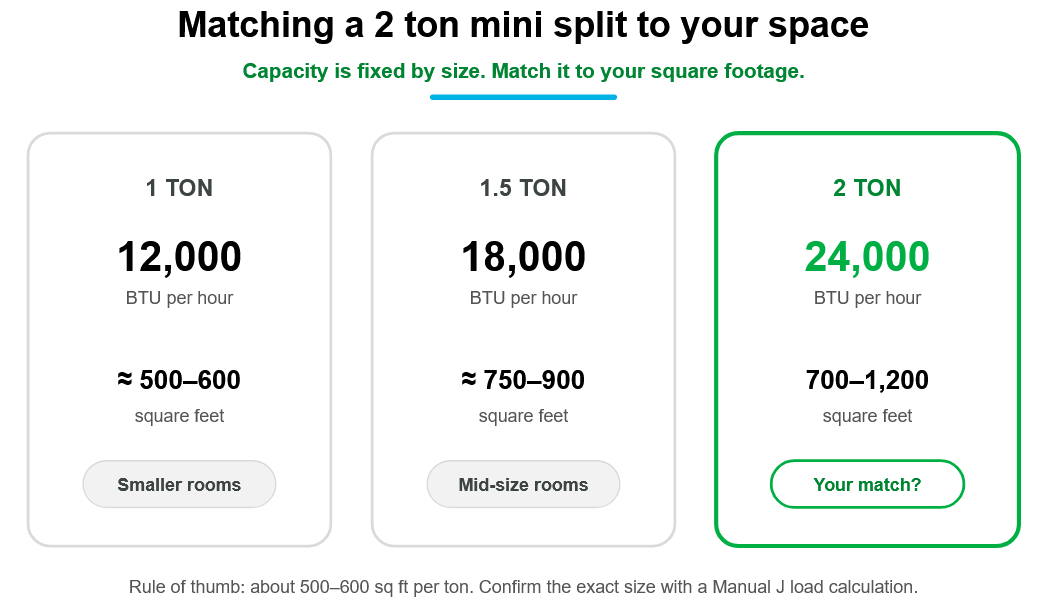
A 2 ton mini split delivers 24,000 BTU and is the right fit for roughly 700–1,200 square feet — think a great room, master suite, finished basement, or open first floor. It connects one outdoor unit to one or more indoor heads, runs on a dedicated 230V circuit, and holds a steady temperature without the on/off cycling of older systems.
Square footage is the starting point, not the final word. Ceiling height, insulation, sun exposure, and climate can move the real number up or down:
Under ~600 sq ft → a 1 ton or 1.5 ton unit fits better and runs more efficiently.
Several separate rooms → choose a multi-zone system (one outdoor unit, multiple heads).
700–1,200 sq ft of open space → a 2 ton mini split is your match.
Not sure it’s your size? Take the quick match quiz below.
Answer 5 quick questions and we’ll match you to the right mini split system.
Takes about 30 seconds — no email required to see your result.
Prefer to browse first? Shop mini split systems →
The Short Version
A 2 ton mini split delivers 24,000 BTU of heating and cooling and is sized for medium-to-large open spaces, roughly 700 to 1,200 square feet in most homes. It connects one outdoor unit to one or more indoor air handlers, runs on a dedicated 230V circuit, and uses inverter technology to hold a steady temperature without the on/off cycling of older systems. It's the "sweet spot" size for a great room, master suite, finished basement, or open first floor.
If that sounds like your space, the rest of this guide walks you through exactly how to confirm the size, what you'll pay in 2026, and the one refrigerant change worth knowing before you buy. We've built and shipped air-quality products to millions of U.S. homes, so we'll keep this practical. No jargon for the sake of jargon.
What Is a 2 Ton Mini Split?
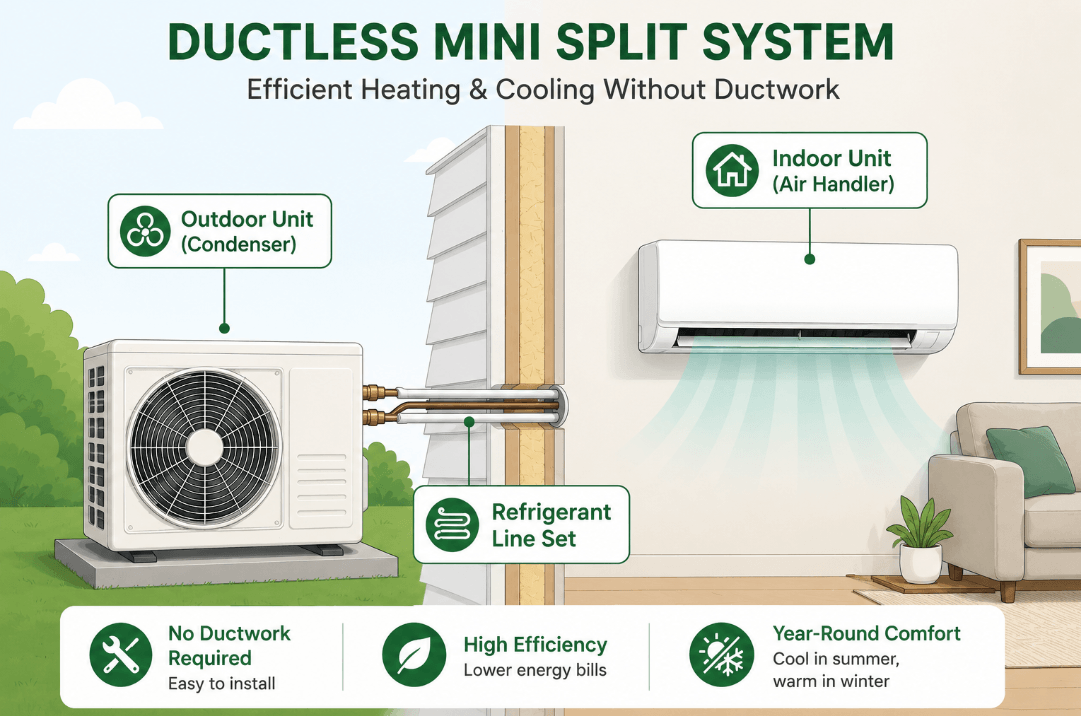
A 2 ton mini split is a ductless heating and cooling system rated at 24,000 BTU per hour. In HVAC, "tonnage" measures cooling capacity, not weight: one ton equals 12,000 BTU, so a 2 ton mini split equals 24,000 BTU. It pairs an outdoor condenser with one or more indoor air handlers connected by a small refrigerant line set, with no ductwork required.
Most 2 ton mini split systems are heat pumps, meaning the same unit cools in summer and heats in winter by reversing the flow of refrigerant. You'll see them sold a few different ways, and the names are mostly interchangeable:
2 ton mini split AC / 2 ton mini split air conditioner: emphasizes cooling
2 ton mini split heat pump: emphasizes year-round heating + cooling
2 ton ductless mini split: emphasizes the no-ductwork design
2 ton mini split system: the complete package (outdoor + indoor units + line set)
The capacity is the same in every case: 24,000 BTU. What changes is the configuration: single-zone (one indoor head) or multi-zone (two or more heads splitting the 24,000 BTU across rooms).
What Square Footage Does a 2 Ton Mini Split Cool?
A 2 ton mini split is generally sized for 700 to 1,200 square feet, based on the common rule of roughly 500–600 square feet per ton of cooling. But square footage alone is a starting point, not the answer. Ceiling height, insulation, sun exposure, climate, and how many people use the room can move the real number up or down by hundreds of square feet. The single most common 2 ton scenario is a 1,000 sq ft space, which we break down in detail in our guide to the best mini split for 1,000 sq ft. For an exact number, ENERGY STAR recommends your contractor run a Manual J load calculation rather than relying on any rule of thumb.
The honest version of "2 ton mini split square footage" is a quick reality check most product pages skip:
The 2 Ton Sizing Reality Check
Start with your room's floor area, then adjust:
Figures reflect 2026 national averages synthesized from Carrier, HomeGuide, Angi, and contractor pricing data. Filterbuy's own installation data puts a straightforward single-zone 24,000 BTU job around $2,300–$5,500. Your local cost may run 15–30% higher or lower.
What moves the price most:
Indoor unit style. Wall-mounted is cheapest. Ceiling cassettes, floor consoles, and concealed-duct units add labor and materials.
SEER2 and brand. Premium, high-efficiency 2 ton mini split inverter systems cost more up front but lower monthly bills.
Install complexity. Long line runs, second-floor mounts, and panel upgrades add labor.
IMPORTANT · 2026 UPDATE
Tax-credit update for 2026. The federal Section 25C Energy Efficient Home Improvement Credit, which covered 30% of a qualifying heat pump's cost (up to $2,000), expired December 31, 2025 under Public Law 119-21 (the One Big Beautiful Bill Act). A 2 ton mini split installed in 2026 no longer qualifies for the federal credit. If your system was installed and placed in service by December 31, 2025, you can still claim it on your 2025 return (IRS Form 5695). Many state and utility rebates remain available in 2026, so check the DSIRE database and your local utility, and confirm specifics with a tax professional.
For a deeper, line-by-line breakdown across every size and zone count, see Filterbuy's full guide on mini split installation cost.
2 Ton Mini Split SEER2, Inverter Tech & Efficiency
Most 2 ton mini split inverter systems in 2026 carry a SEER2 rating between 16 and 26, and high-efficiency single-zone models can exceed 30. SEER2 (Seasonal Energy Efficiency Ratio 2) is the cooling efficiency standard the U.S. Department of Energy updated in 2023 to better reflect real-world conditions, similar to miles-per-gallon for your AC. Higher SEER2 means lower summer energy bills.
A few numbers worth knowing:
2026 federal minimum (split heat pumps): about SEER2 14.3 for cooling and HSPF2 7.5 for heating. Most quality mini splits comfortably beat this.
Typical 2026 SEER2 tiers: entry 16–20, mainstream 20–26, premium 26–30+.
HSPF2 measures heating efficiency, which matters if you'll lean on your 2 ton mini split heat pump through winter.
The reason mini splits hit such high efficiency is inverter technology. Instead of slamming the compressor fully on and off like older systems, an inverter compressor modulates, speeding up and slowing down to match the exact moment's demand. The payoff: steadier temperatures, quieter operation (often under 70 dB, quieter than normal conversation), and less wear over a 15–20 year lifespan.
Bumping up a tier or two in efficiency usually adds a few hundred dollars up front. In climates where the system runs 8–10 months a year, that premium often pays for itself in a handful of years through lower bills.
What to Look for When Choosing a 2 Ton Mini Split
When comparing 2 ton mini split systems, weigh seven things: SEER2/HSPF2 efficiency, refrigerant type, indoor unit style, cold-climate performance, noise level, warranty terms, and the installer behind it. The capacity is fixed at 24,000 BTU, so the differences between models live in efficiency, build quality, and support, not raw cooling power. For brand-by-brand specifics at this size, see our best mini split brands guide.
Use this as a buyer's checklist:
Rule of thumb: if your adjusted load lands near or above 24,000 BTU, a 2 ton mini split is your match. If it's well under ~18,000 BTU, a 1.5 ton unit will likely run more efficiently. An oversized mini split short-cycles, cools unevenly, and never fully dehumidifies.
FILTERBUY HVAC · REVIEWER NOTE
Reviewer note (David Clark, Filterbuy HVAC): "A load calculation, a Manual J, beats any rule of thumb. The chart above gets homeowners in the right ballpark, but I'd never let a contractor skip the actual calc on a $5,000 install."
When a 2 Ton Mini Split Is the Wrong Choice
A 2 ton mini split is the wrong call when your space is too small, too chopped-up, or already served by ducts. Bigger isn't better with mini splits, since an oversized system cycles on and off too fast, leaves humidity behind, and wears out sooner. Consider another option in these cases:
One small-to-medium room (under ~600 sq ft): A 1 ton (12,000 BTU) or 1.5 ton (18,000 BTU) unit fits better and runs more efficiently.
Several separate rooms: A single 2 ton head can't push air around walls. You want a multi-zone system (one outdoor unit, multiple indoor heads) instead.
A home that already has good ductwork: Replacing a working central system with mini splits is often more expensive than it's worth (we lay out the trade-offs in mini split vs. central air). Mini splits shine in additions, garages, basements, and ductless homes.
Whole-home cooling above ~1,500 sq ft of separated space: You'll likely need more total capacity and multiple zones.
We'd rather tell you a 2 ton system is too much than sell you one you'll regret. Right-sizing is the single biggest factor in whether you're happy with the system five years from now.
How Much Does a 2 Ton Mini Split Cost in 2026?
In 2026, a 2 ton mini split costs about $1,500–$4,000 for the equipment alone, and roughly $2,500–$6,500 fully installed for a single-zone system. Multi-zone configurations, premium efficiency, and harder installs push the top of that range higher. Price depends on efficiency (SEER2), brand, indoor unit style, and how complex your install is.
Here's a realistic 2 ton mini split price breakdown for a standard single-zone, wall-mounted installation:
Figures reflect 2026 national averages synthesized from Carrier, HomeGuide, Angi, and contractor pricing data. Filterbuy's own installation data puts a straightforward single-zone 24,000 BTU job around $2,300–$5,500. Your local cost may run 15–30% higher or lower.
What moves the price most:
Indoor unit style. Wall-mounted is cheapest. Ceiling cassettes, floor consoles, and concealed-duct units add labor and materials.
SEER2 and brand. Premium, high-efficiency 2 ton mini split inverter systems cost more up front but lower monthly bills.
Install complexity. Long line runs, second-floor mounts, and panel upgrades add labor.
IMPORTANT · 2026 UPDATE
Tax-credit update for 2026. The federal Section 25C Energy Efficient Home Improvement Credit, which covered 30% of a qualifying heat pump's cost (up to $2,000), expired December 31, 2025 under Public Law 119-21 (the One Big Beautiful Bill Act). A 2 ton mini split installed in 2026 no longer qualifies for the federal credit. If your system was installed and placed in service by December 31, 2025, you can still claim it on your 2025 return (IRS Form 5695). Many state and utility rebates remain available in 2026, so check the DSIRE database and your local utility, and confirm specifics with a tax professional.
For a deeper, line-by-line breakdown across every size and zone count, see Filterbuy's full guide on mini split installation cost.
2 Ton Mini Split SEER2, Inverter Tech & Efficiency
Most 2 ton mini split inverter systems in 2026 carry a SEER2 rating between 16 and 26, and high-efficiency single-zone models can exceed 30. SEER2 (Seasonal Energy Efficiency Ratio 2) is the cooling efficiency standard the U.S. Department of Energy updated in 2023 to better reflect real-world conditions, similar to miles-per-gallon for your AC. Higher SEER2 means lower summer energy bills.
A few numbers worth knowing:
2026 federal minimum (split heat pumps): about SEER2 14.3 for cooling and HSPF2 7.5 for heating. Most quality mini splits comfortably beat this.
Typical 2026 SEER2 tiers: entry 16–20, mainstream 20–26, premium 26–30+.
HSPF2 measures heating efficiency, which matters if you'll lean on your 2 ton mini split heat pump through winter.
The reason mini splits hit such high efficiency is inverter technology. Instead of slamming the compressor fully on and off like older systems, an inverter compressor modulates, speeding up and slowing down to match the exact moment's demand. The payoff: steadier temperatures, quieter operation (often under 70 dB, quieter than normal conversation), and less wear over a 15–20 year lifespan.
Bumping up a tier or two in efficiency usually adds a few hundred dollars up front. In climates where the system runs 8–10 months a year, that premium often pays for itself in a handful of years through lower bills.
What to Look for When Choosing a 2 Ton Mini Split
When comparing 2 ton mini split systems, weigh seven things: SEER2/HSPF2 efficiency, refrigerant type, indoor unit style, cold-climate performance, noise level, warranty terms, and the installer behind it. The capacity is fixed at 24,000 BTU, so the differences between models live in efficiency, build quality, and support, not raw cooling power. For brand-by-brand specifics at this size, see our best mini split brands guide.
Use this as a buyer's checklist:
The 2026 Refrigerant Change Every 2 Ton Buyer Should Know
As of 2026, new 2 ton mini splits use low-GWP A2L refrigerants, primarily R-32 or R-454B, in place of the older R-410A that's being phased out. This is the single most important "gotcha" for buyers right now, and most product listings barely mention it.
What it means for you:
Don't get stuck with old stock you can't service long-term. R-410A is being phased down under the EPA's AIM Act technology-transition rules, which can affect future refrigerant availability and cost. Closeout deals on R-410A systems can be tempting, so go in with eyes open.
A2L refrigerants are mildly flammable, so they carry updated safety protocols around charge limits, placement, and installer handling. This is a real reason to use a licensed installer rather than a DIY kit.
Efficiency is comparable or better, and the environmental footprint is lower, since R-32 and R-454B have a much lower global-warming potential than R-410A.
If you're comparing two otherwise-similar units, ask which refrigerant each uses. It's a fair question, and a good installer will answer it without hesitation.
Electrical and Installation Requirements
Most 2 ton mini split systems require a dedicated 230V circuit (commonly 20–30 amp), and professional installation is strongly recommended. A 2 ton mini split 230V hookup involves more than plugging in. It requires proper refrigerant line connections, evacuation and pressure testing, and code-compliant electrical work.
Before install day, confirm:
Electrical capacity. A 2 ton mini split 230V system needs its own dedicated breaker. If your panel is full, you may need a sub-panel, so budget for an electrician.
Permits. Most areas require mechanical and electrical permits. A reputable installer handles this paperwork.
Placement. The outdoor unit needs ventilation and clearance, ideally out of direct, relentless sun.
Warranty terms. Many manufacturers require licensed installation for full warranty coverage. DIY can void it.
DIY pre-charged kits exist and can save $1,000–$2,000, but weigh that against the safety, code, warranty, and A2L-handling considerations above. For most homeowners, a licensed pro is the safer math.
Keeping Your 2 Ton Mini Split Running Clean
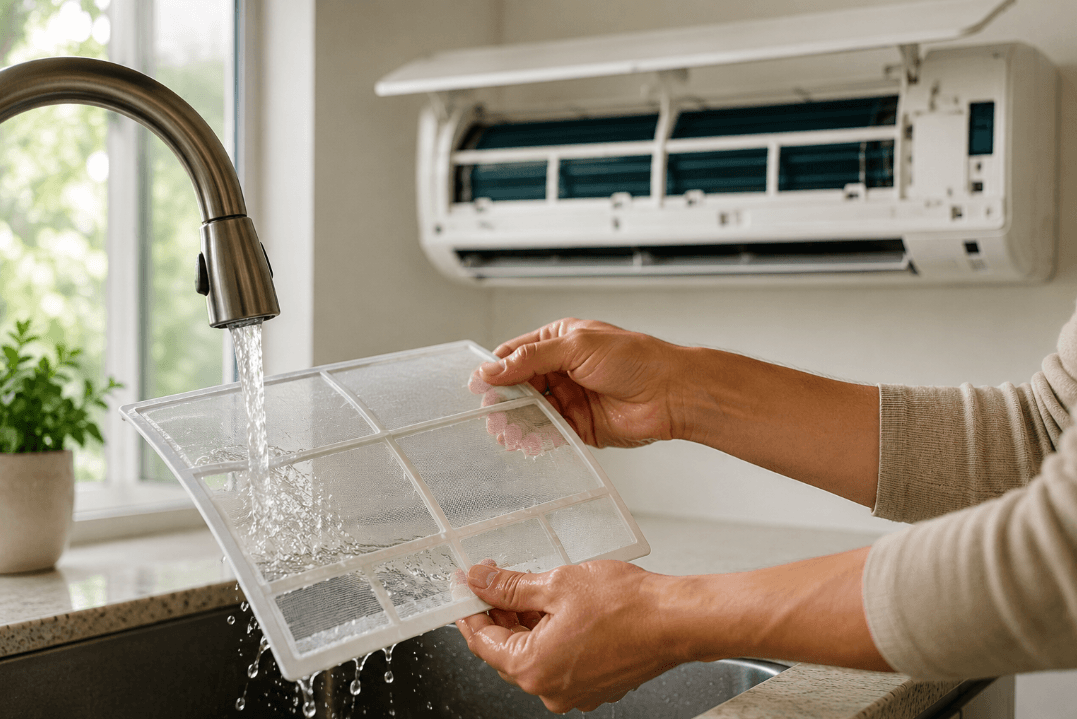
A 2 ton mini split is low-maintenance, not no-maintenance, and clean filters are the difference between fresh, efficient air and a struggling system. Unlike central HVAC, the indoor air handler has reusable mesh filters you rinse, not replace. Most need a gentle cleaning every two to four weeks during heavy use.
A quick maintenance rhythm:
Every 2–4 weeks (in season): Pop out the front-panel filters, rinse with water, let them dry fully, reinstall. A clogged filter chokes airflow and drives up your bill.
Seasonally: Wipe down the indoor unit, clear leaves and debris from around the outdoor condenser, and check the drain line.
Annually: Have a pro inspect refrigerant charge, coils, and electrical connections.
This is where mini splits and whole-home air quality meet: the mesh filter in a mini split traps lint and dust, but it isn't a high-MERV media filter. The EPA recommends a MERV 13 filter (or as high as your system allows) for the fine particles that matter most to health. If anyone in your home deals with allergies, pets, or wildfire-season smoke, the rest of your home's air still matters. If you also run central HVAC, keeping a fresh, properly MERV-rated filter in that system is the easiest win for cleaner indoor air, and it's exactly what we help homeowners do every day.
Frequently Asked Questions
How many square feet does a 2 ton mini split cover?
A 2 ton mini split (24,000 BTU) typically covers 700–1,200 square feet, based on roughly 500–600 sq ft per ton. Ceiling height, insulation, sun exposure, and climate can shift the real number, so a Manual J load calculation is the most accurate way to confirm.
How many BTU is a 2 ton mini split?
Exactly 24,000 BTU per hour. One ton of cooling equals 12,000 BTU, so 2 tons = 24,000 BTU.
How much does a 2 ton mini split cost installed?
In 2026, expect about $2,500–$6,500 fully installed for a single-zone system, with equipment alone running $1,500–$4,000. Multi-zone setups, premium efficiency, and complex installs cost more.
Does a 2 ton mini split need 220V or 230V?
Most 2 ton mini split systems run on a dedicated 230V circuit (the "220V/230V/240V" range refers to the same standard service), typically on a 20–30 amp breaker. Confirm your panel has capacity before install.
Is a 2 ton mini split a heat pump?
Most are. A 2 ton mini split heat pump both heats and cools by reversing refrigerant flow, which is why a single unit can replace separate heating and cooling equipment in many spaces.
What SEER2 should I look for in a 2 ton mini split?
The 2026 federal minimum for split heat pumps is around SEER2 14.3, but most quality 2 ton mini split systems land between 16 and 26 SEER2, with premium models exceeding 30. Higher SEER2 means lower energy bills.
Can I install a 2 ton mini split myself?
DIY pre-charged kits exist, but professional installation is strongly recommended, especially with 2026's mildly flammable A2L refrigerants (R-32/R-454B), permit requirements, and warranty terms that often require a licensed installer.
Is there a federal tax credit for a 2 ton mini split in 2026?
No. The federal Section 25C credit for qualifying heat pumps expired December 31, 2025 under Public Law 119-21, so a 2 ton mini split installed in 2026 doesn't qualify. Systems installed by that date can still be claimed on a 2025 return. State and utility rebates may still apply, so check the DSIRE database and your utility.
Ready to Keep Your Home's Air Comfortable and Clean?
A right-sized 2 ton mini split handles the temperature. Keeping the air itself clean, across your whole home, is where we come in. Explore Filterbuy's HVAC and home comfort guides to plan your system, and if you run central HVAC alongside it, find your exact filter size and set up auto-delivery so a fresh filter shows up right when it's time. Clean air, without the hassle.
About the Author
Michelle Wan writes about indoor air quality and home comfort for Filterbuy, translating technical HVAC topics into plain, practical guidance for everyday homeowners. See more from Michelle →
Reviewed by David Clark, HVAC Specialist at Filterbuy HVAC, who checked this guide for technical accuracy on sizing, efficiency standards, and 2026 refrigerant requirements.
Sources
U.S. Department of Energy: Ductless Mini-Split Heat Pumps (sizing, SEER2 ranges, efficiency)
ENERGY STAR: Ductless Heating & Cooling (certification, Manual J sizing, energy savings)
IRS: Energy Efficient Home Improvement Credit (Section 25C) (tax-credit eligibility and 2025 expiration)
EPA: Regulatory Actions for Technology Transitions (AIM Act) (R-410A to A2L refrigerant transition)
EPA: What Is a MERV Rating? (residential filtration guidance)
AHRI Directory of Certified Product Performance (matched-system certification)
DSIRE: Database of State Incentives for Renewables & Efficiency (state and utility rebates)
Industry installed-cost data: Carrier, HomeGuide, Angi (2026)