
Vancouver Real-Time AQI Tracker


Get Alerts For Unhealthy AQI In Your Area
When air quality in your area reaches unhealthy levels, we'll send you a quick alert, along with expert tips on how to reduce your exposure.
What's Actually In Vancouver Air Today?
What High AQI Means for Your Lungs in Vancouver
How to Read AQI
The Air Quality Index (AQI) measures how polluted the air is and how it may affect your health.
0–50 (Good): Air quality is satisfactory.
51–100 (Moderate): Acceptable, but some pollutants may pose minor concerns.
101–150 (Unhealthy for Sensitive Groups)
151–200 (Unhealthy)
201–300 (Very Unhealthy)
301+ (Hazardous)
Moderate
Still okay for most, but if you have asthma or allergies, take it easy and avoid long outdoor workouts.
Shop MERV 11 filters→What's the Right Filter for Your AQI Level?
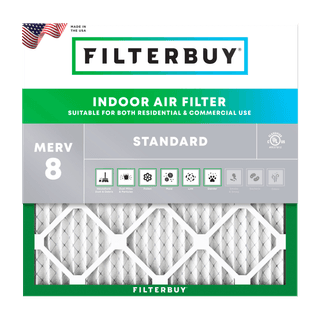
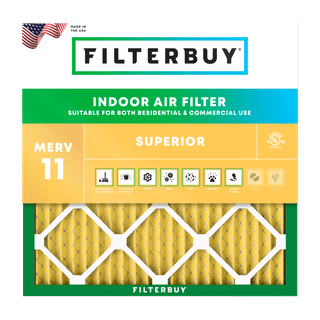
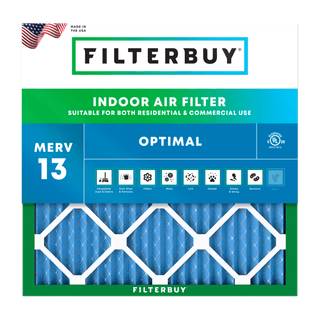

Check Today's Live Real Time Air Quality Index AQI Map in Vancouver, WA Now
By Michelle Wan, Brand Manager and Air Quality Writer at Filterbuy. Reviewed by David Clark, Licensed HVAC Technician. Updated August 4, 2026.
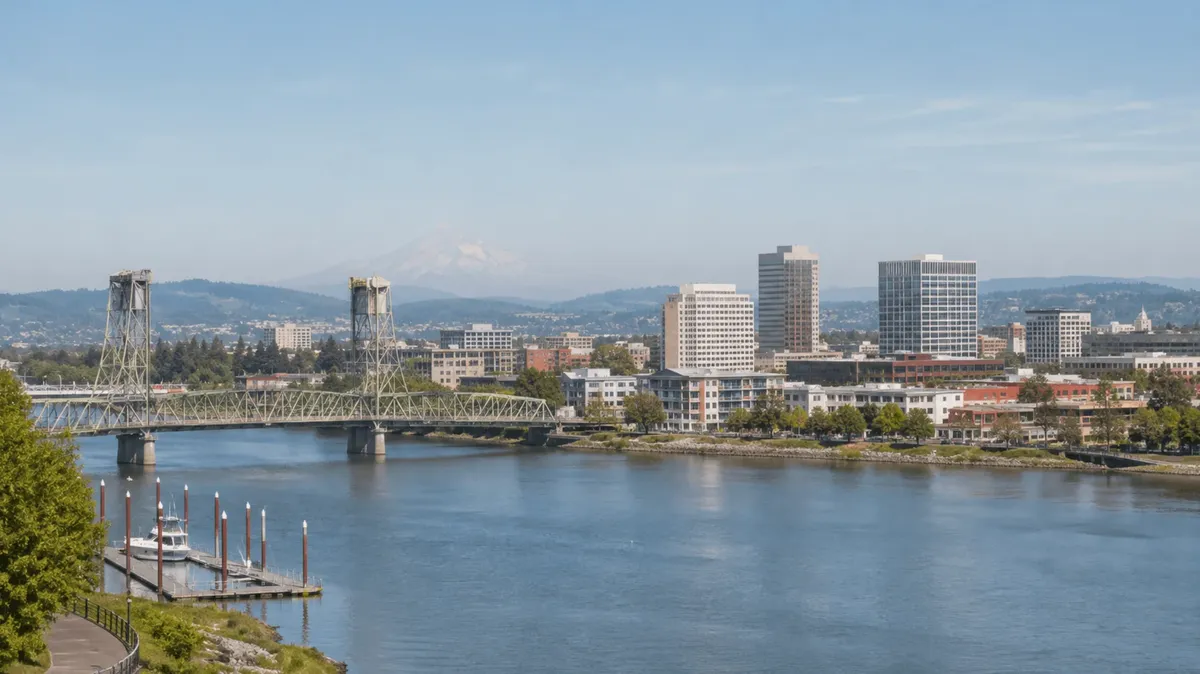
Filterbuy’s live map above reads Vancouver’s air hour by hour, so you know what you are breathing before the sky shows it. This page covers Vancouver, Washington, in Clark County, not Vancouver, BC.
TL;DR Quick Answers
Vancouver’s real-time AQI appears on the live map above, pulled hourly from EPA AirNow and Washington Ecology stations including Vancouver NE 84th Avenue. Most days run Good (0 to 50) or Moderate (51 to 100). During wildfire smoke and winter inversions, readings reach Unhealthy (151+) within hours.
AQI categories follow the U.S. EPA Air Quality Index scale. Check the live map above for the current Vancouver, WA reading.
Top Takeaways
Clark County is the metro’s worst county for short-term particle pollution, per the American Lung Association’s 2026 State of the Air. Portland’s reading is no substitute for your own.
Ozone is Vancouver’s weakest grade, a D, and no air filter removes ozone. Particle levels pass the federal annual standard, so the bad days are sharp and short.
A Filterbuy MERV 11 covers the everyday load. MERV 13 is the smoke upgrade, if your system is rated for the added resistance.
How to Read Today’s Vancouver, WA Air Quality Map
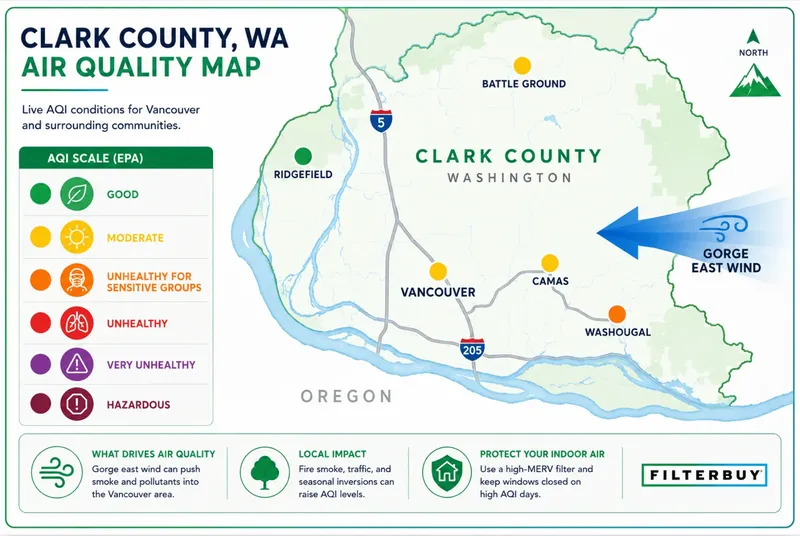
Check the monitor nearest you, not the citywide average. The Columbia River Gorge funnels smoke west into Clark County on east-wind days, and I-5 and I-205 push traffic exhaust through the metro, so two monitors ten miles apart can disagree. Anyone with asthma, COPD, or heart disease should check daily, as should young children and adults over 65.
The question I get most is why the number looks fine when the air already smells like smoke. The AQI is an outdoor average across a monitor’s reporting area. It was never built to describe the room you are standing in. I read it as an early warning, not a verdict.
Michelle Wan, Brand Manager and Air Quality Writer, Filterbuy
Why Two Washington Maps Show Different Colors for the Same Air
The same air can read one category worse on the state map, because Washington runs a second scale. Ecology reports WAQA, the Washington Air Quality Advisory; AirNow and PurpleAir report the federal AQI. WAQA sets lower PM2.5 thresholds above Moderate: at 50 micrograms per cubic meter, the federal AQI reads Unhealthy for Sensitive Groups while WAQA reads Unhealthy. State toxicology research found PM2.5 warrants more protection than the federal scale allows. The two never differ by more than one category, so when they disagree, act on the worse one.
Why the Number Can Lag What Your Nose Already Knows
AirNow publishes NowCast, a weighted average of the last 3 to 12 hours rather than the raw reading, so during a fast Gorge smoke push the map trails the air you are breathing. If it smells like smoke and the number looks fine, close the windows and recheck in an hour.
Check once each morning normally, every two to four hours during wildfire season with fires within 200 miles, and twice daily in winter cold snaps.
Sources: Washington Smoke Information; Ecology.
What Drives Poor Air Quality in Vancouver, WA
Three pollutants rotate by season, each needing a different response.
Windows overlap. Late summer can carry ozone and wildfire smoke on the same day.
SWCAA calls burn bans for the winter pattern, noting that wood smoke carries some of the same carcinogens as cigarette smoke. Inversions trap it at ground level. Ozone days produce no visible haze: on July 22, 2026, SWCAA issued a Clark County advisory driven by heat and stagnant air. Smoke is the extreme end, and in September 2020 Ecology monitors put Vancouver’s AQI at 342.
How Vancouver’s Air Quality Actually Grades Out
The American Lung Association grades Vancouver through Clark County. Here is the 2026 report card.
Source: American Lung Association, "State of the Air" 2026, Portland-Vancouver-Salem OR-WA metro report. Grades reflect 2022–2024 monitoring data.
What to Do Outside on High-AQI Days
Above AQI 100, shorten outdoor time and move hard exercise indoors or to the morning. Choose routes away from I-5 and I-205, where traffic PM2.5 stacks on whatever else is in the air. Cap kids’ play above 100, and bring them in above 150. The local stakes are documented: during the 2017 Eagle Creek Fire, Clark and Multnomah counties logged over 160 asthma-related emergency visits in one day, double baseline.
Protecting Indoor Air in Your Vancouver Home
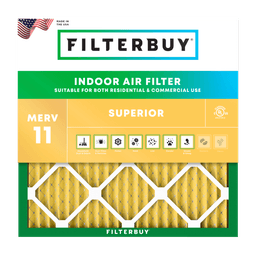
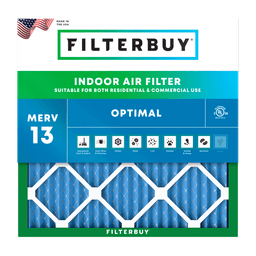
Indoor air is where you have control. Set your HVAC to recirculate, close the fresh-air damper, and seal off one room as a cleaner space with a portable air cleaner running. Most Vancouver homes run well on MERV 11 year-round, with MERV 13 during smoke events if the system supports it.
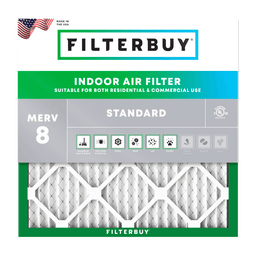
That caveat has a number behind it. Filterbuy’s lab testing across two million-plus filters puts a clean MERV 13 at 0.22 to 0.28 in. w.g. of resistance against 0.08 to 0.12 for a MERV 8, which is why older blowers struggle. Filterbuy builds MERV 8, 11, and 13 plus an activated-carbon Odor Eliminator in 600+ sizes and custom. Smoke also loads a filter faster than dust: replace a MERV 13 every 30 to 60 days during an active stretch.

Most people change one of the two settings that matter and stop. They close the fresh-air intake but leave the fan on Auto, so the filter only sees air when the system is cooling. Both have to move: intake closed, fan on. The households I see struggle are running a filter that was overdue already.
David Clark, Licensed HVAC Technician and CEO of Filterbuy HVAC Solutions
The Honest Part: A Filter Will Not Fix Vancouver’s Worst Grade
No filter removes ozone, and ozone is Vancouver’s weakest grade. MERV rates particle capture, ozone is a gas, and a HEPA purifier does not help either. Filterbuy has made air filters in the United States for over a decade, so we have obvious reason to sell you one. We would rather say this plainly.
What helps on a high-ozone Vancouver afternoon:
Shift hard outdoor activity to morning, before ozone builds in afternoon heat.
Keep windows closed during the peak and run recirculate.
Treat carbon media as a partial measure for odors, not an ozone fix.
Filtration earns its place in the other two seasons: winter wood smoke and wildfire smoke are both PM2.5, which a MERV 11 or 13 captures.
Supporting Statistics
1. Wood smoke reaches up to 70% of outdoor levels indoors, even in homes that burn no wood, because particles seep through cracks around closed doors and windows. Source: Southwest Clean Air Agency.
2. Residential burning is Washington’s main source of winter fine particle pollution, and wood stoves emit hundreds of times more than gas or electric heat. Source: Washington Department of Ecology.
3. The EPA cut the annual PM2.5 standard from 12.0 to 9.0 micrograms per cubic meter on February 7, 2024, and rewrote the AQI to match. Today’s Vancouver AQI reads higher than an older chart on identical air: the scale got stricter, not the air. Source: U.S. EPA.
7 Vancouver Air Quality Sources Worth Bookmarking
Southwest Clean Air Agency: Clark County’s agency since 1967. Current AQI and burn bans.
Washington Air Quality Map, Ecology: the statewide network, carrying WAQA and AQI.
AirNow Fire and Smoke Map: monitors and sensors in one layer. Best during fire season.
Washington Smoke Information Blog: interagency smoke forecasts during events.
SWCAA Clark County Burn Status: an interactive burn map by address.
Clark County Public Health: guidance on schools, events, and respirators.
EPA Health Effects of Particulate Matter: what PM2.5 does to lungs and heart.
Frequently Asked Questions
About the Author and Reviewer
Michelle Wan is Filterbuy’s Brand Manager and Air Quality Writer. She works with Filterbuy’s U.S. manufacturing team across its Alabama, Florida, Pennsylvania, and Utah factories, so her guidance reflects how filters are built and used in real homes.
David Clark is a Licensed HVAC Technician and CEO of Filterbuy HVAC Solutions, whose crews run service calls during smoke events.
Stock Smoke-Ready Filters for Your Vancouver Home
Clean indoor air on Vancouver’s worst smoke days starts with the filter already in your HVAC when smoke arrives. Find your Filterbuy size in under a minute and set up auto-delivery. Made in the USA, factory-direct, over 600 sizes.
Compare nearby: the Washington Statewide AQI Map and the Portland, OR Live AQI Map.
Glossary
PM2.5: particles under 2.5 micrometers, small enough to reach the lungs and bloodstream. The main pollutant in smoke.
Ground-level ozone: a gas formed when emissions react in sunlight, peaking on hot, stagnant afternoons.
SWCAA: the Southwest Clean Air Agency, regulating air quality across five counties including Clark.
WAQA: Washington’s parallel scale, set at lower PM2.5 levels than the AQI.
MERV: the 1 to 16 rating for filter particle capture. Filterbuy builds 8, 11, and 13.