
Lubbock Real-Time AQI Tracker


Get Alerts For Unhealthy AQI In Your Area
When air quality in your area reaches unhealthy levels, we'll send you a quick alert, along with expert tips on how to reduce your exposure.
What's Actually In Lubbock Air Today?
What High AQI Means for Your Lungs in Lubbock
How to Read AQI
The Air Quality Index (AQI) measures how polluted the air is and how it may affect your health.
0–50 (Good): Air quality is satisfactory.
51–100 (Moderate): Acceptable, but some pollutants may pose minor concerns.
101–150 (Unhealthy for Sensitive Groups)
151–200 (Unhealthy)
201–300 (Very Unhealthy)
301+ (Hazardous)
Moderate
Still okay for most, but if you have asthma or allergies, take it easy and avoid long outdoor workouts.
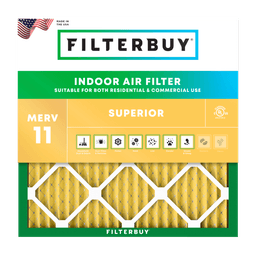
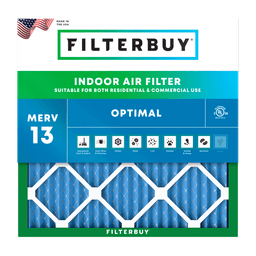
Shop MERV 11 filters→What's the Right Filter for Your AQI Level?



Check Today's Live Real Time Air Quality Index AQI Map in Lubbock, TX Now
The dust you can see over Lubbock is only part of the story. At Filterbuy, we've made pleated air filters in the U.S. for more than a decade, and when we set two decades of Texas Tech University research beside Lubbock's AQI, one pattern kept showing up: the city's worst air comes in short, intense bursts that the index tends to smooth over.
TL;DR
Filterbuy's live, real-time AQI map above shows Lubbock's current air quality and updates through the day. A reading of 0–50 is Good, and above 100 the air is unhealthy for sensitive groups. In Lubbock, blowing dust rather than smog drives the worst days, and a quick spike can hit before the index catches up. At an AQI of 100 or higher, Filterbuy recommends MERV 13 in your HVAC, the fan set to On, a portable HEPA air cleaner in each occupied room, and a closed-up house.
How to Read Lubbock's Live AQI Map Right Now
Start with the map above. Green and yellow mean most people can go about their day, while orange or worse is the signal for sensitive groups to cut back. The map also shows which pollutant is driving the reading. Here, that is usually PM2.5, fine particles smaller than 2.5 microns, which is why "Lubbock PM2.5 today" and "Lubbock AQI today" tend to point to the same number.
Key Takeaways
Blowing dust causes most of Lubbock's highest AQI readings.
Texas Tech researchers counted 609 dust events in Lubbock from 2000 to 2020, most in spring and early summer, and most lasting an hour or less.
The American Lung Association's 2025 report ranked the Lubbock-Plainview metro 12th cleanest in the nation for year-round particle pollution.
MERV 11 suits everyday Lubbock dust; at an AQI of 100 or higher, Filterbuy recommends MERV 13.
Lubbock AQI Levels: What Each Color Means for Your Plans
The U.S. AQI runs from 0 to 500. Its six categories are set by the U.S. Environmental Protection Agency (EPA). Find the color on the live map, then read across the matching row below.
Categories and precautions follow EPA AirNow guidance. Filterbuy's home steps start at AQI 100; see the action list below.
Why Lubbock's AQI Can Lag Behind a Dust Storm
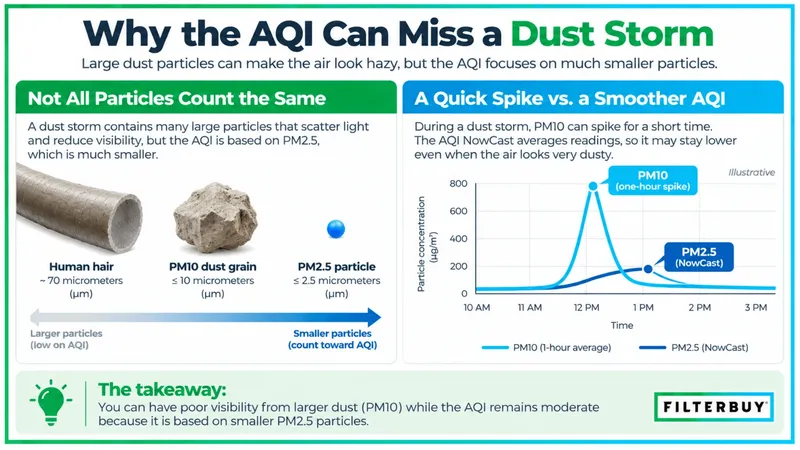
On a windy spring afternoon, the sky can turn brown while the map still says yellow. The sensor isn't broken: current AQI is a NowCast, a weighted average of recent hours, so an hour-long spike gets diluted, and Lubbock's dust events are often that short.
While researching this page, the Filterbuy team found a second gap. Texas Tech researchers note that most West Texas sites they studied measure PM2.5 but not PM10, the coarser particles that make up much of blowing dust. And a study of Lubbock's monitor from 2001 to 2018 found just 12 days above the EPA's daily PM2.5 standard, even though hourly readings reached 486 micrograms per cubic meter during dust events.
Is Lubbock's Air Safe to Breathe Today?
It depends on the live reading and on official guidance. From 0 to 50 the air is Good, and from 51 to 100 it is Moderate. Above 100, AirNow guidance asks sensitive groups, including children, adults over 65, and people with asthma, COPD, or heart disease, to reduce prolonged outdoor exertion. Above 150, it asks everyone to. If you have a health condition, follow your doctor's advice.
Where to Check Lubbock's Air Quality Forecast
For tomorrow's outlook, the Texas Commission on Environmental Quality (TCEQ), the state's environmental agency, publishes a daily air quality forecast for the Lubbock area, updated on workdays and whenever pollution is expected to run high. Dust moves faster than a daily forecast, so on windy days the National Weather Service (NWS) office in Lubbock is the better source.
Lubbock's Air Calendar: When Dust, Smoke, and Ozone Hit
Filterbuy built this calendar from Texas Tech's 21-year dust record, 18 years of Lubbock PM2.5 data, and TCEQ forecasts. One detail most weather apps miss: on windy spring days, Lubbock's dust usually arrives between late morning and midafternoon, which makes early morning the best time to be outside. Particle levels peak in April and June and bottom out in winter, the reverse of many big cities.
Timing reflects Texas Tech analyses of Lubbock dust events (2000–2020) and PM2.5 (2001–2018), plus TCEQ forecasts. Always go by the live map.
What's in Lubbock's Air? Dust First, Then Smoke and Ozone
Whichever pollutant scores highest sets the AQI, and on most days Lubbock's air pollution comes down to particles. Here is where they come from:
Blowing dust. The Southern High Plains ranks among North America's windiest, dustiest inland areas, and bare cotton fields after harvest give the wind plenty to lift.
Local sources. TCEQ's emissions inventory, as analyzed by Texas Tech researchers, points to power plants, cottonseed oil mills, and cotton ginning as the largest local PM2.5 sources.
Smoke. Grassfires across the South Plains and Panhandle can carry smoke into the city in late winter and spring.
Ozone. Lubbock County has no ozone grade from the American Lung Association, but TCEQ forecasts can still place afternoon ozone in the Moderate range.
How Lubbock's Air Compares with Other U.S. Cities
The American Lung Association's 2025 "State of the Air" report ranked Lubbock-Plainview 12th cleanest in the nation for year-round particle pollution. Short-term spikes are the weak spot, with Lubbock County averaging 1.2 unhealthy particle days a year for a C grade. Because the 2026 edition found short-term particle pollution worsened more in Texas than anywhere else, check the Lubbock-Plainview report card for current grades. You can also compare nearby readings on our Texas air quality map.
Dust Storms, Haboobs, and Grassfire Smoke in Lubbock
Those short spikes have a long local history. On October 17, 2011, a haboob rolled through with gusts up to 75 mph and near-zero visibility, in what became Lubbock's driest year on record. On February 26, 2023, gusts reached 76 mph at the airport and visibility dropped to about an eighth of a mile. And on March 15, 2026, a cold front pushed a 60 mph gust across the airport under a Blowing Dust Advisory.
Smoke is the second risk. In February 2024, the Smokehouse Creek Fire burned more than one million acres in the Panhandle, the largest wildfire in Texas history. You can track active fires on Filterbuy's Lubbock wildfire and smoke map or read more in our Texas wildfire smoke guide.
When dust or smoke moves in, check the AirNow Fire and Smoke Map and follow local guidance first. Filtration is one layer, not the whole answer. At an AQI of 100 or higher, Filterbuy recommends four steps, in this order:
Switch to MERV 13 in your HVAC. The EPA recommends a MERV 13 or higher filter during smoky periods. It also notes most furnaces and HVAC systems can accommodate one when the filter is replaced often.
Set the thermostat fan to On. On Auto, the system filters only while heating or cooling. The EPA's indoor air filtration fact sheet reports that running the fan on On can cut indoor particle levels by as much as 24%.
Run a portable HEPA air cleaner in each occupied room, bedrooms first. Choose one with a smoke CADR at least two-thirds of the room's square footage, so a 300 sq ft bedroom needs a smoke CADR of about 200, and skip any model that produces ozone.
Close the house up. Shut windows and doors, turn off any evaporative cooler, and skip candles, frying, smoking, and vacuuming without a sealed unit.
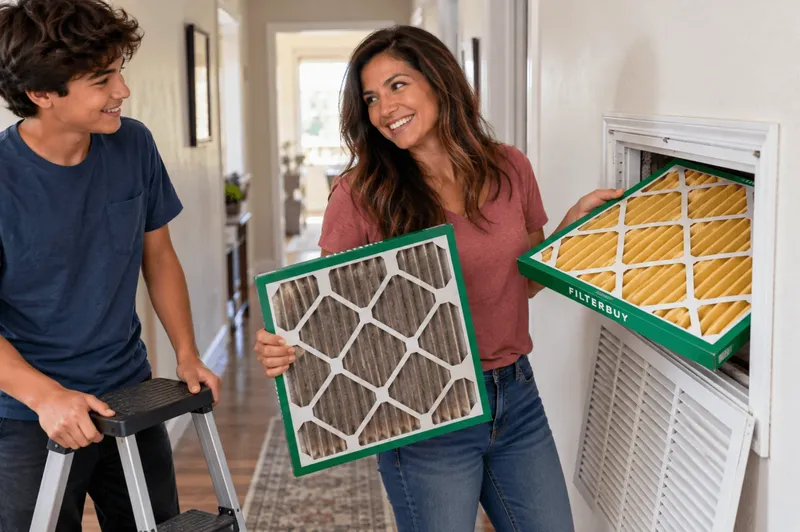
If you must be outside, wear a well-fitted N95; the EPA notes that dust masks and bandanas won't block fine particles. Check your HVAC filter during and after a dust or smoke event, and replace it when it looks dirty, dark brown or black, which can be well before its normal interval. Keep spares on hand.
What a Lubbock Dust or Air Quality Alert Means for Your Day
The NWS in Lubbock issues a Blowing Dust Advisory when dust cuts visibility to a mile or less, and upgrades to a warning when conditions get worse. Either one is a good cue to move exercise indoors and close up the house. If visibility drops while you're driving, NWS Lubbock's advice is to pull as far off the road as you can, turn your lights off, and keep your foot off the brake: “Pull Aside, Stay Alive.”
Swamp Cooler, Window Unit, or No Ducts? What Changes
Evaporative (swamp) coolers are common across West Texas, and they work by pulling outdoor air through wet pads while a window stays cracked. On a dust day, that pulls the problem straight inside, and no Filterbuy filter can fix it, so turn the cooler off during dust alerts. For smoke, the EPA advises covering its outside intakes with 4-inch MERV 13 filters or using it sparingly.
If your home has no ducts, MERV advice won't apply, and we'd rather tell you that than sell you a filter that won't fit. Portable HEPA air cleaners in the rooms you use are your primary defense, not a backup (our MERV 13 vs. HEPA guide compares the options). Just don't seal yourself into a hot house, since heat is a health risk too.
Our Take: What a Filter Maker Sees in Lubbock's Air
Most AQI pages stop at the outdoor number. Filterbuy makes the filters that decide what happens after that air comes inside, so we read Lubbock's data a little differently:
Lubbock's risk is spiky, not chronic. The annual averages look clean, and that is what hides the bad days.
The dust the index misses is the dust your filter catches. In our experience as filter makers, coarse dust cakes on the upstream face of the pleats while fine smoke works deeper into the media, so dust can load a filter in weeks rather than months.
Filter season here runs February through June, when grassfire season overlaps the April and June dust peaks.
Researching Lubbock changed how I read the AQI. On a dust day, by the time the map turns orange, the dust is already at your return vent. My advice: trust the sky and the NWS alerts, and keep a spare filter in the closet before February.
Michelle Wan, Brand Manager and Air Quality Writer, Filterbuy
Before you upgrade, David Clark, the Licensed HVAC Technician who reviewed this page, recommends a simple fit check: confirm your filter slot’s size and depth, the same way you would for any replacement.
Which Filter Lubbock's AQI Level Calls For
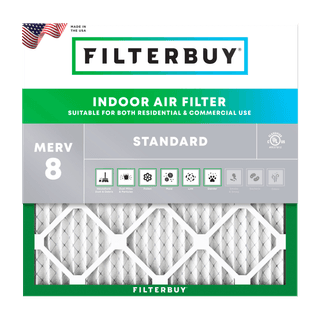
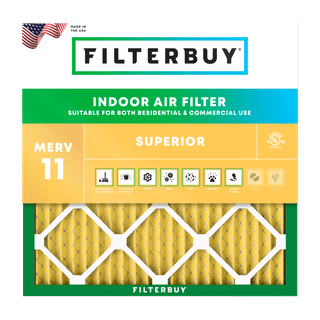
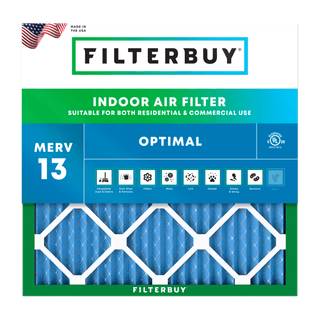
For smoke, the answer is MERV 13. The EPA recommends a MERV 13 or higher filter in central HVAC systems during smoke events. Filterbuy's action line is AQI 100: at that reading or higher, switch to MERV 13. Below it, we point most Lubbock homes to MERV 11 for everyday dust, since it catches finer dust than MERV 8.
Order MERV 13 in your filter's exact size, the same fit check as any replacement. At AQI 201 and above, follow local officials and AirNow first.
Outside of dust and smoke events, our guide on how often to change your air filter covers the normal schedule. A 2- or 4-inch filter holds more dust than a 1-inch one before it needs replacing, and Filterbuy auto-delivery keeps spares on hand. Shop Filterbuy MERV 8, MERV 11, or MERV 13 in your exact size.
Supporting Statistics
Dust days raise Lubbock hospital admissions.
Asthma admissions: up 3.0% per 10 µg/m³ PM2.5 spike, same day.
Acute respiratory admissions: up 8.0% per 5 km drop in visibility.
Source: Herrera-Molina et al., Texas Tech University Repository
Dust storms strain ICUs nationwide.
Total ICU admissions: up 4.8% on dust storm days.
Respiratory ICU admissions: up 9.2% same day, 7.5% five days later.
Most exposure happens indoors.
Americans spend about 90% of their time indoors.
Some indoor pollutants run 2–5x higher than outdoors.
Outdoor dust gets in through doors, windows, vents, cracks, and shoes.
Source: U.S. EPA, Report on the Environment: Indoor Air Quality
Frequently Asked Questions
Glossary
AQI (Air Quality Index): The U.S. daily air quality scale, run by the EPA. It spans 0 to 500, from Good (0–50) to Hazardous (301+).
PM2.5: Fine particles 2.5 micrometers or smaller; the pollutant Lubbock's monitor measures.
PM10: Coarse particles 10 micrometers or smaller, including most blowing dust.
NowCast: The EPA method that weights recent hours to report current AQI.
Haboob: A wall of blowing dust pushed by a thunderstorm outflow or cold front.
Blowing Dust Advisory: An NWS alert for dust cutting visibility to a mile or less.
TCEQ: The Texas Commission on Environmental Quality, the state air agency.
EPA: The U.S. Environmental Protection Agency, which sets the AQI scale and air quality standards.
NWS: The National Weather Service; its Lubbock office issues local dust and wind alerts.
COPD: Chronic obstructive pulmonary disease, a lung condition that raises sensitivity to particles.
MERV: Minimum Efficiency Reporting Value, a 1–16 filter efficiency rating.
HEPA: High-Efficiency Particulate Air filtration, capturing 99.97% of 0.3-micron particles; used in portable air cleaners, not HVAC systems.
Smoke CADR: Clean Air Delivery Rate for smoke, the number used to size a portable air cleaner to a room.
Filterbuy: A U.S. air filter manufacturer founded in 2013 and based in Talladega, Alabama, making MERV 8, 11, and 13 and Odor Eliminator filters in more than 600 sizes.