
Evansville Real-Time AQI Tracker


Get Alerts For Unhealthy AQI In Your Area
When air quality in your area reaches unhealthy levels, we'll send you a quick alert, along with expert tips on how to reduce your exposure.
What's Actually In Evansville Air Today?
What High AQI Means for Your Lungs in Evansville
How to Read AQI
The Air Quality Index (AQI) measures how polluted the air is and how it may affect your health.
0–50 (Good): Air quality is satisfactory.
51–100 (Moderate): Acceptable, but some pollutants may pose minor concerns.
101–150 (Unhealthy for Sensitive Groups)
151–200 (Unhealthy)
201–300 (Very Unhealthy)
301+ (Hazardous)
Moderate
Still okay for most, but if you have asthma or allergies, take it easy and avoid long outdoor workouts.
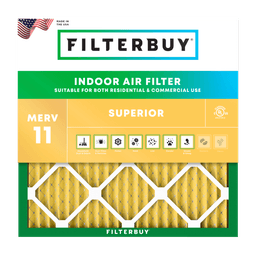
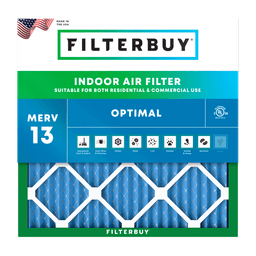
Shop MERV 11 filters→What's the Right Filter for Your AQI Level?



Check Today's Live Real Time Air Quality Index AQI Map in Evansville, IN Now
TL;DR
The live AQI map on this page shows Evansville's current air quality, drawn from EPA and IDEM monitoring. Under 50 is Good; above 100, sensitive groups should scale back. Ozone drives the warm-season spikes and fine particulate runs year-round, a pattern set by the Ohio River valley and the power generation ringing the metro. Whatever the map shows outside, filtration is what decides the air inside your house.
Reading Today's Live AQI Map for Evansville
Start with the map above. It pulls from EPA-monitored stations and color-codes each reading to the six official AQI categories, so the color tells you what to do before the number does. It also names the pollutant setting the reading, and that matters here, because ozone and fine particulate behave differently indoors and southwest Indiana gets both. Readings also vary across the metro, since monitors sit miles apart, so check the station nearest you.
Key Takeaways
The live map reads from EPA and Indiana Department of Environmental Management (IDEM) monitoring, including the Evansville-Buena Vista station.
Ozone is Evansville's warm-season pollutant, forecast mid-April through September 30. Fine particulate (PM2.5) is forecast year-round.
Evansville runs its own municipal air agency. The Evansville EPA sets local alert thresholds the national AQI apps do not carry.
Vanderburgh and Warrick counties sit in an EPA maintenance area for ozone and fine particulate, meaning they met the standard after failing it.
EPA recommends MERV 13 or higher in a central system during smoke events. AQI 100 is where Filterbuy tells customers to act on it.
AQI Categories and What Each One Should Change
The U.S. AQI runs 0 to 500 across six categories, so the quickest read is to match the map color above to a row below. Anything over 100 falls into Unhealthy for Sensitive Groups, and that band is written for a specific group: children, adults over 65, and anyone managing asthma, COPD or heart disease. If that is you, follow your clinician's plan and official guidance rather than this page.
Categories, ranges and colors are EPA's. Follow the category shown on the live map above.
When the Map Lags What You Can Smell
The sky can look hazy while the dial still reads yellow, and that is not a broken sensor. The EPA reports current AQI as a NowCast, an average of up to 12 previous hours weighted toward the last three. During a moving plume, or as a river-valley inversion breaks up, it trails what you can smell, and two nearby monitors can land in different categories.
Trust your eyes and nose first, then cross-check AirNow maps and data, which adds sensor coverage and follows smoke more closely.
Who Forecasts Evansville's Air, and Where to Check First
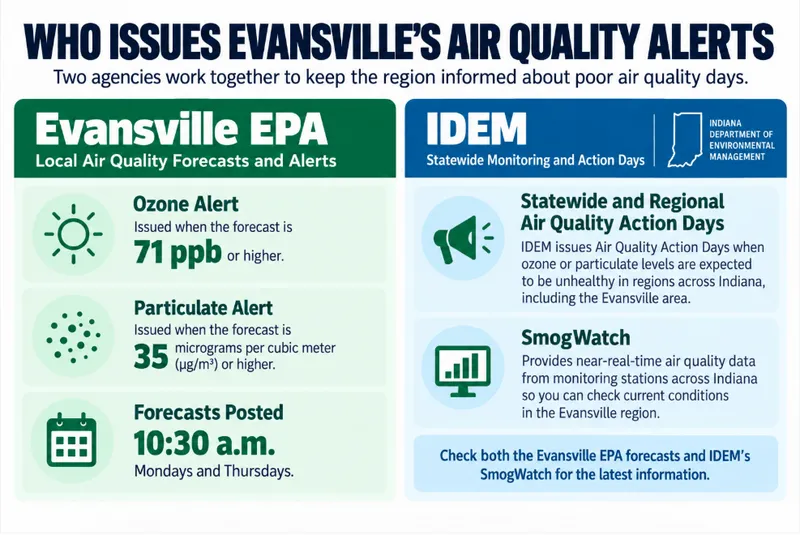
Particulate Alert at forecast 35 micrograms per cubic meter, forecasts posted 10:30 a.m. Mondays and Thursdays. Right column, IDEM. Statewide and regional Air Quality Action Days, SmogWatch near-real-time data. Simple icons, no photography, legible on mobile.
Evansville is unusual for its size: a city agency issues its own alerts alongside the state's. Filterbuy pulled the thresholds below from the health department's own forecast page, because the national AQI apps do not carry them. The Evansville EPA publishes forecasts for Vanderburgh County by 10:30 a.m. local time on Mondays, covering Tuesday through Thursday, and on Thursdays, covering Friday through Monday.
Two alert systems cover Evansville. Either one can fire on a given day.
Those numbers are worth decoding. 71 ppb is exactly the federal Orange breakpoint for 8-hour ozone, so an Ozone Alert lines up with AQI 101. The particulate trigger does not: Orange for PM2.5 starts at 35.5 micrograms, so Evansville alerts a half-microgram early.
IDEM separately declares Air Quality Action Days and posts current conditions on SmogWatch; on June 4, 2026, it declared an ozone Action Day covering almost all of Indiana, Evansville included.
What's Actually in Southwest Indiana's Air
Six pollutants feed the AQI, and the highest scorer sets the number. Around Evansville that is almost always ozone or fine particulate, and both are covered in more depth in our air quality library.
Ozone forms when sunlight cooks vehicle and industrial emissions, which is why it is a warm-season problem here. The setup is a hot, humid, stagnant Ohio Valley afternoon. Usefully, ozone breaks down indoors, so closing the windows solves it.
Fine particulate does not cooperate. PM2.5 is roughly a thirtieth the width of a human hair, small enough to slip past the body's defenses and stay suspended indoors for hours. Removing it takes filtration, where your MERV rating stops being a spec-sheet detail.
Evansville's particulate profile carries a regional signature. Six coal-fired plants have historically operated in southwest Indiana, most within 30 miles of the city, with Warrick and F.B. Culley roughly seven miles southeast on the Ohio. That history is why EPA still regulates the area under maintenance plans covering ozone in Vanderburgh and Warrick counties and fine particulate across six. Maintenance is not the same as clean. The current picture is better than that history suggests. Vanderburgh appears on none of the American Lung Association's worst-25 lists in State of the Air 2026, and in Indiana only Lake and Marion failed all three measures. For comparison, our Indiana air quality map covers the rest of the state, and our national rankings piece shows where U.S. metros stand.
Wildfire Smoke Over the Ohio Valley: What to Do
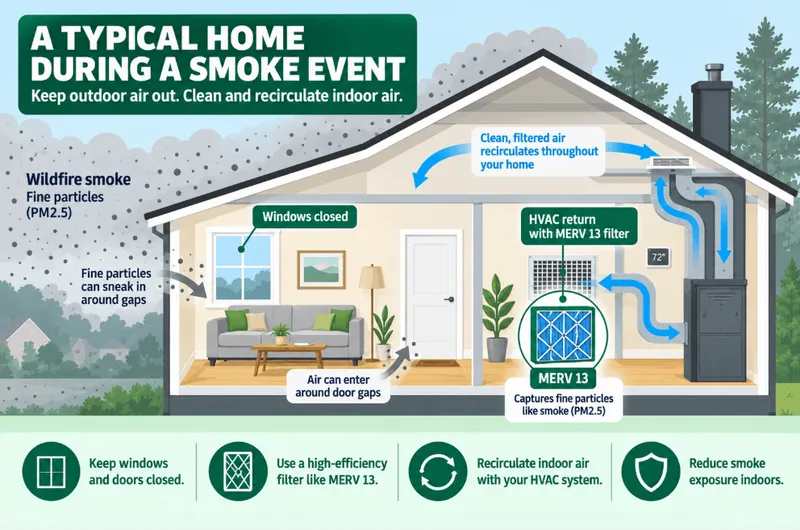
Transported wildfire smoke is now normal in Midwest summers, and southwest Indiana is not exempt. During the July 2026 event, PM2.5 reached the Very Unhealthy purple range at Indiana monitors. Smoke rides the jet stream, then settles when a stagnant high parks over the valley. At AQI 100 and above, the order Filterbuy works through:
Close the house up, and do not add indoor pollution while smoke is in: no candles, no frying, no vacuuming without a sealed unit.
Set the thermostat fan to On rather than Auto. Auto only filters while the system is heating or cooling.
Switch to a MERV 13 in the HVAC. Confirm your size the way you always would; most systems accommodate MERV 13 without equipment problems when the filter is replaced often.
Run a portable HEPA cleaner in each occupied room, bedrooms first. EPA's clean-room rule is a smoke CADR of at least two-thirds of the room's square footage, so a 300 square foot bedroom wants a smoke CADR around 200. Avoid anything that produces ozone.
A pleated filter captures particles, not gases, so smoke odor is a separate problem. Our Odor Eliminator carbon line is where odors route.
Check the filter during the event and replace it when it looks dirty, dark brown or black. That can be well before the normal interval, so keep spares on hand.
Skip the outdoor workout, since hard breathing pulls particulate deeper in.
Filterbuy does not make portable purifiers, and during heavy smoke the honest answer is a true HEPA unit in the bedroom alongside whole-home filtration. Track plumes on our live wildfire and smoke map.
What an Evansville Air Quality Alert Should Change About Your Day
An alert is a forecast rather than a reading. Treat it as advance warning for your kids and your parents, or anyone managing asthma or COPD.
Local guidance is specific: refuel after 6 p.m., postpone gas-powered mowing until evening, avoid idling in drive-throughs, and do not open burn, which is prohibited during alerts. Move a planned run to early morning rather than skipping it, since ozone peaks in the afternoon. If anyone starts noticing symptoms, they usually begin with eye and throat irritation.
Our Take: The Outdoor Sources Are Changing. Your Indoor Exposure Isn't.
Most air quality pages stop at the outdoor number. Filterbuy manufactures the pleated filters that decide what happens once that air is inside, at our plant in Talladega, Alabama, and that changes what we notice here. Three things stand out.
The regional coal fleet is shrinking, more slowly than announced. CenterPoint Energy retired A.B. Brown's coal units in October 2023 and October 2025, replaced them with gas, and exited joint ownership of Warrick Unit 4. But the Department of Energy has repeatedly ordered F.B. Culley Unit 2 to run past its retirement date. The transition is real; the timeline is not.
A cleaner local source mix does not mean a quiet map. Ozone is a weather-and-traffic problem, and transported smoke ignores state lines. Neither depends much on local stacks.
Closing windows is only half an answer. Ozone breaks down indoors. Fine particulate does not.
Filtration is preparation, not response. A filter ordered the morning the sky turns brown arrives late.
“Evansville's outdoor sources are changing faster than most people realize. What has not changed is that the filter protecting your family on a smoke day is the one that was already in the furnace that morning.”
David Heacock, Founder & CEO, Filterbuy
Matching a Filter to the Reading on the Map
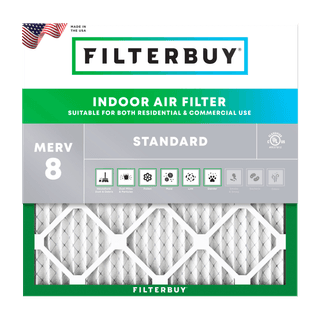
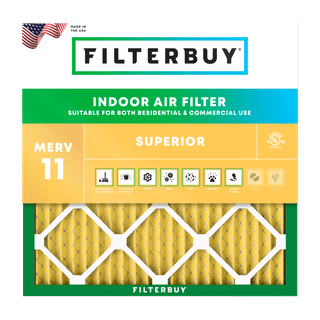
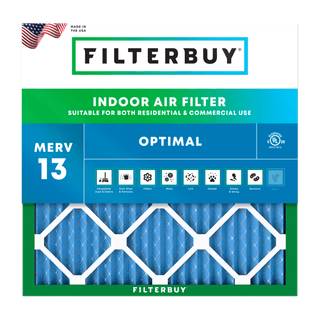
This is the part Filterbuy manufactures, so here is how we choose. EPA recommends a high-efficiency filter rated MERV 13 or higher in a central system during smoke events. AQI 100 is the line where Filterbuy tells customers to act on it. Shop Filterbuy MERV 8, MERV 11, MERV 13, or the Odor Eliminator carbon filter.
EPA's Moderate category runs 51–100 and Unhealthy for Sensitive Groups begins at 101. AQI 100 is the Filterbuy action line, where we tell customers to move to MERV 13. Confirm the filter size the same way you always would; most furnaces and HVAC systems accommodate MERV 13 without equipment problems when the filter is replaced often.
If your home runs on window units, a boiler or mini splits, there is no filter slot and none of the above applies. A portable HEPA cleaner sized to your bedroom is the better buy, and we would rather say so than sell a filter that fits nothing.
“On a humid Ohio Valley smoke day, a filter loads faster than homeowners expect. I tell people to stop counting days during a smoke event and just look at it. If the media has gone dark brown or black, change it, whatever the calendar says.”
David Clark, Licensed HVAC Technician
Supporting Statistics
1 in 10 Indiana adults and 1 in 9 children ages 5 to 17 have asthma. The Indiana Department of Health names outdoor and indoor air pollution among the risk factors.
Americans spend about 90 percent of their time indoors, where some pollutants run 2 to 5 times higher than outdoors. EPA notes the most vulnerable spend even more time inside.
Fine particulate is linked to more than 50,000 U.S. premature deaths a year, with no safe threshold. The American Lung Association finds harm below current standards.
Frequently Asked Questions
Glossary
AQI (Air Quality Index): The EPA's 0-to-500 scale, Good (0-50) through Hazardous (301+).
PM2.5: Fine particulate 2.5 micrometers or smaller, what high-MERV filtration targets.
Evansville EPA: The city's municipal air agency, which forecasts conditions and issues Ozone and Particulate Alerts.
IDEM: The Indiana Department of Environmental Management, which runs the state monitoring network and declares Action Days.
MERV: Minimum Efficiency Reporting Value, the 1-to-16 filter efficiency scale.
Orange breakpoint: The concentration where a pollutant hits AQI 101, the start of Unhealthy for Sensitive Groups.
Action line: AQI 100, where Filterbuy tells customers to move to MERV 13. EPA's category boundary is 101.