
Savannah Real-Time AQI Tracker


Get Alerts For Unhealthy AQI In Your Area
When air quality in your area reaches unhealthy levels, we'll send you a quick alert, along with expert tips on how to reduce your exposure.
What's Actually In Savannah Air Today?
What High AQI Means for Your Lungs in Savannah
How to Read AQI
The Air Quality Index (AQI) measures how polluted the air is and how it may affect your health.
0–50 (Good): Air quality is satisfactory.
51–100 (Moderate): Acceptable, but some pollutants may pose minor concerns.
101–150 (Unhealthy for Sensitive Groups)
151–200 (Unhealthy)
201–300 (Very Unhealthy)
301+ (Hazardous)
Moderate
Still okay for most, but if you have asthma or allergies, take it easy and avoid long outdoor workouts.
Shop MERV 11 filters→What's the Right Filter for Your AQI Level?

Check Today's Live Real Time Air Quality Index AQI Map in Savannah, GA Now
Author: Michelle Wan, Brand Manager and Air Quality Writer, Filterbuy | Reviewed By: David Clark, Licensed HVAC Technician, Filterbuy HVAC Solutions | Published: August 27, 2026 | Updated: August 27, 2026
TL;DR
The live Filterbuy map above shows Savannah's current Air Quality Index (AQI) for Chatham County, updated hourly from state monitors. Most days the reading sits in the Good range of 0 to 50, though it climbs into Moderate on hot, still summer afternoons when ozone builds, and spikes highest when smoke drifts over the coast. Ozone drives Savannah's worst air days, while fine particles account for the rest of the year.
Key Takeaways
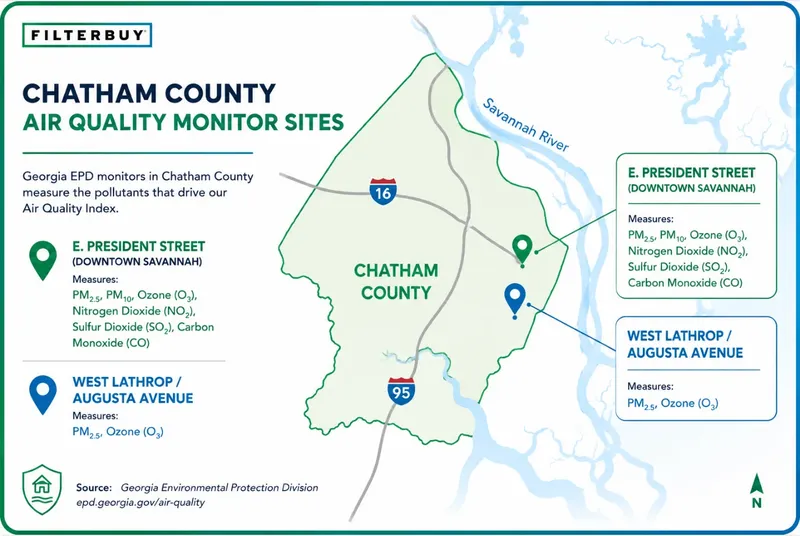
Savannah's AQI comes from just two state monitoring sites, both in Chatham County and five miles apart: Savannah-E. President Street and Savannah-L&A on West Lathrop Avenue.
Ozone is only measured from March through October, because Georgia runs its monitors on a seasonal schedule. From November through February, Savannah's AQI is effectively a PM2.5 reading.
Georgia's summer open-burning ban skips Chatham County. The ban covers 54 counties across north and central Georgia. Savannah is not among them.
Savannah's only PM2.5 monitor carries a data-quality flag because trees blocked airflow to the samplers. Georgia EPD has qualified the L&A site's readings since April 2024.
Pollen is not part of the AQI, so a heavy pollen day can still read Good. The index tracks five pollutants: ozone, particle pollution, carbon monoxide, sulfur dioxide and nitrogen dioxide.
What Is the Air Quality in Savannah, GA Today?
Savannah's air quality today is whatever the live map reports for your corner of Chatham County. The index runs 0 to 500 across six color bands. Green (0 to 50) is Good and yellow (51 to 100) is Moderate. From orange (101 to 150) upward they turn cautionary: Unhealthy for Sensitive Groups, then Unhealthy, Very Unhealthy, and Hazardous above 300.
One detail most air quality pages skip is that the AQI reports the highest single-pollutant score, not an average. If ozone reads 78 while fine particles read 30, Savannah's AQI is 78 and ozone becomes the dominant pollutant. That matters, because the two behave in opposite ways: ozone peaks on hot afternoons and fades after dark, while fine particles can climb overnight and stay high for days when smoke settles in.
Where Does Savannah's AQI Data Actually Come From?
No weather app tells you where its Savannah number comes from, so Filterbuy read the Savannah entries in Georgia EPD's 2026 Ambient Air Monitoring Plan line by line. The answer is two state sites, both in Chatham County.
Savannah-E. President Street (AQS 13-051-0021), at the American Red Cross, 2500 E. President Street. Running since 1995. Measures ozone, sulfur dioxide, and wind, plus 17 volatile organic compounds added in June 2025.
Savannah-L&A (AQS 13-051-1002), at the pumping station where West Lathrop meets Augusta Avenue. Running since 1972. Carries Savannah's PM2.5 monitors.
That is the whole regulatory network: two sites five miles apart, covering 311,855 people. We went looking for a third, and there isn't one.
There is also a footnote nobody reports. The L&A site, which holds Savannah's only PM2.5 monitor, has not met EPA siting criteria since April 2024, because trees grew too close to the samplers, and Georgia EPD has flagged its data with an "SX" code ever since. Crews cut the trees back in April 2026 and a new evaluation is pending, so the readings still publish and remain the best available. They just carry an asterisk the map never shows you.
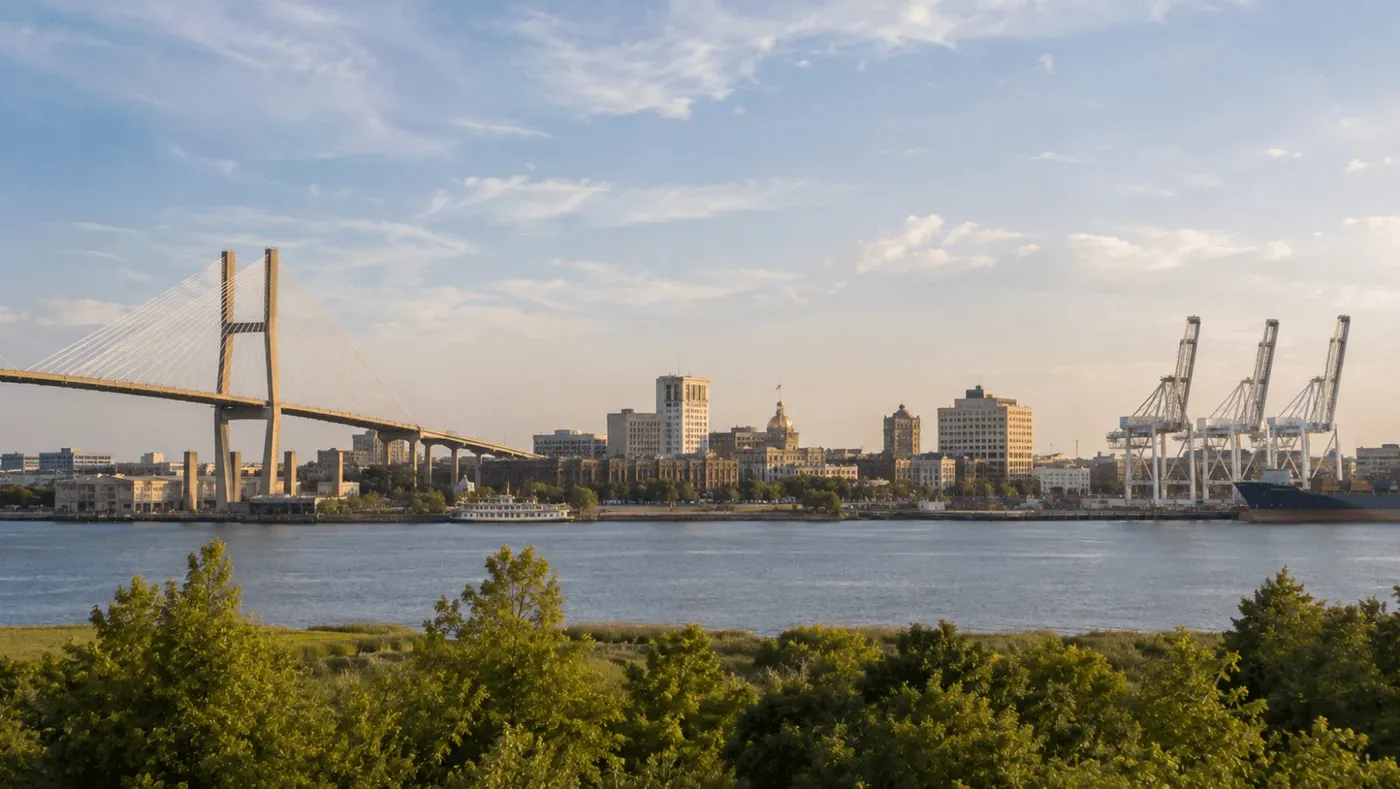
Both sites were also re-designated to track "highest concentration" rather than neighborhood averages, so the number leans toward the dirtier end of local air. Read it as a neighborhood-to-urban figure, not a measurement of your street: air near the port corridors on Georgia 21 and I-516 can differ from air over Ardsley Park the same afternoon.
Why Savannah's Ozone Number Disappears Every Winter
This was the detail that surprised us most. Georgia measures ozone from March through October at every site except two research monitors near Atlanta, following a federal monitoring-season rule. So from November through February, Savannah has no local ozone reading at all, and the map runs on fine particles alone.
Savannah is also one of four Georgia metros required to report a daily AQI, yet the state's air monitoring program forecasts smog for Atlanta, Macon and Columbus only. Savannah gets same-day measurement but no next-day forecast, which is why a live map is worth more here than inland.
What Actually Pollutes Savannah's Air?
Four sources shape Savannah's air, and each announces itself differently on the map.
Port and freight diesel. The Port of Savannah's Garden City Terminal is the nation's largest single-operator container terminal at 1,345 acres. The ships, trucks, locomotives and yard equipment serving it concentrate diesel exhaust into a corridor west of downtown, right where the L&A monitor sits.
Prescribed fire and regional smoke. Georgians prescribe burn about 1.4 million acres a year, and coastal Georgia's pine and longleaf is burned deliberately to cut wildfire fuel. We checked all 54 counties named in Georgia's May 1 to September 30 open-burning ban, and Chatham County is not one of them. Yard-debris and land-clearing burning therefore continues through ozone season, in a way it does not around Atlanta or Macon.
Coastal heat and stalled air. Ozone forms when nitrogen oxides and volatile organic compounds cook in sunlight. Savannah's humid, high-UV summers supply the heat, and light-wind afternoons supply the stagnation. The American Lung Association cut the metro's ozone grade from A to B in 2025.
Pollen, which is not on the map. Savannah's spring oak and pine pollen is heavy, but it is not an AQI pollutant, and pollen season runs on its own calendar.
Is the Air Quality Bad in Savannah Today?
Read the category, not the number. On a Good day nobody needs to change plans, and on a Moderate day most people are fine, though the unusually sensitive may notice symptoms during long exertion. Once the map turns orange, sensitive groups should shorten or reschedule strenuous outdoor activity: children, adults over 65, pregnant people and anyone living with asthma, COPD or heart disease. At red, that extends to everyone.
Two local habits are worth building. First, check the dominant pollutant, not just the color: if ozone is driving an orange reading, a morning run on the Truman Linear Park Trail beats a 4 p.m. one, whereas if PM2.5 is driving it the time of day matters far less. Second, close up rather than air out on smoke days, since opening windows only brings smoke indoors.
Two seasonal notes follow from the gaps above. In winter, treat a clear morning as a PM2.5 reading alone, since ozone is not measured then. And in April, when the map says Good while your eyes are streaming, believe your eyes: that is pollen, and the index is not looking for it.
What Savannah's AQI Means for the Air Inside Your House
Outdoor particle pollution does not stop at your walls. PM2.5 slips through the gaps around windows and doors and gets pulled in by an HVAC return, which makes the map a fair proxy for what your indoor air is about to become, especially in Savannah where humidity keeps the AC running most of the year.
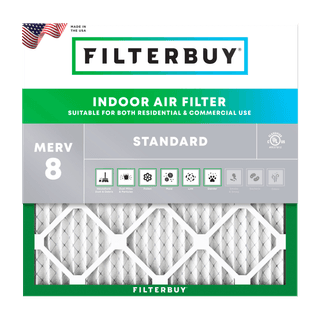
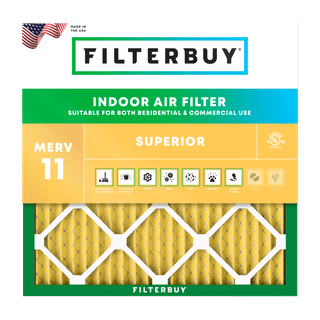
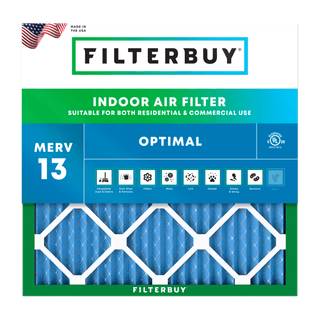
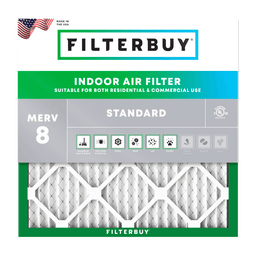
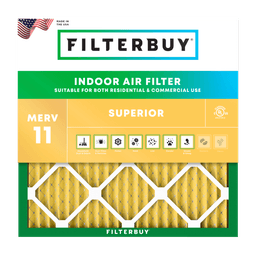
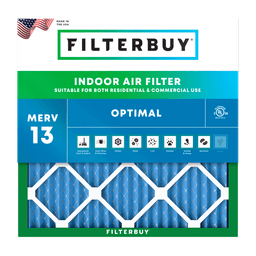
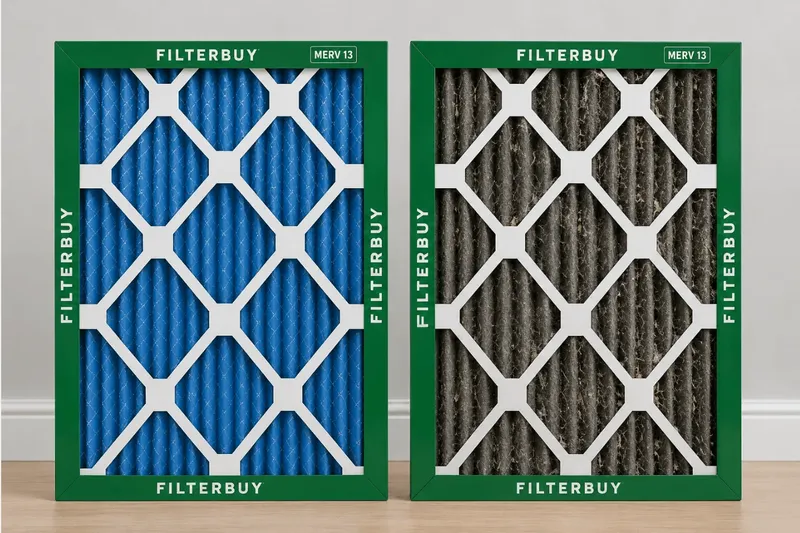
Filterbuy has built filters in the U.S. since 2013, in Alabama, Florida, Pennsylvania and Utah, and the coastal pattern is consistent: filters load faster than the box says. Your filter is the one device treating every cubic foot of air moving through the system. The CDC's wildfire smoke guidance recommends MERV 13 or higher if your system allows, along with recirculate. MERV 13 targets PM2.5-sized particles including smoke, MERV 11 suits homes with pets or mild allergies, and MERV 8 covers everyday dust. If you are unsure how high your system can go, start with how MERV ratings work.
I don’t want anyone to feel like they need an HVAC license just to pick the right filter. My job is to give you the straight answer, explain why it matters, and let you get back to your day.
Michelle Wan, Brand Manager and Air Quality Writer, Filterbuy
The routine that works here is simple: check the map before you open the windows, run the fan on circulate on smoke and orange days, and change the filter more often from March through October than the label suggests.
Find your filter size | Build a custom size | Set up Auto-Delivery. Filterbuy filters are made in the USA in hundreds of sizes, shipped factory-direct.
Supporting Statistics: Three Numbers Behind Savannah's Air Quality
1. More than 1 in 3 Chatham County residents is in an age group sensitive to air pollution.
Source: U.S. Census QuickFacts, 2025.
Population: 311,855
Under age 18: 19.1%
Age 65 and over: 17.8%
Combined: 36.9%, roughly 115,000 people
These are the groups advised to ease off outdoor exertion once the AQI passes 100.
2. At least 31 million Americans live within 5,000 meters of a major port.
Source: EPA, Near-Port Populations, December 2024.
EPA names five diesel sources concentrated in port areas:
Trucks
Locomotives
Cargo handling equipment
Harbor craft
Ocean-going vessels
EPA also found near-port populations hold higher shares of vulnerable groups, the clearest federal explanation of why west Savannah breathes differently from Tybee Island.
3. Americans spend about 90% of their time indoors, where some pollutants run 2 to 5 times higher than outside.
Source: EPA's Report on the Environment.
EPA notes two things that matter on a smoke day:
The most susceptible people, including the very young, older adults and those with heart or lung disease, spend even more time indoors.
Outdoor pollutants enter through doors, windows, ventilation and cracks.
Together they are the argument for closing up and letting the filter work.
Compare the Georgia AQI map, Atlanta AQI map or USA AQI map.
Savannah Air Quality FAQ
Glossary
AQI (Air Quality Index): the EPA's 0 to 500 scale converting pollutant concentrations into one color-coded number, reported daily for U.S. metros.
PM2.5 (fine particulate matter): airborne particles 2.5 micrometers or smaller, able to reach deep into the lungs. Federal standards: 9.0 micrograms per cubic meter annual, 35 for 24-hour.
Ground-level ozone (O3): a lung-irritating gas formed when nitrogen oxides and volatile organic compounds react in sunlight. Federal 8-hour standard: 0.070 ppm.
SX code: Georgia EPD's qualifier for readings from a monitor that does not fully meet EPA siting criteria. The data still counts, but it is flagged.
MERV: Minimum Efficiency Reporting Value, the ASHRAE scale rating how well an HVAC filter captures particles of a given size.
Disclosure: Filterbuy manufactures and sells air filters. All air quality data and health guidance here comes from the public agencies linked above, not from Filterbuy.