
Columbus Real-Time AQI Tracker


Get Alerts For Unhealthy AQI In Your Area
When air quality in your area reaches unhealthy levels, we'll send you a quick alert, along with expert tips on how to reduce your exposure.
What's Actually In Columbus Air Today?
What High AQI Means for Your Lungs in Columbus
How to Read AQI
The Air Quality Index (AQI) measures how polluted the air is and how it may affect your health.
0–50 (Good): Air quality is satisfactory.
51–100 (Moderate): Acceptable, but some pollutants may pose minor concerns.
101–150 (Unhealthy for Sensitive Groups)
151–200 (Unhealthy)
201–300 (Very Unhealthy)
301+ (Hazardous)
Moderate
Still okay for most, but if you have asthma or allergies, take it easy and avoid long outdoor workouts.
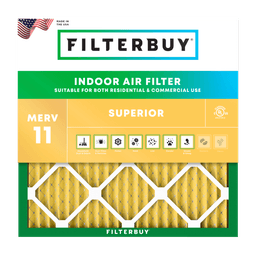
Shop MERV 11 filters→What's the Right Filter for Your AQI Level?



Check Today’s Live Real Time Air Quality Index AQI Map in Columbus, GA Now
By Michelle Wan, Brand Manager & Air Quality Writer | HVAC and filtration guidance reviewed by David Clark, Licensed HVAC Technician. Health guidance follows U.S. EPA, CDC, and American Lung Association sources, linked throughout. | Published: July 19, 2026 | Updated: July 19, 2026
TL;DR — Columbus, Georgia’s air is usually Good, but the metro fails on fine particles, not smog: a B for ozone and an F for short-term particle pollution (American Lung Association, “State of the Air” 2026). The higher-risk window runs late winter through spring, when prescribed burning around Fort Moore peaks and tree pollen climbs. Check the live map above for today’s reading before you plan time outdoors.
The map above shows current conditions across Muscogee County and the Chattahoochee Valley from official monitors, updated hourly. You can also look up your AQI by ZIP code or compare against live air quality across Georgia. Live readings are preliminary (pre-QA), as every agency publishing them notes. One citywide number rarely tells the whole story: neighborhoods near Fort Moore’s northern ranges don’t always read like Uptown, especially on a burn day when a wind shift decides which side of town gets the smoke. Zoom to the monitor nearest you and trust it over the citywide average.
What Really Drives Columbus’s Air (And Why It Isn’t Smog)
Columbus’s dominant pollutant is fine particulate matter (PM2.5), not ozone. The Columbus–Auburn–Opelika, GA-AL metro ranks 46th worst nationally for short-term particle pollution (F) and 31st worst for year-round particle pollution (also failing); for ozone the same metro ranks 143rd worst and earns a B (ALA, “State of the Air” 2026: Georgia). That inverts the standard air-quality story — hot afternoons, summer smog, distant wildfire — which was written for cities whose problem is ozone. Columbus’s problem is soot.
Georgia’s Environmental Protection Division forecasts Columbus by name, issuing a daily smog alert for exactly three places: metro Atlanta, Macon, and Columbus. The state doesn’t just count Columbus’s particles — it chemically fingerprints them. Columbus has hosted one of only six PM2.5 speciation monitors in Georgia since 2002, which is how the state tells wood smoke apart from vehicle soot (Georgia EPD Ambient Air Monitoring Plan). More than two decades of that record sits behind the number on your phone.
Is That Smoke From Fort Moore? Probably — And That’s By Design
Fort Moore, the Army installation adjoining Columbus, burns roughly 30,000 acres of training land each year, and 80–85% of that happens between late December and early May. Foresters cap individual burns near 250 acres and time them to steer smoke away from neighborhoods (Fort Moore Smoke and Sound). That smoke is the good kind: prescribed fire clears fuel load, regenerates longleaf pine, and sustains habitat for species like the endangered red-cockaded woodpecker. Georgia burns ~1.4 million acres a year this way — one of the largest such programs in the country.
Planned doesn’t mean perfectly contained. In March 2023, escaped burn smoke pushed Columbus air to unhealthy levels, and residents with respiratory conditions were told to stay indoors. And the burning is increasing on purpose: the Chattahoochee Fall Line Prescribed Fire Cooperative is expanding prescribed fire on private land across West Central Georgia.
The honest framing isn’t stop the burning — it’s that the smoke is deliberate, seasonal, and scheduled, which is exactly why you can plan around it. You can’t plan around a wildfire; you can plan around a burn calendar. Placing a smell right now? Our guide to why the air smells smoky outside sorts a prescribed burn from a wildfire from a neighbor’s yard fire, and the Georgia wildfire and smoke map shows what’s burning statewide.
How To Read Columbus’s Air Quality Index
The AQI turns pollutant concentrations into one number from 0 to 500 with a matching color — higher number, more pollution, greater health concern. For the full breakdown, see what the Air Quality Index measures and the AQI scale explained. Here’s what each band means for an ordinary Columbus day.
Categories follow the U.S. EPA Air Quality Index scale. Check the live map above for current conditions in Columbus, GA.
The Number And The Nose: What Columbus’s AQI Doesn’t Count
Pollen is not measured by the AQI, which tracks ozone, particulate matter, nitrogen dioxide, sulfur dioxide, and carbon monoxide — not pollen grains. That matters more in Columbus than almost anywhere because of timing: tree pollen (oak, pine, cedar) climbs March through May, right on top of prescribed burn season, so a spring morning can hand you both at once while the AQI reports only one. A Good AQI is not a promise you’ll feel good outside in April — it’s a statement about five specific pollutants, and pollen isn’t one of them.
The Air Quality Index measures ozone, particulate matter, nitrogen dioxide, sulfur dioxide, and carbon monoxide. Pollen is not one of them.
Is It Smoke, Pollen, Or Ozone?
Three questions get you there most of the time. What month is it? Late Dec–early May: suspect smoke. March–May: suspect pollen, possibly both. Hot, still June–September afternoons: suspect ozone. Can you smell it? Wood smoke has a smell and often a low haze; ozone doesn’t (a clear blue afternoon can carry the day’s highest ozone); pollen leaves yellow film on your car. What does the map say? Elevated AQI in spring means particles; a fine AQI while your eyes aren’t fine usually means pollen, which the number never counted. When it’s smoke or ozone, close the windows, run your HVAC, keep hard exercise indoors. When it’s pollen, same actions, different reason. For the full set of causes, see why air quality is bad today.
When Your Nose Is Ahead Of The Number
The map can miss a burn near you — not a defect, just how the AQI works. Georgia EPD runs ~34 monitoring sites across 25 counties, and everything between them is estimated, not measured. A prescribed burn plume is narrow, low, and local: if it rides over your street but not the monitor, the official number won’t move — your nose will be right and the map quiet. So the honest rule for Columbus: green does not mean clear if you can smell smoke. Trust your nose — it’s standing where you are. On a burn day, check the Georgia Wildfire Public Viewer first; it shows the fire, wind direction, and nearby PM2.5 together. Use the AQI for the day, the burn map for the hour.
Columbus Air Quality, Season By Season
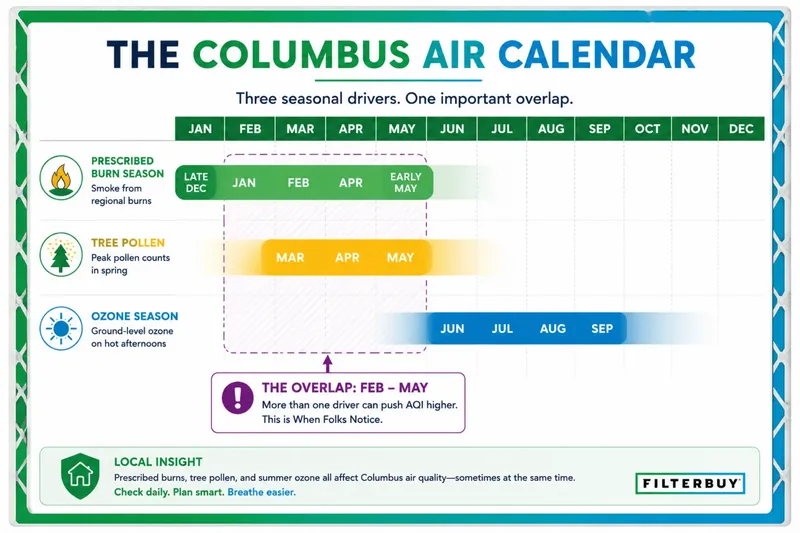
Columbus’s highest-risk window runs late winter through spring, not summer. Prescribed burning peaks late December to early May, and oak, pine, and cedar pollen climbs March through May. Summer brings ozone, but the metro grades B for it. So the season most air-quality pages tell you to fear is the one Columbus handles best.
In Columbus, your filter earns its money in February, March, and April, not July.
How We Built This Calendar
No one publishes a Columbus air calendar — Filterbuy built this by laying three public records on top of each other: Fort Moore’s burn window, the ALA’s Columbus-metro grades, and Georgia EPD’s decision to forecast Columbus by name. Separately, each is a fact anyone can look up; together they say something none says alone. We then checked it against research we had no hand in: a peer-reviewed Georgia study (NIH) puts prescribed burning at 20–30% of ambient PM2.5 during January–April — the same window Fort Moore publishes, reached from emissions modeling instead of a burn schedule.
What A Burn Day Actually Asks Of You
Almost every piece of smoke advice in America is written for wildfire. Columbus mostly gets planned fire, which asks something different — easier, if you know it’s coming.
Distance ranges follow Filterbuy's guide to identifying a smoky smell. The rest reflects how Fort Moore describes its own burn program.
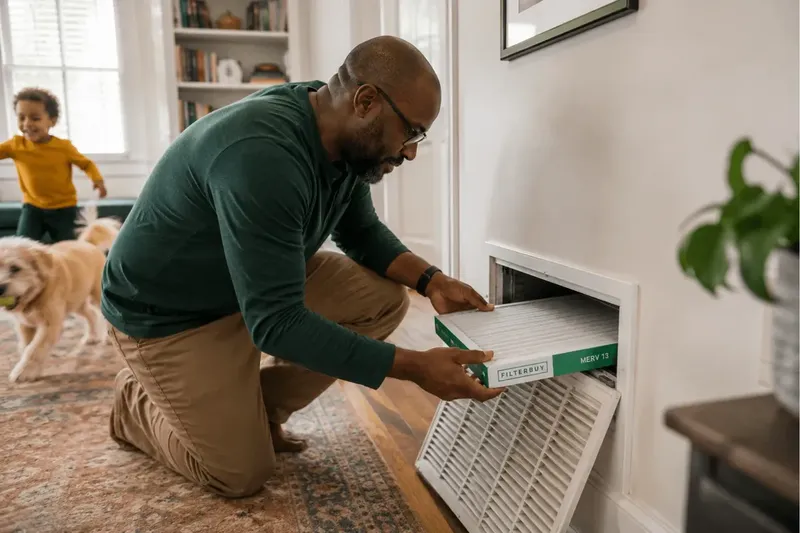
Two rows do most of the work. You can get ahead of a scheduled fire. If the burn map shows fire upwind, run the whole routine before the smoke arrives: windows and doors shut, HVAC on recirculate, fan switched from Auto to On. The EPA puts that combination at roughly a 50% cut in indoor PM2.5 with a high-efficiency filter, versus about 24% with a low-efficiency one. And it happens again next week. One burn won’t ruin your filter; twenty will. Smoke loads a filter far faster than house dust, so February through April is the one stretch where you should look at your filter instead of trusting the date — hold it to a light, and if it’s gone dark, it’s finished, “due” or not.
Why Two Sites Give Columbus Two Different Answers
Air-quality sites report Columbus differently because they use different scales — check two tabs and you can get two verdicts on the same air. Neither is lying; they’re measuring against different yardsticks.
Pick one source and stay with it, so you are comparing today to yesterday rather than one scale to another. For Columbus, that should be AirNow or AirGeorgia.
Where We Check Columbus, GA Air Quality: Sources Worth Bookmarking
Where the Filterbuy team actually looks when a Columbus family asks what’s in their air — four of the seven are Chattahoochee Valley locals you won’t find on a national dashboard. Bookmark them now, while the air is fine, not in March when it isn’t.
Four of these seven are Chattahoochee Valley locals. You will not find them on any national dashboard.
Live links: AirNow · AirGeorgia Columbus forecast · CDC Air Quality and Health · Georgia Wildfire Public Viewer · GFC Prescribed Fire Advisories · Fort Moore Smoke and Sound · ALA “State of the Air”
The Research Behind What You’re Breathing
Three numbers, three independent government sources, one conclusion.
Columbus has Georgia’s highest childhood asthma rate. 13.9% in the West Central Health District (which covers Muscogee County) versus 9% statewide — the highest of any district in Georgia. “Sensitive groups” isn’t an abstraction here; it’s your kid’s classroom. (Georgia DPH, Asthma in Children)
Prescribed fire peaks exactly when we said. Peer-reviewed, Georgia-centered research puts prescribed burning at 24% of primary PM2.5 emissions in the Southeast, 10–15% of ambient PM2.5 year-round, and 20–30% during the January–April burn season. (NIH / PubMed Central)
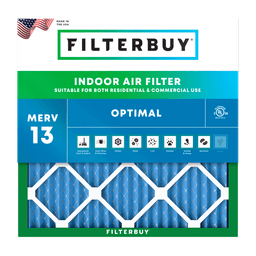
A better filter roughly doubles your protection. ~50% indoor PM2.5 cut with a high-efficiency HVAC filter and the fan running continuously, versus ~24% with a typical low-efficiency filter. The EPA recommends MERV 13 or higher during smoky stretches. (U.S. EPA)
Expert Insight From Filterbuy
Most people assume bad air quality is somebody else's problem, from a fire or a factory far away. In Columbus, it is neither—it is planned, it is local, and it is on the calendar. The number on your phone tells you what is happening outside; what happens inside your home once that air comes through the door is still up to you.
David Heacock, Founder & CEO, Filterbuy
Frequently Asked Questions
Breathe Easier in Columbus
You can’t reschedule Fort Moore’s burn calendar, and you wouldn’t want to — it’s the reason Georgia doesn’t burn the way California does. What you can control is what your HVAC pulls through the house while it’s happening. Filterbuy makes high-efficiency filters in the sizes your system actually needs, shipped on a schedule you set. The pollutant Columbus fails on is exactly the one a MERV 13 is built to catch. Shop MERV 13 air filters and make your home the cleanest room in the valley.