
Thornton Real-Time AQI Tracker


Get Alerts For Unhealthy AQI In Your Area
When air quality in your area reaches unhealthy levels, we'll send you a quick alert, along with expert tips on how to reduce your exposure.
What's Actually In Thornton Air Today?
What High AQI Means for Your Lungs in Thornton
How to Read AQI
The Air Quality Index (AQI) measures how polluted the air is and how it may affect your health.
0–50 (Good): Air quality is satisfactory.
51–100 (Moderate): Acceptable, but some pollutants may pose minor concerns.
101–150 (Unhealthy for Sensitive Groups)
151–200 (Unhealthy)
201–300 (Very Unhealthy)
301+ (Hazardous)
Moderate
Still okay for most, but if you have asthma or allergies, take it easy and avoid long outdoor workouts.
Shop MERV 11 filters→What's the Right Filter for Your AQI Level?


Check Today's Live Real Time Air Quality Index AQI Map in Thornton, CO Now
By Michelle Wan | Reviewed by David Clark, Licensed HVAC Technician | Published September 7, 2026 | Updated September 7, 2026
Thornton's air quality index is a 0–500 score the EPA uses to report how clean or polluted the air is right now across Adams and Weld counties. Filterbuy, a US air filter manufacturer, publishes the live map below, drawn from the nearest government monitors. Thornton sits inside the Denver Metro/North Front Range ozone nonattainment area, so the number climbs for two reasons each year: summer smog, and winter inversions that trap fine particles near the ground.
TL;DR
Thornton's AQI changes hour to hour, so check the live map rather than any static number. Ozone drives the worst air from late spring through August, and fine particles small enough to breathe deep into your lungs (PM2.5) take over for the rest of the year, from wildfire smoke and winter inversions. AQI 100 is our action line for particles: close the house up, put MERV 13 in the HVAC, set the thermostat fan to On, and run a portable HEPA cleaner in occupied rooms. On ozone days, closing the windows is the whole job.
Key Takeaways
Thornton has no state regulatory air monitor inside city limits. The AQI you see comes from CDPHE stations five to six miles south, in Welby and Commerce City.
The Denver–Aurora–Greeley region ranks 8th worst in the nation for ozone pollution. The ranking reflects Jefferson County, the metro’s worst, at 29.7 unhealthy ozone days and an F grade, per the American Lung Association's 2026 State of the Air report.
Adams County, which contains most of Thornton, earned a C for short-term particle pollution in that same report: 1.7 unhealthy particle days a year, improved from 4.7.
An AQI above 100 means the air is unhealthy for sensitive groups: children, adults over 65, and anyone with asthma, COPD, or heart disease. AQI 100 is also Filterbuy’s action line for particles, which is our threshold and not the EPA’s. See what to do above 100.
The EPA tightened the PM2.5 scale on May 6, 2024. "Good" now tops out at 9.0 µg/m³, not 12.0, so days that once read green may read yellow. See how the AQI is calculated for the current breakpoints.
What Is the Air Quality in Thornton Today?
Thornton's air quality today is whatever the live map reports. The index moves hourly, so any number printed on a page is stale within the hour. Read the color first: on the EPA's AirNow scale, green means the air is good, yellow means it is moderate, and orange or anything above it is worth acting on indoors.
Nearly every bad-air day here comes from one of two patterns. In summer, sunlight cooks exhaust from I-25 and E-470 together with oil and gas emissions until the mixture becomes ground-level ozone. In winter, an inversion settles over the Front Range and traps fine particles close to the ground. Thornton straddles Adams and Weld counties, so it is worth checking Denver's live AQI and Greeley's live AQI alongside your own.
Which Monitor Is Thornton's AQI Actually Coming From?
Thornton has no state regulatory air monitor of its own. Colorado's Air Pollution Control Division runs its nearest stations several miles south, so a reading labeled "Thornton" is either borrowed from one of them or modeled from the network around it. Those same monitors sit between north Thornton and the Suncor refinery in Commerce City, the only oil refinery in Colorado. You can watch all of them reporting live on CDPHE's real-time monitoring map.
Distances calculated from station coordinates published by the Colorado Department of Public Health and Environment, measured to Thornton city center. Straight-line, not driving distance.
Coordinates for each station are published on CDPHE’s monitoring site description page.
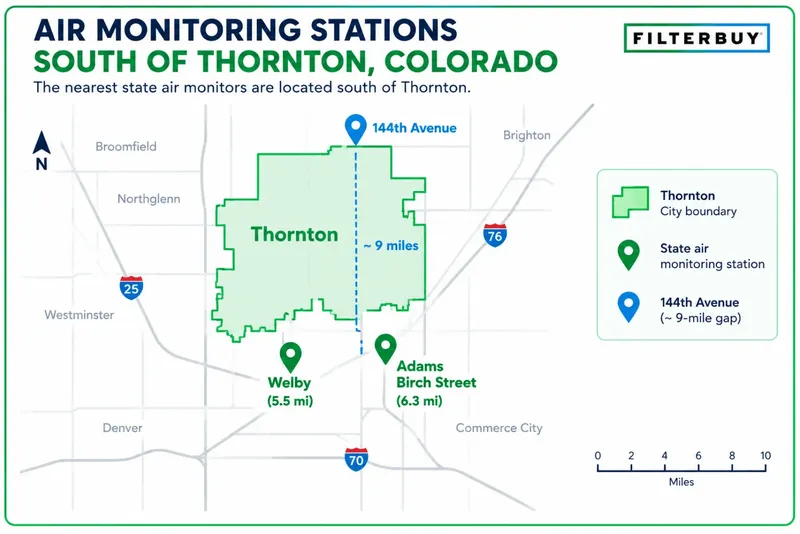
The distance to the nearest monitor matters more on some days than on others. On ozone days the whole Front Range basin cooks at once, so a monitor five miles south is a fair stand-in for your street. On smoke days and inversion mornings it is not, because those particles settle into a shallow layer that can stop well short of your neighborhood. Those are the readings worth checking against a local sensor, whether that is PurpleAir, Adams County's Love My Air, or the EPA’s Fire and Smoke Map, which blends the two.
What the AQI Number Means for Your Home
The AQI is a health scale rather than a weather score. The EPA scores each pollutant separately and reports only the highest, so your reading reflects the worst pollutant in the air that day rather than an average. If you want the arithmetic behind it, see how the AQI is calculated. Each AQI band carries a specific meaning for a Thornton household, set against the PM2.5 breakpoints the EPA revised in 2024.
Categories, ranges, and colors are the EPA’s. PM2.5 concentrations in micrograms per cubic meter, from the EPA breakpoints revised May 6, 2024. The action steps are Filterbuy’s.
Ozone accounts for most of the region’s unhealthy days, and PM2.5 takes over during smoke and inversion episodes. Read more on what PM2.5 is and where it comes from.
Which Pollutant Is Driving Today's Number?
Because the AQI reports your worst pollutant rather than an average, the same reading of 105 can call for two different responses. Check which pollutant is dominant before you decide what to do.
Ozone. A gas. Filters do not touch it. Close windows through the afternoon peak and move hard exercise to early morning.
PM2.5. Fine particles from smoke or inversion haze. At 100 or above: close the house up, MERV 13 in the HVAC, thermostat fan On, and a portable HEPA cleaner in each occupied room.
PM10. Coarse dust, common on windy spring days. Same particle steps as PM2.5.
When you check matters as much as whether you check. Thornton's two pollutants peak at opposite ends of the day. Ozone builds through the afternoon heat and tops out late in the day, which is when CDPHE issues its daily Front Range advisory. Inversion particles work the other way around, at their worst in the cold, still hours after sunrise and thinning as the day warms. In practice that means checking before an evening run in July, and before the school drop-off in January.
Why Thornton's Air Changes With the Season
Thornton's air quality follows a predictable annual cycle, and knowing it lets you get ahead of a bad-air day instead of reacting to one. Colorado runs two alert programs that between them bracket most of the year: daily ozone forecasts from May 31 through August 31, and winter visibility Action Days from November 1 through March 31. Current Front Range advisories are posted each afternoon.
Alert windows per the Colorado Department of Public Health and Environment. Seasons overlap: late summer commonly runs an ozone alert and a smoke advisory in the same week.
One pollutant is missing from Thornton’s air quality calendar: pollen. The AQI does not track it, so a green reading in April tells you nothing about your allergy symptoms. And because ozone is a gas, filtration does its heaviest work between July and February, not during the ozone-alert weeks that draw the coverage. Keep spares on hand through fire season rather than waiting on the calendar. After a smoke episode, read our guide to recover from wildfire smoke exposure.
We manufacture air filters, so let us say the unglamorous part out loud. On a Thornton ozone day, the most useful thing in your house is a closed window. A filter earns its keep in smoke season and on inversion mornings, when the pollutant is something a filter can actually catch.
The Filterbuy Team
What To Do Indoors When Thornton's AQI Reaches 100
AQI 100 is Filterbuy’s action line for particle pollution, and it is ours rather than the EPA’s. The EPA recommends a high-efficiency filter rated MERV 13 or higher in a central system during smoke events, but it does not set an AQI number for making the switch. We act at 100 because it is where sensitive groups start to feel it, one point below the EPA’s Unhealthy for Sensitive Groups band.
One caveat first, and it is the reason this page separates the pollutants. These steps are for particles. On a Thornton ozone day the filter steps do nothing, because ozone is a gas, and closing the windows is the whole intervention.
When the map shows particles at 100 or above, do four things.
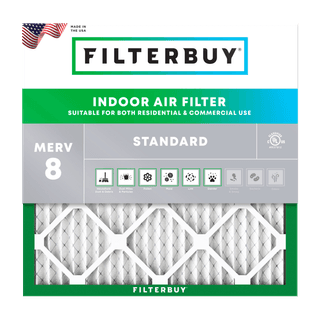
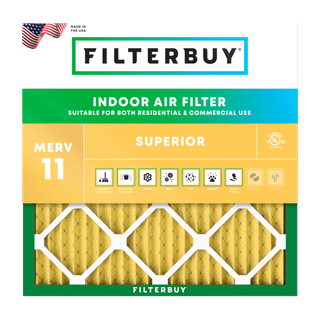
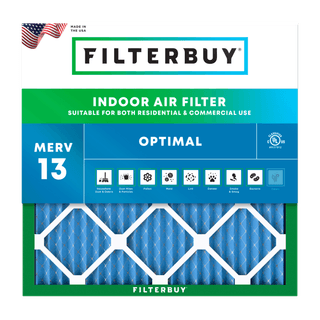
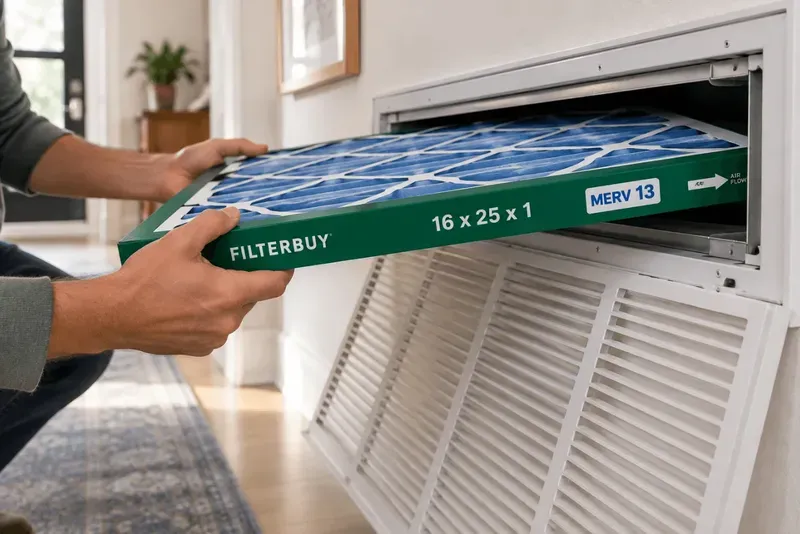
Put MERV 13 in the HVAC. Smoke maps to MERV 13 on the ladder, so if your system is running MERV 8 or MERV 11, switch. Most furnaces and HVAC systems accommodate MERV 13 without equipment problems, provided the filter is replaced often. Confirm the size the same way you would for any replacement, then find your filter size.
Set the thermostat fan to On. Auto only filters while the system is heating or cooling. On filters continuously.
Run a portable HEPA air cleaner in each occupied room, bedrooms first. HEPA belongs in a portable unit, never in a furnace slot. Size it by the EPA’s clean-room rule: a smoke CADR of at least two-thirds of the room’s square footage, so a 300 square foot bedroom wants a CADR around 200. Skip anything that produces ozone, which the EPA advises against.
Close the house up. Windows and doors shut, and no candles, frying, broiling, vacuuming, or smoking while smoke is indoors.
Check the filter during the event rather than waiting on the calendar. Replace it when it looks dirty, dark brown or black, which can come well before the interval on the box, and keep spares on hand. Our guide to MERV ratings compares the tiers side by side.
No central HVAC? In an apartment, a window-unit home, or anything without ductwork, portable HEPA cleaners are your primary defense rather than a supplement. A box fan paired with a MERV 13 filter is a reasonable stopgap the EPA has tested and found effective in homes and schools. Use a certified fan from 2012 or newer and do not leave it running unattended.
At 201 and above, follow AirNow and CDPHE guidance before anything on this page. Filtration reduces what is in the air. It is one layer, not the answer.
Supporting Statistics
Three findings from public agencies behind the claims above.
Nearly one-quarter of Front Range ozone pollution comes from oil and gas operations.
Who measured it: the Regional Air Quality Council, which writes Colorado’s ozone plan for the nine-county metro region.
What it counts: operations, storage, drilling, trucking, engine exhaust.
Why it matters here: Thornton sits inside that area, Weld County production north and east.
Source: Regional Air Quality Council.
985,296 Colorado children live where the air is unhealthy to breathe.
Who counted them: the American Lung Association's 2026 State of the Air report.
Why children: their lungs are still developing.
On this page: kids fall in the sensitive-groups category the AQI flags at 101.
Source: American Lung Association, State of the Air 2026.
A high-efficiency filter on continuous fan cuts indoor PM2.5 roughly in half.
EPA figures for reducing smoke exposure indoors, ranked by effect:
About 50 percent lower indoor PM2.5 with a high-efficiency filter and the fan set to run continuously.
About 24 percent lower with a typical low-efficiency filter on continuous fan.
55 to 60 percent of outdoor levels still get in during smoke events with windows closed and no air cleaner running.
Source: U.S. EPA, Strategies to Reduce Exposure Indoors, citing Fisk and Chan 2017.
Frequently Asked Questions
Glossary
AQI (Air Quality Index): the EPA's 0–500 scale for outdoor air pollution risk, in six color-coded categories.
PM2.5: fine particulate matter 2.5 micrometers or smaller, small enough to reach deep into the lungs. The main pollutant in smoke.
Ozone (ground-level): a gas formed when sunlight reacts with nitrogen oxides and volatile organic compounds. Thornton's summer pollutant. Air filters do not remove it.
Inversion: warm air sitting above cold air, trapping pollutants near the ground. The Front Range brown cloud.
Nonattainment area: an EPA designation for a region failing a national air quality standard. Thornton is in the Denver Metro/North Front Range ozone area.
MERV: Minimum Efficiency Reporting Value, ASHRAE’s 1–16 scale for how well a filter captures airborne particles. True HEPA is a separate category built for portable air cleaners, not for furnace slots.
CDPHE: the Colorado Department of Public Health and Environment, which runs the state's air monitors and issues alerts.
Action Day: a CDPHE advisory when air quality is unhealthy or expected to worsen. Summer versions restrict open burning, winter ones wood burning.