
Lakewood Real-Time AQI Tracker


Get Alerts For Unhealthy AQI In Your Area
When air quality in your area reaches unhealthy levels, we'll send you a quick alert, along with expert tips on how to reduce your exposure.
What's Actually In Lakewood Air Today?
What High AQI Means for Your Lungs in Lakewood
How to Read AQI
The Air Quality Index (AQI) measures how polluted the air is and how it may affect your health.
0–50 (Good): Air quality is satisfactory.
51–100 (Moderate): Acceptable, but some pollutants may pose minor concerns.
101–150 (Unhealthy for Sensitive Groups)
151–200 (Unhealthy)
201–300 (Very Unhealthy)
301+ (Hazardous)
Moderate
Still okay for most, but if you have asthma or allergies, take it easy and avoid long outdoor workouts.
Shop MERV 11 filters→What's the Right Filter for Your AQI Level?
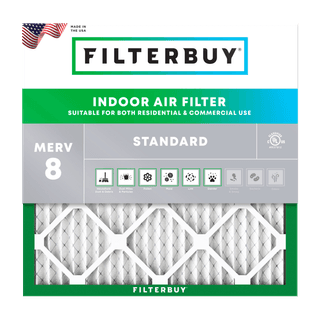
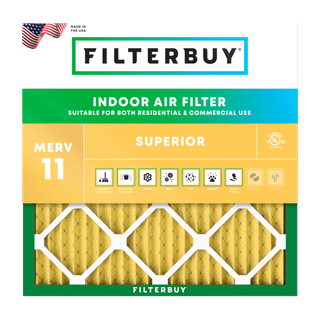
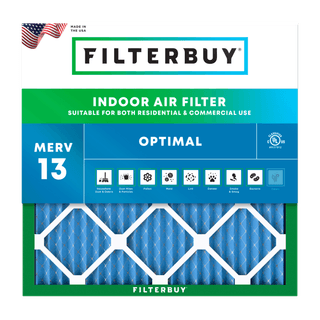


Check Today's Live Real Time Air Quality Index AQI Map in Lakewood, CO Now
By Michelle Wan, Brand Manager & Air Quality Writer at Filterbuy | Reviewed by David Clark, Licensed HVAC Technician | Published: August 18, 2026 | Updated: August 18, 2026
TL;DR
Lakewood, Colorado sits inside the nine-county Denver Metro/North Front Range ozone nonattainment area, so air quality swings between two problems: summer ozone and cool-season or wildfire fine particles. Check the live AQI map below, then match your response to the pollutant behind the number. Ozone calls for less time outdoors and less driving. Fine particles respond to a MERV 13 filter and a continuously running fan.
Key Takeaways
Lakewood has no active EPA-grade regulatory air monitor inside city limits. Colorado decommissioned the Welch station on West Highway 285 in 2021.
The nearest active state monitors sit 4 to 12 miles from central Lakewood, the main reason two apps disagree.
EPA lowered the Good PM2.5 ceiling from 12.0 to 9.0 micrograms per cubic meter on May 6, 2024, so readings that once showed green now show yellow.
Colorado issues daily ozone forecasts and Action Day Alerts for the Denver metro and northern Front Range, May 31 through August 31.
An HVAC filter captures wildfire smoke and other fine particles. It does not remove ground-level ozone, which is a gas.
Live Air Quality Index AQI Map For Lakewood, CO Right Now
The fastest way to see live air quality in Lakewood is the EPA AirNow map, which plots validated readings from state and federal monitors. In smoke season, the Fire and Smoke Map adds thousands of low-cost sensors.
Three sources answer different questions:
AirNow is the official EPA index. Search by Lakewood ZIP code (80214, 80215, 80226, 80227, 80228, 80232) for the nearest reporting area. EPA’s AQI Basics explains the scale.
AirNow Fire and Smoke Map is the one to open when wildfire smoke is in the forecast.
Jefferson County Public Health runs the Love My Air dashboard, with real-time particulate readings from monitors in Lakewood, Edgewater, Wheat Ridge, and Golden.
What Is The Air Quality In Lakewood Today And How Do You Read The Number?
The Air Quality Index is a 0 to 500 scale that converts pollutant concentrations into one color-coded number, and it always reflects whichever pollutant is worst at that moment. A Lakewood AQI of 75 in July usually means ozone. The same 75 in December, or during smoke, means fine particles. EPA tightened the PM2.5 breakpoints on May 6, 2024.
PM2.5 breakpoints reflect the U.S. EPA update to the Air Quality Index effective May 6, 2024. The ceiling for the Good category moved from 12.0 to 9.0 µg/m³.
Which Monitors Produce Lakewood’s AQI Reading And Why Two Apps Disagree
Lakewood, Colorado has no active EPA-grade regulatory monitor within its 43.5 square miles. The Colorado Department of Public Health and Environment monitoring site index records the Welch station on West Highway 285 as decommissioned in January 2021. Every Lakewood AQI figure is therefore borrowed or interpolated from a monitor miles away, which is the biggest reason two apps disagree. Filterbuy built the table below, measuring the distance from Lakewood’s city coordinates to every active station in the region and noting which pollutants each reports.
Distances are straight-line calculations from the Lakewood city coordinates (39.7047, -105.0814) to each station's published coordinates in the Colorado Department of Public Health and Environment monitoring site index. The Welch station at 12400 W. Highway 285 in Lakewood was decommissioned in January 2021.
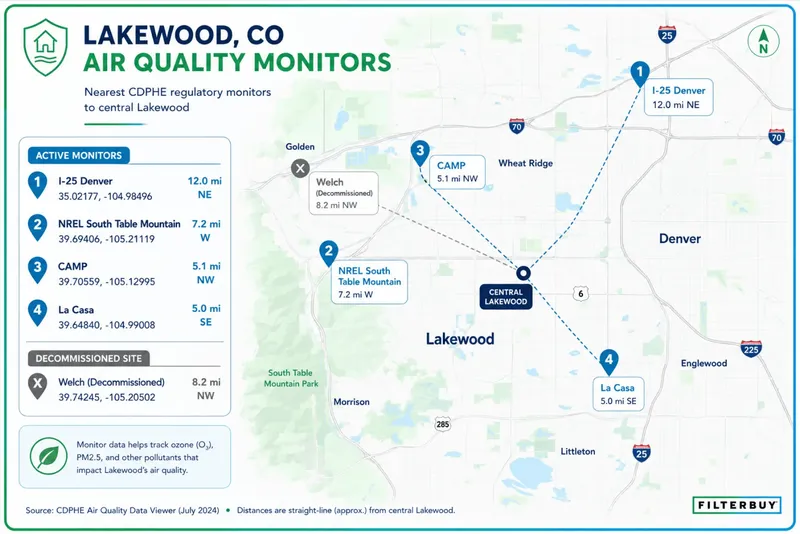
A reading from the Golden monitor tells you nothing about smoke, since that site reports ozone only. And low-cost sensors are not reference-grade, so use them for trend rather than the official number.
Where You Live In Lakewood Changes How Much The Number Means
Lakewood covers 43.5 square miles, and the distance to the nearest monitor varies across it. Filterbuy measured three points:
Northeast Lakewood, near West Colfax and Sheridan, sits 2.1 miles from the I-25 Denver monitor.
Central Lakewood, around Belmar, sits 4.0 miles away.
Southwest Lakewood, around Green Mountain and Bear Creek, sits 8.1 miles away, and that monitor is a roadside site across the metro.
So the citywide figure is roughly four times more local for a northeast Lakewood household than a southwest one. On the southwest side, lean on the neighborhood sensor network during smoke.
Is The Air Quality Bad In Lakewood Today? Lakewood’s Two Air Quality Seasons
Whether the air is bad today depends less on the number than on the calendar. Filterbuy splits Lakewood’s year into two pollution seasons with different causes and different fixes. Households that mix them up buy the wrong protection.
Ground-level ozone is a gas and passes through HVAC filter media. Filtration reduces fine particles, not ozone.
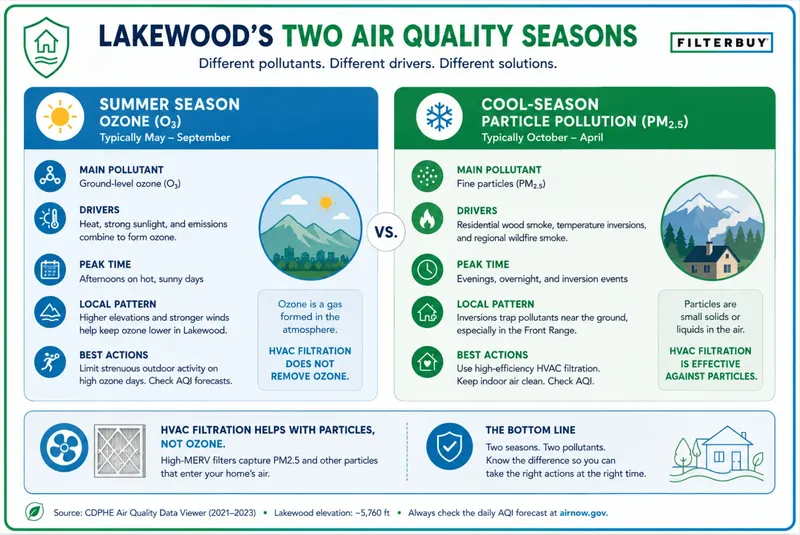
EPA reclassified the Denver Metro/North Front Range nonattainment area, which includes Jefferson County, to Severe for the 2008 ozone standard in 2022 and to Serious for the 2015 standard in 2024. Its three-year ozone average stood at 81 parts per billion against a 70 ppb standard.
Colorado issues a daily ozone forecast from May 31 through August 31, and the notice states plainly whether an Ozone Action Day Alert is in effect.
Supporting Statistics On Lakewood Area Air Quality
Three independent measurements frame what a Lakewood AQI reading means. None is Filterbuy’s.
Jefferson County averaged 29.7 unhealthy ozone days a year and earned an F grade.
Source: American Lung Association, State of the Air 2026, using 2022 to 2024 data.
Lakewood: Lakewood is in Jefferson County. That figure ranked the Denver-Aurora-Greeley metro 8th worst nationally for ozone.
Front Range monitors logged 23 days above the federal ozone standard in 2025. Colorado issued 33 Ozone Action Day Alerts.
Source: Regional Air Quality Council, 2025 ozone season data.
Lakewood: 2025 was the lowest ozone season since 2009, and the nine-county area still failed the standard.
Americans spend about 90 percent of their time indoors. Some indoor pollutants run 2 to 5 times higher than outdoors.
Source: EPA Report on the Environment.
Lakewood: Those most vulnerable to pollution spend even more time inside. An AQI reading is an indoor decision.
Lakewood PM2.5 Today And Where The Fine Particles Come From
PM2.5 means airborne particles 2.5 micrometers or smaller, small enough to reach deep into the lungs and enter the bloodstream. Three sources dominate in Lakewood: wildfire smoke arriving on regional winds, residential wood burning in the cool season, and year-round traffic along Sixth Avenue, Wadsworth Boulevard, Colfax Avenue, and I-70.
Geography concentrates all three. Lakewood sits at 5,519 feet against the foothills, and on cold, still mornings a temperature inversion traps air near the ground. A calm January morning can read worse than a windy one.
What To Do When The Lakewood AQI Is Unhealthy Today
When the Lakewood AQI reaches 101 or higher, act in this order.
Check which pollutant is driving the reading. AirNow names it, and it determines the rest.
Close windows and doors, and close any fresh-air intake or set the system to recirculate.
Switch the thermostat fan from Auto to On so air keeps cycling through the filter between heating and cooling calls.
Move exercise indoors. Shift unavoidable outdoor work to early morning in ozone season.
Skip anything that adds indoor particles: candles, wood stoves, frying, and vacuuming without sealed HEPA.
Check the Front Range advisory page and sign up for Colorado air quality alerts so the next Action Day reaches you before you plan the day.
How To Filter Wildfire Smoke And PM2.5 From Your Lakewood Home
EPA recommends upgrading to an HVAC filter rated MERV 13 or higher during smoky periods, and states that a high-efficiency filter with the fan running continuously may cut indoor PM2.5 by roughly 50 percent. Most Front Range furnaces accept MERV 13 if it is replaced on schedule.
Filters carry a nominal size on the frame and a smaller actual size. Order by nominal size, or build a custom-size filter if your slot is odd.
Replace the filter as soon as it looks dark brown or black. Smoke loads a filter faster than dust, so one smoke week can eat a change interval.
Add a portable air cleaner for one bedroom during a long smoke event. See MERV 13 compared with HEPA for wildfire smoke.
Do not expect any filter to lower ozone. The MERV rating scale measures particle capture, not gas removal, so an Action Day calls for less driving and less outdoor exertion.
Filterbuy manufactures pleated MERV 13 air filters in standard and custom sizes, including the common 20x20x1 MERV 13 one-inch size and the deeper 20x25x4 MERV 13 media cabinet size used in many Front Range homes.
For the wider picture: the live air quality index for Colorado, the Denver air quality index a few miles east, and how to read the Fire and Smoke Map.
Expert Insight From The Filterbuy Team
After manufacturing filters for over a decade and serving more than two million households, we’ve found that the AQI usually spikes hours before a family even notices smoke indoors. That’s exactly why the filter you install before fire season matters more than anything you do once the haze arrives.
Filterbuy Air Quality Team
Frequently Asked Questions About Lakewood, CO Air Quality
Glossary Of Lakewood Air Quality Terms
Air Quality Index (AQI): the EPA 0 to 500 scale converting pollutant levels into one color-coded number.
PM2.5: fine airborne particles 2.5 micrometers or smaller, the pollutant that dominates wildfire smoke.
Ground-level ozone (O3): a gas formed when heat and sunlight react with vehicle and industrial emissions. Colorado’s main summer pollutant.
Ozone Action Day Alert: a Colorado advisory issued when forecast ozone may exceed the federal standard on the Front Range.
Nonattainment area: a region EPA has determined fails a national air quality standard. Lakewood sits in the Denver Metro/North Front Range ozone area.
NAAQS: National Ambient Air Quality Standards, EPA’s health-based limits for six common outdoor pollutants.
MERV: Minimum Efficiency Reporting Value, the 1 to 16 scale rating how well an HVAC filter captures particles.
NowCast AQI: the near-real-time AQI AirNow publishes from hourly monitor data, as distinct from the validated daily figure.
Temperature inversion: warm air over cooler surface air, trapping pollution near the ground. Common on Lakewood winter mornings.
Love My Air: a Denver-originated low-cost sensor network Jefferson County Public Health expanded into Lakewood.