
RV Wildfire Smoke Filtration: Custom Filter Sizes, HVAC Setup, and Tips
September 22, 2026
What Air Filter Should You Use in an RV During Wildfire Smoke?
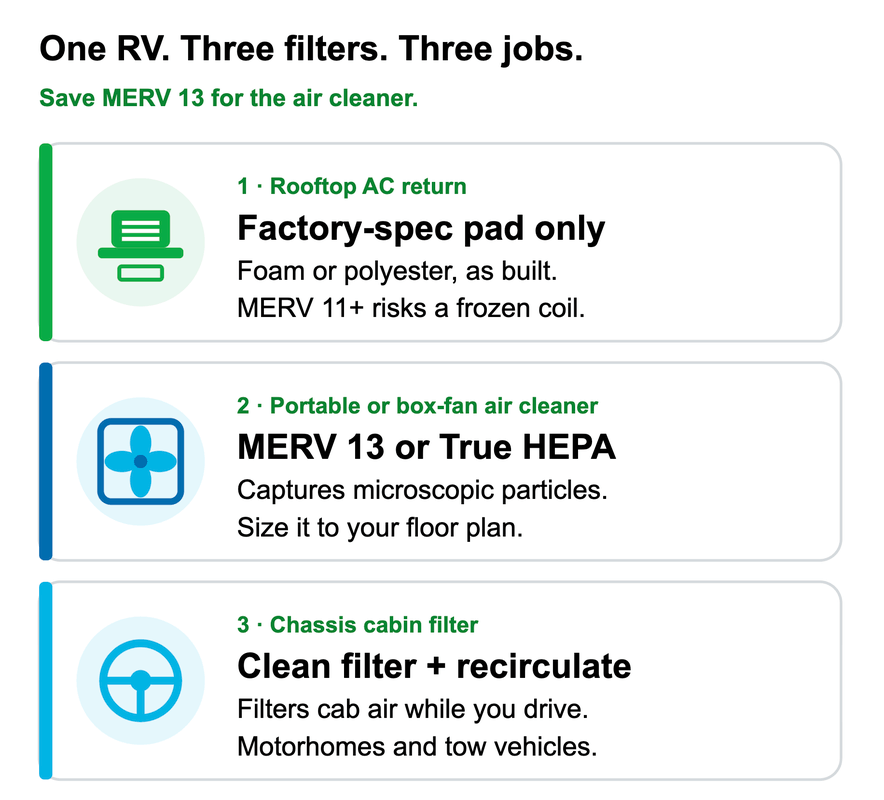
Keep the factory-spec pad in your rooftop AC, and put MERV 13 in a separate air cleaner instead. Rooftop RV units run small blowers, and MERV 11 or higher adds enough airflow resistance to risk a frozen evaporator coil.
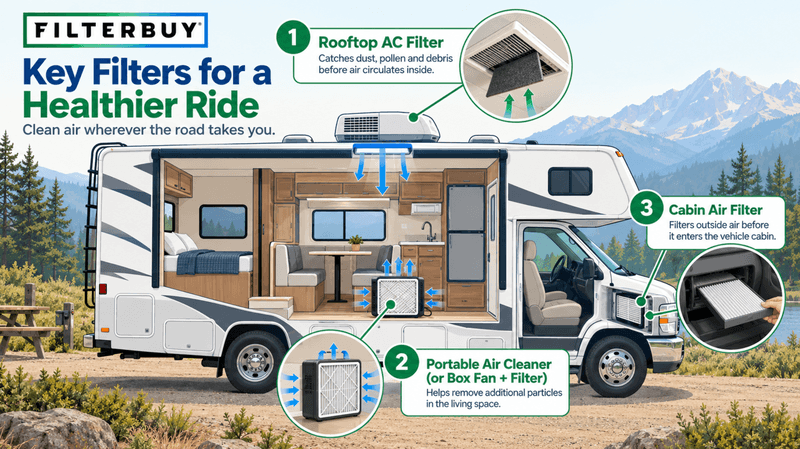
Your rig has up to three filters, and each one has a different job:
Rooftop AC return: the foam or polyester pad it was built for.
Portable or box-fan air cleaner: MERV 13 or True HEPA for microscopic particles.
Chassis cabin filter: a clean filter, with the AC on recirculate while you drive.
Not sure what fits your rig? Take the quick match quiz below.
Made in the USA since 2013 · Custom sizes to your exact measurements · Perfect-fit guarantee
Find Your Filter Match
Answer a few quick questions and we'll match you to the right filter.
TL;DR
Your RV has up to three separate air filters, and the one in your rooftop air conditioner is the wrong place to fight wildfire smoke. RV rooftop units hold a thin foam or polyester pad behind the ceiling return grille, and their small blowers cannot pull air through a MERV 13 pleated filter without risking a frozen evaporator coil. Keep the factory-spec pad clean, run a separate air cleaner sized to your rig, and switch your chassis HVAC to recirculate when you drive.
Key Takeaways
RV rooftop air conditioners recirculate interior air. Most have no outdoor intake, so running the fan on a smoky day filters the air you already have instead of pulling more smoke in.
MERV 13 belongs in a box-fan air cleaner inside your RV, not in the rooftop AC return. RV filter suppliers warn that MERV 11 and above creates too much airflow resistance for rooftop units.
A clogged rooftop AC filter is a leading cause of evaporator freeze-up. During smoke season, check the pad weekly rather than seasonally.
EPA's sizing rule: choose an air cleaner with a tobacco-smoke CADR of at least two-thirds your floor area in square feet. That is roughly 50 for a camper van and 130 for a 30-foot Class C.
Motorhomes have a second filter most owners never touch: the chassis cabin air filter behind the dash, which is what protects you while driving.
Older rigs with discontinued grille sizes can use custom-cut filters, but check depth first. Most pleated filters start near 3/4 inch actual thickness.
A standard air cleaner running nonstop draws roughly 90 amp-hours a day at 12 volts. An ENERGY STAR certified one draws about 42, which is what makes off-grid filtering possible.
An RV can drive out of the smoke. Relocating beats any filter, when road visibility and fire location allow it.
Why an RV Is Harder to Protect Than a House
An RV is a leaky box on wheels. EPA research on indoor smoke levels found that with windows and doors closed, indoor fine particle levels during smoke events typically settle around 55 to 60 percent of outdoor levels, and that tighter, newer, air-conditioned buildings do best. An RV sits at the wrong end of that range, because slide-out seals, roof vents, and a door that opens straight into the living space all let smoke in fast. What works in your favor is volume: a 200-square-foot trailer cleans up quickly once you put real filtration in it, which turns the whole problem into a question of knowing which filter does which job.
Supporting Statistics
Three findings from federal and industry research explain why this matters, and why the fix is not a higher MERV rating.
Asthma emergency visits rose 17 percent on smoke days. When smoke from Canadian wildfires reached most of the contiguous U.S. in 2023, CDC recorded asthma-associated emergency department visits running 17 percent higher than expected across the 19 smoke days between April 30 and August 4. Smoke is a health event rather than a nuisance smell, and a camper offers less protection from it than a house does.
8.1 million U.S. households own an RV, and they are using them more. The RV Industry Association puts RV-owning households at 8.1 million, with median annual use now 30 days a year, up 50 percent from the 20 days recorded in 2021. More days in the rig means more days exposed, and fire season lands squarely on peak camping season.
Running the fan continuously cuts particles even with a basic filter. EPA reports that a high-efficiency filter with the system fan running continuously may lower indoor PM2.5 by about 50 percent, and that even a typical low-efficiency filter still cuts particle concentrations by roughly 24 percent when the fan runs nonstop. That second figure is the one that matters in a camper, because it means keeping the factory-spec pad and running the fan does real work without forcing media the blower was never built to pull through.
The Three Filters in Your RV
Most owners know about one of them. The other two matter just as much:
Towables have two of these and motorhomes have all three, and the mistake almost everyone makes is asking the first one to do the second one's job.
Why MERV 13 Can Damage Your Rooftop AC
Rooftop RV air conditioners run small, low-power blowers designed around very little airflow resistance. Retailers in the RV filter market state plainly that MERV 11 or higher creates too much resistance for these units and reduces cooling performance. The failure mode is specific and expensive: when airflow across the coil drops, coil temperature falls below freezing, humidity ices onto the surface, and that ice blocks whatever airflow was left. The unit blows warm air or quits cooling entirely.
Physical fit is the second problem. Dometic Duo-Therm ceiling assemblies take a 14 by 7.5 inch pad, while Coleman-Mach grilles commonly take 14 by 6 or 16 by 4, and all of them are open-cell foam or non-woven polyester running 1/4 to 1/2 inch thick. A pleated filter is about 3/4 inch even at its thinnest, so in plenty of rigs the grille will not latch closed over one.
The scale of the thing is what owners tend to miss. That Dometic pad is roughly 101 square inches of face area, about the size of a sheet of letter paper, against roughly 478 square inches on a common 20x25 home filter. Your rig is defending the same set of lungs with a fifth of the media, which is exactly why it loads so fast once smoke arrives.
The Rule
Match the rooftop AC filter to what the unit was built for. Fight smoke somewhere else.
What to Actually Do at Your RV Rooftop AC
Three moves, none involving a higher MERV rating:
Confirm you have no outdoor intake. Most RV rooftop units pull only interior air through the ceiling grille; Airstream and Forest River owner communities consistently report no outside intake. If your model has an optional fresh-air damper, close it and verify against your AC manual.
Run the fan continuously. With the intake closed, the AC is a recirculating loop, and EPA advises running the fan continuously rather than on "auto" so interior air keeps passing through your filtration. The same logic decides whether a home air conditioner filters wildfire smoke.
Change the pad far more often. Standard guidance is every 60 to 90 days of active use, and smoke loads a filter much faster. Inspect weekly during a smoke event, and stock spares before fire season.
Build the Air Cleaner That Actually Removes Smoke
This is where filtration belongs, because a box fan can pull through MERV 13 media that a rooftop AC cannot.
EPA recommends a commercially made portable air cleaner first, treating DIY box-fan cleaners as the option when a commercial unit is not available or affordable. Both work. EPA research on DIY air cleaners found one cut fine particles by roughly 99 percent in a smaller room within an hour during a smoke event, and about 56 percent in a larger room within 90 minutes. RV-sized spaces behave like that smaller room.
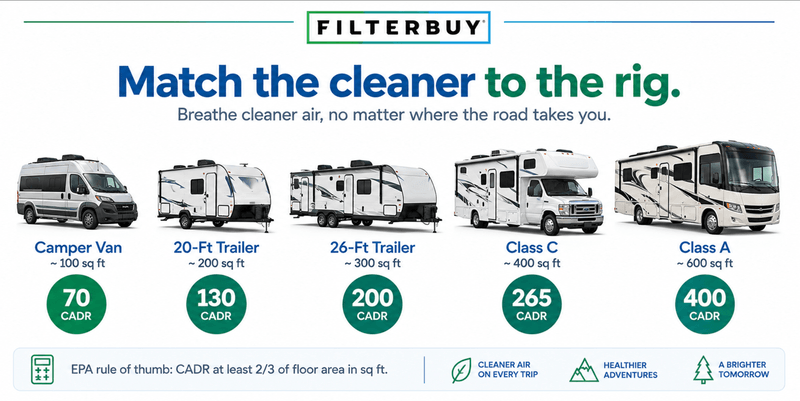
Sizing your cleaner. EPA's sizing rule for smoke is a tobacco-smoke CADR of at least two-thirds of the floor area in square feet. Applied to common RV floorplans:
Areas are typical interior living space; measure your own floorplan. RV ceilings are usually under eight feet, which works slightly in your favor.
Whatever you choose, confirm it produces little or no ozone. The California Air Resources Board publishes a list of CARB-certified air cleaning devices screened for ozone emissions.
If you build one: strap a MERV 13 filter to the intake side of a box fan with the airflow arrows pointing into the fan, and seal the edges so air cannot bypass the media. A single 20x20x1 MERV 13 is the simplest version, and it is a stock Filterbuy size rather than a special order.
The Power Question Nobody Answers
If you camp off-grid, this is the number that decides everything, and almost no guide will give it to you. ENERGY STAR reports that a standard room air cleaner running continuously uses about 394 kWh a year, which works out to roughly 45 watts, or about 90 amp-hours a day at 12 volts. That is more than a single 100 Ah battery will hand you in a day. A certified model cuts the draw by more than half, to roughly 42 amp-hours a day, which is the difference between filtering all night and watching the battery monitor instead. On shore power none of this matters and the cost is pennies either way. On battery in fire country, that certification stops being a green badge and becomes the spec that decides whether your rig can filter at all.
Your RV Cooktop Is Working Against You
EPA’s guidance during smoke events is to avoid gas and propane stoves and to go easy on frying and broiling. In a house that just means reaching for the microwave. In an RV, propane is usually the only burner you have, and most RV range hoods recirculate through a grease filter rather than venting outside, so cooking loads particles straight into the air your cleaner is trying to scrub. Cook outside on the picnic table where you can, lean on an electric kettle or induction plate when you have shore power, and save the frying for a clear day.
Custom Filter Sizes for Older and Odd-Sized Rigs
Older campers are where standard sizes run out. Discontinued ceiling assemblies, aftermarket grilles, and previous-owner modifications leave plenty of rigs with an opening no catalog size fits.
Filterbuy builds custom air filters to exact measurements at its own U.S. factories, in any length, width, and depth from 3/8 inch to 30 inches, and in MERV 8, MERV 11, MERV 13, or activated-carbon Odor Eliminator. Orders ship in two to three business days with a perfect-fit guarantee: if it does not fit as specified, Filterbuy remakes it free.
Why a filter manufacturer is telling you not to buy the upgrade. Filterbuy has built air filters in the United States since 2013 and served more than two million households. We manufacture rather than resell, and every custom specification is tested in our own lab for filtration efficiency, airflow resistance, and structural integrity before it goes into production. Airflow resistance is the number that governs this page. RVs and mobile homes also sit on our own published list of the most common reasons customers order a custom size, and they are a hard case for exactly that reason: the openings are non-standard, but the blowers sitting behind them are small. A filter that fits is not automatically a filter your rooftop unit can pull air through, and we would rather say so than sell you a MERV 13 that ices your evaporator coil in August.
I don’t want anyone to feel like they need an HVAC license just to pick the right filter. My job is to give you the straight answer, explain why it matters, and let you get back to your day.
Michelle Wan, Brand Manager and Air Quality Writer, Filterbuy
Two cautions before ordering:
Check depth against your grille. Pleated media is thicker than a foam pad. Measure the closed depth of the return grille, not just length and width.
Do not jump MERV ratings on a rooftop AC. A filter that fits is still one your blower has to pull through. Match the original specification, and save MERV 13 for the box fan.
Driving Through Smoke
Motorhome drivers and anyone towing have a filter with nothing to do with the RV's HVAC: the chassis cabin air filter, behind the dash or glovebox of a Ford, Ram, Mercedes, or Chevrolet chassis. One thing trips up nearly every new motorhome owner: you search this filter by the chassis under the coach, not by the coach brand. Your registration or door jamb sticker will tell you which chassis you are on, and from there a Filterbuy cabin filter lookup by year, make, and model will find the part.
EPA advises closing windows and running the vehicle's air conditioning in recirculation mode when smoke levels are high. The recirculation button shows a car outline with a looping arrow inside it. Recirculate plus a clean cabin filter makes a real difference. One vehicle owner who logged cabin readings with a particle counter during a smoke event reported counts falling to near zero within about 30 minutes on recirculate, against several times that on fresh-air defrost. That is a single informal test rather than a controlled study, so treat the direction as reliable and the exact figures as indicative.
Practical notes for long smoke-season drives:
Recirculate can raise carbon dioxide over hours in a closed cabin. Crack a vent briefly when you can.
Visibility wins. If windows fog, use defrost even though it pulls outside air.
Smoke loads a cabin filter faster than mileage intervals assume. Inspect it after a smoky trip.
Check conditions before you roll. Wind shifts move smoke plumes hundreds of miles in a day.
Your Best Filter May Be the Steering Wheel
An RV has one advantage a house never will: it moves. EPA notes that leaving an area of thick smoke is generally a good protective measure for people at higher risk, and no filter beats simply not being under the plume. Check the map before you commit to a site, and treat a multi-day smoke forecast as a reason to relocate rather than a reason to seal up and wait it out.
Two caveats keep that honest. Smoke cuts road visibility and makes driving hazardous, so a bad-visibility day is not a travel day, and moving toward a fire to get around its smoke is never the trade. When relocating is not realistic, whether that is a reservation you cannot move, a rig you cannot tow, or roads that are closed, everything above still applies.
When to Open the RV Back Up
Sealing up is only half the job, and the page you are reading would fail you if it stopped there. EPA advises airing out the space once smoke clears, even briefly, so open windows and roof vents on the first clean day rather than staying buttoned up out of habit. Pull the rooftop pad and the air cleaner filter at the same time, because both will be loaded well ahead of schedule. Ash settles on surfaces too, so wipe down counters and soft furnishings with a damp cloth instead of dry-dusting, which just puts the particles back in the air. Watch your pets on the way out as well, since dogs and cats sharing a 200-square-foot space breathed everything you did and often show irritation a day or two behind you.
Fire-Season Checklist
Do this before you leave, not when the sky turns orange.
Stow two or three factory-spec rooftop AC filter pads in the rig, and confirm whether your rooftop AC has a fresh-air damper you can close.
Buy or build an air cleaner meeting the CADR figure for your floorplan, plus spare filters on Filterbuy auto-delivery so you do not run out mid-season.
Replace the chassis cabin air filter if it is more than a season old, and reseal roof vents, slide seals, and window gaskets.
Bookmark a live AQI map and AirNow’s Be Smoke Ready guide.
Frequently Asked Questions
Can I Put a MERV 13 Filter in My RV Air Conditioner?
Generally no. RV rooftop air conditioners use small, low-static blowers, and RV filter suppliers warn that MERV 11 and above creates too much resistance for these units, reducing cooling and risking evaporator freeze-up. Use the factory-spec pad in the rooftop unit and run MERV 13 in a separate box-fan cleaner.
What Size Is an RV Air Conditioner Filter?
It depends on the ceiling assembly, not the RV. Dometic Duo-Therm assemblies commonly take 14 by 7.5 inches; Coleman-Mach grilles commonly take 14 by 6 or 16 by 4. Check the model number stamped on the rooftop shroud or interior assembly, or measure the pad you pull out.
Does My RV Air Conditioner Pull in Outside Air?
Most do not. Rooftop RV air conditioners typically draw only interior air through the ceiling return grille. Some models offer an optional fresh-air damper. Close it during smoke events and verify against your AC manual.
How Often Should I Change My RV Air Filter During Wildfire Smoke?
Far more often than the standard 60-to-90-day interval. Inspect the rooftop pad weekly during an active smoke event and replace it whenever it looks loaded or gray.
Will an Air Purifier Work in an RV?
Yes, and small spaces are where they perform best. If the distinction is unclear, air filters and air purifiers do different jobs. Size it using EPA's rule of a tobacco-smoke CADR at least two-thirds your floor area in square feet, and confirm it produces little or no ozone.
Do I Need a Custom Filter for My Camper?
Only if your grille size is discontinued or non-standard, or if you are building a DIY cleaner around a fan that will not take a catalog size. Measure length, width, and closed depth, then have Filterbuy build a custom size filter to those measurements.
Glossary
AQI (Air Quality Index). The EPA scale reporting outdoor air quality on a 0-to-500 range, color-coded green to maroon.
CADR (Clean Air Delivery Rate). A standardized measure of how much filtered air a portable cleaner delivers. The tobacco-smoke CADR figure is the one that matters for wildfire smoke.
Evaporator coil. The cold coil inside a rooftop air conditioner that removes heat and moisture from cabin air. Restricted airflow across it causes freeze-up.
HEPA (High-Efficiency Particulate Air). A standard requiring capture of at least 99.97 percent of particles at 0.3 microns. Used in portable air cleaners, not RV rooftop HVAC.
MERV (Minimum Efficiency Reporting Value). A 1-to-16 scale rating how effectively a filter captures particles. Higher numbers capture more, and resist airflow more.
PM2.5. Fine particulate matter 2.5 microns and smaller. This is the fraction of wildfire smoke that reaches deep into the lungs, and the reason smoke is a health concern rather than just a smell.
Return grille. The vented ceiling panel beneath an RV rooftop air conditioner where interior air is drawn in.
About the author and reviewer
Michelle Wan
is Brand Manager and Air Quality Writer at Filterbuy, where she translates MERV ratings, filtration, and HVAC efficiency into plain-English advice for homeowners. She works directly with Filterbuy’s U.S. manufacturing team, so her writing is grounded in how filters are built, tested, and used rather than in spec sheets alone. She also fronts much of Filterbuy’s educational video content. Michelle holds a B.A. in Sociology from the University of California, Santa Cruz. Learn more on her author page.
David Clark
is a Licensed HVAC Technician with Filterbuy HVAC Solutions who reviews Filterbuy’s maintenance and system-compatibility guidance for technical accuracy.