
Is Wildfire Ash Toxic? A Complete Guide to Urban vs. Forest Ash Chemistry, Health Risks, and Safe Cleanup Steps for Homeowners
August 20, 2026
By Michelle Wan | Reviewed by David Clark, Licensed HVAC Technician
Published: August 21, 2026 | Updated: August 21, 2026
Wildfire ash can be toxic, and how toxic depends on what burned, not on how big the fire was. Ash from trees and brush is alkaline mineral residue that irritates eyes, skin, and airways. Ash from burned homes, cars, and businesses concentrates lead, arsenic, asbestos, and PAHs, and should be treated as hazardous until it is tested.
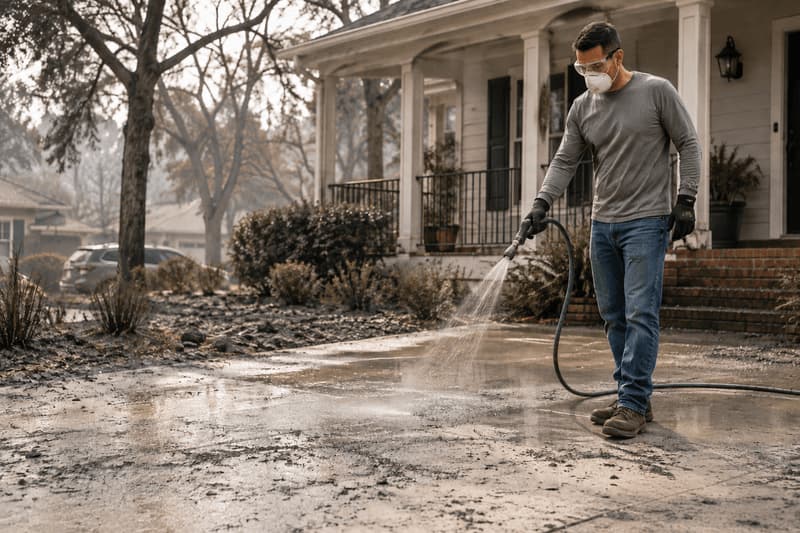
Vegetation burned: an irritant. Gloves, goggles, a fitted N95, mist and wet mop.
Structures burned: assume metals and asbestos. Wet-clean with HEPA, or hire it out.
Either way: never dry-sweep and never use a leaf blower. Both put settled ash back in the air.
Filtration belongs before the cleanup, not after it. Researchers studying post-fire Los Angeles homes recommended running central HVAC with filters rated MERV 13 or higher, which capture microscopic particles, before reoccupying. The quiz below matches your system to the right filter.
Answer 3 quick questions and we will match you to your filter.
Know your size already? Shop Filterbuy air filters, built in the U.S. and shipped factory-direct.
TL;DR
Wildfire ash can be toxic, and how toxic depends almost entirely on what burned. Forest ash is mostly alkaline mineral residue: irritating, but chemically simple. Ash from burned homes, cars, and businesses concentrates lead, arsenic, asbestos, and PAHs. Find your situation in the table below, then never dry-sweep, never use a leaf blower, and never touch wet ash with bare skin.
Key Takeaways
Urban wildfire ash and forest ash are not the same material. Structural ash carries metals and synthetic-chemical residues that vegetation ash does not.
Roughly 28% of structural-ash samples from the 2025 Eaton and Palisades fires exceeded the EPA’s 200 ppm residential lead screening level, and 50% exceeded California’s stricter 80 ppm limit (Dossou et al., Environmental Science & Technology Letters, 2026).
Wildfire ash is chemically basic, not neutral. Mineral ash turns alkaline in solution (Bodí et al., via USGS); a global survey by Sánchez-García et al. put the mean at 8.8, ranging to 11.2. Wet ash on skin can cause chemical burns.
The most common cleanup mistake is the one that makes exposure worse. The EPA instructs homeowners to never use a leaf blower and to avoid dry sweeping. Both aerosolize settled ash you would otherwise never inhale.
Ash exposure does not end when the smoke clears. In a study of 19 Los Angeles homes measured before reoccupancy, lead on surface wipes exceeded EPA dust clearance levels in multiple homes, especially window sills and entry floors, two months after the fires (ACS ES&T Air, 2026).
Is Wildfire Ash Toxic?
Yes, wildfire ash can be toxic, and the risk depends on what burned rather than on the fire’s size. Ash from trees and brush is primarily alkaline mineral residue that irritates eyes, skin, and airways. Ash from burned homes, vehicles, and businesses concentrates heavy metals, asbestos fibers, and carcinogenic combustion byproducts. Treat any ash from a structure fire as hazardous material.
The trouble is that most of us picture a fireplace. That instinct is now formally out of date, and the EPA says so plainly: ash from burned structures in the wildland-urban interface generally contains more harmful chemicals than forest ash. What lands on driveways and windowsills after a neighborhood burns is a chemical record of everything that was inside those buildings when they went up.
Which points to the distinction most coverage skips, and the one that should drive every decision you make afterward: the question is not how big the fire was. It is what burned. A 100,000-acre forest fire can leave ash chemically closer to fireplace ash than a single burned cul-de-sac does, because acreage makes the headlines while fuel makes the toxicity.
Caltech geochemist François Tissot put the contrast plainly after the Eaton Fire: if mostly trees burn, the worst-case inhalation risk is largely potassium, which is not especially dangerous. Because Eaton burned a populated area of older buildings, residents faced particulates from car batteries, lithium, and lead paint instead.
First, Which of These Three Situations Are You In?
Almost every guide on this subject is written for someone standing in a burn scar, and almost nobody reading it is. So before anything else, find your row below. The three situations call for genuinely different responses, and only one of them is a job a homeowner should take on.
That middle row is the one people miss. A house that never caught fire, on a street that never evacuated, can still be holding structural ash on its surfaces, because the plume does not stop at the fire line. If you are not sure how far the smoke actually reached, the Filterbuy live U.S. air quality index map shows current conditions by city and state.
Urban Ash vs. Forest Ash: What’s Actually Different
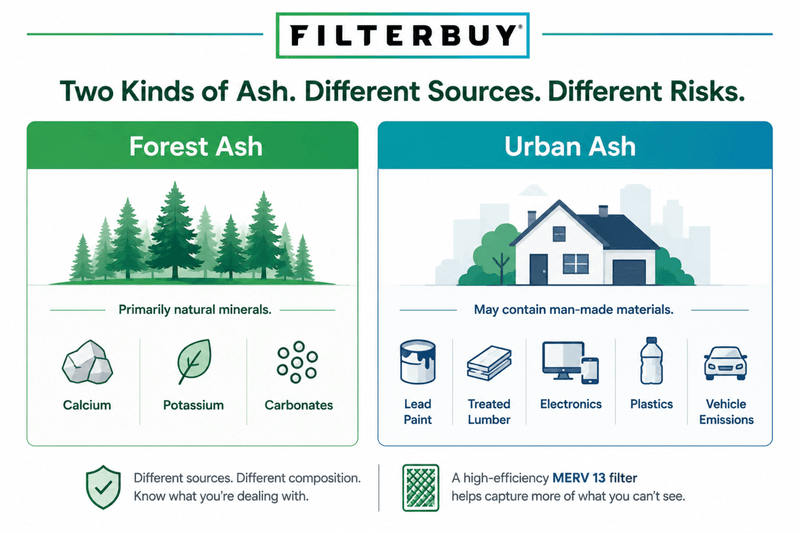
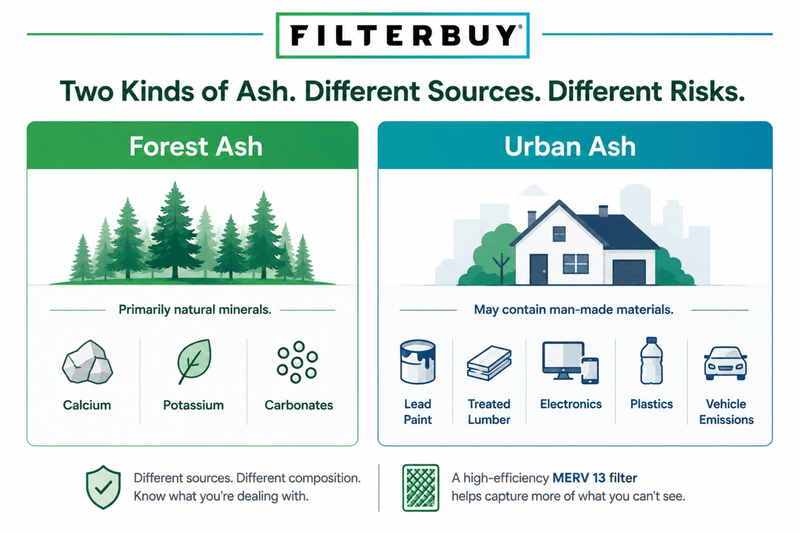
Both kinds of ash share a mineral backbone, and that is where the similarity ends. Vegetation ash is mostly calcium, magnesium, potassium, and silicon in carbonate or oxide form. Structural ash carries all of that plus lead from pre-1978 paint, arsenic from treated lumber, asbestos from older building materials, and PAHs from burned plastics and fuels.
Sources: Bodí et al. via USGS; Sánchez-García et al., Environment International (2023); Dossou et al., Environmental Science & Technology Letters (2026).
What the 2025 Los Angeles Fires Revealed About Ash
We are not guessing at any of this. The January 2025 Eaton and Palisades fires destroyed more than 16,000 structures and became the most thoroughly sampled urban ash event in U.S. history, and what the sampling found is the clearest evidence yet that structural ash behaves differently from wildland ash. It also showed that contamination is patchy rather than uniform.
A Duke University team led by soil scientist Daniel Richter sampled structural ash and yard soil at 32 burned residences. About 28% of structural-ash samples exceeded the EPA’s 200 ppm residential lead screening level, and 50% exceeded California’s 80 ppm standard. Lead concentrated in ash from pre-1970s homes, consistent with lead-based paint.
Los Angeles County’s own testing program, conducted by environmental firm Roux, found that as much as 80% of soil samples downwind of the Eaton burn scar exceeded California’s 80 mg/kg lead limit, with roughly 36% of parcels inside the burn scar and 47% just beyond it. In the Palisades area, the county found isolated exceedances of heavy metals and PAHs but no evidence of widespread fire-related contamination.
Caltech’s sampling of 52 homes adds what matters most to anyone outside a burn scar: lead travelled more than seven miles from the burn zone and got inside most homes sampled. Roughly 90% of the homes that burned in the Eaton fire predate 1975, when lead paint and asbestos were standard. A standing home downwind can be affected even though it never caught fire.
What Wildfire Ash Does to Your Body
Ash reaches you three ways: you breathe the fine particles, the alkalinity irritates whatever it touches, and the metals accumulate. The first two show up quickly as coughing, sinus and throat irritation, itchy eyes, and worsened asthma. The third is the one that matters over a lifetime, since lead is a neurotoxin with no known safe level in children, and arsenic and hexavalent chromium are carcinogens.
Of those, the alkalinity is what homeowners overlook most. Ash is chemically basic, which means contact with wet ash can cause chemical burns or skin irritation. Gloves and long sleeves are non-negotiable even for a five-minute sweep. CDC/NIOSH adds a backyard hazard most people would never think of, warning homeowners to avoid ash from decks, fences, and retaining walls treated with chromated copper arsenate (CCA), because it can contain lethal amounts of arsenic.
One piece of federal guidance deserves more attention: the EPA advises that people with heart or lung disease, older adults, and pregnant women should not take part in ash cleanup, and that children should not be near ash until areas are cleaned. If that describes your household, hiring the work out is the guidance, not an upgrade.
How Long Does It Actually Last?
Ash exposure runs on three separate clocks that do not expire together. Airborne metals clear within days, contaminated surfaces hold on for months, and smoke absorbed into soft furnishings keeps releasing compounds longest of all. Which is why a green AQI reading, the thing most people wait for, is the least reliable all-clear a homeowner can use.
That leads to a sequencing error almost everyone makes. People wait for the air to clear before they start cleaning, when clearing air is precisely the signal that the risk has finished settling onto their floors.
The Cleanup Mistakes That Make Exposure Worse
Here is the thing about settled ash: it is not really a risk until something puts it back in the air. Nearly every serious cleanup mistake turns out to be the same error wearing a different tool, and it is always the fast one.
Sources: U.S. EPA, Protect Yourself from Ash; CDC/NIOSH, Hazards During Wildland Fire Cleanup; ACS ES&T Air (2026), post-wildfire indoor sampling of 19 Los Angeles homes.
How to Clean Up Wildfire Ash Safely
Safe ash cleanup comes down to keeping the material wet, captured, and off your body. Mist surfaces before touching them, sweep gently and wet mop rather than dry sweeping, vacuum only with HEPA, and wear a fitted N95 or P100 with goggles and gloves throughout. Filter the air before you start, not after you finish.
1. Confirm it is safe to return and clean. Ask local authorities about restrictions. Heavily damaged property calls for professional restoration, not a DIY weekend.
2. Gear up before you open the door. Fitted N95 or P100 with two head straps, goggles (not safety glasses), gloves, long sleeves, long pants, closed-toe shoes.
3. Filter the air first. Run a HEPA air cleaner in the rooms you will work in and install a fresh high-efficiency HVAC filter before you disturb any ash.
4. Mist, don’t blast. Dampen surfaces with as little water as possible. Excess water creates contaminated runoff.
5. Sweep gently, then wet mop. Public health agencies consistently recommend gentle sweeping followed by wet mopping. Caltech’s team found cleaning removed about 90% of deposited lead, bringing most surfaces back under the EPA limit – this step does most of the work.
6. Vacuum with HEPA only. Use a disposable bag and change it outdoors.
7. Double-bag and seal everything, including used filters, cloths, and mop heads.
8. Decontaminate yourself. Remove shoes at the door, bag ash-covered clothing, wash skin promptly, and never track ash into your car.
9. Hit window sills and entry floors twice. Surfaces within a meter of a window carried roughly ten times the lead of those farther inside.
10. Change your HVAC filter again after cleanup, then keep a shortened replacement schedule while ash remains in the area.
What If You Already Dry-Swept or Used a Leaf Blower?
Plenty of people find a guide like this one after the fact. If you already swept dry, ran the leaf blower, or reached for the shop vac, the situation is recoverable, and it is worth acting on rather than losing sleep over. Airborne spikes from disturbed ash are short-lived, and the surfaces you re-contaminated answer to the same wet-and-HEPA methods that would have worked the first time.
1. Wash up and change clothes. Wash exposed skin, launder what you were wearing separately, and leave the shoes at the door.
2. Re-clean the same surfaces properly. Mist, wipe or wet mop, then HEPA vacuum. Caltech’s sampling suggests thorough cleaning recovers most of the ground you lost.
3. Change the HVAC filter and any purifier filter. Both just absorbed a concentrated dose, and a loaded filter stops helping. This is the moment a spare in the closet matters, which is why Filterbuy ships in 600+ sizes and runs auto-delivery.
4. Re-do window sills, entry floors, and anywhere the blower pointed. Airflow drives ash into corners and gaps you would not otherwise think to clean.
5. Watch for symptoms rather than assume them. Coughing, throat irritation, or headaches after a heavy exposure are worth raising with your doctor, especially for children and anyone with heart or lung conditions.
Keeping Ash Out of Your Indoor Air
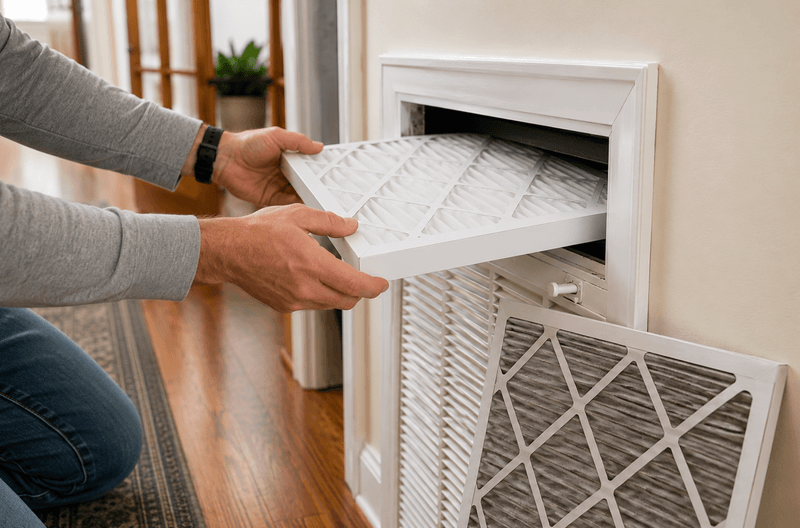
Your HVAC system is the biggest air-moving machine in the house, which quietly makes its filter the most powerful tool you own during an ash event. Researchers studying post-fire Los Angeles homes recommended running central HVAC with filters rated MERV 13 or higher, plus HEPA purifiers, before reoccupying. MERV 13 is the practical threshold for the fine particulate ash generates.
This is the part of the problem Filterbuy works on directly, as a U.S. air-filtration manufacturer that has built HVAC filters in Alabama since 2013.
One point gets lost between the two halves of federal guidance: filtration belongs before the cleanup, not after it. Agencies tell you to run a high-efficiency filter, and separately they tell you not to stir up ash, but nobody puts the two instructions together. Read side by side they mean the filter should already be in and running before you touch a surface, because that is the moment airborne concentrations peak.
The same 19-home study measured the payoff: homes running air purifiers averaged 33.3 micrograms/m3 less indoor PM10 than homes without them.
Two habits matter as much as the rating itself. Replace the filter far more often than your normal schedule, because ash loads one fast, and a clogged filter both stops working and drags on the blower motor. Then keep filtering after the visible ash is gone, since indoor surfaces go on re-suspending particles for weeks. If you are weighing filter types, our guide to MERV 13 vs. HEPA filters for wildfire smoke explains why true HEPA cannot run in most residential blowers. No particle filter captures smoke’s gases, which is what activated carbon filtration is for.
Check conditions in your area on the Filterbuy live U.S. air quality index map before you plan any outdoor cleanup.
Related reading: best MERV filter for wildfire smoke · do air conditioners filter wildfire smoke · what PM2.5 is and why it matters · how often to change your air filter · track live wildfire and smoke maps.
Shop Filterbuy MERV 13 air filters in 600+ sizes, or set up auto-delivery so a clean filter is on hand before the next fire season. Odd cabinet? Filterbuy also builds custom-size filters.
Supporting Statistics
The research behind this guide, drawn from U.S. federal and state agency sources.
1. Airborne lead rose roughly 110-fold during the Los Angeles urban fires.
A federal monitoring station in Pico Rivera, 14 miles from the Eaton Canyon fire, measured average PM2.5 lead of 0.00068 micrograms/m3 in the days before the fires. From January 8 to 11, 2025, that average jumped to 0.077 micrograms/m3 and peaked near 0.5. CDC’s own conclusion is the thesis of this article: urban fires emit air pollutants that pose risks different from those of conventional wildfires. Source: CDC, Morbidity and Mortality Weekly Report (2025).
2. Lead spiked 50 times above normal in the Camp Fire – and not at all in three vegetation fires the same year.
California’s Air Resources Board compared the structure-heavy 2018 Camp Fire against three large 2018 wildfires that burned mostly vegetation. Only the Camp Fire produced lead and zinc above normal. Lead in Chico reached 50 times the site average, and the metal-laden smoke was detected more than 150 miles away in San Jose and Modesto. This is the clearest controlled evidence that what burns determines what you breathe. Source: California Air Resources Board (2021).
3. A MERV 13–16 filter can cut indoor particles by as much as 95%.
The federal wildfire smoke factsheet puts a number on the filtration step. A true high-efficiency filter in a central system can reduce indoor particle concentrations by up to 95%, and portable air cleaners with high-efficiency filters by up to 85%. Even without upgrading the filter, switching the thermostat fan from “Auto” to “On” has been shown to cut particle concentrations by as much as 24%. Source: AirNow / U.S. EPA, Wildfire Smoke Factsheet: Indoor Air Filtration.
Frequently Asked Questions
Is wildfire ash dangerous to touch?
Yes. Wildfire ash is alkaline, and wet ash can cause chemical burns or skin irritation. Structural ash may also carry lead, arsenic, and asbestos. Wear gloves and long sleeves, and wash skin promptly.
How long does wildfire ash stay dangerous?
It depends which risk you mean. Airborne metals cleared within about four days in Los Angeles monitoring. Settled surface dust lasted months, with lead above EPA dust clearance levels two months later. Smoke absorbed into textiles and upholstery off-gasses longest.
Does an N95 mask protect against wildfire ash?
A tight-fitting, NIOSH-approved N95 or P100 with two head straps filters ash particles, but not gases or vapors. Bandanas, surgical masks, and single-strap masks do not seal.
Can I compost or reuse ash from my yard?
Only if you are certain it is vegetation ash from a non-structural fire. Never reuse ash from a burn zone that included homes, vehicles, or CCA-treated wood.
Should I get my soil tested?
If you live inside or downwind of a burn zone, yes. Los Angeles contamination varied significantly property to property. Check with your county public health department for free or subsidized programs.
How often should I change my HVAC filter during ash cleanup?
Far more often than your normal schedule. Ash loads a filter in days rather than months, and a clogged filter both stops capturing particles and strains the blower motor. Check it after every cleaning session and replace it when the media looks gray or you cannot see light through the pleats. Having spares on hand matters more than the brand on them; Filterbuy builds MERV 13 in 1-, 2-, and 4-inch depths across 600+ sizes, with auto-delivery for exactly this reason.
Glossary
Wildfire ash – Residue left after fuels or structures burn: mineral material plus charred organic matter.
Structural ash – Ash from burned buildings and contents, carrying construction materials and household chemicals.
Wildland-urban interface (WUI) – Where residential development meets undeveloped wildland vegetation.
PAHs (polycyclic aromatic hydrocarbons) – Compounds formed by incomplete combustion; several are probable human carcinogens.
CCA (chromated copper arsenate) – A preservative in older decks and fences; its ash can carry dangerous arsenic levels.
Hexavalent chromium – A chromium form classified as a human carcinogen, found in ultrafine particles after the 2025 LA fires.
pH – A 0–14 acidity scale. Above 7 is basic; wildfire ash commonly measures 8 to 11.
PM2.5 / PM10 – Airborne particles under 2.5 and 10 micrometers. PM2.5 reaches deep into the lungs.
MERV – The 1–16 scale for an HVAC filter’s particle capture. MERV 13 captures smoke and ash particulate.
HEPA – A standard capturing at least 99.97% of 0.3-micrometer particles.
Soil screening level (SSL) – The threshold triggering further evaluation. EPA’s residential lead SSL is 200 ppm; California’s is 80 ppm.
Sources & References
U.S. EPA, Protect Yourself from Ash – Structural ash carries more harmful chemicals than forest ash; never use a leaf blower; wet ash causes chemical burns; vulnerable groups should not clean.
CDC / NIOSH, Hazards During Wildland Fire Cleanup – Shop vacuums exhaust fine particles; CCA-treated wood ash can contain lethal arsenic levels.
Dossou et al., Environmental Science & Technology Letters (2026) – Duke sampling of 32 burned Eaton and Palisades residences; 28% of structural ash over 200 ppm lead.
Goftari et al., ACS ES&T Air (2026) – 19 Los Angeles homes pre-reoccupancy; non-HEPA vacuuming +26.3 and air purifiers -33.3 micrograms/m3 PM10.
Caltech Science Exchange, François Tissot on post-fire lead – Lead transported 7+ miles; cleaning removed ~90% of deposited lead; leaf blowers fragment ash particles.
Bodí et al., via USGS Publications Warehouse – Wildland ash composition and alkaline pH in solution.
LA County soil testing findings (Roux), via CBS News – Lead exceedances downwind of the Eaton burn scar; isolated PAH exceedances in the Palisades.
Yao et al., medRxiv (2025) – Recommends MERV 13+ HVAC filtration and HEPA purifiers before reoccupying smoke-affected homes.
About the Author and Reviewer
Michelle Wan, Author. She writes about indoor air quality and home filtration for Filterbuy. More on her author page.
Why this guide exists: most articles answering “is wildfire ash toxic” treat ash as one substance and answer yes. True, but not useful: it gives a homeowner in a smoke plume and a homeowner in a burned-out neighborhood the same instructions for two different chemical problems. This guide separates them, quantifies the gap using the 2025 Los Angeles sampling record, and sequences the response so filtration comes before disturbance. Where the research is preliminary or not yet peer-reviewed, we say so in the line that cites it.
David Clark, Reviewer, Licensed HVAC Technician. This article was technically reviewed by David Clark for accuracy on filtration, airflow, and HVAC system impacts during ash and smoke events, including the claim that ash loading shortens filter service life and raises static pressure on a residential blower.
Published by Filterbuy, a U.S. air-filtration manufacturer that has built HVAC filters in the United States since 2013 and shipped them factory-direct in 600+ sizes to households nationwide, including the wildfire-prone West. This guide reflects current EPA, CDC/NIOSH, and peer-reviewed guidance; it is not a substitute for advice from a qualified HVAC or medical professional.