
When to Change an Air Filter After Wildfire Smoke, With Photos and EPA Loading Data You Can Trust
September 12, 2026
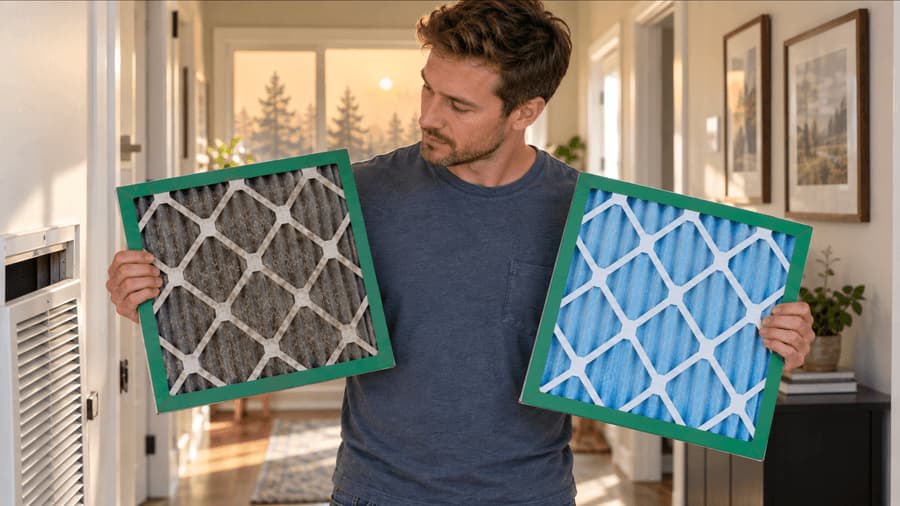
During wildfire smoke, inspect your filter every 7 days and replace a 1-inch MERV 13 every 2 to 4 weeks, not every 90. Smoke strips the filter's electrostatic charge long before airflow drops, so a spent filter still breathes like a clean one. Color is the signal to trust.
A 1-inch pleated filter in wildfire smoke, week by week. Appearance varies by home, ductwork, and system runtime. Source: U.S. EPA.
Pull your filter and hold it to the light. If no light comes through the pleats, or it smells like a campfire, it is spent. Find your filter size at Filterbuy and keep a spare on the shelf before the next smoke event.
TL;DR
During an active wildfire smoke event, check your air filter every 7 days and replace a 1-inch filter every 2 to 4 weeks rather than the usual 90. The U.S. Environmental Protection Agency states that during smoke events, filters may need changing every few weeks or days. Wildfire smoke is almost entirely PM2.5, which loads filter media far faster than dust. EPA recommends MERV 13, a continuously running fan, and replacing the filter once it looks dirty or smells like smoke.
Key Takeaways
Inspect weekly, replace every 2-4 weeks. A 1-inch pleated filter rated for 90 days can be spent in 14 days under heavy smoke.
EPA recommends MERV 13 or higher during smoky periods, or as high a rating as your system fan and filter slot can accommodate.
A high-efficiency filter plus a continuously running fan can cut indoor PM2.5 by roughly 50%. A standard low-efficiency filter with the fan running achieves closer to 24%.
Airflow is the signal to ignore. In EPA testing, 10 milligrams of smoke cut a MERV 13 filter’s clean air delivery rate by 96% while pressure across it rose only 7%. Use our Three-Signal Rule instead: look, smell, count.
The 90-day rating is a dust rating. Filter life is measured against inorganic test particles under ASHRAE 52.2, not smoke. We print that number on our own boxes, and it does not describe fire season.
Color and smell are your best at-home signals. EPA advises changing the filter when it appears dirty or starts to release smoke odors.
Why Your Filter’s 90-Day Rating Does Not Apply to Wildfire Smoke
Almost every article on this topic repeats a number that was never measured against smoke. the 90-day rating on your filter is not a lifespan. It is a dust rating. That rating comes from ASHRAE Standard 52.2, which challenges filter media with inorganic test particles rather than smoke. The 2026 Urban Science research makes this explicit: filtration performance under wildfire smoke is not adequately captured by current standards based on inorganic test aerosols.
We make these filters, so we’ll say the uncomfortable part plainly. When Filterbuy prints 90 days on a MERV 13 box, that number describes how the filter behaves against household dust in a home with ordinary air. It’s an honest number for the conditions it was measured in. Wildfire smoke isn’t those conditions, and no rating on any manufacturer’s box, ours included, tells you what happens when a smoke plume parks over your county for a week. That gap is why this guide exists.
How Often Should You Change Your Air Filter During Wildfire Smoke?
Change your air filter every 2 to 4 weeks during active wildfire smoke, and inspect it once a week. EPA’s guidance on wildfires and indoor air quality says the same thing in plainer terms. During periods of heavy smoke, replace the filter more often than the manufacturer recommends, and if it looks heavily soiled when you swap it, go more frequently still.
So we built the schedule below ourselves, keyed to AQI rather than to the calendar. It is our recommendation rather than an EPA standard. EPA tells you to inspect often and replace when the filter looks dirty or smells like smoke, which is correct but leaves you guessing at the intervals. We turned that into numbers you can plan around, working from the published smoke-loading research and what we know a 1-inch pleated filter can hold.
Table 1. Filter Inspection and Replacement Schedule by AQI
A 4-inch media filter holds roughly four times the surface area of a 1-inch filter. Under the same conditions, expect two to three months rather than two to four weeks, but inspect on the schedule above. EPA advises replacing filters more often than the manufacturer recommends during periods of heavy smoke.
Not sure what your air looks like right now? Check the AQI near you or pull up our live AQI and wildfire smoke maps. For a fuller picture of how smoke and AQI interact, see our guide to wildfire smoke and the Air Quality Index.
Why Wildfire Smoke Destroys a Filter Faster Than Dust
Wildfire smoke is dominated by PM2.5, particulate matter 2.5 microns across or smaller. A human hair runs about 70 microns wide, which makes these particles roughly thirty times thinner than a single strand. Lint and pet hair collect on the surface of the pleats. Smoke drives deep into the fiber matrix instead, where it neutralizes the thing that makes a modern filter work.
Your airflow will feel fine long after your filter has stopped protecting you. Most modern residential filters use charged media, also called electret, meaning synthetic fibers that carry a static charge and pull fine particles out of the airstream. Smoke degrades that charge. Researchers at the EPA’s Office of Research and Development measured exactly how much, and their numbers are the most useful thing on this page.
Table 2. EPA Filter Loading Data: What Smoke Does That Dust Does Not
Source: Holder, Halliday & Virtaranta (2022), U.S. EPA Office of Research and Development, published in Indoor Air. Measured on a box-fan air cleaner using MERV 13 electret filters, not a ducted HVAC system, and the loading was deliberately heavy. The pattern still holds: smoke ruined the filter at roughly 1/5000th the mass of dust, and did it without meaningfully restricting airflow.
Read the middle row twice. Ten milligrams of smoke, an amount you couldn’t pick out of your palm, took a MERV 13 filter from 111 CFM of clean air down to 4. That’s a 96% collapse. Meanwhile the pressure across it moved from 0.27 to 0.29 inches of water, which is essentially nothing. The filter still breathed. It just stopped filtering.
The bottom row is what makes that land. Dust loading ran 5,300 times heavier by mass and drove pressure up sevenfold, yet it still left the filter performing five times better than smoke did. The EPA researchers also noted something you can use: the smoke-loaded filters were dark, and they carried a distinct smoke smell.
Ducted HVAC filters behave the same way. A 2026 study in Urban Science tested more than seventeen commercial HVAC media rated MERV 10 through 15. Charged MERV 13 media from one manufacturer started at 62.9% smoke-removal efficiency and fell to 17.8% after eighty minutes of continuous exposure, with no measurable change in pressure drop at all. The authors concluded that rising pressure is not a reliable signal for when to change a filter during a smoke event. (Disclosure: the study’s authors work for a filtration company, Metalmark Innovations, and the work was funded by an EPA SBIR grant. We flag it because the finding matters and you should weigh the source.)
The practical lesson is short. Don’t wait to feel a difference at your vents, because that difference may never come. Look at the filter, and smell it.
Does a Higher MERV Rating Last Longer in Smoke? Not Necessarily
Look closely at the Urban Science data and something awkward shows up. Among charged media, the higher the MERV rating, the faster the smoke degraded it. Their MERV 11 charged sample lost 47% of its smoke-capture efficiency over 80 minutes of exposure. The MERV 13 and MERV 15 samples each lost 72%. Mechanical media, the uncharged and fiberglass kinds, held their efficiency far better but at the cost of much higher airflow resistance.
A filter manufacturer telling you to buy MERV 13 has an obvious reason to skip past that. We’re putting it in front of you instead, because the honest reading of it reinforces the advice on this page rather than undermining it.
MERV 13 still starts far ahead. In that same testing it began at 62.9% smoke-removal efficiency against MERV 11’s 37.5%, so even while degrading it captured substantially more smoke along the way. EPA and ASHRAE both still recommend MERV 13 for smoke events, and so do we. What the decay curve changes is the timeline: the advantage you paid for has a shorter half-life than you’d assume. The answer isn’t a lower rating. It’s changing the higher one more often.
That’s the whole argument of this guide. In a normal season it sells fewer filters, not more. During fire season it happens to mean the same thing, and we’d rather you knew why.
What a Smoke-Loaded Filter Actually Looks Like: A Photo Timeline
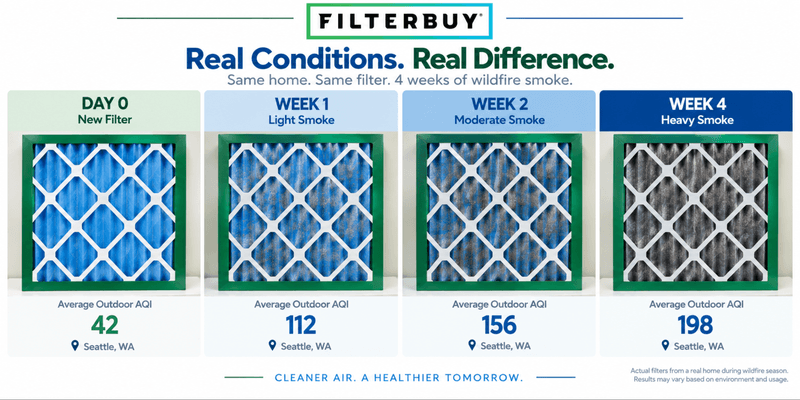
A new pleated filter is bright white. After one week in wildfire smoke it turns a uniform light gray. By week two the gray has darkened and the pleat valleys look sooty. By week four the media is dark brown to charcoal and matted flat. Light no longer passes through the pleats. EPA guidance is to change the filter when it appears dirty or starts to release smoke odors.
Table 3. Smoke Loading Timeline: What to Look For, Week by Week
EPA advises changing the filter when it appears dirty or begins to release smoke odors. Appearance varies by home, ductwork, and system runtime, and a filter can lose smoke-capture efficiency before it looks dark, so treat color as a floor rather than a countdown.
The Three-Signal Rule: A 60-Second Filter Check
Most filter-check advice hands you four signals and treats them as equals. Look at it, feel the airflow, check the date, give it a sniff. The research above says one of those four is broken, and it happens to be the one homeowners trust most. Smoke strips a filter’s electrostatic charge without meaningfully blocking it, so airflow keeps telling you everything is fine long after it stopped being fine.
So we teach three signals and deliberately leave airflow out. Run through them once a week during smoke season, and if two of the three say replace, replace. No tools required.
Signal 1: Look.
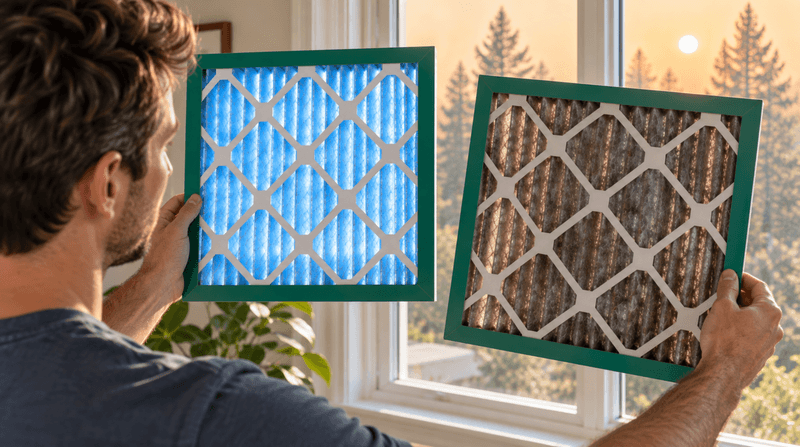
Turn the system off at the thermostat, slide the filter out, and hold it up toward a window or a flashlight. Uniform light gray means it’s still working. Dark brown, black, or matted media means it’s spent. Look into the pleat valleys rather than just the face, since smoke settles into the folds first. If no light comes through the pleats at all, stop here and replace it.
Signal 2: Smell.
Hold it close. If it smells like a campfire, replace it whatever the color says. EPA lists smoke odor as a replacement trigger in that same guidance, and remember that the researchers who measured the 96% collapse found their filters already smelled of smoke at ten milligrams of loading. Your nose gets there before your eyes do.
Signal 3: Count.
Write the install date on the frame in marker, then read it against Table 1 and against how many days of elevated AQI your area has actually logged since. Days in smoke count for far more than days on the calendar. A filter that sat through nine clean days and five hazardous ones isn’t two weeks old in any meaningful sense. It’s closer to spent.
And the signal we left out.
Airflow is the most intuitive check and the least reliable one during smoke. If you take a single idea away from this page, make it that one. A smoke-loaded filter breathes almost exactly like a clean filter, right up until you pull it out and look at it.
What the EPA Recommends During a Smoke Event
EPA’s guidance for smoky periods comes down to four steps that work together: upgrade to a filter rated MERV 13 or higher, switch the thermostat fan from Auto to On so the system keeps filtering between heating and cooling cycles, close the fresh-air intake or set the system to recirculate, and keep windows and doors shut. The full protocol lives in EPA’s Strategies to Reduce Exposure Indoors and the AirNow Indoor Air Filtration fact sheet.
One addition worth making explicit. While you are sealed in, avoid anything that adds particles indoors, which means no candles, no frying, and no vacuuming without a HEPA-equipped machine. Every one of those puts load on the same filter you are now trying to make last.
Table 4. How Much Filtration Actually Reduces Indoor Smoke
Source: U.S. EPA, Strategies to Reduce Exposure Indoors (updated October 10, 2025), drawing on Fisk & Chan (2017). Ranges across individual homes run from 30% to 100% of outdoor levels.
Will a MERV 13 Filter Hurt My HVAC System?
For most residential systems, no. EPA advises choosing MERV 13, or as high a rating as your fan and filter slot will accommodate, and an HVAC technician can tell you where your system tops out. The condition attached is frequent replacement, and it isn’t a footnote.
A loaded MERV 13 restricts airflow far more than a clean one, and that’s the point at which blower strain and frozen coils stop being hypothetical. The filter that damages your system is the one you left in too long, not the one with the higher rating.
Be careful with systems installed before roughly 2005, systems already running at high static pressure, and any unit whose manual caps the filter rating. If yours makes new noises, short-cycles, or trips a breaker after a filter change, call a licensed technician. HEPA is a separate question, and we cover those trade-offs in MERV 13 vs HEPA for wildfire smoke. See also our guides to the best MERV filter for wildfire smoke and running an air purifier during wildfire season.
What This Actually Costs, and What to Do if It Is Too Much
Telling someone to replace a filter every two weeks instead of every ninety is telling them to buy roughly six times as many filters. That’s a real cost, it lands in the same weeks the news is telling everyone to stay inside, and most guides on this topic never mention it at all. So, the honest version.
A typical fire season with four to six weeks of elevated AQI works out to two or three extra filters on a 1-inch system, or one extra on a 4-inch. That’s the whole difference. It isn’t nothing, but it also isn’t the several-hundred-dollar problem people brace for. What matters more is buying before the season rather than during it, because smoke events cause stockouts and price spikes on exactly the sizes everyone suddenly needs at once.
That stockout problem is worth naming, because it’s the one we hear about most and the one we’re actually built to solve. Filterbuy manufactures in the United States and stocks more than 600 sizes, including the odd and half-inch dimensions that older homes and retrofitted systems tend to need and that big-box shelves never carry. If your size doesn’t exist as a standard, we build it custom. In the middle of a smoke event, the gap between a filter that ships and a filter back-ordered until October is not a small one, which is why we’d rather you ordered in April than in August.
If the cost is genuinely out of reach, or your size is sold out anyway, don’t just leave a spent filter in and hope. There’s a well-tested fallback worth knowing about before you need it. EPA researchers measured the clean air delivery rate of do-it-yourself air cleaners built from a box fan and furnace filters, and the results are better than most people expect. The comparison below uses their published figures.
Table 5. What Each Filtration Option Actually Delivers
CADR and cost figures from Holder, Halliday & Virtaranta (2022), U.S. EPA Office of Research and Development. Costs are April 2022 U.S. retail and will have moved. Whole-home PM2.5 reduction figure from EPA. EPA recommends DIY air cleaners only when commercial units are unavailable or unaffordable, and not as a permanent substitute.
Three things are worth pulling out of that table. A $74 box of four filters taped to a $30 fan moves more clean air than a $123 purifier does. Filter thickness matters far more than most people expect, with the 4-inch version more than doubling the 1-inch output. And every one of those numbers assumes a clean filter, which lands us back at the same problem, since the EPA testing that produced them also found a smoke-loaded filter dropping from 111 CFM to 4. The fallback needs fresh filters just as badly as your furnace does.
One practical note if you build one. A standard 20-inch box fan takes a 20x20x1 filter, and the Corsi-Rosenthal design takes four. That’s a stock size, so it’s easy to keep a few on hand, and Filterbuy sells it in MERV 13. Frankly, we’d rather you bought four inexpensive filters for a box fan you already own than went without filtration because the purifiers sold out. EPA is clear that DIY cleaners are a temporary measure rather than a permanent substitute for properly filtered HVAC, and we agree. But a temporary measure that works beats a permanent one you don’t have.
If You Only Have One Spare Filter and a Two-Week Smoke Event
This is the question we’d want answered if it were our house, and nobody seems to address it. You have one filter in the system, one on the shelf, and a smoke forecast running longer than either will last. When do you swap?
Wait for the peak, not the start.
Smoke events are rarely flat. They build, peak across one to three days, then taper, which means a filter installed on day one is already partly spent by the time the worst air arrives. Watch your local AQI forecast and install the fresh one just before the highest predicted concentrations, so it’s at full electrostatic strength during the hours that matter most.
Concentrate rather than spread.
If the spare won’t cover the whole event, protect sleep. You breathe the same air for seven or eight uninterrupted hours overnight, which is the single largest continuous exposure block in your day. A fresh filter behind a closed bedroom door beats the same filter working against an open house.
Do not run nothing.
A degraded filter still captures more than an empty slot does, and running the system bare risks pulling debris into the blower and coil. Leave the spent one in place until the fresh one goes in.
This is judgment rather than a standard. No agency publishes triage guidance for a single spare filter, because agencies write for the well-supplied case. We’re writing for the actual one.
The better answer, obviously, is not to end up here. If you live somewhere fire season is predictable, keep three filters on the shelf by April instead of one. Filterbuy customers on auto-delivery can shorten the interval for the months that matter and stretch it back out afterward, which is about as close to solved as this problem gets. The filters arrive on a fire-season cadence rather than a calendar one, and nobody has to remember anything in the middle of a smoke event.
No Central HVAC? Here Is What Applies to You
Two-thirds of U.S. households use a central system as their main air conditioning equipment, according to the U.S. Energy Information Administration’s 2020 Residential Energy Consumption Survey. That leaves roughly a third of the country outside every filter-replacement schedule ever written, this one included. If you rent, live in an apartment, or cool with a window unit, the schedule above won’t help you, though the underlying physics still applies.
The gap is widest exactly where smoke hit hardest in 2023, since half of Northeast households rely mainly on window, wall, or portable units rather than central air. EPA’s guidance covers these cases directly.
Window air conditioner: close the outdoor air damper. If it will not close, EPA advises not running the unit during heavy smoke, since it pulls outdoor air in. Its internal mesh screen is a lint filter, not a smoke filter, and no MERV rating applies to it.
Portable AC with one hose: use sparingly during smoke. Single-hose units create negative pressure that draws unfiltered outdoor air in through every gap in the room. A two-hose unit is fine if the window seal is tight.
Evaporative cooler: cover the outside air intakes with 4-inch MERV 13 furnace filters if you can reach them safely. Expect to replace them often, since weather damages them.
No cooling system at all: a portable or DIY air cleaner in one room is your whole strategy. Use Table 6 to pick one, and prioritize the bedroom.
If you rent and the building has central air, the filter is usually still yours to change and the slot is usually reachable. Worth asking your landlord before fire season rather than during it. And if the slot turns out to be a nonstandard size, which in older buildings it often is, that’s exactly what our custom sizing is for.
Supporting Statistics
Three findings from federal agencies and national health organizations explain why the schedule above runs shorter than the one printed on your filter box.
1. Wildland fires produced 52% of all fine particulate matter emitted in the United States.
EPA’s 2020 National Emissions Inventory attributes more than half of total U.S. PM2.5 emissions to wildland fires, more than transportation and industry combined. Source: U.S. EPA, Wildland Fire Research: Reducing Exposures (updated July 2026). What it means for your filter: smoke is not an edge case your filter occasionally encounters. Nationally it is now the single largest source of the particles your filter exists to capture.
2. During the June 2023 smoke event, PM2.5 across New York ran 590% to 1,229% above the ten-year seasonal baseline.
CDC’s Morbidity and Mortality Weekly Report recorded daily mean PM2.5 of 55.2 to 122.3 micrograms per cubic meter on June 7, 2023, against a 2013–2022 June baseline of 8.0 to 9.2. Source: CDC MMWR, Asthma-Associated Emergency Department Visits During a Wildfire Smoke Event, New York, June 2023. What it means for your filter: a filter rated for 90 days at normal particle loads was processing roughly seven to thirteen times that concentration. Rated life assumes baseline air, and smoke events are not baseline air.
3. Asthma-associated emergency department visits rose 81.9% statewide in a single day.
The same CDC analysis found statewide asthma ED visits climbed from a daily average of 80.8 to 147 on June 7, with a 197.6% increase among people aged 10 to 29. Separately, the American Lung Association’s “State of the Air” 2026 report found 61.5 million Americans live in counties graded F for short-term particle pollution spikes, the exact category wildfire smoke falls into. What it means for your filter: the consequences of a spent filter are measured in hospital visits, and the exposure is no longer regional.
Table 6. Supporting Statistics at a Glance
All figures verified against primary sources on August 21, 2026. EPA and CDC figures are federal data. American Lung Association figures are drawn from EPA, state, local, and Tribal monitoring data for 2022–2024.
Frequently Asked Questions
How Often Should I Change My Air Filter During Wildfire Smoke?
Every 2 to 4 weeks for a 1-inch filter during active smoke, with a weekly visual inspection. Under hazardous AQI above 200, plan on every 1 to 2 weeks. EPA states filters may need changing every few weeks or days during smoke events.
Can I Just Vacuum a Smoke-Loaded Filter and Reuse It?
No. Vacuuming a disposable pleated filter damages the media, releases trapped particles back into your home, and cannot restore the electrostatic charge that smoke has already degraded.
Does a Gray Filter Mean It Is Still Working?
A uniform light gray filter is still capturing particles. Dark brown, black, or matted media means replace it now. But color is a lagging signal: EPA testing found a filter can lose 96% of its performance while still looking and breathing acceptably.
Is MERV 13 Enough, or Do I Need Hepa?
MERV 13 is the EPA recommended rating for HVAC systems during smoke events and the highest most residential systems handle safely. Add a portable HEPA purifier in bedrooms rather than forcing HEPA into your ductwork.
Should I Run My Hvac Fan Constantly During a Smoke Event?
Yes. Set the thermostat fan from Auto to On. EPA notes that even with a low-efficiency filter, continuous operation cuts particle concentrations by about 24%.
How Long After the Smoke Clears Should I Keep Changing Filters Early?
Give it one more replacement cycle. Ash keeps infiltrating and re-suspending for days after outdoor AQI recovers.
Glossary
AQI (Air Quality Index): The EPA 0-to-500 scale for reporting daily outdoor air quality in the United States. Readings above 100 are unhealthy for sensitive groups.
PM2.5: Particulate matter measuring 2.5 microns in diameter or smaller. PM2.5 is the dominant and most harmful component of wildfire smoke.
MERV (Minimum Efficiency Reporting Value): The ASHRAE Standard 52.2 rating scale describing how effectively an air filter captures particles of a given size. Higher numbers capture smaller particles.
MERV 13: The filter rating EPA recommends for residential HVAC systems during wildfire smoke events. Filterbuy MERV 13 filters are identified by blue packaging.
Electret (charged) media: Filter fibers carrying a permanent electrostatic charge that attracts fine particles. Most modern pleated residential filters use it. Wildfire smoke degrades this charge.
CADR (Clean Air Delivery Rate): The volume of filtered air an air cleaner delivers per minute, in cubic feet per minute (CFM). Higher is better.
Pressure drop: The resistance a filter creates against airflow, measured in inches of water. Smoke loading barely changes it, which is why it is a poor warning signal.
HEPA (High-Efficiency Particulate Air): A filter standard capturing 99.97% of particles at 0.3 microns. Standard in portable air purifiers, generally unsuitable for residential ductwork.
Filterbuy: A U.S.-based air filter manufacturer producing pleated HVAC filters in over 600 sizes, sold factory-direct.
Sources
U.S. EPA, Wildfires and Indoor Air Quality (IAQ), updated August 18, 2026.
U.S. EPA, Strategies to Reduce Exposure Indoors, updated October 10, 2025.
U.S. EPA / AirNow, Wildfire Smoke Factsheet: Indoor Air Filtration (EPA-452/F-18-005).
American Lung Association, State of the Air 2026: Key Findings.
How Many Filters Should You Stock Before Fire Season?
Fire season doesn’t give much notice, and the worst possible time to discover your filter is spent is the day the sky turns orange. Stock two or three MERV 13 filters in your size before smoke arrives, or put auto-delivery on a shorter interval for the months that matter and let them show up on their own.
If you don’t know your size, it is printed on the cardboard edge of the filter already in your system. Pull it out and read the nominal dimensions, the rounded numbers like 20x25x1, rather than measuring the filter itself, since actual dimensions run slightly smaller. If nothing is printed or the frame is damaged, measure the slot opening instead.
Made in the USA. 600+ sizes. Fast, free shipping.
Medical note: If you have asthma, COPD, or a heart condition, filtration reduces exposure but does not eliminate it. Follow your local health authority guidance during smoke events.